
Continuing the Beirut kick – here’s a full live concert recorded at Ancienne Belgique in 2011. Sumptuous stuff. Crank open another tab and go about your business with this playing in the background – it’s exquisite.
Beirut – ‘Elephant Gun’
This is one of my favourite songs. I’ve been sharing it a lot lately, but I wanted to pop it on the blog as well. Passionate, decadent, shambolic, elegant, glorious and unashamed. It makes me want to take my wife and my daughter round Europe and drink pastis in cafes.
Verbalising
This is just a quick post to invite you – yes, you – along to Verbalise at the Brewery on the 22nd February.
It’s going to be ace. The open mic is already packed with talent – I know that short story guru Brindley Hallam Dennis is coming, and so is my photo challenge sparring partner BigCharlie Poet, both of whom are exceptional performers. I feel absolutely honoured to have a guest slot, and I’m really looking forward to getting my teeth stuck into such a long session – I’ve never had 20 minutes to play with before. I’m already planning my stories. I’m definitely going to read Marrow, which is about dubious experiments in home cooking, and Hutch, which is about guinea pigs vanishing from a suburban garden. I’m probably going to read The Black And The White Of It, too. All three are in my flash fiction collection, Marrow, which should – assuming I’ve managed to print it right way up and right side out – be a real buzz to read from. I’m also going to read some new work. I’ve been working on a piece about the dark side of a village bakery competition, and I also want to try running a dozen of my Twitter stories together as a quickfire rattle through relationship disasters. I think I’m going to call that 10 Second Speed Dates, and might even try and read against the clock. If there’s time, I might read a very short flash piece called Real Life, too, which was published by Paragraph Planet last week. I’m going to relish the words – to invest my confidence in these stories I’ve written and endlessly rewritten. After all that time glued to a computer, reading live is where the stories draw breath.
If you can come, it would be great to see you. Compere Ann the Poet tells me that anyone who wants an open mic slot will get one, so roll on up and bring a story…
A quick aside with some good news, too – after a couple of story rejections in January, I’m delighted to have had two acceptances in as many days. I’ve landed flash fiction Circle Stone with the tenth issue of estimable magazine Gutter, and sci-fi short story Patience in an anthology called After The Fall. Go team!
Drowned villages
I’m a little ashamed to say that I nearly didn’t post this. It’s probably the most amazing writing competition I’ve ever seen, and I’m so hungry for it that a purely selfish part of me doesn’t want anyone else to know about it. But that’s not how a writing community functions, and I’d rather the prize-winner was the best possible piece of work. So take a look at this: a brand new poetry competition where the top prize is having your work soundtracked by Mogwai.
In case you missed that, I’ll say it again.
THE TOP PRIZE IS HAVING YOUR WORK SOUNDTRACKED BY MOGWAI.
I’ve written about Mogwai before (here and here). They recorded my favourite ever album, Come On Die Young, and they’ve been one of my favourite bands for well over a decade. It’s no exaggeration to say that they have soundtracked around half my writing output. Although I don’t really count myself a poet, this is too good an opportunity to miss. What’s more, the theme is tight and thrilling: the judges are seeking poems about drowned villages, and this is where the competition gets really interesting. There’s a submerged village in Lanarkshire in Scotland; another in Cumbria in England; and a third in Gwynedd in Wales. The competition is only open to library members of those specific regions. By happy coincidence, I’ve been a member of Cumbria Libraries for years.
The judges are Scottish Makar Liz Lochhead, top poet Ian McMillan and Manic Street Preachers bassist Nicky Wire. I’ve never known a catchment so small for such an intriguing competition, such big judges and such an amazing prize. The theme really sings to me; I’ve written before about my love of French mystery drama The Returned (also soundtracked by Mogwai) which features a drowned village, and I’ve often been haunted by the thought of steeples emerging from Haweswater.
By weird coincidence, I also have the makings of a poem that fits the theme. A year or so ago, I started work on a piece about the landscapes of the Lakes. While I was pleased with the language and form, I couldn’t find a hook to hang it on, and abandoned it unfinished. This competition gives me the hook.
I’ve spent most of today working on the poem, writing and redrafting and always reading – reading it to myself, reading it to the cats – trying new forms, new phrases. I’m pleased with it, as far as it goes, but I’m really unsure about my poetry, and I don’t know how it will fare against stiff competition. I’m going to revisit several more times over the rest of the month, and submit only when it’s as tight as possible.
Soundtracked by Mogwai. A man can dream…
UPDATE – If you want to see my thoughts on the winning poems, mosey over here.

Kicking monsters down the hall
Improving my spoken word performance is an ongoing mission. There’s no substitute for actually reading live, and I have my first two events of the year booked in for February. First up is a support slot at Dreamfired on Valentine’s Day, and then I’m top of the bill (eek!) for Verbalise at the end of the month.
As well as actual readings, I’ve started looking for workshops. I attended a great Spotlight session in Lancaster with Brindley Hallam Dennis last year. He set the class the truly startling task of having other people read our work. My workshop partner went through my flash piece Marrow at a third of the pace I usually do, really savouring the words, and she made it three times better. That was an important lesson. I’ve also taken a huge amount from veteran performer David Hartley’s tips for spoken word.
I watch a lot of readings, both live and online, to see how other writers project and present their words. I’ve seen some great stuff, and some terrible stuff. This performance by Shane Koyczan is absolutely, completely, one of the very best. I’ve listened to it a dozen times, and it grows ever more wonderful.
Inky Little Fingers
Okay. Steady breathing. I’ve finally sent Marrow off to the printers. It’s a nerve-wracking process, especially for a first time. I’ve gone with Inky Little Fingers on the recommendation of Flashtagger Fat Roland. If it goes wrong, I’m blaming him.
Early in the process, Inky Little Fingers estimate the thickness of the spine from the number of pages involved. That measurement (in this case, 5.6mm) needs to be factored into the dimensions of the custom document created for the cover. Then, when you upload the cover art and contents, they generate an online proof for a final check. I was extremely relieved to see that my measurements were right, as I was certain I’d get everything horribly wrong and have to start again. Then I paid for 100 copies (which didn’t hurt too much, because I’ve been saving for this for a year) and submitted the final order. So there it is. Out of my hands, and into the production queue. The next step is a box of books turning up in a week or so, just in time for my spoken word support slot at February’s Dreamfired. I’m looking forward to reading from the book, rather than from the tatty shreds of paper I keep in my back pockets, all crisscrossed with notes and late amendments. I’m also terrified that I’ve missed something really obvious and the cover will be printed upside-down. Something abominable is bound to happen.
A couple of people have asked if I’m going to have a launch for Marrow, but I don’t think so. It was never supposed to be a big deal – just something to sell at readings, and something to teach me new skills. I’ve learned big chunks of Photoshop and InDesign over the last few weeks. And it’s been fun to oversee the entire process, too. I’m already drafting the next collection, which I think I’m going to call Real Life, after a story about checkers.
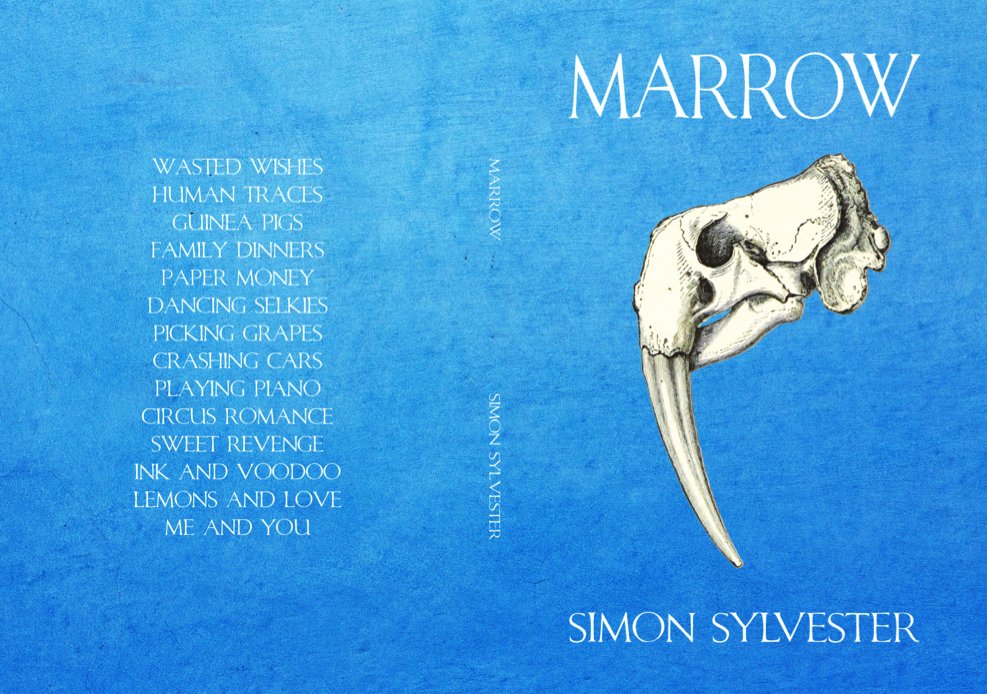
Here’s the final version of the Marrow artwork, with front and back covers.
In the belly of a whale
I’ve talked a lot about wanting to get back to my novella The Year Of The Whale, and I’ve just spotted this novella competition judged by the excellent writer Jenn Ashworth. The deadline is distant enough that I think I can get it finished in time, so that’s now a concrete target for me.
In the course of researching and writing The Year Of The Whale, I’ve come across a huge variety of whale material. I’ve seen Medieval whales, drawn as dragons and devils, and countless images of beached whales, spilling themselves in streaks onto the shingle. And then there’s much weirder stuff, like this profoundly sad, surreal animation. It’s about childhood betrayal, I suppose, but there’s a lot of other things going on in there at the same time. I would say ‘Enjoy’, but it’s not that sort of film.
Marrow cover – take two

Here’s another draft of the cover with massive changes to background, font, spacing, colour and contrast. I’ve decided that all this design stuff is HARD.
Odobenus rosmarus
I found this picture of a walrus skull (odobenus rosmarus, according to my friend Ross) in the British Library archives, cut away the background, made it black and white, lifted it into InDesign, added the background colour, changed the transparency mode so the skull turned shades of blue, found and added the fonts, and exported it.
If you knew what you were doing with Photoshop, this would probably take you about four minutes. But I don’t know what I’m doing, and it took me all night.
ALL BLOODY NIGHT.
Anyway – this is a first draft of the cover of my flash fiction collection Marrow, which I’m going to self-publish in the next few weeks. I’d appreciate any thoughts, positive or negative, about the design. I want something lean, but is it too simple?

The Blog Tour – answers
I was delighted when Elizabeth Stott invited me to follow her on the blog tour. I’m a fan of Elizabeth’s writing – I bought her short story Touch Me With Your Cold, Hard Fingers from Nightjar Press last year, and was engrossed in the tense, almost existential body horror she conjured in a few short pages. A lot of Elizabeth’s work generates that sense of claustrophobia – another of her stories, Mrs Wetherby, delivers simmering sexual tension amongst uptight ex-pats in the setting of a baking Gulf. Have a read – highly recommended.
Many thanks to Elizabeth for the invitation – here are her answers to the blog tour questions – and here are mine:
What am I working on?
More than I can handle! Foremost is new novel Grisleymires. Whenever possible, I’m trying to guide my rare writing days towards this; it’s the story of a man who loses his memories, and the woman who goes to find them. It’s set in a huge swamp, which is great fun to write, and I’m really excited by the characters and how they’re evolving. The issue is finding time to write around my other projects. I’ve been working on a novella called The Year Of The Whale for about five years (though I haven’t touched it for the last two). That’s about a whale beached in Morecambe Bay. It’s about 20,000 words finished, with only another 5 or 10k to go, but novels are taking precedence. I’d love to finish it soon, though – my partner Monica wants to make a series of linocut prints to illustrate it, and I think that could look fantastic – something like Alex Garland’s novella The Coma.
I’m also putting the finishing touches to my first flash fiction collection, Marrow, and starting to draft the second, which might be called Real Life. Around all this, I’m periodically developing my future novels – I already have plans for another four or five after Grisleymires. I’d love to write more often, but I struggle for time around my teaching and film jobs.
The final thing I’m working on is the copy edit of my first novel, The Visitors. The editor’s notes are due back next week, and I’ll need to go through those slowly and carefully (and with flagons of cider, according to Ali Shaw).
How does my work differ from others in its genre?
This is a difficult question to answer, as I believe all writers differ from others – that’s part of the wonderful polyphony of writing. As soon as a writer begins to speak in the first words of their own voice, they’re different. Genres are useful for sifting and gathering – I use genre far more as a reader than a writer.
That said, I guess I’m moving increasingly towards low fantasy. That’s where I can best tell the stories I want to tell. If my stories are in any way unique, it’s because of the themes I work in and the juxtapositions I explore. When I walk through woodlands, I worry about velociraptors. When I visit London, I imagine minotaurs haunt the Underground, dodging Tube trains as they roam beneath the city. There are doppelgängers watching from rooftops, waiting to make the switch. There are secret societies of pigeon fanciers that keep the internet alive, and kelpies working for the local council. I try to infuse my work with the same sense of magic I find in the world. I think every writer tries to do that. I’m interested in memories, and walking, and the idea of threshold spaces. I’m interested in myths and especially in folk tales. I’m interested in the breakdown in gender and what it is to be alive. Ultimately, though, lots of writers are interested in those things. What makes my work different is that it’s mine.
Why do I write what I do?
Writing brings me comfort through escapism, I suppose. I’m an army brat – we didn’t settle in one place until I started secondary school in Inverness, and I’ve often struggled to feel at home. Books and stories have been havens for as long as I can remember, and it was probably only a matter of time before I tried to create my own. As for the actual topics I write about – that’s evolved wildly over the six or seven years that I’ve been writing fiction. I started with experimental, deliberately obscure literary pieces, aping the styles of challenging writers like Hubert Selby Jnr and William S. Burroughs. After finishing my first attempt at a novel, which took me to some personally unpleasant places, I started to rediscover my love of stories that took me on adventures, rather than stories that were flayed to the bone. I reread David Mitchell and Sarah Waters and Jasper Fforde and Neil Gaiman – and I realised that those were the worlds that sang loudest to me. And so I started again, near enough, finding new ways to tell my stories. The more I’ve worked in this vein, the more I’ve enjoyed my writing.
How does my writing process work?
My ideas tend to arrive as acorns – I stumble upon them everywhere, buried in mud or blown into gutters. Some of those ideas never escape my notebook – and others explode, branching and sprouting into completely new directions. I can’t explain how an idea arrives already fully formed, but my best stories are already bristling with life. They evolve as I write. I know I’m working with strong characters when they start doing things I don’t expect; when it becomes inevitable, no matter what I’ve planned, that they’re going to do something else.
Landscape and place are important to the way I work – I like those strong characters to be in landscapes that I care about, so the air fills my lungs and I can feel the ground beneath my feet. In good locations, the story is a drop of water, taking the most organic route to ground. Place is as important to me as character, plot and emotion – when I write, I try to keep all those strands of story entwined together. Writing is a holistic process, following disparate elements all at once. That’s one of the things that makes extensive redrafting so hard. It’s easy for the fabric of the story to become tangled. When my stories are in a muddle, so am I.
Because I have so little time to work, I tend to write in fierce bursts. If I’m on a roll, I can manage more than 10,000 words a day, but that’s rare. A good writing day is 2,000-3,000 words I’m really pleased with. When I’m not writing, I think about my work constantly. I’m often awake at night, staring into darkness, tracing my way through story strands, trying to work out where they run to, where they meet. More often than not, I fall asleep without working it out – but sometimes I have to turn the light back on and write them down.
I’m also an helpless tinkerer. I can’t let go of my stories, and I return to them obsessively – even years after they’ve been published – to develop the story and tweak the prose. My flash fiction collection Marrow is typical of this – of the 28 pieces, around half have been published elsewhere – but in preparing the collected manuscript, I’ve spent months compulsively redrafting them. Some no longer bear any relation to the original. I can’t help myself. That tweaking and revising comes into first drafts, too. My stories are probably one third writing, two-thirds editing.
Another of the keys to my workflow is reading aloud – as I write, I constantly read, lips moving, shaping the phrases to find the most organic flow, and then reworking it on the page. On the rare occasions I’ve been asked for writing advice, that’s my first suggestion. Nothing has done as much for developing my work as reading aloud. My second suggestion is to carry a notebook. You never know when those acorns will tumble from the sky.
***
So there we have it. If anyone’s still reading, these are some of the things that go into my work. I’m now passing the baton on to David Hartley and Iain Maloney, who’ll publish their blog tour answers on Monday 3rd February. In their own words, they’re a bit like this:
David Hartley is a story botherer and blog tickler based in Manchester whose debut collection of flash fiction ‘Threshold’ was published by Gumbo Press precisely a year ago. He is one fifth of the writing collective Flashtag and can be regularly seen haunting the open mic stages of the North West. He blogs at http://davidhartleywriter.blogspot.co.uk/ and tweets at @DHartleyWriter
Iain Maloney was born in Aberdeen, Scotland and now lives in Komaki, Japan. A widely published writer of fiction, non-fiction and poetry, his debut novel, First Time Solo, a story of World War 2 RAF pilots and jazz, will be published be Freight Books in June 2014. He blogs at http://iainmaloney.wordpress.com
Thanks for reading.
 Simon Sylvester