Just a quick post to say that I’ve been invited to join the blog tour by the excellent writer Elizabeth Stott. The idea is that writers post answers to the same four questions, then pass the baton to another writer. If you trace it back, there are dozens of fascinating responses around the idea of what it is to write. Here are Elizabeth’s answers, which are a tough act to follow.
I’m due to post my responses on Monday 27th January. These are the questions in question:
What am I working on?
How does my work differ from others in its genre?
Why do I write what I do?
How does my writing process work?
There’s quite a bit to get through in there, but I’ll try extremely hard not to be boring.
I’d also like to introduce David Hartley and Iain Maloney, the writers who’ll follow me on the blog tour. David is an intimidatingly prolific writer of scintillating flash fiction and short stories, and he’s working on his first novel, which is pretty cool. Already looking forward to what he has to say about writing.
David Hartley is a story botherer and blog tickler based in Manchester whose debut collection of flash fiction ‘Threshold’ was published by Gumbo Press precisely a year ago. He is one fifth of the writing collective Flashtag and can be regularly seen haunting the open mic stages of the North West. He blogs at http://davidhartleywriter.blogspot.co.uk/ and tweets at @DHartleyWriter
Iain is an old friend of mine. We’ve been reading each other’s work for seven or eight years, and I’ve learned a lot about writing from him. He has broad interests, from haiku to historical fiction, and I’m especially eager to see his thoughts on genre.
Iain Maloney was born in Aberdeen, Scotland and now lives in Komaki, Japan. A widely published writer of fiction, non-fiction and poetry, his debut novel, First Time Solo, a story of World War 2 RAF pilots and jazz, will be published be Freight Books in June 2014. He blogs at http://iainmaloney.wordpress.com
I’ve lived in England for thirteen years, on and off, with stints in Edinburgh, Inverness and Australia. Aside from Cumbria, which is the closest thing to home I’ve felt in my adult life, and London, which is a bubble, I often feel a stranger here. Despite moving around so often, there are big chunks of the country I’ve never seen. East Anglia is one of them. We spent this weekend exploring the area as research for my next novel, which is called Grisleymires. On Friday we drove down a smart diagonal sweep across the country from Burneside in Cumbria to Kirby Cross, almost on the Naze, and stayed the night with friends. On Saturday morning we jagged back up to Wisbech, stopping at Wicken and Ely. For the first time, I’ve been to the Fens.
Grisleymires has been in the back of my head for a while. From the beginning, I knew that it was set in a swamp – the earliest incarnation of the story was essentially Time Bandits with bog bodies. It’s evolved massively since then, but the marsh has been a constant: I want to write about mud and water. I’m now quite secure in the plot, but the location has been troubling me. Location is crucial to the way I write, and I didn’t feel confident in my knowledge of any British bogs. I picked the Fens on instinct, and decided to find out more from there.
The first person I spoke to about Fenland felt so negatively about it that he could only laugh hysterically. He’s one of the most articulate people I’ve ever met, and he simply couldn’t formulate words to describe how powerfully it repelled him. That was exactly the sort of start I was hoping for. Since then, people have told me that the Fens are creepy, strange, powerful and weird. Everyone talks about ‘big skies’. Now that I’ve driven through them, I can understand why. It’s the flattest landscape I’ve ever seen. The horizon is broader, the perspective unnerving, the sky an impossible bowl. There are miles at a time without undulation – miles without trees. Ditches run in straight lines to vanishing points. In places, roads run lower than canals, with dykes and bridges guiding the contours. It’s especially strange near the coast, where the horizon is curtailed by the shore.
We stopped at Wicken Fen, where I stood in the blustering wind and stared into the winter sun. Tall grass became an ocean and hissed at me in waves. I never expected so much noise from emptiness. The sun turned orange, and the dusk turned blue, and pylons hung like giants against the scraps of cirrus. At one point, we drove along beneath a dyke for a mile or more. The road turned sharply up the bank and at the top, blinded by sunset, the world opened up like Noah’s flood – the entire horizon drowned in water, withered trees and battered shrubs emerging in silhouette against the sun. That was the road to Wisbech, submerged in wetlands.
We drove the alternative route to Wisbech on undulating single track roads lined with Nissen huts and broken hedgerows, tumbledown houses and gigantic piles of sugar beet, surrounded all the while by thousands upon thousands of acres of thick, turned loam.
Wisbech was a strange town. The B&B was huge and empty. When we went to look for food, we found ourselves in what seemed to be a red light district. Drunken Polish men yelled at each other across the street, while girls on corners danced to techno on CD stereos. On Friday night, above the Naze, the stars were clearer than I’d seen in years; on Saturday, the sky was full of murk. On Sunday morning, we drove on Droves – lumpy roads, arrow straight for five miles or more, then zigzagging madly to meet the next. They separate broad strips of industrial agriculture, riven with canals, ditches and soakaways. All the trees wear killing coats of ivy. For the most part, we drove in silence, occasionally pointing things out to each other. The landscape was relentless without becoming monotonous.
The Fens is witchcraft and weak bridges; rotten thatch and revolution; gallows and windmills. At one point, we passed a narrowboat moored beneath a sickly weeping willow. It looked like it was about to break in half and sink. It was small, and covered with lichen, but I could still make out the name: it was called Icarus.
I don’t know if the Fens are creepy, but they are profoundly strange. We felt edgy all the time. We’re used to the cradle of the mountains, a constant presence in our peripheral vision. It’s incredibly strange to be without that subconscious company. Mon pointed out that the sheer amount of space makes you feel exposed – vulnerable. We didn’t find it creepy, so much as missing. It’s an absence, a nothing, a void. It felt like a sort of purgatory; fields unfolding endlessly, stretching on forever.
I went on this trip hoping for a sort of Green Venice, but that’s not what the Fens are about. They aren’t what I expected, or what I wanted, but maybe this trip has been exactly what I need, and here’s why:
I invented Bancree for The Visitors. It’s an amalgam of Islay, Jura, Gigha, Kintyre and the Black Isle, plus a host of other Scottish spots; and I’m already planning a novel set in a fictional city, based around my short story Vanishings. The point is this: I thought nothing of creating an island, and I can’t wait to write a city. I don’t know why it’s taken me this long to consider inventing a Fenland of my own. Writing a new region into an existing geography feels more daunting than something as self-contained as an island, but that would give me the perfect environment for Grisleymires.
I’ve only started considering this today, but it’s already gathering weight. It would let me combine the heat and life of Green Venice with the sodden bogs of Islay and the upland Cumbrian basin mires with the Fens and Norfolk Broads. I could do as I pleased with accents and geography and culture, and that’s a real magnet for me. I’d be sad to leave or even dilute the Fenland folklore, though – I’ve grown attached to Tiddy Mun and Old Shuck.
As a research trip, it’s thrown up more questions than it’s answered. But that, in itself, is part of the journey.
It is with tremendous pleasure that I share the cover to The Visitors. It looks like this:
…and I’m utterly thrilled with it. The artist, an outstanding book designer called Leo Nickolls, has captured so many elements of the story in his design. I love the composition, the style, the palette – everything about it.
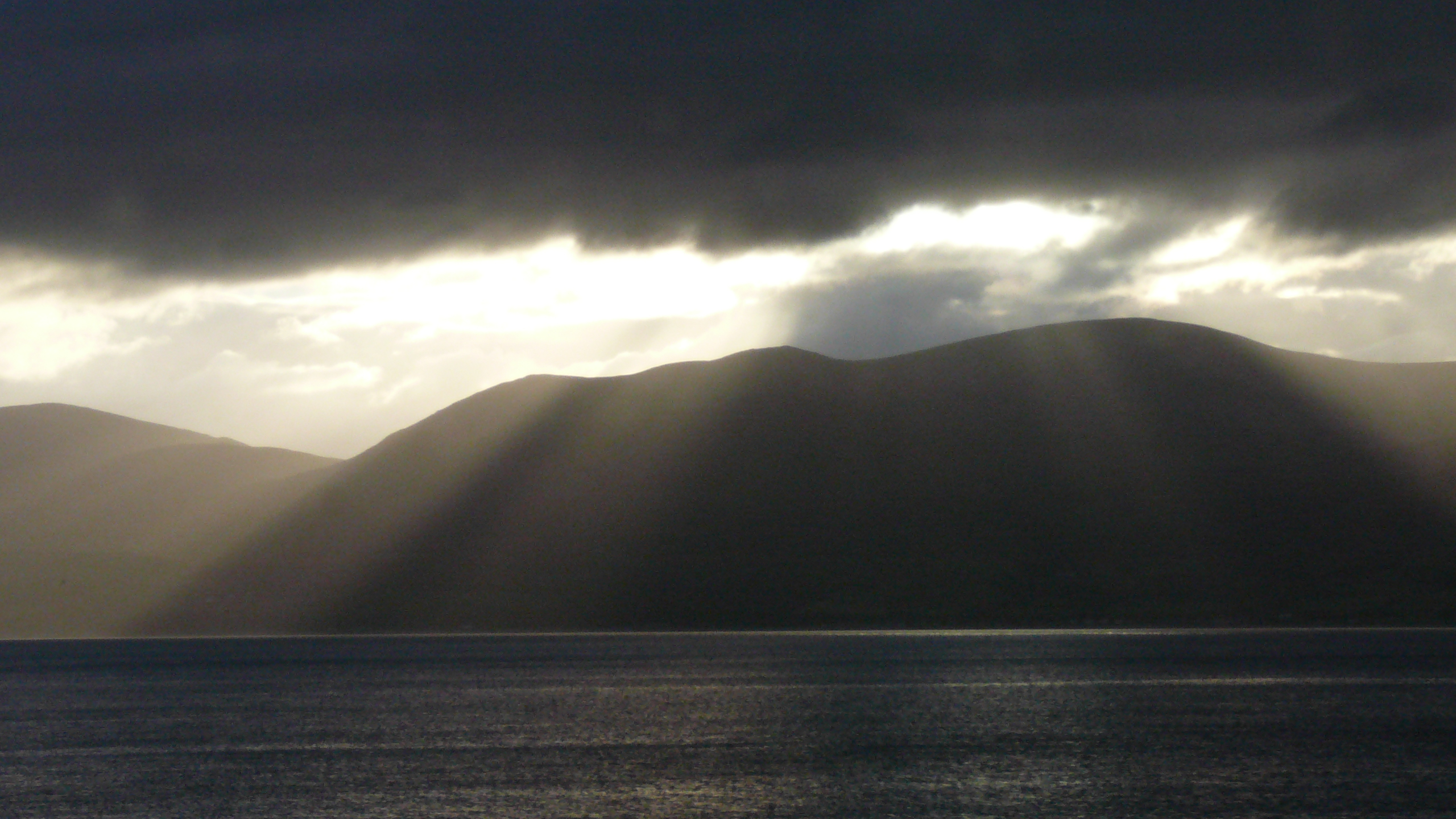
Most of the story of The Visitors fell into my head while on holiday in Grogport on Kintyre. It’s connected to the Scottish mainland by a narrow isthmus, but it feels like an island. From Tarbert, it’s a thirty or forty minute drive along weaving single track roads to the tiny village of Grogport, which is no more than ten houses and a beach. It was our first holiday as a new family, and we stayed there for a week. Dora was only five months old, and she was unsettled by the change in her surroundings. After sleeping late for most of the previous month, she started waking early – at four or five in the morning. On one of those bleary mornings, we sat in awed silence and watched the sun crest behind humpback Arran, the island pitched into shadow beneath titanic columns of light. I took some pictures. They looked like this:
The first time I saw Leo’s cover, this image came to me as a jolt. Memories shivered at me; the cold tiles underfoot, the grit in the coffee and the grit in my eyes, the herons on the beach. Even now, I feel a little unnerved at the similarity in the mountains. I scribbled out the plot of The Visitors no more than a day either side of this picture. Unheimlich.
Seeing the cover has been amongst the most surreal parts of this crazy journey. The closer I come to publication, the further I feel from reality. Being so immersed in redrafts and work, this often feels as though it’s happening to someone else.
“A young couple trapped in a remote estate of empty houses and shrieking foxes are beckoned from their isolation into a twilight world…”
This is a haunting, excruciatingly tense short film, worth every frame of its fifteen minutes. Metamorphosis and the idea of threshold places – of things having twin natures, existing in two states at once – are becoming increasingly key to my work. A film like this gets my pulse racing and synapses snapping, hungry to write.
I’m not sure I totally get this, but I’m not sure I totally need to. This is a magnificent, monochrome splash of neo-noir animation from the Czech Republic. Enjoy.
I’ve always been a little dismissive of New Year’s Resolutions, because if I want to make a change in my life, that can happen any time I choose. That remains true, but there are things I want to do differently going into 2014. Post-Christmas binging is a natural place to draw a line and make a start, and I quite like the idea of formalising the changes I want to make. So here’s what’s going to happen this year:
Exercise
Because I don’t really do any, other than the odd Lakes walk and the exhaustive mania of teaching. I’ve already started walking the 2 miles to work – which I enjoy for the headspace as much as the activity – but I miss my bike and I miss my climbing. So I’m going to start cycling the long way to work and back. That’s only about 6 miles a day, so it’s not a great deal really, but it’s more than I’m doing at the moment. I’m also really keen to get back to my climbing. When I lived in London, I climbed four or five times a week. Now it’s four or five times a year. I’m going to start going for a few hours at least once a week. That, supplemented by some pull-ups at home and the cycling, should be steps in the right direction. I might even join Mon for the odd yoga, too.
Writing
The best I can hope for here is more of the same, I think. I crave more time to write, but the day jobs don’t allow it. In a good week, I get two days and two nights on my stories every week. Within that, I have specific aims for 2014. First and most important, I want Grisleymires finished in a year. This is a big ask, but it’s well planned, I’m excited by the story, and I can do it if I work hard. Research trip to the Fens in January!
Second, I want to have my flash fiction collection Marrow typeset and printed by the end of February. I’m reading at Spoken Word at the Brewery on Saturday 22nd, and I want it in my hands by then. This isn’t as big a deal as it seems; the stories are written and redrafted ten times over, and having typeset it once already as practice, I know glimmers of InDesign. With some guidance from knowledgeable friends and a few late nights, I think I can send the manuscript off to Inky Little Fingers in a few weeks. I’ve already saved most of the £225 it’ll cost to print 100 copies, so that’s not going to hurt my wallet too much.
Third, I want to keep on performing. 2013 was a turning point for me in reading my work aloud, and I want to push that as far as I can. Reading live brings an entirely new aspect to the way I write, and this is something I want to keep developing – pushing towards more theatrical performance where my confidence allows it.
Fourth, I want to submit my work to more competitions. I’ve never entered any of the big short story competitions before now, and I’m going to try and start this year. And I want to write new pieces, too, if the ideas keep coming to me. I’m not going to rehash old stories. I’ve pretty much drawn a line under my older work, but for two particular pieces: the excellent people at Comma Press have been considering my short story Every State In America for their delayed Reveal anthology for a couple of years. They’ll have first refusal on it for as long as it takes; being published by Comma would be an incredible honour. The other piece is called Art Is Long, Life Is Short, which is perhaps three years old and freshly redrafted for the BBC Radio 4 Opening Lines strand. That’s ready to go when the submission window opens in January.
Fifth, I want to finish Year Of The Whale, my long-running novella about a whale beached in Morecambe Bay. It’s been work in progress for three or four years, and it’s overdue. But writing resolutions one through four come first.
That’s lots of resolutions wrapped up in two strands, really. Writing and exercise. I’m only going to buy the time for everything else if I start saying no to low-paid film jobs, so I’m not doing any freebies/cheapies this year unless they have a clear benefit further down the line. I’m also going to try and rein in my irrational compulsion to reply to emails RIGHT THIS SECOND. I just don’t have the time. Most of the email I receive can probably wait until I’m ready. The point of all of this is to spend more quality time with Mon and Dora. Unless deadlines get in the way for either of us, we’re generally good at keeping weekends as family time, and I want that set in stone. There are a host of other things I can do towards this – less time online, for a start – and turning off the computer on free evenings. I want to read more, too.
I guess I’ve picked out goals, rather than resolutions, but it’s all the same in the end. I haven’t kept a blog to monitor resolutions before; I’m curious to see to whether writing about my success or lack thereof will impact on my success or lack thereof. Gazing into the void and so on.
There are few things as scary to me as blank white paper. Gorgons live in blank paper. A ream of paper holds universes. The infinite weight of that potential is a terror.
I’ve been shying away from it for weeks, claiming other jobs and seeking different priorities, but yesterday I finally started work on Grisleymires. It’s been roughly planned for months (the plan gets vaguer towards the end, allowing for inevitable mutation, but it’s all there). Yesterday, at last, I had the brain space AND the opportunity to sit down and start work. I’m still expecting another draft of The Visitors, but hopefully that should be fairly light, and this novel has been clamouring at me. I didn’t want to wait any more.
Working in the wonderful Scrivener, I sat down and blasted through most of the first chapter. 2,750 words, which is pretty good for a disjointed day. A dozen words came easily, and the word count raced to the first hundred. From there, progress slowed. The thousands took hours, and tens of thousands will take weeks or months. A hundred thousand might take me a year, around my various jobs, and that’s how it goes.
To be clear, I don’t think word counts are important to anyone but the person counting. It’s not something to boast about, and it in no way measures the quality of those words. I’ve had great writing days when I’ve written 11,500 words in twelve hours, great writing days where I’ve written a single sentence, and great writing days when I’ve deleted 10,000 words over a pint of beer. I’ve also had a stupendous amount of terrible writing days, where every word is a breeze block.
I think it was Graham Greene who advocated writing no more than 500 words a day. I guess the idea was to make sure those words were perfect, and to be fresh the next day. That doesn’t work for me. I need a word processor, I need to copy and paste and cut as I work. I need to work fast if it suits, or to dawdle over minutiae, depending on what the story wants from me. When I worked as a feature writer for a magazine, I wrote well over 10,000 words of published copy each month, not counting the blogs, the emails, the phone calls or the coffee run. Word counts became the way I managed my work. I had deadlines, and I hit them fast, because that was what paid the bills. When I started writing fiction, looking for a way to save some of my sanity, I brought the same workflow into my stories. Workflow is an interesting word. The flow is one of the things that generates the work. I’m talking about immersion; I’m talking about drowning in a story, and writing as though words are air. Anthony Burgess wrote A Clockwork Orange in a month.
I count climbing grades, too, when I go bouldering. Like writing, climbing is a competition of one. And exactly like the grades of rock climbing routes, word counts measure personal progress. In other words, they exist for me alone.
So, why share them? That comes back to my feeling that writing is a profoundly lonely thing to do – not simply being shut away for the time it takes to actually get words on paper, but to be lost in another world, to know characters better than best friends, to be so buried in a story that big chunks of real life feel like something to endure between writing sessions. Counterintuitively, this is also the good stuff – this is why I write. Redrafting makes something worth reading, but that first draft is where the magic is. Sharing the progress of a story is how I connect with the world outside – how I remember that there is a world outside.
I hardly ever remember my dreams, but I still have lucid recall of the time Scroobius Pip stole my bicycle. I was talking to a friend on the street when he seized the bike and ran off. I chased him into the Foundry, a dingy pub in Shoreditch. Inside, I pursued him through a labyrinth of tiny rooms, narrow corridors and crooked staircases. At every corner, I had to elbow my way through crowds of louche hipsters. Even encumbered by my bicycle, Scroobius Pip melted between them like a shadow. I couldn’t catch him, and then he vanished in the dark.
As well as being an expert ethereal bike thief, he is an exceptional performance poet. Here you’ll find him presenting an hour of spoken word on XFM. Quite aside from the tantalising prospect of a solid hour of poetry on mainstream radio, there are some absolute gems in there. It’s worth the time, so put your feet up and bask like a shark through this sea of lyrical genius.
Obviously, the end of every year gives pause for reflection. For me, this used to manifest itself in a range of Top Tens – films, albums, books, gigs – but these days I don’t really do enough of any of those things to justify it. So here’s my combined Top Ten of 2013 instead. They’re not in order.
Securing a publishing deal with the wonderful Quercus Books has been one of the most amazing things to ever happen to me. I’m still waiting for someone to pull the rug out from under my feet, but until they do, I’ll keep enjoying every moment of this exhilarating, terrifying, extraordinary rollercoaster. I feel bowled over by the support for my writing, even as I feel a massive weight of pressure to deliver. I started the year with a manuscript called Riptide Heart; I finished with a rigorous redraft, now called The Visitors. Working with Quercus editor Jane Wood has made my writing tighter and my story much stronger. It has also given me a real hunger to push on with my work – I now have half-a-dozen novel ideas clamouring for my time.
This wouldn’t have happened without the hard work of my awesome agent, Sue Armstrong at Conville & Walsh, and the support of my amazing partner Monica. That brings me to the second thing on the list:
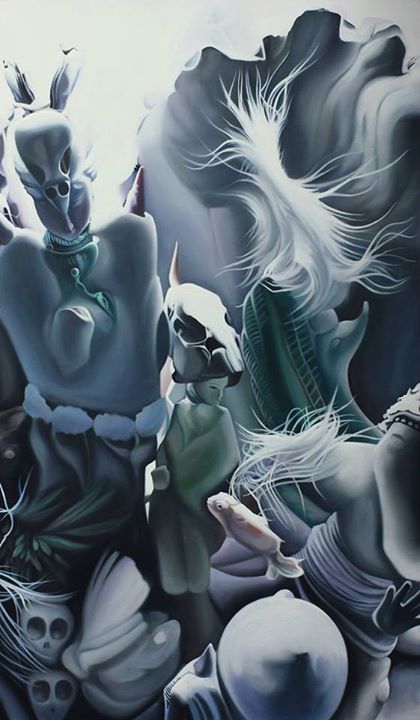
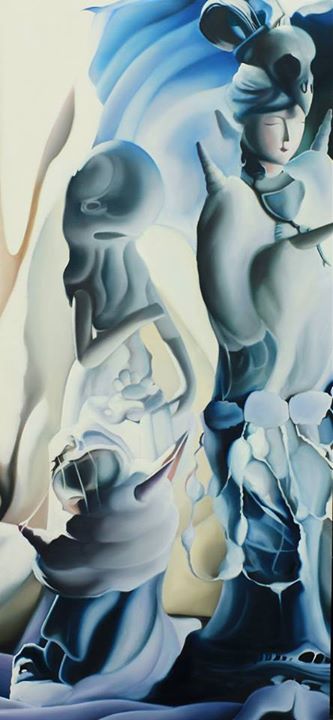
2. New work from Monica Metsers
While she was pregnant, and in the first year of Dora’s life, Mon took time away from her painting. 2013 was the year she really started again, and the results have been amazing. She has a solo show in London next year, and as well as a few smaller paintings and a range of drawings, she’s made these two stunning large-scale paintings, which I think are amongst the best work she’s ever done:
I’ve never been good at public reading, and this year I set myself the challenge of improving. I went on to read my work twice at Spotlight in Lancaster, once at Kendal’s Spoken Word, once (performing from memory) at Dreamfired in Brigsteer, and once at the Flashtag 2013 writing competition in Manchester, where I won second place. My confidence grew with each reading, though I still feel I’ve a way to go.
I also attended a spoken word workshop run by the excellent Brindley Hallam Dennis. One of the activities he set has changed everything: he had other members of the workshop read our stories. The lady who read my flash piece ‘Marrow’ performed it at a third of the pace I do. She relished every word, and it was three times better as a result. I haven’t performed since then, but I’m going to practice reading with that sort of gusto at the next opportunity. I’m booked in for a 20-minute slot at Spoken Word in February, and I’d like another couple of events under my belt by then. My goal has evolved a little, too: what I’m aiming for now is something closer to outright performance than simply reading. That will come with confidence, and confidence will come from practice.
4. Seven Seals – Plan of Salvation
After a whopping 18 months, I finally finished making this music video for amazing psychedelic synth punks Seven Seals. They’re an extraordinary band, and it was an honour to be involved. They’re working on new material, which will hopefully be available in 2014 for their ten-year anniversary gigs.
Quite simply, the finest collection of short stories I’ve ever read. Hempel’s writing is so sensitive, so honest, that it infuses her stories with devastating grace. Unmissable.
6. Les Revenants
This French drama is the best thing I’ve seen on television in years, remarkable for its intrigue, restraint and power. It delivers on every level, exploring an extraordinary narrative without needless exposition to unravel the mysteries of the Returned, all of whom are troubled in different but connected ways. The locations and cinematography are stunning, while the soundtrack by Mogwai is my album of the year. There’s a startlingly surreal lucidity to the conclusion, and I think they could have left it there; but I’m delighted to see a second series in the works. Here’s the trailer for season one:
In TV terms, an honorable mention also goes to Game Of Thrones. Tyrion Lannister might be the finest character ever committed to screen, and the Red Wedding haunts me even now.
7. Success for friends
It’s been a good year for many of my friends and peers, too. Iain Maloney landed an agent and a book deal with Freight, Kirstin Innes found an agent, Anneliese Mackintosh got a book deal, Kirsty Logan landed a book deal and won everything in the world. Friends Andy and Gemma had a baby boy called Miles, and Ali and Iona had a little girl called Inka. There have been a lot of richly deserved congratulations this year. Good work, team.
8. Cats
Yup. Two of them. I wasn’t sure, at first, but then we met these two cats in the Wainwright Animal Rescue Centre, and it was an easy decision. They came to us with the names Remus and Teddy, which we’ve kept. They’re brothers, about three years old, and half-Persian. They’ve been an amazing addition to our house. They are incredibly relaxed and friendly, and they actively seek our company. That’s especially welcome when I’m having a writing day alone at home.
We were overdue a break, and this fortnight in France was exactly what we needed. We camped in half-a-dozen places, the best of which was Green Venice, a vast network of canals, ditches and overgrown waterways, crawling with vines and willows, alive with dragonflies and katydids. It was an extraordinary landscape. I read more in that fortnight than I’d managed in four months. Best of all, the holiday gave me enough mental space to plan my next novel, which will be called Grisleymires. That’s now blocked out on Scrivener, waiting for my next writing day.
10. Another year with Dora.
In their first year, babies are basically little puddings. Awesome little puddings, but puddings nonetheless. In their second year, they gather the basic tools to discover the world. And in year three, that toolkit expands exponentially; physically, vocally, intellectually and emotionally. Going through that with Dora has been nothing short of a joy. Seeing the world through her eyes has made me reevaluate so many things for myself. Her conversations leave me in stitches, and everything about her makes me smile. And she hasn’t been to A&E this year, which I consider something of a triumph. Though there’s still a week of 2013 left.
So that’s my Top Ten. It’s been a good year, and 2014 is alive with possibilities. I might even pop some resolutions up in a few days.





 Simon Sylvester