Quick on the uptake, as ever, but I’ve just caught this excellent video on the history of typography:
It’s funny how much the right font matters. There are some fonts I cannot abide to work with, and others I’ll use fleetingly but intensively. More than once, I’ve given up on reading a book because I found the font so unpleasant. When I first started writing, I only used Courier. With the benefit of hindsight, this was pretty much exactly as juvenile as my early stories. Then, after working in Times New Roman for years, I switched to Arial for The Visitors. I’ve started my new novel in Baskerville, which I love. At college, I use Gill Sans for all my planning documents, and in my video work I tend to use Century Gothic or Mrs Strange, which could scarcely be further apart.
The more I discover about fonts, the more I come to appreciate the vast psychology behind typography. It’s a gigantic field, and I tend to stick to knowing what I like.
One of my Twitter very short stories is about fonts:
She was Arial Black. He was Wingdings. “Why can’t you take anything seriously?” she wept. “Maybe you need to lighten up,” he snarled.
Any favourite fonts out there? I’m assuming, of course, that everyone avoids Comic Sans.
On Friday 11th October, Dreamfired takes over Brigsteer village hall for a night of traditional music and storytelling. I’ve managed to land one of the support slots for headliner Emily Parrish, aka Scandalmongers. She’s retelling the classic Norse myth of Loki, the trickster and troublemaker at Odin’s court. Her show has received amazing reviews, and I’m really excited about seeing her perform live.
I’ll be reading two short pieces I’ve been practising live – Circle Stone and The Lion Tamer’s Daughter. I wanted to get into the spirit of the night by performing from memory: no notes, no paper. Reading them at Spotlight and Spoken Word has been good for practising their delivery. I already know Circle Stone by heart, and I’m four-fifths of the way there with Lion Tamer. The prospect of reading live is not yet as scary as it will be on Friday afternoon.
By dumb chance, my storytelling uncle Rich Sylvester is up in the Lakes for a workshop that weekend, so he’s coming along too – and I’ve just discovered that legendary Cumbrian singer, songwriter and banjo maestro Bill Lloyd is playing as well. It’s a blinding line-up, and I feel a little overawed to be reading at such a great event. I’m looking forward to sharing my stories, then sitting back with a beer to enjoy a great night of tall tales and folk music…
For one reason or another, something has arisen on the last Saturday of the month – every month – for well over a year. And that’s a real shame, because Spoken Word is on at the Brewery Arts Centre in Kendal on those last Saturdays, and I’ve therefore missed well over a dozen of my local literature night. Yesterday, however – at last – I was able to make it across town to the Brew, and I read at the open mic.
This won’t mean anything to anyone but me, but Spoken Word was also the place of my first ever live reading, more than three years ago. That’s why this post is called Take Two. It was curiously satisfying to take to the stage again and remember how I was shredded with nerves back then. And another first for me, this time round – I’ve never read without Monica in the audience. I missed her. It’s much easier to perform knowing at least one person out there is absolutely rooting for you.
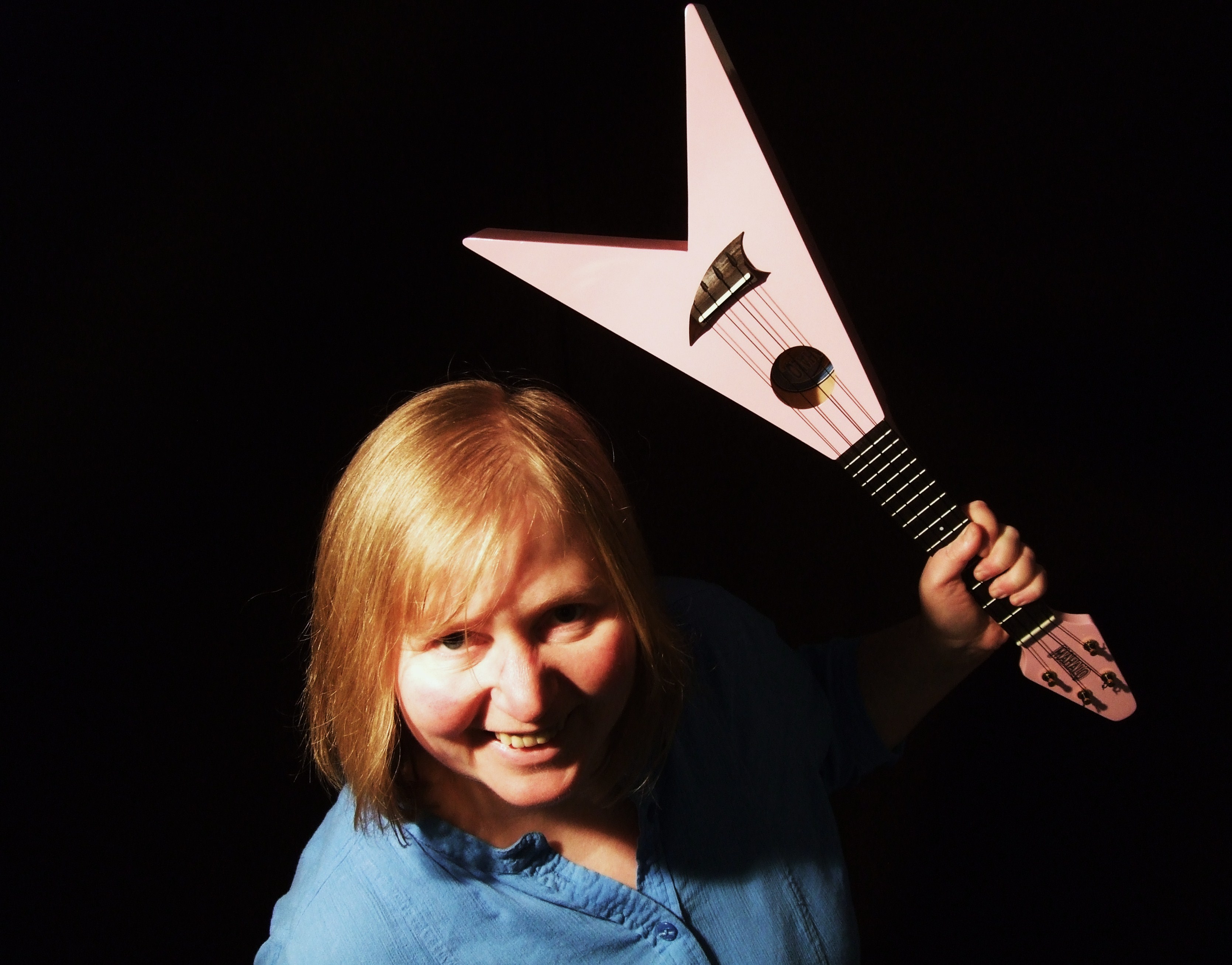
I was first to sign up to the open mic, so I was first onstage after excellent compere Ann the Poet had introduced the night and read a couple of her poems. I always enjoy Ann’s work – it’s witty, it’s wise, it has energy, and her poems tell stories about people. For me, that’s what all this is about. She’s also a very funny host. She looks like this:
It was weird being the first reader onstage. There hadn’t been a chance to gauge the audience, and so I didn’t know entirely how to pitch my work. With a five-minute slot to play with, I read The Lion Tamer’s Daughter and Circle Stone. I didn’t exactly pick up where I left my last reading in terms of confidence, but I tried to invest a little more faith in my stories. They seemed to go down quite well, and Circle Stone found a bigger laugh than at Spotlight.
The other open mic readers were brilliant – I especially enjoyed poet Kate Davies. She had polio as a child, and her second piece was a stunning juxtaposition of that experience with a car maintenance manual; the more of an automaton she made the child, the more human she became. It was mesmerising.
After the break, Luke Brown read two of his short stories. He’s a young writer of great reputation round Cumbria, so I was really excited to see him live – and he didn’t disappoint. His work was engrossing, and both his stories had killer, killer pay-offs. I really hope I can see him again. I haven’t found a website for him yet, but if I do, I’ll update the blog.
Second headliner Louise Mary Martin topped out the bill. I’ve come across her work before – she’s the singer in South Lakes reggae group Righteous Bees, and my brother-in-law Ben Metsers has used her vocals in some of his work. Last night she played four songs – two bluesy Americana/alt.country covers, played with guitar, and two extraordinary songs in which she used live loops of her vocals in dense layers, beautifully timed to create a stunning collage of sound. I’ve seen it before from Adam Stafford:
…but it was quite something else to watch live. The focus and the timing required is amazing. Just astonishing stuff.
It was a great night, with one slight downer. During the interlude, while I was chatting with Kate Davies, a man I didn’t know joined us. He was perfectly friendly, but our conversation left me feeling strange. He told me that the trouble with my story was the moment he knew it was about lion tamers (i.e., from the title), he thought of a news article from the 1960s about a lion tamer who was attacked by his own lion – and he thought of that instead of my piece. Which I guess is fine, but I don’t know how any writer can future-proof their work against audience association. Indeed, writers need audiences to bring their own associations with them; it’s a reader’s empathy that brings a story to life. Anything less would be exposition. The man also thought I was self-conscious during my reading. Maybe I was, a little, but I was a goddamn powerhouse compared to a year ago. That was a bit of a funny one to leave me with.
I wanted to talk to Luke Brown afterwards and congratulate him on such a great show, but he was swamped with other people wishing him well, and I had to go. I walked home through Kendal listening to a playlist I’m making for Monica. As I headed out of town, taking the back road to Burneside, the last streetlight made a giant of my shadow, casting it far up the road into the night. The further I went, the dimmer the streetlamp, until my shadow and I were absorbed entirely by the darkness. It was a clear night, but there was no moon. My eyes adjusted to the gloom and I walked a mile or so lit only by stars, pinpricks of light lifting the path half a shade above the vegetation.
I thought a lot about my reading, and about what the man said. By the time I reached my house, my mind was clear. Different opinions are how we know ourselves as individuals, and I’m sure I’ll hear much worse when The Visitors hits the shelves. I can’t do anything about an audience’s associations, and nor would I want to. And if I seemed self-conscious, then that’s partly because I am, and it’s something I need to keep working on. I do want to improve my performance even further, to be bolder, to be more technically confident in how I speak into a microphone, to relax into my stories, to try different voices. And I’ve another date in the diary to aim towards, now: Ann has asked me back to read as one of the guest slots for February’s Spoken Word. I feel deeply honoured to have that as something to work towards. I’ll go back to the open mic whenever I can, too, and I’ll keep trying new stories. Because I have to.
Jane Wood, my editor at Quercus Books, sent her notes on my novel this week. It’s a moment I’ve been dreading and craving in equal measure, and I wanted to take a moment to think about what it means now it’s actually here.
I’ve already done four drafts of The Visitors. Some of the drafts were very heavy, and some were extremely light. Redrafting is essential to all writing – I still, even now, return to stories published years ago to tweak and rework them. I have little paranoias about all my work, and can’t help but return to it. Sometimes I make changes of single words, and other times I excise entire scenes. Sometimes I catch myself totally rewriting published work, and I have to make myself leave it behind – I have to take stock and force myself to walk away.
On the second draft of The Visitors, I pussyfooted around Sue’s notes, making tiny changes, scared of diving in. When I came to a third draft, I made myself stamp on it, brutalising the manuscript with broad changes and moving onto the next alteration, no matter how ugly the massacre I left behind. Then, when it looked like a crime scene, I started rebuilding again. That’s what I’ll do this time, too, no matter how hard I find it. And I’m going to find it hard.
Whenever I come to editing and redrafting, I think there are two broad categories of change:
Cosmetic
These are the easy ones, often little more involved than line edits. Cosmetic changes this time include switching a character’s name, cutting some internal monologue and reconsidering some of the vocabulary used by my main character. I could blitz through that in a day, tops. Unfortunately, the other editing category is:
Structural
…and this is the big stuff. Making structural alterations means redrawing the map of the story while trying to maintain the same emotional trajectory, and that can be difficult to keep in balance. In this case, I have two substantial changes to make. Firstly, a minor character needs to become a major character, and he needs to appear much sooner in the story. I already know this is going to be awkward, because I attempted something similar in the third draft, and I struggled to bump him up the narrative even to his current position. It’s going to be tough to find or create somewhere to introduce him sooner.
The second change initially felt even more challenging, but on reflection perhaps isn’t quite so bad. Jane has suggested a different direction for the ending that I’m really excited about. At first I was really worried about it, but I’m starting to see it as a case of unravelling the current conclusion and retying the strands of story into a different shape of knot. This will involve more writing, but actually it’s less of a challenge – with the current ending gone, I’ll be writing into blank space. That’s a thrilling proposition at this late stage of the manuscript.
While it’s still a skeleton, a novel plot is essentially arbitrary. Things can be changed extremely quickly and easily. New characters come and go, and the story shifts like a dune, blown into organic and occasionally bizarre shapes by the wind of imagination. But the more developed a story becomes, the less arbitrarily it can change. There comes a point where making big alterations means breaking the momentum you’ve fought to generate, then patching up the holes and hoping no-one can tell the difference. That’s where a writer needs to have paranoid convictions about the emotional tone of their work, and strive to make it as cohesive as possible in plot, character, voice and soul, then work it again and again and again, hammering and thrashing and beating and combing through the manuscript until it’s carved against your optic nerve.
Editing is frantic. It’s really hard. Throughout the process, a storm cloud hangs over you, an implicit sense that you didn’t do it well enough the first time. Then there’s the crashing changes you wreak on something you loved. And then there’s the dread that whatever you make to take its place won’t come close to what you had before. It’s an exciting time, too, but the whole process is riven with a crawling, monstrous, excruciating anxiety.
This is mostly my load to carry, but I’m glad I’m not taking the journey alone. I’m now far too close to The Visitors to critically appreciate it, and working with other people helps triangulate my own perspective about the story. I’ve often stated my belief that writing is as much about the community as the individual – not least as it counts for little without a reader. When I write short stories, I read them to Mon, and I send them to writer friends. And I pay attention to what they say, even if I disagree. Working with other people – and working with Jane and Sue, now – has repeatedly shown me the importance of opening myself and my ideas to an audience. I have people I can talk to, and that makes me lucky.
Of course, I say this before actually beginning the edits. Try me in a week.
This post is about names for stories. Sometimes I come up with a title first – I have a story called You Don’t Talk To The Driver, The Driver Talks To You, which developed entirely from the title. And sometimes the title is really obvious – The Lion Tamer’s Daughter couldn’t be anything else. Sometimes it’s lifted from a phrase in the story, like The First Time I Died. Sometimes it evolves after a struggle, like my novella The Year Of The Whale (which I will finish one day). And sometimes, I just can’t think of anything at all. And all this is relevant because we’ve just changed the name of my novel.
I’ve been calling it Riptide for the last six months, but my novel has had dozens of different names. I went through bucketfuls of working titles – occasionally to the point that I was changing it two or three times in a single writing session. Nothing stuck. I’d reached a point where the novel was finished, and I wanted to send it away, but it didn’t have a name. After another few days dedicated only to looking for titles, I called it Riptide Heart because it had to be called something, then sent it to some friends.
“Love the book, mate,” came one of my first responses, “but the title’s balls.”
In the end, a lot of people said pretty much the same thing. But no-one had any better ideas, so I sent it off to Sue as Riptide Heart. I used Dora’s grubby paw to click the send button. A week later, Sue got back to me, and here we are – a year has passed, and once more I’ve been driving myself up the fucking wall looking for a name for the book.
We moved on from Riptide Heart fairly quickly, and I was fine with that. Everyone involved has been calling it Riptide, because that’s better than ‘the book’ or the ‘the novel’. But the closer we’ve moved towards publication, the more important the title has become. Sue and Jane and I have been searching for a month. Churning through endless combinations of possibilities has turned my brain to mush. I’ve ransacked the manuscript half a dozen times and tried literally hundreds of potential titles. Last week it reached a point where not only could I not think of anything better, but I was no longer capable of judging other suggestions. That’s one of the reasons I’m fortunate to be working with such professional people at Quercus and Conville & Walsh. Linking wonderfully to the stunning cover art commissioned by Jane, I’m delighted that we’ve finally settled on a name which I’m happy with – my first novel is now and forevermore called The Visitors.
So, what’s in a name? A rose would smell as sweet, and so on… but a novel is like a child, and you spend so much time with it as it grows, learning what it wants to be, getting to grips with its tantrums and moods, guiding its ambitions, and being constantly surprised and amazed by what it becomes… I can’t imagine Dora by any other name. Knowing that Riptide was a temporary title hasn’t lessened the jolt of losing it; after so many months, it had become Riptide.
The Visitors grows on me by the day. It has the human element I wanted so badly, and it has a ghostly feel which I love. As my friend Iain pointed out, I spent so long looking for The Best Name Of Any Book In The World Ever Ever Ever – which doesn’t exist, of course – that I stopped being able to consider what was right in front of me. I’ve often used the idiom of not seeing the wood for trees when discussing writing – and writing novels in particular – and it’s proved true for this title search as well.
I can barely express my relief of being out of those woods…
Jane’s editorial notes have arrived, and I’m really excited about some of her ideas. Next stop: the final draft.
I performed four stories at the 200th Spotlight Club in Lancaster last night, and it was great. I’ve talked before about how nervous I get before a reading, and yesterday was no exception; I spent the whole day oscillating between calm and stomach-churning tension. It’s always terrifying to put my work before another person: the fear that they’ll hate it never goes away. I get worried whenever I show a new story to Monica, who is always my first reader, and I’m just as nervous when I send it on to Sue and writer friends like Iain Maloney and Steven John Malcolm. Any happiness at having a story published is matched by the anxiety that people will realise I’m making it up as I go along.
Performing live takes those concerns to a different place altogether. My heart thrums in my solar plexus, and my throat goes tight. Last night was the biggest audience I’d ever read to, of fifty or sixty or seventy people, and I was scheduled quite late on the bill. As the night rolled on, more and more people joined the crowd – and the more nervous I became – not least as the bar was set extremely high right from the first performance.
Big Charlie Poet (a.k.a. Simon Hart) kicked off the open mic with an extremely brave, extremely good poem about bullying. I really like Simon’s work and I’ll definitely try to catch him again. I also really enjoyed Ros Ballinger’s poems – tight, witty work about one-night stands and more.
After the open mic came musician Kriss Foster & Friend. All I knew of this act was that Kriss wore a homemade leopard onesie – it turns out they are Lancaster’s equivalent of Flight of the Conchords. They combined a great stage show with three songs about our wee corner of the north-west, and had the audience in stitches. Their first song was from the point of view of a taxidermied seabird in Kendal Museum:
Then came the tragedy of a blind date gone wrong in Rivington motorway services, before they finished with a love song to Morecambe. Brilliant.
They would have been a hard act to follow, so I’m glad there was an interlude before the next slot. The first performer after the break was Italian poet Carla Scarano. Her poems about portraits married intricacy to power – and the last two, about Francis of Assisi and Beowulf, were simply magnificent.
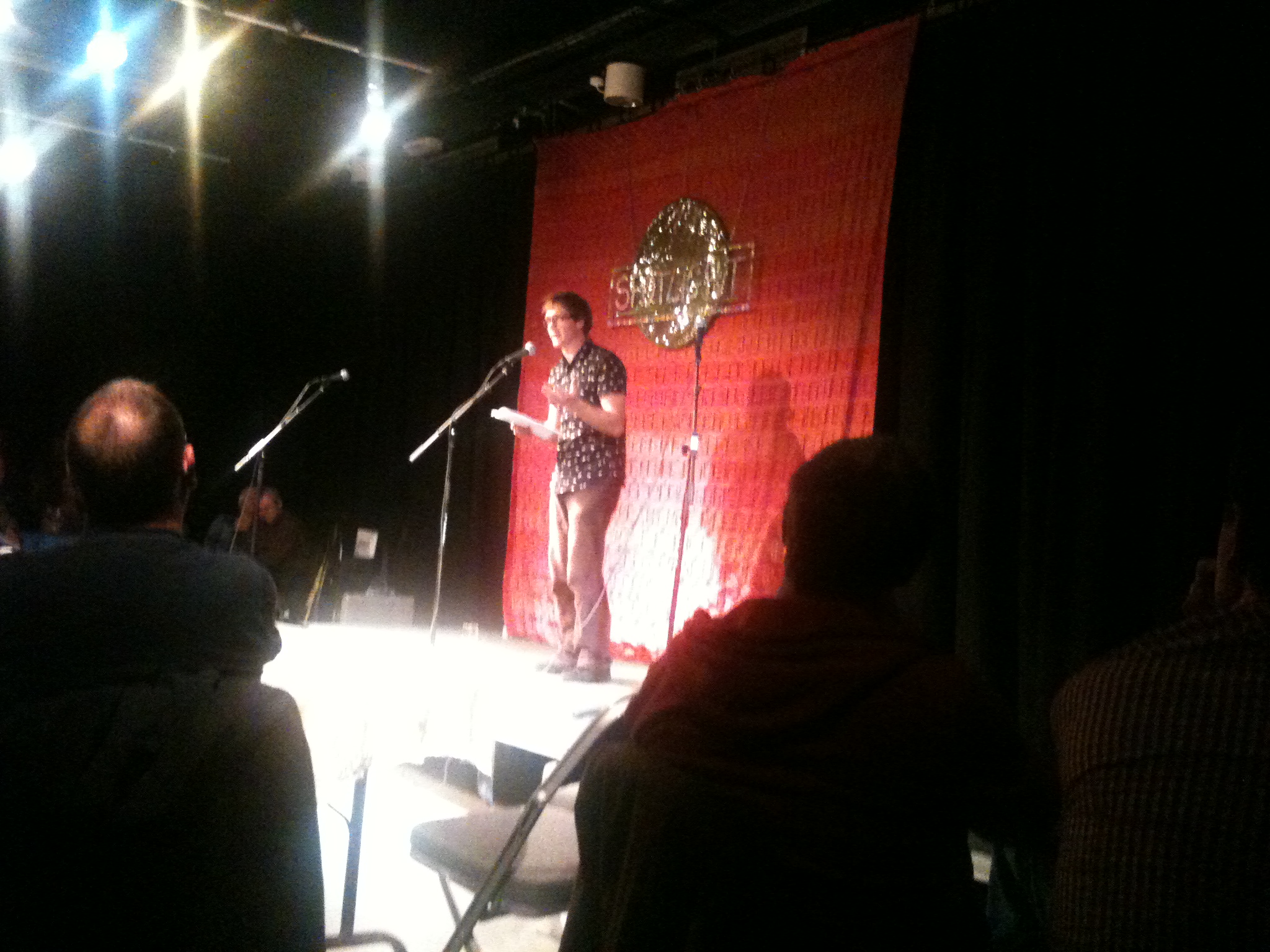
Then it was my turn. On Mon’s suggestion, I started with the Lion Tamer’s Daughter, and I’m pleased to say it went down quite well – I followed with The Black And The White Of It, then Hutch, and finished with new flash piece Circle Stone. I had twelve minutes, which is probably the longest slot I’ve had to work with. About halfway through I was surprised to realise that the nerves had gone. The good reaction from the audience helped, without a doubt, and gave me greater confidence in my stories. That in turn helped me relax and enjoy the reading, and I think that improved my performance. I don’t know if there’s some secret to starting a reading with that attitude – I suspect it needs to be earned at each new event. Anyway – I loved it. It was my best reading by a mile. If anything, it made me want to write more flash fiction for live events.
I was followed by performance poet Miss P, who managed to combine memory and incisive observation with humour and relentless energy. It seemed to be a bittersweet show for her – she’s moving to Oxford, and this was her last gig in Lancaster. Large sections of the audience had come to support her, and the reaction to her work was explosive and good-humoured.
Paddy Garrigan finished the night with half-a-dozen of his excellent songs. I really like Paddy’s stuff, and it was so good to see him live for the first time. My favourite song was loosely about cathedrals – or, more accurately, our notions of what makes something important. I can’t find it online to share, unfortunately, but it was sumptuous. If I can track it down, I’ll update the post; for now, here’s another of his gigs, playing ‘Where Do The Dead Go When They Die’ with his full band:
Thanks go to compere Simon Baker, too. He was a generous and very funny host. There was a great atmosphere around the occasion of Spotlight’s 200th event, a real sense of community and history. I’m always impressed at how eclectic the performers are, and it’s an honour to be part of something so embracing. It reaffirmed to me how important it is to share my work with others – to validate what I do away from a computer screen.
I signed up to compete at their annual Slam next month, so I’ll be back to Spotlight in October. I haven’t done a slam event before. Hopefully I won’t disintegrate. Each of twenty contestants has a three-minute slot. It’s not a lot of time, but I already have a few ideas brewing away about how I can make best use of it…
Now then, humans. I’m off to Lancaster tonight for the 200th Spotlight Club at the Storey Institute. I’m really excited to be reading again at such a great event – I have four flash stories lined up for my 10 minute slot, and the other performers look a brilliant crew. Please come if you can – all the details are right here.
Curiously, I’m not terrified yet. That will probably kick in about 4 or 5 in the afternoon, when the stories I’ve worked on for weeks and weeks spontaneously turn into this:
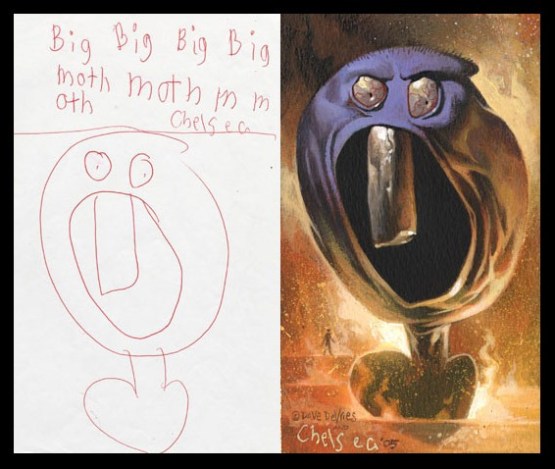
My amazing partner Monica brought this to my attention today: The Monster Engine, a series of children’s nightmares made ferociously lifelike by talented DC comics artist Dave Devries. His skill as an illustrator makes the imagination of these kids all the more fantastical, and all the more frightening. These are just astonishing – and their naivety, their anatomical awkwardness, makes them so sinister. This is true horror:
You can see more of The Monster Engine here. I’m going to try and get the book.
These images resonate very strongly with me, because I don’t remember much of my dreams or my childhood. I remember virtually nothing before the age of ten – just scraps of memories, like the time I snapped a penknife shut on my finger, and the time I didn’t realise I was standing in an ants’ nest. I do remember some of my nightmares, though I can’t attach them to any sense of how old I was, or where. I remember watching the shadow of a man stalking up the stairs towards me, infinitely slowly – even though the door was closed and there was no way I could see the stairs. I remember a white face watching from a mezzanine. I remember lying in bed, early one morning, frozen with fear while a fog boiled from the bottom of my cupboard.
This sounds daft, but I sometimes wonder if I write precisely because I don’t recall my dreams.
If dreams are how we interpret the world and remember events, perhaps we need access to that process of recording and interpretation, just to be reassured that we have been alive despite it all. That access comes from remembering dreams, or scraps of dreams. I don’t remember mine, and so I’ve found another way to interpret my life. It probably doesn’t work so simply, but writing, for me, is the wax crayon drawing of things that might have happened. Reading is what makes them spring to life, and growl from underneath the bed.
This is pure gold: a gallery of real-life sunken cities.
For me, Atlantis has always been a gigantic city, sitting in a natural amphitheater, the houses and temples still essentially the same – only drowned and crusted in shells and weed. Ghosts still haunt the city, sharing terracotta pots with octopi and crabs. They watch the transatlantic liners and factory trawlers comb the seas above them.
Have a browse right here, and lose yourself underwater…
What a couple of weeks. The start of college has been a bit rough, but we’re getting there. I’m spread fairly thin at the moment, and it doesn’t feel like I’m getting much done… but in the background I’ve completely redrafted my flash fiction collection Marrow, so that’s ready for typesetting when I find the time to get to grips with InDesign. Paragraph Planet published a 75-word story from that collection last week, too, which is pretty cool. I’ve also redrafted the longer short story I talked about in my last post, and started blocking out my new novel in the excellent Scrivener.
Even more exciting, Riptide is beginning to gather pace. I’m expecting notes from my editor this week, so I can start work on what should be the final draft, and I’ve just had a sneak peek at a rough of the cover art, which is scintillating. While I’ve been so busy drowning in real life, just trying to stay afloat, seeing the cover has been a timely reminder of what I’m working towards. The artwork is simply perfect, but I’ll wait for a final version before I share it.
The 200th Spotlight Club in Lancaster is looming on the horizon. It feels like only last week I was reading at their open mic night. I’m excited about performing there again, and hopefully catching up with old friends Rich Turner, Dan Haywood and Paddy Garrigan (pictured above) – Paddy’s playing out the night, which should be a blast. I have two or three new pieces lined up. I’m going to start with a short story about guinea pigs, and finish with a very short 75-word piece about avocados. I think there’s probably time for another story in between, but I haven’t decided what just yet.
After Spotlight comes the Brewery open mic, if I can get a spot, and then Dreamfired in October. By happy coincidence, my storytelling uncle Rich Sylvester is up from London that night. I don’t get to see Rich very often, so if we’re organised enough, I’ll try and knock up a quick video of one of his stories.







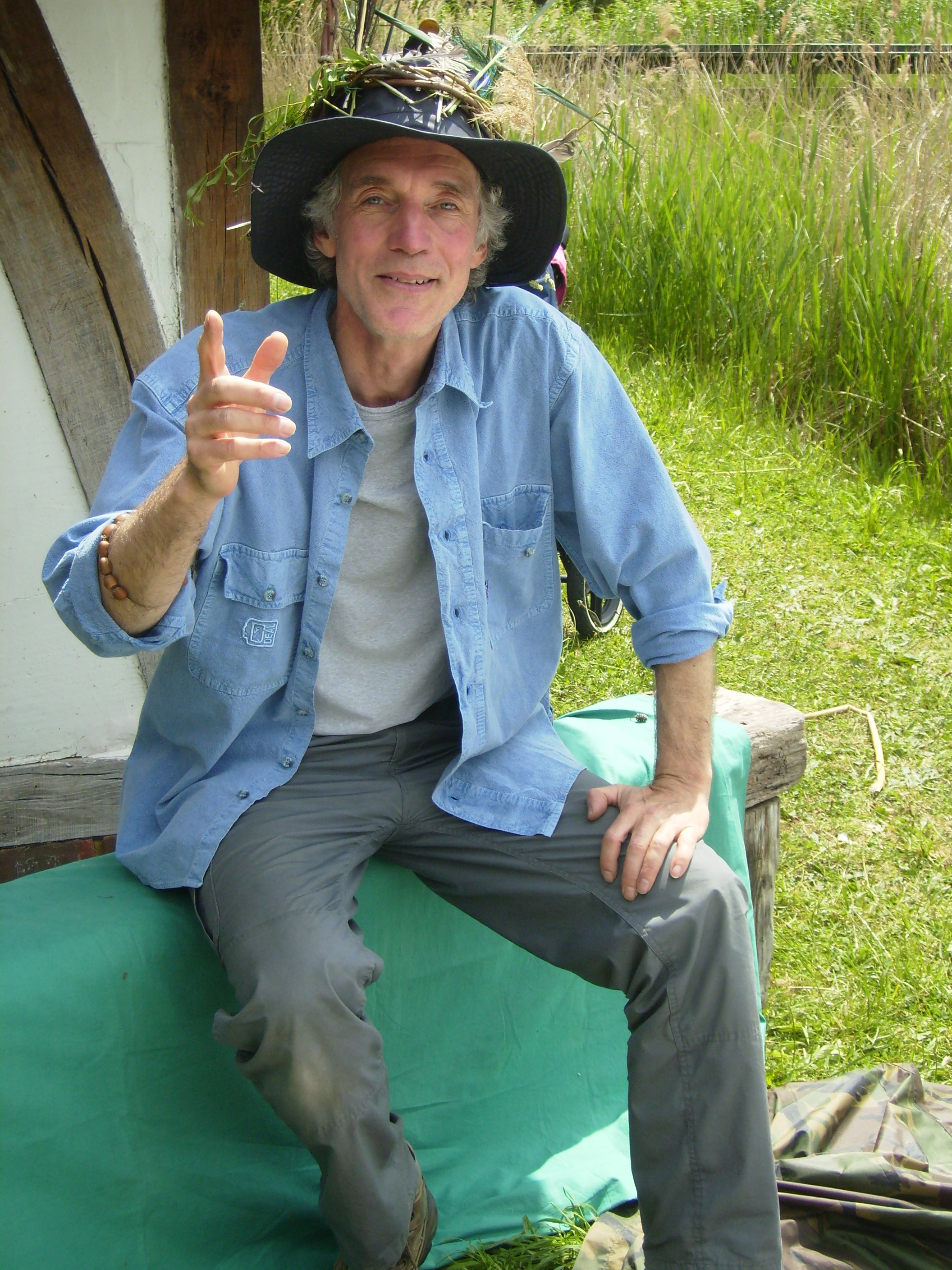
 Simon Sylvester