The Black And The White Of It

black and white

I’m very pleased to have a story published with 1000 Words today. It’s about an out-of-tune piano, amongst other things. I’d be delighted if you wanted to share it or leave a comment. All feedback gratefully received.

The story links with the picture above, taken from the 1000 Words Pinterest boards. I’ve only recently started using Pinterest, but I’m finding it’s a great place to store ideas. Here’s my board, in case you’d like to have a look at some of my story/place/character inspirations.

Who likes short shorts?

I’m between novels – making notes for the second while working on edits for the first – and as a result of this fairly disjointed workflow, I’ve also been writing a lot of flash fiction. I write flash fiction for three reasons. In order of importance, these are:

1. To keep my writing and imagination ticking over.
2. As a depository for the ideas I haven’t time to develop.
3. To create short sharp stories for readings.

However you feel about flash fiction – and there are a lot of people who deem it totally irrelevant – these reasons are good enough for me. Number one, in particular, is very important to me when I’m so busy. I can’t work on a novel if I have a spare hour – I need more space in my head – but I can write flash. For me, flash fiction is a fun and constructive way to write more often (notwithstanding J. Robert Lennon’s excellent ‘ass-in-the-chair canard’, of course).

Like most writers, I suppose, I started learning my craft with short stories. In the first two years, almost all of them fell between 1,500 and 2,500 words. This wasn’t deliberate – I was simply writing stories that told themselves in that sort of space. As my writing developed, the scope of my ambition widened; I wrote Meat (mentioned briefly here), abandoned a subsequent novel at 50,000 words, and started work on my extremely long-running novella The Year of The Whale, which I had almost finished when Riptide exploded in my life. Over the following year, Riptide was pretty much the only thing I worked on. By this point, my longer pieces had absorbed any time for short story writing, with flash fiction increasingly fitting into the small hours between proper writing sessions.

In essence, then, I’d stopped writing short stories. But I’ve had an idea nagging me for a while, and it clearly wanted to be a short story. I decided to make it a little more considered than my older shorts, and spend more time letting the character paint the world around her. I finally settled down to work on it last week, and I finished a first draft last night. In my head, I expected it to be about 5,000 words, which is easily double the length of my next-longest short story. It has been a very strange space to work in, especially after so long away from the form.

Some flash fiction packs a conventional narrative into a smaller space, and some flash fiction snatches at a single moment, a single voice – a heartbeat – and gives the reader just enough to fill in the blanks themselves. The short story expands on those themes (obviously), giving them greater room to grow, but for the form to have an inherent function, it needs to achieve more than simply stretching out those moments – more than filling in some of those blanks.

I seem to recall a quote – possibly by Chekhov, though I can’t find a source – declaring that all short stories are the end of longer stories. I think there’s something in that, and I like the abstraction inherent to the form. My best short stories – the ones I personally consider most successful – are the ones where I’ve managed to hardwire some sense of trajectory. I want my writing to have momentum. I aspire to a ferocity, a certainty of narrative. I don’t know how well I achieve that, but it’s what I’m working towards.

I have now finished this new piece, and I think it’s come the closest yet to what I’m trying to create. It’s abstract and a little dangerous, but I think I’ve generated the emotional whirlpool I strive for, with discontiguous strands of story focused to a single point. After so much time away from the medium, I found it quite difficult to write. Although I knew my character’s voice right away, and I knew what I wanted to achieve in the story, it took me a long time to untangle the threads and find my way. I’ve been plodding through it, whisky in hand, on odd nights for a couple of weeks. Last night I finally had the breakthrough, which involved redrafting the whole thing from present into past tense, cutting a couple of sections and writing a new scene. I’m now going to take a day or two away from it, and see if a little distance helps with the redraft. Happily, the first draft came to 5,220 words.

I’m now waiting for feedback from a couple of readers, but I wanted to write this post before talking to anyone about the story; I needed to get my own thoughts in order. At some point I’m going to write more about my ultra-flash fiction on Twitter, but I wanted to use my first short story in a year to have a think about why I don’t write them any more.

Goussainville ghost town

Goussainville-6

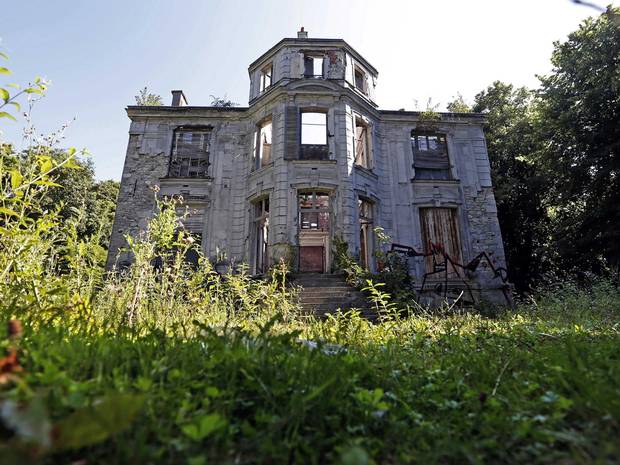
I’m such a sucker for ghost towns and abandoned places. This gallery explores the village of Goussainville-Vieux Pays, abandoned after first a plane crash, and then the opening of Charles De Gaulle airport, drove the residents into Paris or the quieter villages nearby.

I think, for me, that silence – or at least natural sound – is an important part of defining a true edgeland, and the incessant roar of aeroplanes would discount Goussainville. But there’s something so sad about the sight of deserted buildings. The energy that comes from their construction – and the energy needed to sustain the life, and love, and relationships inside them – doesn’t dissipate when the people leave.

This comes hot on the heels of Les Revenants, too…

Keys

I’ve just been paid for a big film job I completed earlier in the year, and I decided to treat myself. It’s not exactly special, but I’ve invested in a new keyboard. Here’s why:

I work on a Mac, which is the only sensible choice for my video editing. The Mac came with a wireless keyboard and magic mouse. Now, the mouse is superb. No complaints. It’s a dream to use, and I don’t begrudge it batteries. And in isolation, the feel of the keyboard is ideal – the keys are low and responsive, and for a clumsy typist like me (for the most part, I’m a four-finger thug) there’s nothing to trip over. As a result, it helps me type quickly and efficiently.

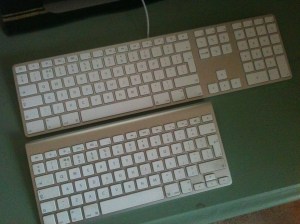
BUT… it’s too damn short. Look at it against the new one. It’s smaller than my last laptop keyboard. Where are the number keys?

IMG_0492

I fact, I don’t care about the number keys. But why are the cursor keys packed together like urchins in a bus stop? My hands are big and I type too fast, so I constantly hit Shift when I’m pitching at Up. And where are the Home/End travel keys? And where’s the Delete key? I miss all of that, and I want it back. Pus I resent dripfeeding batteries into it every two months. Plus it gives me RSI in my right hand little finger, which hangs useless and suspended while my middle and forefingers hammer out der stories. I don’t know why, but the pain goes away with a bigger keyboard. A wired mouse is a pain in the ass, but when I work glued to a screen, a wired keyboard makes no difference whatsoever to my workflow, either for editing or writing.

So there you have it: time for a new, full-size, slimline, wired keyboard. Happy days. If you write a lot, then it’s important to be comfortable in the tools of your trade; over the last few years, I’ve used keyboards that I cursed every time I touched them. Or thought about them. Keyboards with stuck or missing letters. A keyboard where the space bar only worked if it was smashed on the left. A keyboard with a dodgy USB cable, leading to entire lost paragraphs when the thing came loose; though maybe this is my fault for staring at the keyboard, rather than the screen. I wore through the keyboard on my old laptop to the point that my most frequent letters ceased to function. I’ve written on typewriters before, too. I love the clunk-thwack-bang of a solid metal typewriter, but all romance aside, those things are completely unsuited to the way I work: constantly revising, deleting, reshuffling, backtracking, jumping ahead, cutting and pasting and stitching it together. I use Cmd+S, X, C and V more often than full stops. And I often work out of sequence, too; a necessarily chronological workflow would drive me distracted.

Speaking of which – I’m currently giving the free trial of Scrivener a run, on the advice of novelist pals Ali Shaw and Iain Maloney. For the most part, I’m extremely impressed at how it helps me organise my work – but I’ll write more on this another time.

For now – a pox on miniaturisation!

huge_hands_10_Reasons_Why_Big_Boobs_Suck_King_of_Fighters_Animation-s425x535-278909-535

Postscript: my friend Tom has just alerted me to this. Oh, my.

Sue Armstrong: spy

Image

I’m delighted to share the news that my bodacious agent Sue Armstrong has been promoted to Senior Agent at Conville & Walsh. Now, first of all, this makes her sound more like a spy, which is obviously very cool. But it is also testament to her talent, character and drive. She has been unremittingly excellent to work with, helping me develop my ideas and secure the deal with Quercus. I’m so pleased for her: well done Sue!

R.I.P. Elmore Leonard

leonard

American crime maestro Elmore Leonard has passed away at the age of 87.

I’ll remember him best for ‘The Tonto Woman and other stories‘, his excellent collection of Western short stories, including the classic ‘Three-ten to Yuma’.

Leonard’s prose became increasingly minimalistic as his work developed, stripping away everything but story. This led to very stark, albeit engrossing, reading. Here are his famous rules for writers. I’m partially guilty of breaking some of these… even though I agree with most of them.

#StoryShop

For the last three years, I’ve kept my brain ticking over by writing ultra-flash fiction – also known as nanofiction and twiction, amongst other names – on Twitter. It keeps my imagination in good shape, and has also been useful in my wider work, as writing with the concision demanded by a 140-character limit has fed back into my longer stories. I try to write a new story at least once a day, and I’ve now written more than 1,300 of them…

I’ve been meaning to write a proper post about nanofiction, and flash fiction, for a while now – but that’s for another time; right now, the Edinburgh International Book Festival is in full swing. Over the last few years, the festival has curated a range of Twitter-based writing challenges, and this year is no exception. There is a daily prompt from the official festival using the #StoryShop tag, and associated companies like Jura Whisky are setting challenges too.

I like writing to themes – the tighter the better. Trying to deliver stories – journeys – inside 140 characters has taught me that necessity is the mother of invention; working to a theme often boosts that drive for invention. The best thing about these tags, though, is the sense of community they foster. I love seeing how other people have interpreted the same theme, and sharing and discussing their responses. There have been some belters at this year’s festival: here are my responses to ‘The Missing Duck’…

Screen Shot 2013-08-20 at 17.05.05

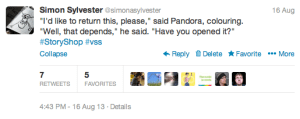
…’The Return’…

Screen Shot 2013-08-20 at 17.05.36

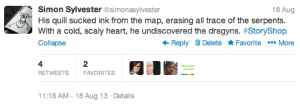
…and ‘The Undiscovered Map’…

Screen Shot 2013-08-20 at 17.05.51

If you fancy giving it a go, check out #ThePush for story prompts outside the festival, and look for the #vss tag – very short story. Which, ultimately, is what it’s all about.

Valve and Hound

newlogo

170 unread emails greeted my return from holiday, and this almost passed me by in a whirl of administration – but while I was in France, I received the great news that Valve have accepted two of my short stories for the third edition of their excellent journal.

The first story is ‘When The Bough Breaks’. It’s a brutish, experimental piece about a life-term prisoner trying to deal with horticulture in his halfway house.

The second story is called ‘Hound’. I consider ‘Hound’ to be my only true story, so much as any story can be true; I wrote it when I lived in Manchester, back in 2009, and it’s about a stray dog that haunted the streets of Withington. For a month, or maybe six weeks, I saw him again and again, scavenging in the alleys and lanes around our flat. Mon and I would often stop to talk to him, though he became increasingly scared of people. When he finally vanished, as I think I’d always known he would, I looked for him; and when I couldn’t find him nearby, I searched for him on the city’s animal rescue websites. I never discovered what happened to him, but I’ll always feel guilty that I didn’t do more when I had the chance. We left about a month after the dog had gone.

Dog-by-Giacomo-Brunelli-001

Manchester was a strange time in my life. Three days a week I worked on my first book, a novel-length prose-poem called ‘Meat’, and three days a week, I worked in a bespoke veneer workshop in Stockport. I lost my job when the owner died suddenly from complications of swine flu. On Monday he was there, and on Tuesday he was dead. We finished the last order, then the workshop closed. Desperate for work, I applied for about a hundred jobs in a month: in delis, cafes, factories, shops, offices. I received two rejections and approximately ninety-eight silences. We packed everything we owned into a hired van and drove to Kendal twice in a day. On the second trip, dumb with tiredness, I had to do an emergency stop on the M6 near Preston. There were swans waddling across the motorway. Goddamn swans.

Each of my stories means something to me, but ‘Hound’ is special. Unlike the majority of my work, it is mostly true, and it records a turning point in my life. I had finished ‘Meat’, which took me to some extremely dark and upsetting places, but exorcised a lot of the poison I’d carried through my twenties. I received some good feedback on the manuscript from friends, writers, indie publishers and agents, but the consensus was that it was too dark for a first novel. I think this is probably fair. My reading and writing began to evolve again after Manchester, and ‘Hound’ marks the start of this change in my work: becoming more constructive, more concise and more direct. After ‘Hound’, I became interested in writing as a vehicle for immersive storytelling, rather than writing for the brutality of raw emotion.

As well as being one of my favourites, ‘Hound’ is also the most rejected of all my short stories. I don’t interpret rejection as a validation of the quality of a story, but I’ve been a little dismayed that no-one wanted to take it. I really wanted ‘Hound’ to go to the right home, and I’m humbled and delighted that Valve have taken it on.

I didn’t mean to write so much about this, or to get quite so personal. We only lived in Manchester for eleven months, but when I pull it apart, I feel surprisingly emotional about this point in my life. It marked a step change in who I was and who I am, and ‘Hound’ is a measure of that change. And this perhaps is mostly why I write: to interpret and record my world and myself.