Roberto Bolano – The Third Reich

art-353-Bolano3-300x0

I’ve just finished The Third Reich by Roberto Bolano. He fascinates me, as both a writer and a reader, and I’ve now only two novels left before I’ve read all of his work. The Savage Detectives is my favourite ever novel, and I think Bolano’s prose is pretty much close to perfect. There’s no doubt, however, that a lot of his unpublished work wouldn’t have seen the light of day (in English, anyway) without his posthumous rise to fame. Some of his novels should have stayed in the drawer, and The Third Reich only just squeezes out of that category.

It’s an intense, engrossing study of one man’s slide into paranoia, returning to Bolano’s common themes – Fascism, the birth and death and being of nations, poetry, love, sex, anxiety, terror, innocence, dreams, language – but is very insular, very claustrophobic, and too long.

German war games champion Udo Berger goes on holiday with his partner Ingeborg. They meet another German couple, Hanna and Charly, and the four of them fall in with local layabouts and petty crooks. When Charly goes missing, only Udo stays, against all reason, drawn deeper into his WWII game, deeper into his obsession with the hotel owner.

The game allows Udo to replay World War II, as Germany, and win. He dominates the first few turns of a game against a complete novice, and then he starts to lose. His fatalistic delusions – like Adolf Hitler’s – drive him to a bitter defeat. As the net of Allies closes around him in the game, so Udo’s paranoias choke his spirit in real life, and his dreams merge with the everyday. His psychological collapse mirrors that of the Axis. ‘I’m not a Nazi,’ he bleats, at one point, ‘I’m more like an anti-Nazi.’ His protestations are interspersed with hero-worship of successful German generals. Bolano (who fought against Pinochet in Chile, and despised Fascism) uses The Third Reich to crush the Nazis all over again.

It’s a profound and complex book. As Udo unravels, his thought processes make increasingly random connections – this is one of Bolano’s greatest strengths, in both dialogue and inner monologue – and his claustrophobia is compelling. But Third Reich is also too slow and too long, and once Udo’s hubris has been established, his collapse is prolonged and the climax, when it comes, is vague and dissatisfying. This deliberately mimics the real War, I suppose (each turn of the board game is marked out in quarters – Winter ’42, Spring ’43, and so on) but means the narrative drags in a mirror of the attrition on the board.

It remains an interesting addition to Bolano’s astonishing canon, and I’m glad I had the chance to read it, but it’s far from his best or most interesting work. As with all his novels, though, the prose is nothing short of scintillating. Bolano was a truly gifted writer. Whenever I’m flagging, I read a sentence or two at random from one of his books, and it reminds me of what I should be aspiring to.

Foxes

“A young couple trapped in a remote estate of empty houses and shrieking foxes are beckoned from their isolation into a twilight world…”

This is a haunting, excruciatingly tense short film, worth every frame of its fifteen minutes. Metamorphosis and the idea of threshold places – of things having twin natures, existing in two states at once – are becoming increasingly key to my work. A film like this gets my pulse racing and synapses snapping, hungry to write.

Loki

Well, that’s my first Dreamfired done and dusted. It was a really good night – more people need to know about the Storynights.

First up was banjo virtuoso Bill Lloyd. He’s a legend in Cumbria and the north, and he didn’t disappoint, starting with a haunting ‘Wayfaring Stranger’, and segueing into a range of folk songs from America and Ireland. My storyteller uncle Rich Sylvester had the next slot, relating an anecdote about exploring the London Olympic equestrian venue at midnight with a bellyful of Russian beer. It was very funny. Rich is an extremely affable raconteur, and his stories are always engaging – I haven’t seen his work for a few years, and it was great to be part of the audience.

I was on after Rich. I’d decided to get into the traditional spirit by performing without notes. In the minutes before going onstage, my nerves were worse than ever, but I settled fairly quickly.  I read two stories I’ve been practising lately – Circle Stone and The Lion Tamer’s Daughter.  I stumbled once in Lion Tamer, and for a moment I thought I would go entirely blank – but I recovered, found my place and delivered the rest without a hitch. Circle Stone is an extremely quick flash piece of only 75 words, and it’s surreal enough to counter the darkness of Lion Tamer. The two work well in combination, but I’m going to semi-retire them now. They’re both destined for my flash fiction collection Marrow, and I’ll try and get them published elsewhere first, but I’ve read them a lot recently, and it’s time for some new material. On reflection, though, the reading went well. I don’t think I’ll make a habit of performing without notes, but Dreamfired was a perfect place to give it a whirl.

After me came a poet, whose name I didn’t catch, who read some playfully nostalgic pieces; and then a story about a 21st century Grim Reaper. Bill Lloyd returned to round off the first part of the night with another couple of songs – his cover of Frankie’s Gun, which I absolutely love – it was Bill who introduced me to the music of The Felice Brothers – and one of his own compositions, a haunting Armenian lament.

This is what Frankie’s Gun looks like:

After the interval came Emily Parrish, aka Scandalmongers. She walked onto the stage singing and beating a drum, and launched without preamble into the Norse creation myth. Her show explores the role of Loki, the trickster god, and all his jealousies and cruelty and fun. What made the show all the more remarkable was the way she entwined Norse mythology with her own childhood. The transitions between the Cotswolds and Asgard were frankly astonishing – from the top of a perfect climbing tree to the horrors whispered into Baldr’s troubled brain. It was lyrical, visceral and intense, and it left the audience stunned.

emily-loki

Loki comes highly recommended from me – catch it if you can.

Thanks, too, to Kat Quatermass, who organises and hosts Dreamfired. Lovely to meet her after months of email contact. I’m definitely going back in November to catch Peter Chand performing Grimm’s Sheesha.

What’s next for me, then? I’ve been thinking about my novel edits for a week or so – a process I refer to as ‘brewing’ – and I’m almost ready to start work. I mentioned in a previous post the structural changes I need to make, and my uncertainty about how to make some of those changes. That has passed. I now know where that character is going to enter the story. Although it means a lot of work, I feel secure in the knowledge of how to do it, so a lot of that worry has eased.

My next booked reading is at the Brewery’s Spoken Word night in February, though I’ll try and land a few more open mic spots before then. Stay tuned. And go to Dreamfired.

Dreamfired

Loki-norse-mythology-loki-30846883-570-732

On Friday 11th October, Dreamfired takes over Brigsteer village hall for a night of traditional music and storytelling. I’ve managed to land one of the support slots for headliner Emily Parrish, aka Scandalmongers. She’s retelling the classic Norse myth of Loki, the trickster and troublemaker at Odin’s court. Her show has received amazing reviews, and I’m really excited about seeing her perform live.

I’ll be reading two short pieces I’ve been practising live – Circle Stone and The Lion Tamer’s Daughter. I wanted to get into the spirit of the night by performing from memory: no notes, no paper. Reading them at Spotlight and Spoken Word has been good for practising their delivery. I already know Circle Stone by heart, and I’m four-fifths of the way there with Lion Tamer. The prospect of reading live is not yet as scary as it will be on Friday afternoon.

By dumb chance, my storytelling uncle Rich Sylvester is up in the Lakes for a workshop that weekend, so he’s coming along too – and I’ve just discovered that legendary Cumbrian singer, songwriter and banjo maestro Bill Lloyd is playing as well. It’s a blinding line-up, and I feel a little overawed to be reading at such a great event. I’m looking forward to sharing my stories, then sitting back with a beer to enjoy a great night of tall tales and folk music…


Here Be Monsters

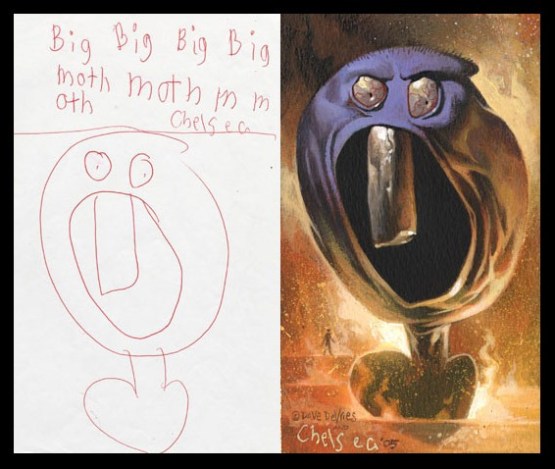
My amazing partner Monica brought this to my attention today: The Monster Engine, a series of children’s nightmares made ferociously lifelike by talented DC comics artist Dave Devries. His skill as an illustrator makes the imagination of these kids all the more fantastical, and all the more frightening. These are just astonishing – and their naivety, their anatomical awkwardness, makes them so sinister. This is true horror:

Image

Image

You can see more of The Monster Engine here. I’m going to try and get the book.

These images resonate very strongly with me, because I don’t remember much of my dreams or my childhood. I remember virtually nothing before the age of ten – just scraps of memories, like the time I snapped a penknife shut on my finger, and the time I didn’t realise I was standing in an ants’ nest. I do remember some of my nightmares, though I can’t attach them to any sense of how old I was, or where. I remember watching the shadow of a man stalking up the stairs towards me, infinitely slowly – even though the door was closed and there was no way I could see the stairs. I remember a white face watching from a mezzanine. I remember lying in bed, early one morning, frozen with fear while a fog boiled from the bottom of my cupboard.

This sounds daft, but I sometimes wonder if I write precisely because I don’t recall my dreams.

If dreams are how we interpret the world and remember events, perhaps we need access to that process of recording and interpretation, just to be reassured that we have been alive despite it all. That access comes from remembering dreams, or scraps of dreams. I don’t remember mine, and so I’ve found another way to interpret my life. It probably doesn’t work so simply, but writing, for me, is the wax crayon drawing of things that might have happened. Reading is what makes them spring to life, and growl from underneath the bed.