Little paranoias

Jane Wood, my editor at Quercus Books, sent her notes on my novel this week. It’s a moment I’ve been dreading and craving in equal measure, and I wanted to take a moment to think about what it means now it’s actually here.

I’ve already done four drafts of The Visitors. Some of the drafts were very heavy, and some were extremely light. Redrafting is essential to all writing – I still, even now, return to stories published years ago to tweak and rework them. I have little paranoias about all my work, and can’t help but return to it. Sometimes I make changes of single words, and other times I excise entire scenes. Sometimes I catch myself totally rewriting published work, and I have to make myself leave it behind – I have to take stock and force myself to walk away.

On the second draft of The Visitors, I pussyfooted around Sue’s notes, making tiny changes, scared of diving in. When I came to a third draft, I made myself stamp on it, brutalising the manuscript with broad changes and moving onto the next alteration, no matter how ugly the massacre I left behind. Then, when it looked like a crime scene, I started rebuilding again. That’s what I’ll do this time, too, no matter how hard I find it. And I’m going to find it hard.

Whenever I come to editing and redrafting, I think there are two broad categories of change:

Cosmetic

These are the easy ones, often little more involved than line edits. Cosmetic changes this time include switching a character’s name, cutting some internal monologue and reconsidering some of the vocabulary used by my main character. I could blitz through that in a day, tops. Unfortunately, the other editing category is:

Structural

…and this is the big stuff. Making structural alterations means redrawing the map of the story while trying to maintain the same emotional trajectory, and that can be difficult to keep in balance. In this case, I have two substantial changes to make. Firstly, a minor character needs to become a major character, and he needs to appear much sooner in the story. I already know this is going to be awkward, because I attempted something similar in the third draft, and I struggled to bump him up the narrative even to his current position. It’s going to be tough to find or create somewhere to introduce him sooner.

The second change initially felt even more challenging, but on reflection perhaps isn’t quite so bad. Jane has suggested a different direction for the ending that I’m really excited about. At first I was really worried about it, but I’m starting to see it as a case of unravelling the current conclusion and retying the strands of story into a different shape of knot. This will involve more writing, but actually it’s less of a challenge – with the current ending gone, I’ll be writing into blank space. That’s a thrilling proposition at this late stage of the manuscript.

While it’s still a skeleton, a novel plot is essentially arbitrary. Things can be changed extremely quickly and easily. New characters come and go, and the story shifts like a dune, blown into organic and occasionally bizarre shapes by the wind of imagination. But the more developed a story becomes, the less arbitrarily it can change. There comes a point where making big alterations means breaking the momentum you’ve fought to generate, then patching up the holes and hoping no-one can tell the difference. That’s where a writer needs to have paranoid convictions about the emotional tone of their work, and strive to make it as cohesive as possible in plot, character, voice and soul, then work it again and again and again, hammering and thrashing and beating and combing through the manuscript until it’s carved against your optic nerve.

Editing is frantic. It’s really hard. Throughout the process, a storm cloud hangs over you, an implicit sense that you didn’t do it well enough the first time. Then there’s the crashing changes you wreak on something you loved. And then there’s the dread that whatever you make to take its place won’t come close to what you had before. It’s an exciting time, too, but the whole process is riven with a crawling, monstrous, excruciating anxiety.

This is mostly my load to carry, but I’m glad I’m not taking the journey alone. I’m now far too close to The Visitors to critically appreciate it, and working with other people helps triangulate my own perspective about the story. I’ve often stated my belief that writing is as much about the community as the individual – not least as it counts for little without a reader. When I write short stories, I read them to Mon, and I send them to writer friends. And I pay attention to what they say, even if I disagree. Working with other people – and working with Jane and Sue, now – has repeatedly shown me the importance of opening myself and my ideas to an audience. I have people I can talk to, and that makes me lucky.

Of course, I say this before actually beginning the edits. Try me in a week.
miniscule

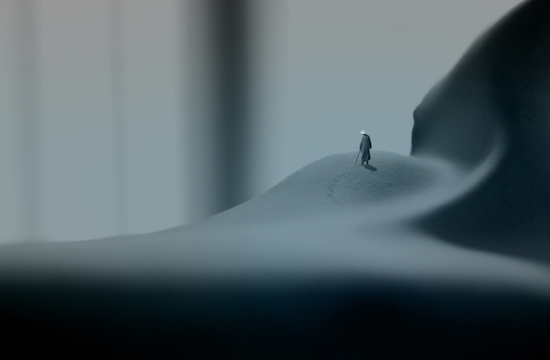
Photo lifted from ‘Minuscule Series’ by Maité Guerrero

What’s in a name…

This post is about names for stories. Sometimes I come up with a title first – I have a story called You Don’t Talk To The Driver, The Driver Talks To You, which developed entirely from the title. And sometimes the title is really obvious – The Lion Tamer’s Daughter couldn’t be anything else. Sometimes it’s lifted from a phrase in the story, like The First Time I Died. Sometimes it evolves after a struggle, like my novella The Year Of The Whale (which I will finish one day). And sometimes, I just can’t think of anything at all. And all this is relevant because we’ve just changed the name of my novel.

I’ve been calling it Riptide for the last six months, but my novel has had dozens of different names. I went through bucketfuls of working titles – occasionally to the point that I was changing it two or three times in a single writing session. Nothing stuck. I’d reached a point where the novel was finished, and I wanted to send it away, but it didn’t have a name. After another few days dedicated only to looking for titles, I called it Riptide Heart because it had to be called something, then sent it to some friends.

“Love the book, mate,” came one of my first responses, “but the title’s balls.”

In the end, a lot of people said pretty much the same thing. But no-one had any better ideas, so I sent it off to Sue as Riptide Heart. I used Dora’s grubby paw to click the send button. A week later, Sue got back to me, and here we are – a year has passed, and once more I’ve been driving myself up the fucking wall looking for a name for the book.

We moved on from Riptide Heart fairly quickly, and I was fine with that. Everyone involved has been calling it Riptide, because that’s better than ‘the book’ or the ‘the novel’. But the closer we’ve moved towards publication, the more important the title has become. Sue and Jane and I have been searching for a month. Churning through endless combinations of possibilities has turned my brain to mush. I’ve ransacked the manuscript half a dozen times and tried literally hundreds of potential titles. Last week it reached a point where not only could I not think of anything better, but I was no longer capable of judging other suggestions. That’s one of the reasons I’m fortunate to be working with such professional people at Quercus and Conville & Walsh. Linking wonderfully to the stunning cover art commissioned by Jane, I’m delighted that we’ve finally settled on a name which I’m happy with – my first novel is now and forevermore called The Visitors.

So, what’s in a name? A rose would smell as sweet, and so on… but a novel is like a child, and you spend so much time with it as it grows, learning what it wants to be, getting to grips with its tantrums and moods, guiding its ambitions, and being constantly surprised and amazed by what it becomes… I can’t imagine Dora by any other name. Knowing that Riptide was a temporary title hasn’t lessened the jolt of losing it; after so many months, it had become Riptide.

The Visitors grows on me by the day. It has the human element I wanted so badly, and it has a ghostly feel which I love. As my friend Iain pointed out, I spent so long looking for The Best Name Of Any Book In The World Ever Ever Ever – which doesn’t exist, of course – that I stopped being able to consider what was right in front of me. I’ve often used the idiom of not seeing the wood for trees when discussing writing – and writing novels in particular – and it’s proved true for this title search as well.

I can barely express my relief of being out of those woods…

Jane’s editorial notes have arrived, and I’m really excited about some of her ideas. Next stop: the final draft.

trees

Keys

I’ve just been paid for a big film job I completed earlier in the year, and I decided to treat myself. It’s not exactly special, but I’ve invested in a new keyboard. Here’s why:

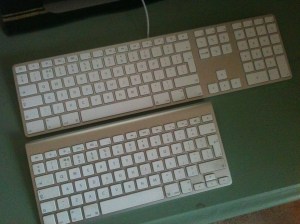
I work on a Mac, which is the only sensible choice for my video editing. The Mac came with a wireless keyboard and magic mouse. Now, the mouse is superb. No complaints. It’s a dream to use, and I don’t begrudge it batteries. And in isolation, the feel of the keyboard is ideal – the keys are low and responsive, and for a clumsy typist like me (for the most part, I’m a four-finger thug) there’s nothing to trip over. As a result, it helps me type quickly and efficiently.

BUT… it’s too damn short. Look at it against the new one. It’s smaller than my last laptop keyboard. Where are the number keys?

IMG_0492

I fact, I don’t care about the number keys. But why are the cursor keys packed together like urchins in a bus stop? My hands are big and I type too fast, so I constantly hit Shift when I’m pitching at Up. And where are the Home/End travel keys? And where’s the Delete key? I miss all of that, and I want it back. Pus I resent dripfeeding batteries into it every two months. Plus it gives me RSI in my right hand little finger, which hangs useless and suspended while my middle and forefingers hammer out der stories. I don’t know why, but the pain goes away with a bigger keyboard. A wired mouse is a pain in the ass, but when I work glued to a screen, a wired keyboard makes no difference whatsoever to my workflow, either for editing or writing.

So there you have it: time for a new, full-size, slimline, wired keyboard. Happy days. If you write a lot, then it’s important to be comfortable in the tools of your trade; over the last few years, I’ve used keyboards that I cursed every time I touched them. Or thought about them. Keyboards with stuck or missing letters. A keyboard where the space bar only worked if it was smashed on the left. A keyboard with a dodgy USB cable, leading to entire lost paragraphs when the thing came loose; though maybe this is my fault for staring at the keyboard, rather than the screen. I wore through the keyboard on my old laptop to the point that my most frequent letters ceased to function. I’ve written on typewriters before, too. I love the clunk-thwack-bang of a solid metal typewriter, but all romance aside, those things are completely unsuited to the way I work: constantly revising, deleting, reshuffling, backtracking, jumping ahead, cutting and pasting and stitching it together. I use Cmd+S, X, C and V more often than full stops. And I often work out of sequence, too; a necessarily chronological workflow would drive me distracted.

Speaking of which – I’m currently giving the free trial of Scrivener a run, on the advice of novelist pals Ali Shaw and Iain Maloney. For the most part, I’m extremely impressed at how it helps me organise my work – but I’ll write more on this another time.

For now – a pox on miniaturisation!

huge_hands_10_Reasons_Why_Big_Boobs_Suck_King_of_Fighters_Animation-s425x535-278909-535

Postscript: my friend Tom has just alerted me to this. Oh, my.

To Do: Part Two

Okay, back to work. College returns in three weeks, which feels frighteningly imminent. I’ve films to finish for Cumbria Wildlife Trust, Three Dimensional Tanx and Seven Seals, some short stories to write, the Riptide edits to complete for Quercus, Scrivener to learn, family and friends coming to stay, a log store to build, readings to practice, paperwork as deep as my hand, and Marrow to edit and complete.

Head down. Press on. Fail better.

miranda3a

Decline

On Tuesday, Sue started submitting Riptide Heart to editors. I’m excited, but the thought fills me with fear. It’s incredibly scary to think of publishers reading my work. With all the nerves, I have to keep reminding myself how far I’ve come since cooking up the idea in 2011.

It’s inevitable that there will be rejections. Rejection is inherent to writing. I reckon I’ve had no more than one acceptance for every four short story submissions. There’s a certain fatalism that comes with sending off a story. After all the graft and anguish, it’s a moment of horrible exposure to submit it for the consideration of editors. Rejections are raw, even when they feel inevitable, and that’s just for short stories. The stakes will be much higher with a novel.

Sue has asked whether I want to know who has declined Riptide Heart, and why – or whether I’d prefer not to know. I ummed and aahed about this for a wee while, before deciding that I’ll take all the feedback I can get. I think most writers would give eyeteeth for criticism from professional editors, and I’ll cherish anything constructive, no matter how raw the rejection.

Some editors have already been in touch with Sue to say they’re enjoying Riptide, which is a great start – but doesn’t translate into anything definitive. My nerves are frayed beyond measure, and I feel about two seconds behind the rest of reality, but it’s exciting stuff.