Objects In The Rear View Mirror

I forgot to do this last year for a bunch of reasons I can’t completely remember, but I’m back on track for a round-up of my favourite things that have happened in the last 12 months. In no order, these are:

1. The kids. This year has been another cracker with my wee family. It hasn’t always been easy, but seeing Dora and Indy getting on with the world has been a treat. In particular, Indy learning to talk has given us such joy — almost every day now we get a new word, and with every word our communication grows, our interactions develop, our bonds become stronger. He’s funny, he’s happy. Dora is still mostly feral, but she’s finding her way, all the time, a few steps back and then a few more forward. She’s developed an addiction to Lego, she loves reading Ottoline and Harry Potter and the Worst Witch, she argues about pretty much everything, she laughs all the time. They’re good kids, and I love getting to know them.

2. Mon’s art. Mon’s finally, slowly, getting to paint again with some regularity. Like me, she doesn’t get nearly enough time to make her work — and it’s therefore brilliant that she’s finished off these astonishing paintings and started on some really exciting new work. After she lost so much time in Indy’s first year, it’s been a real thrill to see these pieces coming together, and I’m so so excited by the work she’s sketching out and backpainting. She’s a bloody genius, my wife, and I count myself beyond lucky to watch her art unfolding in the studio.


3. Kefalonia. I used to write long posts about my holidays, but don’t blog as often as I used to, and so haven’t. But we went to Greece for two weeks in the summer, and it was brilliant. We went swimming every day and collected pretty pebbles. There was a titanic storm that rumbled all morning while Indy stood at the window and thumped the glass every time the lightning struck, and the day broke into vast grey Miyazaki clouds that washed away into the bluest of sweet blue skies. Waves had painted the beach in perfect smooth sand. The insects were incredible — a praying mantis, big black bees with pearlescent wings, swallowtail butterflies, a great emerald beetle that zipped about my head and lit on my hand. It then bit me, which wasn’t quite as cool, but for a wee moment I felt like Dr Doolittle. I read loads, wrote loads, and threw Dora in the swimming pool about a thousand times. It was brilliant. This is the actual moment Indy fell out of the sky. We decided to keep him.

indy


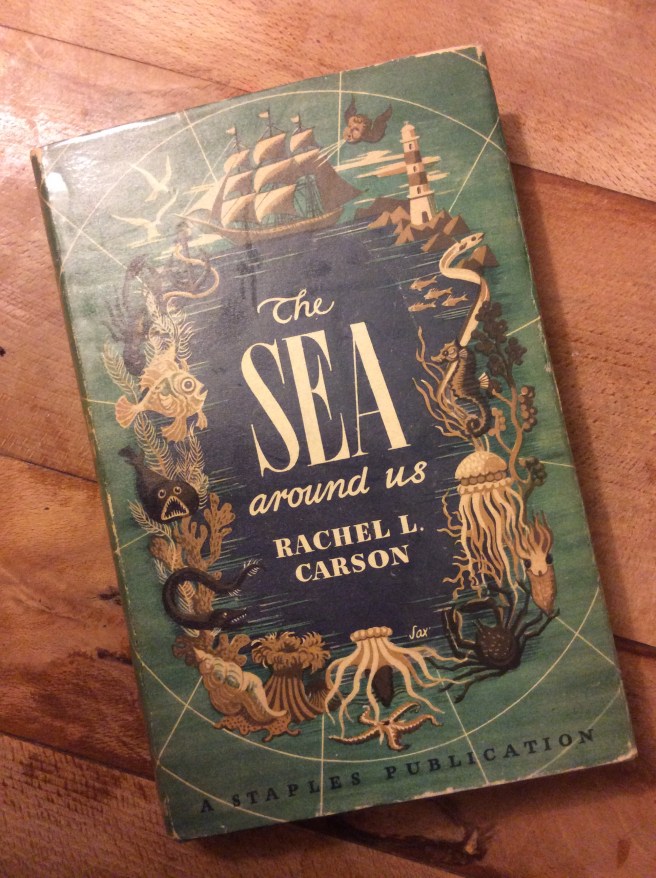
4. Reading sea books. My original resolution was to read only sea books in all of 2017, and in this regard I’ve failed. I abandoned the task around August after finishing Moby-Dick, firstly because I stopped writing the sea book I’d been working on, secondly because very few of the sea books I tackled actually had much to say about the true nature of the sea, and finally because nothing else quite cut the mustard after the Melville. The stand-out was Rachel Carson’s The Sea Around Us, which is an extraordinary book and everyone should read it. Overall, though, I mostly felt relief when I decided to let it go and read some books that were not about the sea.

5. Wainwrights. As a family, we’ve started the long, slow process of sending Wainwrights. We’ve now walked about 16 of the 214 fells that Alfred Wainwright ascribed in his famous guidebooks, so there are clearly still loads of them to go, but we’ve loved every one we’ve done so far. The uphills are hard, the downhills are hard, but the tops are completely worth it — especially the plateaus and ridges, and earning a sense of having climbed up out of the world below. At some point Indy’s going to get too heavy for the sling, and then we’ll have to slow the numbers a wee bit, but for now — up we go.

6. Film and video work. This has been a fairly steady year for my freelance video work, but most of all I’m soaringly proud of my work for Kendal Mountain Festival. Along with my friend Dom Bush, I edited the trailer for this year’s festival, as well as copyediting the voiceover poem. The film edit was difficult and time-consuming, and I’m really proud of what we made:


7. Getting veganised. Come June 2018 I’ll have been vegetarian for 10 years, a decade in which I’ve eaten wider and healthier, become a much better cook, and made better decisions in spending my money. Taking that to the next step hasn’t been easy, but over the last two years, Mon and I have moved steadily towards a vegan diet. We’re pretty much dairy-free and I go weeks at a time without eggs — and again, it’s improved my cooking and my eating and my thinking about where my food comes from. I’m not quite ready to go fully vegan, but I am moving steadily in that direction (especially since working out how to make my own seitan, which is just tremendous).

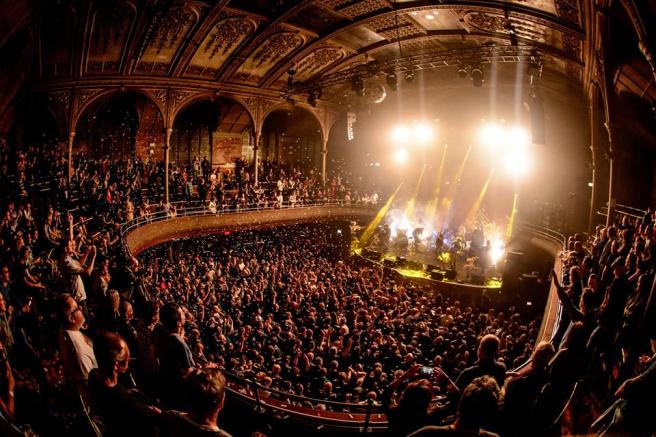
8. British Sea Power. I saw my favourite band three times this year. First was in London, where I took my students on a college trip — on the Tuesday we watched Under The Skin with a live soundtrack by the London Sinfonietta, and the students all despised it — beautiful, discombobulating enigma that it is. But on the Wednesday, we watched BSP perform a live soundtrack to a collection of Communist-era existential Polish animations, and they were majestic. Their music was sublime and transporting and wonderful in every way. The second gig was on the tour of their new record, Let The Dancers Inherit The Party. It’s another cracking record — of course it is — that slots in perfectly with the rest of their catalogue. Fave tracks are Electrical Kittens, What You’re Doing, St Jerome and Bad Bohemian, but the whole album’s brilliant. Third and finally, Mon and I zipped down to Manchester to see them headline the People’s Festival in the Albert Hall, which was epic — Dutch Uncles and Field Music playing too — a heart-thumping whirl through their finest moments. Their music is consistently superb and in constant reinvention. They’re the best band in Britain. I hope I see them three times in 2018.
BSP

9. Moy’s 90th. My grandmother Moy turned 90 this year. She’s amazing. She’s travelled all over the place. Once, in her 80s, she sent me a postcard from a youth hostel on a glacier in New Zealand. For her birthday she wanted all of her grandchildren together, and so we went — Kate, Anna, Ali, Emma, Kirsty, Tim and me, plus partners Kees, Ian, Adam, Ina and Mon, plus great-grandchildren Tom, Jack, Dora and Indy. We descended on Aberfeldy in the rain and spent all day drinking tea or wine, and it was brilliant. I don’t get to see anyone in my family as often as I’d like to, and it’s always a treat to catch up. Anyway, Moy’s a badass. Here’s the squad:

20170819_0012
Photo by the bodacious Adam Seward

10. Writing. A year of ups and downs for me and my writing. Then again, aren’t they all? In the last 12 months, I finished my third distinct draft of The Hollows, decided against rewriting it again, and moved on with surprisingly few regrets. No regrets, really. The more space I put between me and that third draft, the less I like it, and the more I want to get the story right. I’ve now sketched out the plot for the fourth draft, which already feels more cohesive and engaging, but that’s on a back-burner until I’ve finished something completely different. To that end, I’ve been working on another novel since June or so, tapping away with 100 Days Of Writing. It’s going okay, by which I mean that I’m enjoying it. I very seldom had fun while working on The Hollows #3, and on leaving it behind, I promised myself that I wouldn’t spend all these hundreds of hours wallowing in my own head unless it was making me happy. Novels aside, my short story output and publications have been very few and far between — only half-a-dozen pieces here and there, with barely as many written again. I’ve mostly finished a couple of short film scripts, another flash collection and a ‘novella-in-flash’, but there’s nothing wrapped up and ready to go. I only get one day a week to write, and that time needs to go on the new book. And that’s okay. I like the novels best of all.

So that’s that. Looking ahead to 2018, there are a few things I want to do. Most of all, I hope to finish the new novel and another flash collection. And if, by hook or crook, I somehow manage to get those finished, then I’ll start The Hollows #4. I’d like to go back to a Scottish island for a bit. I’d also like to direct a short drama film, which is something I’ve had in my mind for a while. It’s about 12 years since I directed people, and I’ve learned a lot about cinema since then — and about people. Finally, I want to read more, because books are the best of things.

2017 has been a strange one. For all of the terrific things I’ve been lucky enough to have in my life, Brexit is still the batshit stupidest thing in the world, and Trump is still a howling sphincter. Those twin sprawling catastrophes have haunted and defined my year, and they both push me into furious despair pretty much whenever I think about them. It hasn’t got easier. It’s worse. The longer they endure, the worse they become. Maybe 2018 is the year we can put them both to bed and step back into the light. Please, 2018. We’re ready.

100 Days Of Writing

100-door-number

Yesterday was day 100 from my 100 Days of Writing challenge, or #100DaysOfWriting if that’s the sort of thing you’re into. It’s an initiative from the excellent Jenn Ashworth, who challenged herself to write once a day for 100 days and document the experience — as well as inviting other writers to work alongside her. I got involved after spotting all round top bloke Dave Hartley going for it, and tagged along with him. That was more than 3 months ago, and yes, I’ve written every day. Sometimes it’s only been a sentence, hacked out before bed or in the winter pre-dawn, and sometimes it’s been entire chapters. I’ve only once struggled to get anything at all down — while I was drowning in my video edits — but even then managed to grab a scrap of paper and claw something out of my brain. I’ve added 28,000 words to the new manuscript, and what have I learned?

  1. Writing every day is not a chore. And if writing becomes a chore, perhaps don’t do it. That’s okay.
  2. Writing every day forms muscle memory — pen in hand, fingers on keyboard, bum on seat — that makes it easier to write every day.
  3. Writing every day, even on the shitty days, keeps you in touch with the draft. You can’t possibly come to it cold if you’re working on it every day.
  4. I don’t feel quite right if I’m not writing. I knew that already, but this has completely affirmed it.

And no.5, I guess, is that if it ain’t broke, don’t fix it. I’ve enjoyed this so much I’ve decided to crack on and do another hundred days. If I can add another 28,000 words, then the book will be close to a finished first draft by Easter. That might be wishful thinking — but I guess I’ll find out a hundred days from now.

Jesus’ Blood Never Failed Me

Day 84 of my 100 Days of Writing! I’ve been steady away on the novel, and it’s been feeling pretty good. Managed to blast through 4,074 words, and I liked most of them, too. It’s been my most productive writing day in well over a year — a year of missteps and wrong turns, 100 words here and 200 words there, fuelled on the blind optimism that it would somehow work out in the end. It’s strange how these things go. After three versions of The Hollows, plus my very first, mercifully unpublished novel, I’ve now written five of the blasted things, of which only The Visitors was published — and that came after a torturous year of redrafts and rewrites. As much as I’d like to, I don’t know if I’ll ever work out how to write a long story in a single go. My stories seem to meander and discover things along the way. Characters change, plots change, I change — in particular, I change. Once I’ve lost faith in my writing, I find it hard to reclaim.

I needed a total break from The Hollows, and I have one in the new novel. Writing into the new and empty pages is my favourite part of the process — it’s like reading a book for the first time, and knowing I’m the first person in the world to read it. Possibly the only person, given how the stories stutter. So far on this book, I’ve already battled up to 35,000 words and then promptly cut 20,000 of them. No matter how it hurts, the last years have taught me to understand when it isn’t working — and why. If it takes all that pruning to discover the true shape of the thing, then not a word of it is wasted.

My soundtrack today has been a combination of Mogwai, Rachels, and Gavin Bryars. I first heard Bryars’ astonishing work Jesus’ Blood Never Failed Me on BBC 6Music, and immediately set out to track it down. It’s twinned with the equally extraordinary Sinking Of The Titanic — two tracks soaring through 50 minutes of woozy wonder. Check it out, popsters:

Notes on a redraft

I’m fortunate to have some terrific writers as friends. On finishing my third version of The Hollows, I sought the indulgence of their feedback, and they were kind enough to give it. As well as my wife Mon, who reads everything first, I’ve now bounced the book off David Hartley, Abi Hynes, and Ali Shaw, and had the time to digest their thoughts.

The first piece of good news is that all four readers had almost the exact same reactions to the book. It would have been abominable if they’d had totally different responses. The second good thing is that their responses made complete sense to me — they chimed with a lot of my own thoughts after some time away from the story. The third good thing is that although, from the feedback, there are definitely things I need to change — none of them are very terrible in terms of the structure. Reworking the structure is what hurts the most. And the final good thing is that all four readers seem to have enjoyed the book very much. After so long buried in the mazes of The Hollows, it’s been incredibly uplifting to feel that the work has not been wasted. Perhaps I shouldn’t need the validation of others, but I do. I do.

So — what needs redrafting?

The book is too long. My first draft came in a whisker under 140,000 words, and I already knew I needed to cut it down, a lot. I wanted to get it below 120,000, and that’s not the sort of change you get by combing through the manuscript and filleting the adverbs. I’ve needed to cut and combine chapters, which means removing minor story strands. It wasn’t until I started writing novels that I truly understood the meaning of ‘seeing the wood for the trees’ — and that’s what my first readers have done. It’s the advice of Abi, Ali, Dave and Mon that helped me prioritise what matters to the core of the story, and what’s only fluff.

Secondly, and connected to the length, there’s a lot of repetition and some exposition. In writing such a long book, I needed this to help me navigate the plot and maintain the atmosphere — the descriptions were for me, I suppose, signposts to know where I was. By its nature, repetition is pretty easy to cut and undo, and this has been one of the easiest parts of the redraft.

Third, killing darlings. Grotty work, but important — all those clever little stylistic tics and tricks that I was so proud of when I wrote them, but stick out like sore thumbs for readers. The indulgent stuff, basically. This part of redrafting isn’t hard so much as humbling. What’s the quote? Chandler or Carver or someone — “If it looks like writing, get rid of it.” That’s true up to a point. I love a decent bit of splashy flashy writing too. If you kill all your darlings, then what’s left to love?

Fourth — the only thing I completely cheated on was a character’s reason for doing something. I didn’t believe it myself at the time, but having exhausted dozens of other possibilities, it was the least bad thing I could come up with, so I tried to sneak it in regardless. And obviously all four readers saw through it like a window, which forced me to think again — as I should have done at the beginning. My readers have made me work harder and work better, and I’ve come up with a solution. Threading the new idea into place has required significant changes throughout the manuscript, and this has been the most challenging part of my redraft, even though it’s the right thing to do. For all that editing is painful, it helps to remember that these changes make the story stronger.

Fifth is the scraps. A line of dialogue that doesn’t ring true — an inconsistency in character — the things that smack too much of coincidence. None of it is very difficult, but this is the stuff that makes me wince, because it seems so obvious once it’s been pointed out. How could I have missed it in the first place? …because of the wood and the trees.

I was terrified of sending the book out. I’ve invested three years in The Hollows, and the thought of wasting all that time — all that work — was excruciating. What if my readers came back and said yeah, all right… but naw? In the end, their responses have made it worth the while. I don’t have a deal in place for the book, and it may never be published. That would hurt. But I now believe I’ve written something worth reading, and maybe that’s enough. That’s what I’m writing for.

I’ve said it before, and I’ll say it again, but writing is nothing without community. Mon, Abi, Ali and Dave — thank you. I owe you, and I won’t forget.

bog-fog

Always, always, always the sea

I’ve been thinking a lot about the sea, lately — I was lucky to be given several books about the sea for Christmas presents, and then my excellent wife tracked this stunner down for me too —

img_3843

The next story I write will be about the sea — the idea fell into my head, perfect as a cowrie, while I was working on the closing chapters of my last book. And although I was planning another novel altogether for my next one, the sea book has overtaken it. I’m excited.

I’m desperately trying to finish off a film edit right now, so bear with me — I’ll write more about the sea another time. For now, I’ll leave you with this — a quick mix I threw together of ocean songs, featuring British Sea Power, Bat For Lashes, Modest Mouse, Frightened Rabbit, James Yorkston, The Waterboys and many more. Enjoy.

Peril


This afternoon was glum and rainy as Storm Barbara rattled across Cumbria, so Dora and I made a film starring her toys. The idea was hers. I helped with the technical stuff and a little narrative guidance here and there.

It was the best way to spend a rainy afternoon that I know. Being with Dora, and seeing her play, seeing her imagination expand and explode and take flight — that’s something truly humbling. Human imagination is a ferocious engine, and to witness it in children is to see it pure and whole, before the hooks of self-consciousness and adulthood begin to pluck and nip and pull it down. Picasso was right — every child is born an artist, and the challenge is to remain so.

As anyone who’s met her already knows, Dora is a challenging girl. We’ve never known anyone like her. She is hot-headed and obstinate and fierce and contrary and rude, and there are times when she drives us up the fucking wall. She is also clever, funny, wildly inventive and capable of staggering compassion, and we adore every fragment of her wild and fizzy heart. She lives as much in a daydream as the real world. As her parents, we’ve decided that our job is getting her to adulthood with as much of that intact as possible. At the moment, she’s an artist. The challenge is to keep her so.

Counting beans

Ever since losing a large document many moons ago, I have become a compulsive hoarder of files. I email myself a copy of the manuscript every time I make any significant changes, keep the files neatly labelled by date and word count, and sleep safe in the knowledge of a bombproof back-up (until the day that California slides into the sea).

The second draft of my story is now finished. This also means, as a curiosity, that I can look back and map my progress with a chart like this:

endless-mirrors-word-count

So there we go. I didn’t really start backing up the manuscript until I had something worth saving, which was in late summer — and thereafter, almost every Thursday and Friday (my writing days) had a file of its very own.

Now, what does this tell us?

Yes, that’s right — bugger all. What we therefore need is some context. Here is my context.

endless-mirrors-word-count-annotated

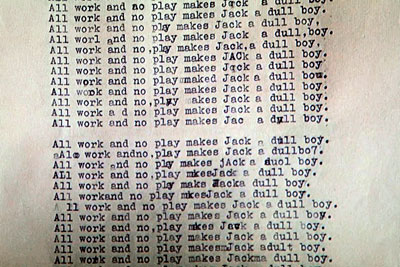
Here’s the thing — I know that word counts don’t actually count anything at all, whether it’s 500 a day or 5,000. They measure only a quantity of words, not a quality. Grinding the fuckers out in the right order is what matters. Counting words alone is the same as counting beans, as Jack Torrance knows all too well—

luna59_13

— and still, with all that said, I like looking at that chart and how it simplifies the last 11 months into the zigs and jigs of gradual progress. There have been so many times when I thought I wouldn’t finish the book, and so many times when it bamboozled me completely, and there’s an odd sense of finality to seeing it mapped out. Those 4am and 5am mornings, those eye-dragging days of staring at Scrivener, and those crushing, inevitable moments of deleting a chapter here, a character there — all that graft set out into a neat blue line.

Will it need edits? Very much so. I’ve now sent the manuscript to some writery friends because I need walls to bounce off, and I’m both dreading and excited at what they’ll have to say. Their perspectives will help me triangulate my own sense of what needs doing. For now, I’m going to put the book away and not think about it until 2017. I might drink a beer or something.


The Old Man Of The Sea

Help me, internet.

When I was a kid, I remember reading a short story, possibly from a book of short stories, that finished with the Old Man Of The Sea swimming away in a furious huff. He was seething because his plans had been somehow thwarted. I remember the illustration in particular — the old man, long hair swamped by the sea, low down and mean in the waves.

I’m now trying to find this book, but haven’t a clue what it’s called or who wrote it. I’m fairly sure it’s not the Grimms or Andersen, and we’ve also now discounted The Water Babies, Rupert the Bear, Sinbad, and The Old Man Of Lochnagar.

Dora loaned me her good pencils so I could draw an approximation of the old man in his grump. Here he is — any ideas?

old-man-of-the-sea

A business of wrens

720-wren-img_3405

I’ve been making good progress on the book in the last two weeks, so I’m allowing myself a wee break to write about collective nouns. I love collective nouns. There’s something about them, at once melancholy and sweet — an innocence — that I find utterly beguiling. We all know prides of lions and herds of cows, but the rare ones are better, because they’re strange and odd and upside-down. In his heartbreaking new album Skeleton Tree, Nick Cave sings about a charm of hummingbirds. A week or so ago, researching a story about birds, I wrote of murders and murmurations, wakes and gulps, springs and flings, scolds and pantheons.

A good collective noun needs to personify some characteristic of the collection, rather than simply iterate what the noun is or does. My favourite collective noun is a drift of swifts — the sheer simplicity of the rhyme, the soaring swing of the swifts as they zip around the house in the sheerest of circles.

In the new book, I wrote of a pocketful of jackdaws. I didn’t think a thing of it until reading the chapter back, later on, and wondering where it had come from. Then I decided to ask people to make up some collective nouns of their own. This was only a few days after Trump had been elected, and around a third of the responses were basically ‘a bastard of Trumps’ or similar. Here are some of mine, on the left, and my favourites from the folk who joined in on the right:

A business of wrens
A pocketful of jackdaws
A compass of clouds
A misery of clowns
A duplicity of toads
An orchestra of bees
A clarity of cats
A spindle of witches
A philosophy of starlings
An orbit of angels
A kerfuffle of mice
A haunting of pike
A cathedral of jellyfish
A parley of pirates
A calamity of bats
An ocarina of ocelots
A knot of weasels
A panic of pigeons
A snippet of crones
A juice of pumas
A punnet of fucks
A scuttle of rats
A tangle of sparrows
A sundial of shadows
A shower of seedlings
A murmur of dreams
A wheeze of bagpipers
A choir of carnations
An apprehension of streetlights
A bribe of winkles


There were many more — I couldn’t include them all. There’s something in a good collective noun that elevates the noun itself, or reveals another side of its nature. Some of these are so obvious they should fit into daily use — ‘Pigeons exploded in their panics, clattering about the station roof’ — and others are more abstract. There’s no particular reason, for instance, why ‘a juice of pumas’ should work, but somehow, it does — ‘One by one, a juice of pumas slipped from the gloom and gathered near the tracks.’

What are your favourite collective nouns? And what would you invent for a new one?