A love letter to an island

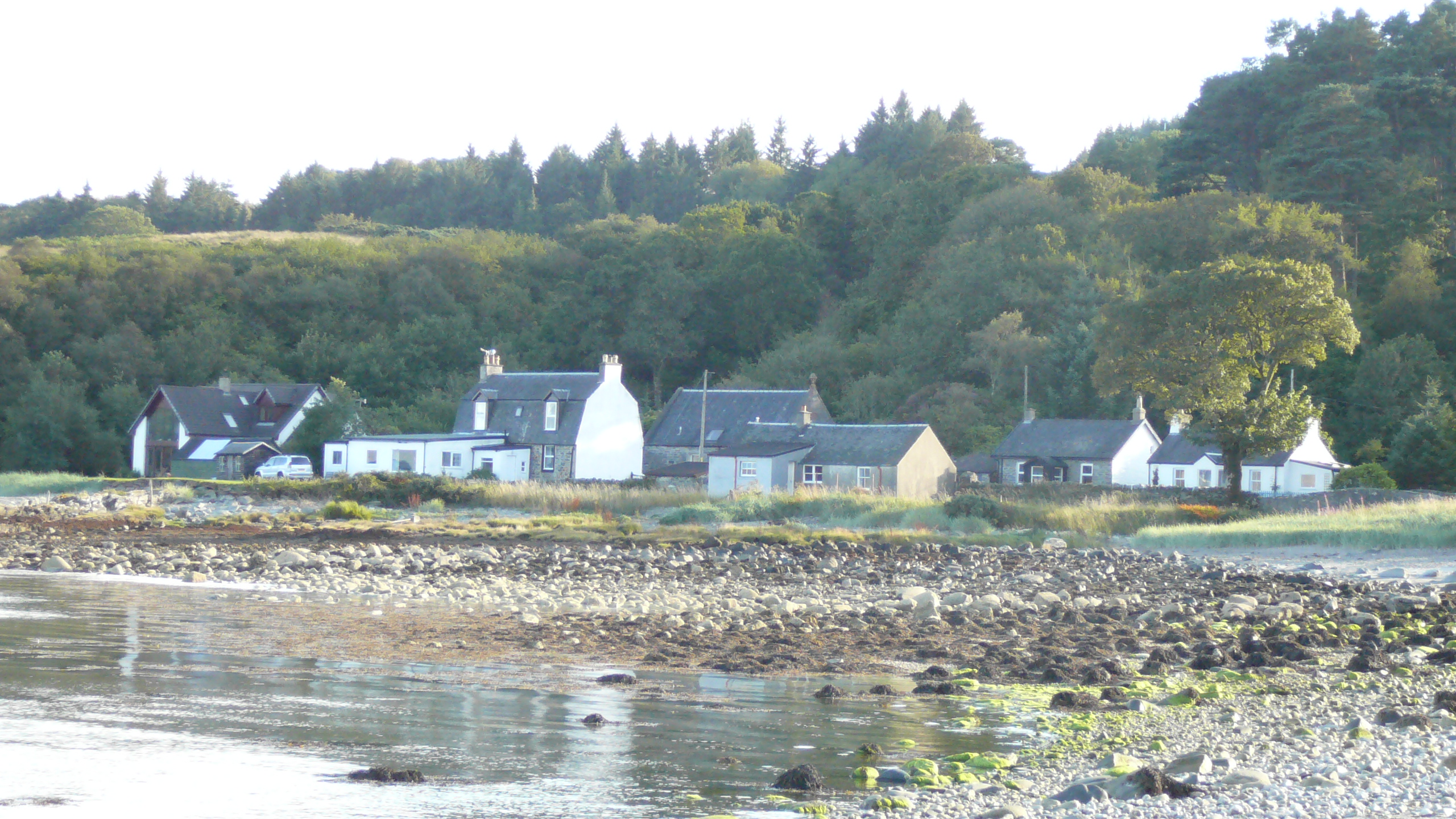
P1050513The idea for The Visitors fell into my head almost fully formed while on holiday in Grogport, a tiny hamlet on the east coast of the Kintyre peninsula. It’s connected to the mainland by a narrow isthmus, and it feels like an island. The beaches are sandy and studded with pebbles. Hills rise steeply from the shore and narrow roads wind around the coast, ducking inland to skirt the inlets. To the east, Arran lurks like a beached whale, and Gigha is smudge in the haze on the horizon to the west. Abandoned crofts explode with rowans, and in places the ferns fall into the road, wet and green.

P1050459My daughter was three months old, and the long drive from Cumbria had unsettled her. She started waking early – around five in the morning – and wouldn’t go back to sleep. My wife and I made coffee and watched the sun rise over Arran, casting blue light on the millpond Kilbrannan Sound. From the kitchen window, we saw herons stalk the surf, lashing down on crabs or minnows. Seals hunted in the bay every evening, and an otter dismembered fish on the shoreline. The garden thronged with little birds, and at one point I saw a kestrel sitting on the washing line, no more than five yards from the house. When we walked around the island, there were butterflies in the gorse, spiders on the sand, bees in the grass, gulls wheeling on the updrafts. I was shaken, at times, by how much life was around me, living as it always had, as though the land itself was alive and conscious. In so many places, it looked as though people, civilisation, had simply given up and moved elsewhere. It felt as though the land was waking after centuries of slumber, and just beginning to stretch.

On the third or fourth morning, watching a seal swim like quicksilver in the bay, the spark of a story flared brightly inside me. It caught fast, and began to smoulder. That story became The Visitors. Selkies, living in Grogport. A murder mystery. A young girl, desperate to leave an island. And it would be an island, I decided; the Kintyre peninsula was beautiful, but didn’t do everything I wanted for the story. I started drafting a sense of what the island looked like. I called it Bancree. As I began to write the story, the island evolved too, morphing into something real enough to touch.

P1050458Bancree is a scrapbook of my Scotland. I grew up in Inverness, where I could see Ben Wyvis from my bedroom window. We walked our dogs on the shingle beach at Ardersier and through the sodden plantations of Culloden. I’ve been canoeing and camping on Loch Maree in torrential rain, and climbed the boulder fields of Torridon and Glen Nevis. I’ve been to the top of Schiehallion, and walked on the clifftops of Dumfries, and fallen out of bars on Tobermory, and seen friends crash cars by the shore of Loch Ness. I’ve taken the train from Edinburgh to Inverness so many times that the journey is engrained in my memory. From the top of Glen Affric, with June snowmelt still feeding the burns, I’ve seen both coasts glitter in the sun. Scotland has a hundred landscapes that sing to me, and I collected something from each of them to build Bancree.

P1050526The island is my love letter to Islay, Jura, Gigha, Mull, Iona, Ullapool, the Highlands, the Black Isle, Moray and the Great Glen – to the landscapes I grew up in, the landscapes I love. I’ve never tried to sketch Bancree or make a map. I know what it looks like, and where to find Grogport, and Tighna, and Izzy’s hut, and the windfarm on the Ben. But more importantly, I can drive the road around Bancree simply by closing my eyes. I can feel the scrunch of shingle underfoot, and the batter and bluster of the Atlantic coast. There is dew sagging on spiderwebs, spun between the thorns of gorse, and rafts of flotsam hefted on the beaches. Dead, empty crabs still scuttle on the breeze. The twiggy scratch of heather, the rivulets of water in the bracken. Titanic clouds, dark and warm and scudding low enough to touch. The fluttering machair, alive with bees. Fog that swallows the tops of trees and telegraph poles. The water in the bog pools, dark with peat, staining all the world around, pouring brown from every tap. Sands that hiss and sing as the wind rolls across the beach in waves.

Bancree is as real as a dream to me. It is vivid and bursting with life. I can feel the rub of sand between my fingers, but there is no map to go there.

P1050540

A Song In My Own Language

On Friday night, Fred Versonnen performed ‘The Elephant Story’ at Dreamfired, and it was magnificent. The open mic night was as interesting as ever, but one of the scheduled performers couldn’t make it – and so Fred agreed to do another 10-minute spot before the interval. Fred is Belgian. He started by apologising for his (obviously excellent) English, and then announced that he was going to sing a nursery rhyme – ‘A song in my own language,’ he said, which is a phrase I’ve been unable to shift. And then he sang.

I don’t know a word of Belgian, but in that minute, or maybe two, Fred managed to generate genuine laughter and even a sense of the bittersweet, entirely through action, expression and body language. It was remarkable. I later discovered the song was about the birth of seven cats – six big and one very small – and all the mice running away.

He then performed a story I’d heard before, about a young monk who goes out into the world, tasked with discovering the meaning of life. Although I’d come across it before, Fred piled farce upon farce on the poor monk, earning howls of laughter from the audience – again using expression, the shape of his body, and most especially – pauses. (I’ll have a lot more to say about Fred, and pauses, and Fred’s pauses, when I’ve finished thinking about them, but that’s for another post.)

After the interval came The Elephant Story. This was my first experience of storytelling that did not have conventional myth or fairytale at its core; from Emily Parrish performing Loki, to Peter Chand’s Punjabi Grimm tales, to Kat Quatermass and her queer fairytale city, all the amazing storytellers I’ve witnessed have drawn at least a little something from our shared bank of generational stories – the lexicon of myth that has been passed around firesides and whispered over cribs for centuries.

Fred’s story was different. His background is in clowning and the circus, and the story was a love letter to a way of life long gone. Set at the start of the 20th Century, the story follows a little boy called George ‘Slim’ Louis, who falls in love with elephants and runs away to join the travelling circus. Over the years, he experiences cruelty and compassion, cutthroats and camaraderie. His story is remarkable, but made amazing by the way Fred ties it to the stories of the elephants themselves – anecdotes of their strength, and intelligence, and suffering, and occasional violence. There are moments of unbearable barbarity and tragedy, and moments of hysterical joy. The Elephant Story is a parable of all animals in captivity and a truly exceptional show.

Fred is a very physical storyteller. I don’t mean that he moves around a lot, but rather that his movements are measured and completely organic in developing, exploring and reinforcing the power of the story. His ability to hold a neutral expression conveys extraordinary meaning to his words, and that gives an audience space to reflect, savour, empathise and drown – in sadness, in humour, in understanding.

The next day, I attended Fred’s clowning workshop. It was held a hall in Arnside. By some dumb coincidence, there were elephants in the windows. I learned a great deal in the workshop, though I also found it very challenging. I’m going to write about that another time, because I’m still making sense of the things I learned, still processing some of the questions it raised. For now, here’s a picture of a boy and a circus elephant.

005625b2

Dreamfired with Kat Quatermass

Last night was my third Dreamfired storynight, and my second reading in support. It was a wild and windswept night in Brigsteer, but a decent crowd of thirty or so had battled through the rain and sleet. The open mic is always good fun, and I was absolutely delighted to see Trev Meaney again – he’s a dazzling slam poet who I’ve seen in action at Lancaster’s Spotlight. He combines breakneck delivery with great comic timing, and his quick-fire poems never fail to impress. Last night he performed several pieces, including the excellent confessional ‘Lancaster to London’, which looks like this:

I was the last of the support acts. For the first time, I was reading from Marrow (because yes! The books turned up on Thursday. I’ll write more about that in the next post). I read The Black And The White Of It, Hutch and After The Rains – sad, dark and joyful, by turns. It seemed to go quite well – I didn’t fully relax until the second story, but then I started to enjoy it, to really take my time with the words. If I can get to that place at the start of a reading, rather than halfway through, I’ll count that a success. I’d love to perform with Trev’s confidence and flair, but I’m still learning to walk. Running comes with time.

Kat Quatermass – who runs Dreamfired – was the headliner. She performed a startlingly original sequence of contemporary fairytales, couched in feminism and queer culture. It was an excellent show. First she painted a modern city, with an abandoned fairground, pebbledash tower blocks, supermarkets and a polluted river – then she populated it with modern kids, kids looking for ways to fit in, ways to escape – ways to survive. Kat then sent her cast of disaffected adolescents into the gritty, fantastical city, where their stories intermingled with talking foxes, golden birds, the months of the year and Hungarian hag Baba Yaga. The stories chop and change and intermingle, played out in a carnival of urban fairytales. The show was equal parts Neil Gaiman, Brothers Grimm and Arcade Fire’s LP ‘The Suburbs’. Kat’s city made me think of my short story Vanishings – that sense that anything can happen in cities when the lights go down and no one’s looking. She explained that this was a work in progress – she plans to refine and develop the show over the next six months. If last night was anything to go by, audiences are in for a real treat over the lifetime of the show.

All in all, another cracker from Dreamfired. Next up, my 20-minute guest slot at Verbalise

To finish, here’s a picture of Baba Yaga’s hut, which walks around on chicken legs, because Baba Yaga is awesome. This is by illustrator Bojana Dimitrovski:

Baba Yaga hut Bojana Dimitrovski freelance illustrator advocate art

The Blog Tour – answers

I was delighted when Elizabeth Stott invited me to follow her on the blog tour. I’m a fan of Elizabeth’s writing – I bought her short story Touch Me With Your Cold, Hard Fingers from Nightjar Press last year, and was engrossed in the tense, almost existential body horror she conjured in a few short pages. A lot of Elizabeth’s work generates that sense of claustrophobia – another of her stories, Mrs Wetherby, delivers simmering sexual tension amongst uptight ex-pats in the setting of a baking Gulf. Have a read – highly recommended.

Many thanks to Elizabeth for the invitation – here are her answers to the blog tour questions – and here are mine:

What am I working on?

More than I can handle! Foremost is new novel Grisleymires. Whenever possible, I’m trying to guide my rare writing days towards this; it’s the story of a man who loses his memories, and the woman who goes to find them. It’s set in a huge swamp, which is great fun to write, and I’m really excited by the characters and how they’re evolving. The issue is finding time to write around my other projects. I’ve been working on a novella called The Year Of The Whale for about five years (though I haven’t touched it for the last two). That’s about a whale beached in Morecambe Bay. It’s about 20,000 words finished, with only another 5 or 10k to go, but novels are taking precedence. I’d love to finish it soon, though – my partner Monica wants to make a series of linocut prints to illustrate it, and I think that could look fantastic – something like Alex Garland’s novella The Coma.

I’m also putting the finishing touches to my first flash fiction collection, Marrow, and starting to draft the second, which might be called Real Life. Around all this, I’m periodically developing my future novels – I already have plans for another four or five after Grisleymires. I’d love to write more often, but I struggle for time around my teaching and film jobs.

The final thing I’m working on is the copy edit of my first novel, The Visitors. The editor’s notes are due back next week, and I’ll need to go through those slowly and carefully (and with flagons of cider, according to Ali Shaw).

How does my work differ from others in its genre?

This is a difficult question to answer, as I believe all writers differ from others – that’s part of the wonderful polyphony of writing. As soon as a writer begins to speak in the first words of their own voice, they’re different. Genres are useful for sifting and gathering – I use genre far more as a reader than a writer.

That said, I guess I’m moving increasingly towards low fantasy. That’s where I can best tell the stories I want to tell. If my stories are in any way unique, it’s because of the themes I work in and the juxtapositions I explore. When I walk through woodlands, I worry about velociraptors. When I visit London, I imagine minotaurs haunt the Underground, dodging Tube trains as they roam beneath the city. There are doppelgängers watching from rooftops, waiting to make the switch. There are secret societies of pigeon fanciers that keep the internet alive, and kelpies working for the local council. I try to infuse my work with the same sense of magic I find in the world. I think every writer tries to do that. I’m interested in memories, and walking, and the idea of threshold spaces. I’m interested in myths and especially in folk tales. I’m interested in the breakdown in gender and what it is to be alive. Ultimately, though, lots of writers are interested in those things. What makes my work different is that it’s mine.

Why do I write what I do?

Writing brings me comfort through escapism, I suppose. I’m an army brat – we didn’t settle in one place until I started secondary school in Inverness, and I’ve often struggled to feel at home. Books and stories have been havens for as long as I can remember, and it was probably only a matter of time before I tried to create my own. As for the actual topics I write about – that’s evolved wildly over the six or seven years that I’ve been writing fiction. I started with experimental, deliberately obscure literary pieces, aping the styles of challenging writers like Hubert Selby Jnr and William S. Burroughs. After finishing my first attempt at a novel, which took me to some personally unpleasant places, I started to rediscover my love of stories that took me on adventures, rather than stories that were flayed to the bone. I reread David Mitchell and Sarah Waters and Jasper Fforde and Neil Gaiman – and I realised that those were the worlds that sang loudest to me. And so I started again, near enough, finding new ways to tell my stories. The more I’ve worked in this vein, the more I’ve enjoyed my writing.

How does my writing process work?

My ideas tend to arrive as acorns – I stumble upon them everywhere, buried in mud or blown into gutters. Some of those ideas never escape my notebook – and others explode, branching and sprouting into completely new directions. I can’t explain how an idea arrives already fully formed, but my best stories are already bristling with life. They evolve as I write. I know I’m working with strong characters when they start doing things I don’t expect; when it becomes inevitable, no matter what I’ve planned, that they’re going to do something else.

Landscape and place are important to the way I work – I like those strong characters to be in landscapes that I care about, so the air fills my lungs and I can feel the ground beneath my feet. In good locations, the story is a drop of water, taking the most organic route to ground. Place is as important to me as character, plot and emotion – when I write, I try to keep all those strands of story entwined together. Writing is a holistic process, following disparate elements all at once. That’s one of the things that makes extensive redrafting so hard. It’s easy for the fabric of the story to become tangled. When my stories are in a muddle, so am I.

Because I have so little time to work, I tend to write in fierce bursts. If I’m on a roll, I can manage more than 10,000 words a day, but that’s rare. A good writing day is 2,000-3,000 words I’m really pleased with. When I’m not writing, I think about my work constantly. I’m often awake at night, staring into darkness, tracing my way through story strands, trying to work out where they run to, where they meet. More often than not, I fall asleep without working it out – but sometimes I have to turn the light back on and write them down.

I’m also an helpless tinkerer. I can’t let go of my stories, and I return to them obsessively – even years after they’ve been published – to develop the story and tweak the prose. My flash fiction collection Marrow is typical of this – of the 28 pieces, around half have been published elsewhere – but in preparing the collected manuscript, I’ve spent months compulsively redrafting them. Some no longer bear any relation to the original. I can’t help myself. That tweaking and revising comes into first drafts, too. My stories are probably one third writing, two-thirds editing.

Another of the keys to my workflow is reading aloud – as I write, I constantly read, lips moving, shaping the phrases to find the most organic flow, and then reworking it on the page. On the rare occasions I’ve been asked for writing advice, that’s my first suggestion. Nothing has done as much for developing my work as reading aloud. My second suggestion is to carry a notebook. You never know when those acorns will tumble from the sky.

***

So there we have it. If anyone’s still reading, these are some of the things that go into my work. I’m now passing the baton on to David Hartley and Iain Maloney, who’ll publish their blog tour answers on Monday 3rd February. In their own words, they’re a bit like this:

David Hartley is a story botherer and blog tickler based in Manchester whose debut collection of flash fiction ‘Threshold’ was published by Gumbo Press precisely a year ago. He is one fifth of the writing collective Flashtag and can be regularly seen haunting the open mic stages of the North West. He blogs at http://davidhartleywriter.blogspot.co.uk/ and tweets at @DHartleyWriter

Iain Maloney was born in Aberdeen, Scotland and now lives in Komaki, Japan. A widely published writer of fiction, non-fiction and poetry, his debut novel, First Time Solo, a story of World War 2 RAF pilots and jazz, will be published be Freight Books in June 2014. He blogs at http://iainmaloney.wordpress.com
Thanks for reading.

Fenland wyrdly

I’ve lived in England for thirteen years, on and off, with stints in Edinburgh, Inverness and Australia. Aside from Cumbria, which is the closest thing to home I’ve felt in my adult life, and London, which is a bubble, I often feel a stranger here. Despite moving around so often, there are big chunks of the country I’ve never seen. East Anglia is one of them. We spent this weekend exploring the area as research for my next novel, which is called Grisleymires. On Friday we drove down a smart diagonal sweep across the country from Burneside in Cumbria to Kirby Cross, almost on the Naze, and stayed the night with friends. On Saturday morning we jagged back up to Wisbech, stopping at Wicken and Ely. For the first time, I’ve been to the Fens.

Grisleymires has been in the back of my head for a while. From the beginning, I knew that it was set in a swamp – the earliest incarnation of the story was essentially Time Bandits with bog bodies. It’s evolved massively since then, but the marsh has been a constant: I want to write about mud and water. I’m now quite secure in the plot, but the location has been troubling me. Location is crucial to the way I write, and I didn’t feel confident in my knowledge of any British bogs. I picked the Fens on instinct, and decided to find out more from there.

The first person I spoke to about Fenland felt so negatively about it that he could only laugh hysterically. He’s one of the most articulate people I’ve ever met, and he simply couldn’t formulate words to describe how powerfully it repelled him. That was exactly the sort of start I was hoping for. Since then, people have told me that the Fens are creepy, strange, powerful and weird. Everyone talks about ‘big skies’. Now that I’ve driven through them, I can understand why. It’s the flattest landscape I’ve ever seen. The horizon is broader, the perspective unnerving, the sky an impossible bowl. There are miles at a time without undulation – miles without trees. Ditches run in straight lines to vanishing points. In places, roads run lower than canals, with dykes and bridges guiding the contours. It’s especially strange near the coast, where the horizon is curtailed by the shore.

We stopped at Wicken Fen, where I stood in the blustering wind and stared into the winter sun. Tall grass became an ocean and hissed at me in waves. I never expected so much noise from emptiness. The sun turned orange, and the dusk turned blue, and pylons hung like giants against the scraps of cirrus. At one point, we drove along beneath a dyke for a mile or more. The road turned sharply up the bank and at the top, blinded by sunset, the world opened up like Noah’s flood – the entire horizon drowned in water, withered trees and battered shrubs emerging in silhouette against the sun. That was the road to Wisbech, submerged in wetlands.

sunset1

We drove the alternative route to Wisbech on undulating single track roads lined with Nissen huts and broken hedgerows, tumbledown houses and gigantic piles of sugar beet, surrounded all the while by thousands upon thousands of acres of thick, turned loam.

Wisbech was a strange town. The B&B was huge and empty. When we went to look for food, we found ourselves in what seemed to be a red light district. Drunken Polish men yelled at each other across the street, while girls on corners danced to techno on CD stereos. On Friday night, above the Naze, the stars were clearer than I’d seen in years; on Saturday, the sky was full of murk. On Sunday morning, we drove on Droves – lumpy roads, arrow straight for five miles or more, then zigzagging madly to meet the next. They separate broad strips of industrial agriculture, riven with canals, ditches and soakaways. All the trees wear killing coats of ivy. For the most part, we drove in silence, occasionally pointing things out to each other. The landscape was relentless without becoming monotonous.

The Fens is witchcraft and weak bridges; rotten thatch and revolution; gallows and windmills. At one point, we passed a narrowboat moored beneath a sickly weeping willow. It looked like it was about to break in half and sink. It was small, and covered with lichen, but I could still make out the name: it was called Icarus.

I don’t know if the Fens are creepy, but they are profoundly strange. We felt edgy all the time. We’re used to the cradle of the mountains, a constant presence in our peripheral vision. It’s incredibly strange to be without that subconscious company. Mon pointed out that the sheer amount of space makes you feel exposed – vulnerable. We didn’t find it creepy, so much as missing. It’s an absence, a nothing, a void. It felt like a sort of purgatory; fields unfolding endlessly, stretching on forever.

I went on this trip hoping for a sort of Green Venice, but that’s not what the Fens are about. They aren’t what I expected, or what I wanted, but maybe this trip has been exactly what I need, and here’s why:

I invented Bancree for The Visitors. It’s an amalgam of Islay, Jura, Gigha, Kintyre and the Black Isle, plus a host of other Scottish spots; and I’m already planning a novel set in a fictional city, based around my short story Vanishings. The point is this: I thought nothing of creating an island, and I can’t wait to write a city. I don’t know why it’s taken me this long to consider inventing a Fenland of my own. Writing a new region into an existing geography feels more daunting than something as self-contained as an island, but that would give me the perfect environment for Grisleymires.

I’ve only started considering this today, but it’s already gathering weight. It would let me combine the heat and life of Green Venice with the sodden bogs of Islay and the upland Cumbrian basin mires with the Fens and Norfolk Broads. I could do as I pleased with accents and geography and culture, and that’s a real magnet for me. I’d be sad to leave or even dilute the Fenland folklore, though – I’ve grown attached to Tiddy Mun and Old Shuck.

As a research trip, it’s thrown up more questions than it’s answered. But that, in itself, is part of the journey.

pylons1

Resolve

I’ve always been a little dismissive of New Year’s Resolutions, because if I want to make a change in my life, that can happen any time I choose. That remains true, but there are things I want to do differently going into 2014. Post-Christmas binging is a natural place to draw a line and make a start, and I quite like the idea of formalising the changes I want to make. So here’s what’s going to happen this year:

Exercise

Because I don’t really do any, other than the odd Lakes walk and the exhaustive mania of teaching. I’ve already started walking the 2 miles to work – which I enjoy for the headspace as much as the activity – but I miss my bike and I miss my climbing. So I’m going to start cycling the long way to work and back. That’s only about 6 miles a day, so it’s not a great deal really, but it’s more than I’m doing at the moment. I’m also really keen to get back to my climbing. When I lived in London, I climbed four or five times a week. Now it’s four or five times a year. I’m going to start going for a few hours at least once a week. That, supplemented by some pull-ups at home and the cycling, should be steps in the right direction. I might even join Mon for the odd yoga, too.

Writing

The best I can hope for here is more of the same, I think. I crave more time to write, but the day jobs don’t allow it. In a good week, I get two days and two nights on my stories every week. Within that, I have specific aims for 2014. First and most important, I want Grisleymires finished in a year. This is a big ask, but it’s well planned, I’m excited by the story, and I can do it if I work hard. Research trip to the Fens in January!

Second, I want to have my flash fiction collection Marrow typeset and printed by the end of February. I’m reading at Spoken Word at the Brewery on Saturday 22nd, and I want it in my hands by then. This isn’t as big a deal as it seems; the stories are written and redrafted ten times over, and having typeset it once already as practice, I know glimmers of InDesign. With some guidance from knowledgeable friends and a few late nights, I think I can send the manuscript off to Inky Little Fingers in a few weeks. I’ve already saved most of the £225 it’ll cost to print 100 copies, so that’s not going to hurt my wallet too much.

Third, I want to keep on performing. 2013 was a turning point for me in reading my work aloud, and I want to push that as far as I can. Reading live brings an entirely new aspect to the way I write, and this is something I want to keep developing – pushing towards more theatrical performance where my confidence allows it.

Fourth, I want to submit my work to more competitions. I’ve never entered any of the big short story competitions before now, and I’m going to try and start this year. And I want to write new pieces, too, if the ideas keep coming to me. I’m not going to rehash old stories. I’ve pretty much drawn a line under my older work, but for two particular pieces: the excellent people at Comma Press have been considering my short story Every State In America for their delayed Reveal anthology for a couple of years. They’ll have first refusal on it for as long as it takes; being published by Comma would be an incredible honour. The other piece is called Art Is Long, Life Is Short, which is perhaps three years old and freshly redrafted for the BBC Radio 4 Opening Lines strand. That’s ready to go when the submission window opens in January.

Fifth, I want to finish Year Of The Whale, my long-running novella about a whale beached in Morecambe Bay. It’s been work in progress for three or four years, and it’s overdue. But writing resolutions one through four come first.

That’s lots of resolutions wrapped up in two strands, really. Writing and exercise. I’m only going to buy the time for everything else if I start saying no to low-paid film jobs, so I’m not doing any freebies/cheapies this year unless they have a clear benefit further down the line. I’m also going to try and rein in my irrational compulsion to reply to emails RIGHT THIS SECOND. I just don’t have the time. Most of the email I receive can probably wait until I’m ready. The point of all of this is to spend more quality time with Mon and Dora. Unless deadlines get in the way for either of us, we’re generally good at keeping weekends as family time, and I want that set in stone. There are a host of other things I can do towards this – less time online, for a start – and turning off the computer on free evenings. I want to read more, too.

I guess I’ve picked out goals, rather than resolutions, but it’s all the same in the end. I haven’t kept a blog to monitor resolutions before; I’m curious to see to whether writing about my success or lack thereof will impact on my success or lack thereof. Gazing into the void and so on.

2013 was a great year in many ways. Here’s to 2014, people. Be safe, be happy. Here’s a 1921 picture of a cat and a goblin in a tree:

goblin

Flash fiction challenge: Graffiti

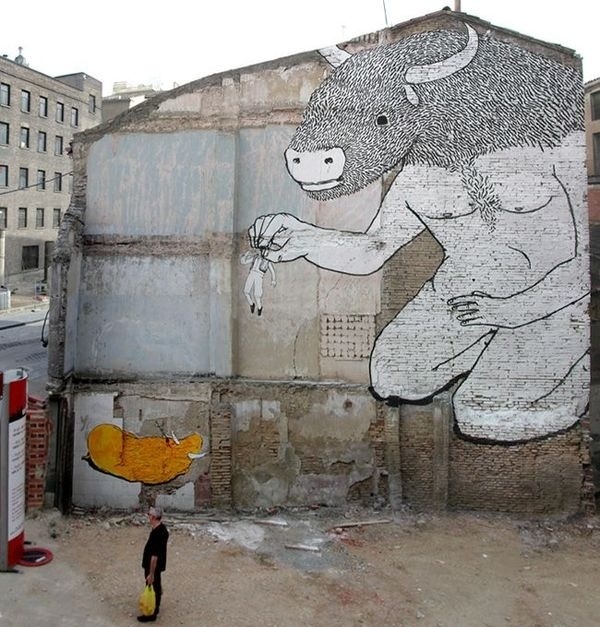
Okay, folks. Here’s round three of the writing challenge I’m working on with performance poet Simon Hart, also known in certain Mafia circles as BigCharlie Poet. This is how it goes: we take it in turns to choose a picture, both of us write a response around it, and we post the results up here. Round one was Cathedrals. Round two was Libraries. For round three, it was my turn to pick the image, and I opted for this doozy from my Pinterest short story board:
20131220-223914.jpg

Although I had some inklings, I didn’t entirely know where to go with this at first. I was also embroiled in a marathon redraft of The Visitors, and so the challenge slid by the wayside a bit. Simon was finished in two days, the swine. Anyway, when I had a chance to work on it properly, the ideas came fairly quickly. My first story was well over a thousand words long and barely halfway in when I decided to put it on ice. It’s going to be a good piece, when I’ve time to finish it, but it’s not right for this. My second attempt was finished in a single session, plus a few tweaks the following day. As with my Libraries story, this feels like it could be the start of something much bigger; since finishing it, I’ve been brewing on a full novel about the characters and their situation, and I have some exciting ideas starting to spark. I think I’ll be taking it a lot further in the future.

It’s interesting, as well, that Simon and I had fairly similar responses to the picture. Our work in the first two challenges was quite diverse; I don’t know whether this image is more specific, and therefore limiting, or whether it actually offers more themes, and we simply happened to choose the same one.

Here’s what Simon has to say about the picture:

“What a difference an image makes! Last time out I (we) struggled a bit under the weight of a well-mined seam of creation for us with my choice of a library pic… I’m glad to say that the responsibility of the choice for this challenge came from Mr Sylvester, and, from my perspective at least, I think he should pick them all! To say that the creation of this piece contrasts with the last process would be underselling it somewhat… I also know that despite the complexity of trying to describe this picture to an audience, I really want to perform this.

This poem came about very quickly and with a very clear idea of what I wanted straight away, and I think it has delivered what I wanted from it. Seeing the image for the first time, I was struck how old monsters are never really old monsters, and they always find their way back somehow. They may change their locale and era, but they continue on…”

With that said, here’s Simon Hart’s response to the picture:

Urban Myth
by BigCharlie Poet

I started my life as a hasty scrawl
Daubed in white paint on a houses side wall
An innocuous way for me to be born
Not really planned, just hurriedly drawn
Against the time constraints of another coming dawn,
The sun creeping almost afraid of my form
And boy did I grow!
There was no way that they could ever know
What i would become, the strength i would show
And each feed of paint gave me a new glow
Though my home was a wall, i still reached for the sky
Never once did i ask for the reason why
I became a creature that makes young kids cry
Which the ancient greeks locked in a maze to die
That people turn their heads away hurts, i won’t lie…
But soon i was so big that single cans of paint didn’t suffice
When you’re twenty feet high, with the head of a bull, who do you turn to for advice?
I couldn’t exactly stroll into a restaurant and say “give me whatever’s nice”
So i had to come up with a solution of my own making
And because i couldn’t do any great british baking
I looked around and saw souls, ready for the taking…
I mean, it’s not as if you lot even notice they’re missing
You still stumble through each day like you’re barely living
Not looking away from what your tv is giving
So now, when you try to open your mind
And use your soul for guidance, you suddenly find
Yourself empty, and you don’t know the reason
But you convince yourself it’s because you watched another season
Of “I’m a Celebrity, get me out of here!”
Or you drowned your brain cells in far too much beer
That i am the culprit will never be clear…
So thank you for giving me what i really need
A simple, quick and nourishing feed
But i won’t let myself give in to my greed
I’ll satisfy myself with the odd soul waiting for a bus
The business professional in too much of a rush
The guy who’s become a 3pm lush…
Just enough to keep me going
After all, this wall doesn’t leave much room for me growing…

…and here’s my response:

Vanishings
by Simon Sylvester

We assembled at dusk and waited, scanning the skyline, binoculars flitting between the sunset buildings. Half the squadron wore night vision goggles, for all the good they’d do. It was only my third year with the division, and I was already the oldest. The kids were tense, but they struggled with all-night shifts. By two in the morning, a couple of them had dozed off. Dew glistened on their spray suits.

“Contact! Contact!”

As the radio crackled into life, slumbering officers stumbled to their feet. I checked the chamber on my gun. It was clean.

“Where are they, Jenkins?”

My voice was calmer than I felt.

“Corner of Gresham and Moorgate.”

I could hear her panic.

“Stay calm, Jenkins. We’re on our way n-.”

Even as I spoke, her scream clattered in my earpiece.

I gestured to the others. Grim-faced, we lined up and marched out, trooping along King William Street at a jog. At Bank, I gestured for the squad to slow and break formation. They fanned out, torches sweeping beams of light across the deserted road. I took point, and we stepped in silence through the Old Town.

Halfway along Prince’s Street, prickles ran down my spine. The feeling turned my bones to ice, but I knew better than to ignore it. That feeling had kept me alive for three years. I raised my fist, signalled to freeze. The squad halted at once. Nothing moved but sheets of paper, cartwheeling through the night.

On the wall ahead was a perfect, life-sized painting of Jenkins, caught mid-scream. I grimaced. She’d only been in the division three weeks. Some animal instinct made me raise my torch and scan the buildings above. The cone of light crawled up the wall into darkness.

I peered into the gloom at the edge of the light.

The top third of the building was graffitied with a gigantic white minotaur. It loomed above the street, unmoving, and for a heartbeat, I thought it was already dead. But then the minotaur grinned, and a fist clenched in my guts. Behind me, Stevenson shrieked and loosed a burst of fixative. The minotaur was too quick for him, melting back into the bricks even as the web of glue spattered across the wall. The beast darted around the corner of the building, pouring across the stone, the molecules of paint sliding from brick to brick. Splashes of fixative showered the empty wall.

“Hold your fire!” I bellowed.

The squad gathered closer together. In my earpiece, someone was hyperventilating.

“Shit! Jenkins has gone west.”

“He’s big. He’s big, sir-”

“I’ve seen worse, son. Be calm. Keep your wits about you. He’s somewhere close.”

There was another yell behind me. I spun round to see the minotaur reach out of the building, pour onto the pavement and swing his vast arm across the road, knocking half my squad to their knees. Redmayne lay closest to him. In two dimensions, his paint poured across the tarmac, wrapping around her ankle. She screamed and kicked, but the paint held fast. The minotaur yanked her to the ground, and began hauling her towards the wall. The rest of the squad were firing indiscriminately. Wherever splashes of the fixative caught the minotaur, fragments of paint were trapped within the brick, but he was big enough to shrug them off, leaving patches of himself behind. Redmayne was almost at the wall when I found a clear shot. I raised my gun, aimed and fired off half a tank. The glue showered across the beast in a net of spray, pasting his entire head. He juddered to a halt, mouth fixed in a permanent, silent roar. His painted hands continued to sweep across the bricks, scrabbling for purchase, but his head was stuck fast. One by one, my squad found targets, and soon every part of the monster was stuck to the wall. Redmayne scrambled free, sobbing, and backed into a knot of her comrades. We gathered together and looked up at the beast.

He was easily four storeys tall, made with gallons and gallons of paint. His creator had been a talented artist. Even fixed fast to the wall, the minotaur wriggled with life. His horns came to wicked points, and despite the fixative now coating his body, veins and muscles still pulsed on the brickwork. He must have taken weeks to make, back in the day. In a sense, he was even beautiful.

It was hard to remember a time before the paintings came to life.

The Cleaners arrived within the hour, all dead-eyed and paint-smeared with their mops and detergents. We watched them scrub the minotaur from the building, watched him dissolve into suds and drip into the sewers. Then they washed Jenkins from the wall, too. I didn’t watch that part. When they were done, we walked back to the depot. The new trainees looked shellshocked. The older squaddies looked harder, meaner. Redmayne wasn’t talking. She was one of my best officers, but this would be her ticket out. Poor Jenkins hadn’t even made it this far.

Every step of the way, ghosts watched us from the walls. The Cleaners worked hard, but every day, new faces stared out from the brick. And no matter how hard they worked, they couldn’t wash the faces from my nightmares.


‘Selkie’ by Robin Robertson

Thanks to Iain Maloney for sending this poem my way; it’s a cracking wee piece by poet Robin Robertson.

In memory of Michael Donaghy

“I’m not stopping,”
he said, shrugging off his skin
like a wet-suit, then stretching it
on the bodhran’s frame,
“let’s play.”
And he played till dawn:
all the jigs and reels
he knew, before he stood
and drained the last
from his glass, slipped back in
to the seal-skin,
into a new day, saluting us
with that famous grin:
“That’s me away.”

There’s talk of selkies in The Visitors, and this chimes nicely with the last stages of my redraft. It also makes me want to read more of Robertson’s work. Try reading this aloud; the scan is sensational.

Grimm’s Sheesha

peter-full

Last night, storyteller Peter Chand performed his show Grimm’s Sheesha at Dreamfired in Cumbria, and it was bloody brilliant.

A sheesha is a mirror, and you probably all know about the Brothers Grimm; throughout the 19th Century, brothers Wilhelm and Jacob Grimm collected and published folk stories from across Germany and beyond. Their books preserved many – if not most – of our classic fairytales. When they feel so intrinsically European, hard-wired into grey stone and rain and winter, it’s crazy to discover that threads of those same tales have existed in India for centuries. In retrieving and retelling the original stories, Peter’s show gives the Grimms an Indian incarnation – or, more accurately, reflection – and hence the titular sheesha.

Just like people, stories evolve as they travel, building on a core, becoming something new, fitting themselves around each new place. The same elements are plain to see in the fairytales of both cultures – family discord, revenge, blood, luck, magic – but Peter’s stories explode with language and laughter. His characters flit between between Punjabi and English – sometimes with translations, sometimes without – and the seamless interplay of both languages is dizzying, dazzling, mesmerising. The stories balance violence with humour, using voice and movement and body language and expression to conjure holy men and jealous sisters, gods and donkeys, poison and pakora, loom shuttles, bloody shawls and magic mango stones.

It was an electrifying show and an inspiring night. By the end of the performance, my face ached with so much smiling and laughing. I can’t do it justice; hunt down Peter Chand and hurl yourself headfirst into his stories.

I’m fascinated by the evolution of stories, and it was a delight to chat to Peter after the show and hear more about how he’d found and developed the show – and how the show had then evolved again, changing around him with each new performance. His medium is more dynamic than mine, but that idea of evolution is something I can understand; it’s there in my inability to let go of written work, returning to it time and time again, even years after publication, tweaking and cutting and expanding, improving, building towards something ever new. We also spoke about his performance style, which is both relaxed and spontaneous – at one point he said “Bless you” to an audience sneeze without breaking the suspense – and he was kind enough to give me some advice on how to improve. I’ll never be a storyteller of his calibre, and that’s not really where I want to take my work – but I absolutely strive to read and perform my stories with greater confidence, and it was useful to talk to a master! Peter also put me onto Festival At The Edge – the country’s oldest storytelling festival – which I think we’ll try and attend next year.

As a tangent to all this, my friend (and real-life Lovejoy) Ben Piggott claims there are actually only two stories: 

  1. Boy/girl leaves to find fortune
  2. Trouble comes to town

I’ve tried, but I can’t think of a story worth its salt where one or both of these sound hollow. And yes, they’re vast catch-alls, but that’s okay, because they’re also entirely true.

For a number of reasons, I’ve stalled on the novel redraft since discussing Freedom. As of today, I think I’ve found a way back into the light – but I need to brew on it for a couple of days, so that’s for another post. For now, here’s an illustration from The Old Woman In The Wood.

the_old_woman_in_the_wood