
I loves a bit of juggling, I do.
Tag: performance
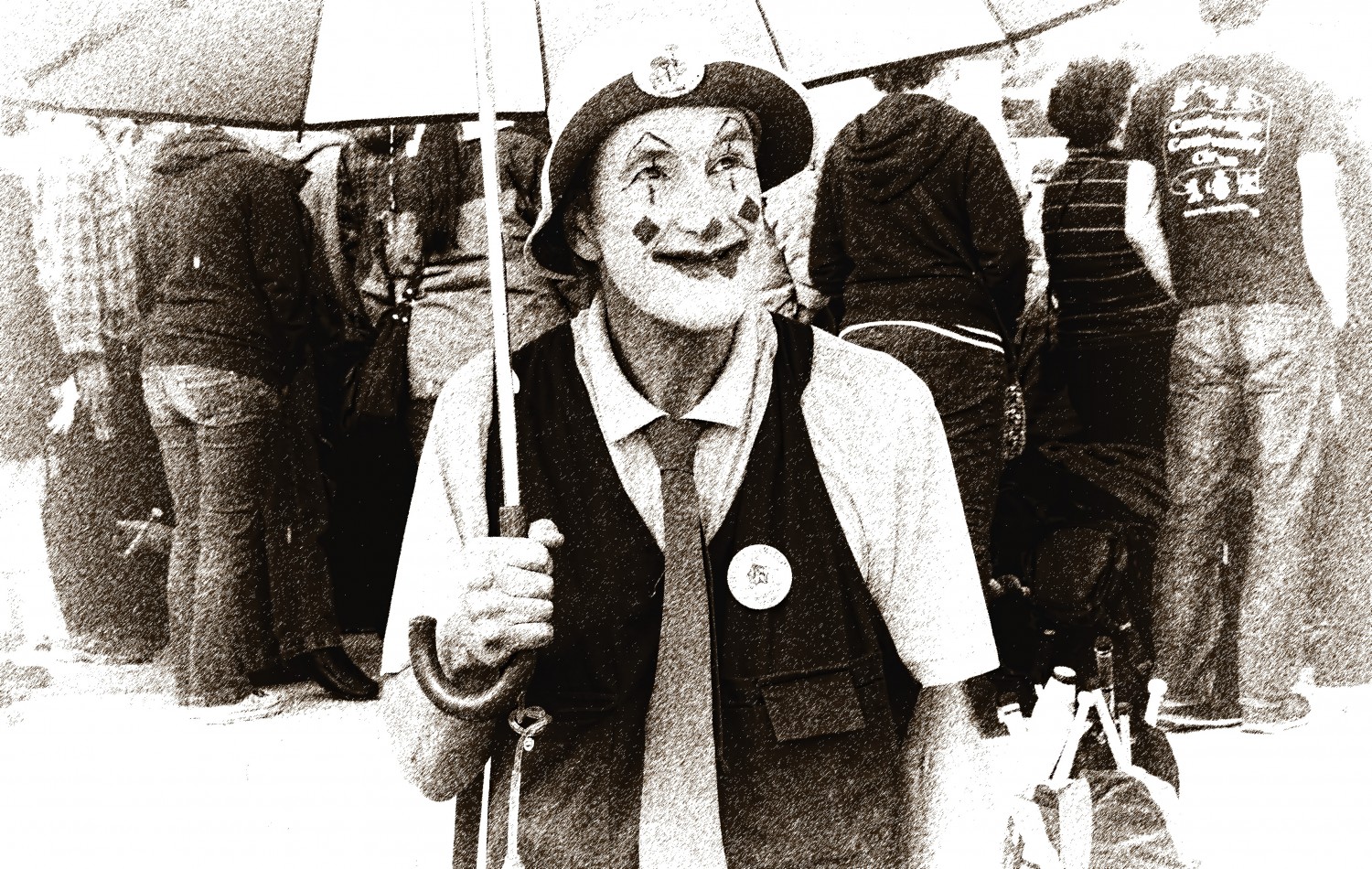
Playing the clown
Last month, at Dreamfired, I saw storyteller Fred Versonnen perform the amazing Elephant Story. The next morning, I attended his clowning workshop in Arnside. This had almost nothing to do with the stereotypical idea of clowning – no silly noses, no silly shoes – and was essentially a 101 on delivery, performance and body language.
Fred warned us at the start of the session that it might take us to some uncomfortable places. I didn’t believe him, but he was right. It’s taken me this entire month to process some of the things that happened in that class. I’m not sure I’ll ever totally get to grips with it, but at the same time, I no longer think I need to. I just wanted to record a few thoughts on what clowning means to me.
I’m not going to talk about the specific activities Fred led us through. They were plentiful, varied, invigorating, intense and brilliantly useful, but they will mean different things to each person who attended, and I don’t feel the need to dissect the actual workshop. I want to talk about what I learned.
I learned that I’m frightened of embarrassment. Most of us are, probably. During the workshop, we performed tasks specifically designed to undermine dignity and strip away the topmost layers of self-respect. I found myself trying to rationalise the embarrassment by imposing a narrative upon it, but every time, Fred forced me to confront it.
‘For a clown, embarrassment is a gift,’ he said.
In this way, I learned that clowns are truly fearless.
I also learned to wait.
In a world consumed with noise and signals, the clown is silent. She waits, absorbing everything, and then she waits some more, until the wait itself becomes excruciating – until the pause itself becomes the embarrassment – and then she responds. In that pause, the clown is naked. Every part of her is laid open for the world to see. The clown waits long enough for the audience to connect, to project their own feelings onto the situation, to drown in empathy, to cringe in anticipation. Every part of them is laid wide open. This is the tragedy of the clown, and the triumph. It has nothing to do with face paint or comedy trousers. Laurel and Hardy are clowns, and Pennywise is not.
I couldn’t live that way, but I’m trying to bring some of it into in my own readings. At the Flashtag story slam, I made myself pause, and wait, then wait some more. I took a stupid hat onstage for my final story, and I forced myself to wear it. I tried to share anticipation of what was coming next with the audience. It was, without a doubt, the happiest I’ve ever been with my performance – the best I’ve ever read my stories. For everything I learned, I’m not sure I’ll ever know how to apply it properly. But I think I understand, now, that not knowing is itself part of clowning. It is Zen – pure action, without thought. I think too much.
At the start of this post, I said that the workshop had nothing to do with silly noses. That isn’t entirely true. At the very start of the session, as people were still arriving, we gathered in the kitchen to wait. Fred began to ransack the drawers, looking for props to use in the workshop. He found an orange ping pong ball. In a single, fluid motion, he spun to face me, bringing the ball to his nose, and he grinned. Just as quickly, he replaced the ball and closed the drawer. But in that second, or half a second, he’d become a clown. His face changed, his body changed – with the sheer, magnificent, wondrous joy of finding a ping pong ball in a kitchen drawer.
I don’t think I’ll ever be able to articulate what happened in that workshop. I don’t need to articulate it, of course, but I want to; and that is why I will never be a true clown. A clown wouldn’t need to analyse it, because they wouldn’t be scared of it. A clown would simply shrug, smile, and turn to embrace the vastness of this mad, sad, glorious thing that we call life.
The Sprint Mill Sessions
I love this: my friend Dom has been filming the grassroots Cumbrian folk scene. Last summer he gathered dozens of people for a campfire session at Sprint Mill, and this was the result – young musicians, sharing their songs by firelight. The sessions so far can be found right here, but I’ll leave you with Paddy Rogan and The Way You Used To Do…
Slamming
After a wild and wonderful night in Manchester, I’m bowled over to report that I somehow managed to win the Flashtag Short Short Story Slam. It’s still sinking in, but I’m delighted.
It was something of a journey – we left Dora with her grandparents, and drove down from Cumbria in the afternoon. Mon and I met friends Steve and Clare in the Northern Quarter, ate in the revelation that is V Revolution, then headed across the road to Gullivers to scope the venue: a brilliant space of worn floorboards and ornate plaster ceilings. The stage was bathed in blue and red light, creating corners from which the writers would prowl to read their stories. For the first round, competitors were paired off at random, with names plucked from a bowl and a coin toss to decide who read first. Once each writer had performed their story, the audience voted blue or red to decide a victor, and that writer continued to the next round.
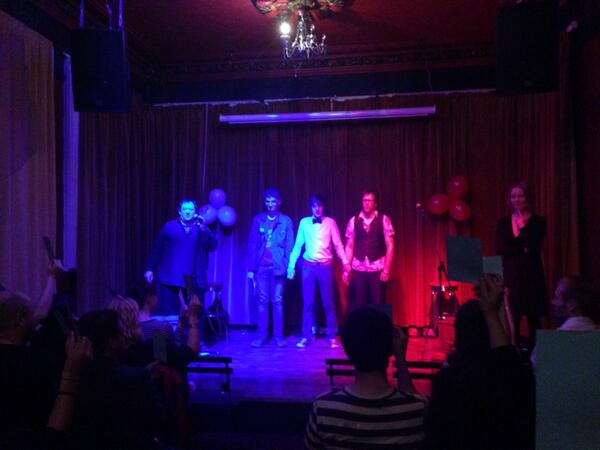
It started ferociously, with the amazing Joy France reading an intimidatingly strong story about cleanliness (and willies). Her opponent was good, but that story would have annihilated all comers. I was very, very glad I hadn’t been drawn against her. She was duly voted through, and set the bar for the rest of the night. The stories were consistently excellent. Hand on heart, there wasn’t a bum note. Mark Mace Smith and Mark Powell, Joe Daly, Abi Hynes, Sarah Stuart, Geraint Thomas, Trisha Starbrook, Thomas Jennings and Ailish Breen all read absolute belters.
My name was drawn in the fourth bout. I read a piece called What I’ll Do To Be In Love With You, about a boy who turns into a harmonica. I was anxious, as always, but I’d been practicing, and I made myself take the time to enjoy it. My opponent was Thomas Jennings, who read a brilliant piece about the end of the world as experienced through last orders in a MacDonalds. It was a funny and affecting story, and I would have been happy to lose to it; but I scraped through into round two, where I was paired off with Mark Mace Smith. Mark is a vivacious slam poet who often performs under the name Citizen Mace – check out his stuff here – and he made for another tough competitor. I was up first, with a story called Charlie Loved The Circus. This is a 200-word nasty about why you shouldn’t be mean to clowns. Mark’s piece was a sweet wee story about a man falling – literally – for a girl. Another close vote, but I made it to the third round.
In the final, I read against Mark Powell and Joe Daly. Both are stalwarts of the Manchester literary scene – Mark runs Tales Of Whatever, and Joe is one half of Bad Language – and their stories were excellent. I was last to read, and went with a story called The Jubilee Best Bake Competition. I always planned to read this with an accent, but bottled it at Verbalise. So I bought a frumpy hat onstage. It’s made of green wicker, has a broad brim and is covered with flowers. Once I’d donned the hat, I couldn’t back down from the accent; and so I launched into my idea of what happens when the village baking competition takes a turn for the worse. The audience (joined, at this late point, by three exceedingly stocious men who thought they’d come to a boxing match) kindly gave me some laughs, and that helped me relax into the story. The hat helped, too.
The vote was tight again, but I sneaked it. I’m still thrilled, delighted and surprised – as well as humbled and happy to have shared my stories with such an amazing crowd. We stayed for a couple of hours after the slam, happily chatting away with the Flashtaggers, audience and contestants. It made me wish, once again, that I’d made more of the astoundingly vibrant Manchester literary scene when I actually lived there; then again, I’d barely started writing when we lived in Withington.
It was after 11 when we left Manchester, and we drove a deserted motorway in the dark. The journey gave me time to think. I’m over the moon to have won, but there are two things that burn brighter. Firstly, I won’t forget the sense of community I experienced at the slam; it’s a real thrill to share my love of stories with friends and strangers, and events like the slam are a howl of affirmation that stories are alive and people are hungry to share them.
Secondly, and quite honestly, I would have been proud to have been knocked out at any point, from round one onwards. This is because, for the first time, I read my stories the way I want them read. I used to gabble or murmur my way through a reading. A year or so ago, I set out to be better. I haven’t shaken the nerves, but I’m learning to manage them, and I’m coming to trust my stories. I’m not a confident person, but running a gauntlet of open mics has given me some confidence in my work.
Back at home in Cumbria, I tiptoed in to see my daughter. She snuffled in her sleep, and buried herself in the blanket. All journeys, no matter how big, are measured in stages and steps. For all the things I would change about myself – to write more often, to be more focused, to perform better – I wouldn’t change a step of the path I’ve taken to where I stand now.
Here’s a picture of me with a cheesy grin and my cheque for £1,000,000,000,000,000,000,000,000,000,000,000,000,000,000,000,000,000,000. I’ll be cashing this tomorrow, Flashtag – if there’s any trouble at the Post Office, I’ll be back with my bat.

A Song In My Own Language
On Friday night, Fred Versonnen performed ‘The Elephant Story’ at Dreamfired, and it was magnificent. The open mic night was as interesting as ever, but one of the scheduled performers couldn’t make it – and so Fred agreed to do another 10-minute spot before the interval. Fred is Belgian. He started by apologising for his (obviously excellent) English, and then announced that he was going to sing a nursery rhyme – ‘A song in my own language,’ he said, which is a phrase I’ve been unable to shift. And then he sang.
I don’t know a word of Belgian, but in that minute, or maybe two, Fred managed to generate genuine laughter and even a sense of the bittersweet, entirely through action, expression and body language. It was remarkable. I later discovered the song was about the birth of seven cats – six big and one very small – and all the mice running away.
He then performed a story I’d heard before, about a young monk who goes out into the world, tasked with discovering the meaning of life. Although I’d come across it before, Fred piled farce upon farce on the poor monk, earning howls of laughter from the audience – again using expression, the shape of his body, and most especially – pauses. (I’ll have a lot more to say about Fred, and pauses, and Fred’s pauses, when I’ve finished thinking about them, but that’s for another post.)
After the interval came The Elephant Story. This was my first experience of storytelling that did not have conventional myth or fairytale at its core; from Emily Parrish performing Loki, to Peter Chand’s Punjabi Grimm tales, to Kat Quatermass and her queer fairytale city, all the amazing storytellers I’ve witnessed have drawn at least a little something from our shared bank of generational stories – the lexicon of myth that has been passed around firesides and whispered over cribs for centuries.
Fred’s story was different. His background is in clowning and the circus, and the story was a love letter to a way of life long gone. Set at the start of the 20th Century, the story follows a little boy called George ‘Slim’ Louis, who falls in love with elephants and runs away to join the travelling circus. Over the years, he experiences cruelty and compassion, cutthroats and camaraderie. His story is remarkable, but made amazing by the way Fred ties it to the stories of the elephants themselves – anecdotes of their strength, and intelligence, and suffering, and occasional violence. There are moments of unbearable barbarity and tragedy, and moments of hysterical joy. The Elephant Story is a parable of all animals in captivity and a truly exceptional show.
Fred is a very physical storyteller. I don’t mean that he moves around a lot, but rather that his movements are measured and completely organic in developing, exploring and reinforcing the power of the story. His ability to hold a neutral expression conveys extraordinary meaning to his words, and that gives an audience space to reflect, savour, empathise and drown – in sadness, in humour, in understanding.
The next day, I attended Fred’s clowning workshop. It was held a hall in Arnside. By some dumb coincidence, there were elephants in the windows. I learned a great deal in the workshop, though I also found it very challenging. I’m going to write about that another time, because I’m still making sense of the things I learned, still processing some of the questions it raised. For now, here’s a picture of a boy and a circus elephant.

Dare!
I’m delighted to share the news that my 100-word story Dare has been Highly Commended in the National Flash Fiction Day writing competition. You can read it, along with the rest of the winners and commended stories, right here.
To reach the top 10 against such strong competition has really made my day. I’m also delighted to see Cathy Lennon take top spot with her story Never Let Me Go, because Cathy is lovely and her story is fantastic.
Someone landed on my blog a few days ago with the search term ‘is flash fiction a proper noun’. I’ve been giving that some thought, and the answer is no. But I love that flash fiction is becoming more established. It’s the perfect counterpart to my novel writing, and it keeps me keen. More thoughts on flash fiction to come soon, I think. I’ve written a host of shorter stories lately, and I want to take the time to explore what the format means to me.
In celebration, I’m off to see international storytelling superstar Fred Versonnen perform at Dreamfired tonight; and even more exciting, tomorrow I’m off to Arnside to attend his clowning workshop. I’m hugely excited about what clowning could do for my performance, and seeing Fred tell his stories is a perfect start.
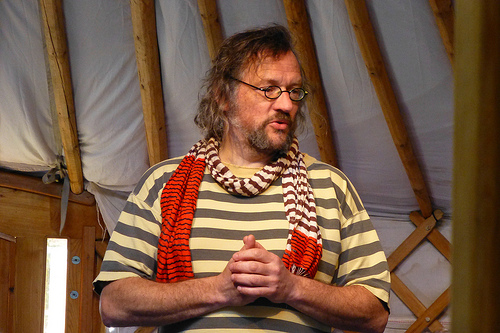
Fred looks like this:
Know Your Enemy
I’ve just been emailed the list of all the contestants for the Flashtag Short Short Story Slam. If I wasn’t nervous before – which I was, actually – I certainly am now. Here’s the dirty dozen:
Ros Ballinger
Ailish Breen
Joe Daly
Joy France
Abi Hynes
Thomas Jennings
Mark Powell
Mark Mace Smith
Trisha Starbrook
Sarah Stuart
Simon Sylvester
Geriant Thomas
Joy France read at the open mic before my Verbalise guest spot, and she was amazing. I saw Ros Ballinger read some blinding poems at Lancaster Spotlight last year, and she was also very good. I know Mark Mace Smith and Trisha Starbrook by reputation – Trisha won last year’s slam, having never read in public before, and Mark is a noted slammer and favourite of my friend Ann The Poet. Some online stalking reveals the others to be an intimidatingly talented bunch of comedians, poets, theatre performers and practiced improvisers. Oof. We’ll be paired at random in the first round, reading a 150-word story head to head. The audience votes for their favourite to proceed into the second round. Round two cuts six readers with 200-word stories down to three, and the final trio read a 250-word story for top spot.
In the last week, I’ve written five or six new flash pieces, though none of them are quite right for the slam; they’ve either been too short or too long. I’m struggling especially with the first story and that 150 limit; I have a multitude of pieces of that length, but most are either abstract or downers, and I want something both bawdier and more focused for the slam. While I’m really happy with the story I’d read if I made it to the final three, getting through rounds one and two is becoming a real worry; it’s pretty much all I’m thinking about. I’m sure the right ideas will come, but I wish they would hurry up.
If you want to see me drop like a domino – and who wouldn’t? – the slam costs a measly £1 and should be a blast, so no excuses. Here’s the skinny:

Not right not writing
I’m a bit behind on my blogging, so here’s a quick round-up while I have the time to do some rounding.
I’ve barely written a word for two months. A combination of college, gardening and film jobs has demanded every scrap of time, and my writing has taken a unfortunate but unavoidable back seat. That makes me ache. I’m not right when I’m not writing. I’ve only recently become aware of how writing relaxes me; and that not writing is one of the things that stresses me out. I’ve also noticed that ideas are more of a struggle when I’m not writing with any regularity. When I’m working often, I’m flooded with plots and characters and lines of dialogue. Not having that internal chatter makes me anxious, and I haven’t been feeling quite myself; this has been exacerbated by pushing myself to come up with new work for the Flashtag Short Short Story Slam, which is only a fortnight away. I think I have the three pieces now, but they’ve been hard work, and I’m not yet convinced they are the right stories.
I travelled to London last week to meet my agent Sue, editor Jane and publicist Margot. The amazing Quercus building feels like something from a James Bond film; everything is glass and aluminium, with automated barriers and security cards. It’s a far cry from my little house, where starlings and sparrows have started nesting in the slate walls. We popped down from the Quercus office to a quiet bar called Hardy’s, and we drank wine and talked about publicity for The Visitors. There’s an idea to offer short stories or flashes as bonus material with the book – and I might make a couple of short films about how it came to life, too. We also talked about some of my future ideas, including current work-in-progress The Hollows. It was a great meeting, and I left it feeling really enthused. With all the chaos of my day jobs, it’s easy to lose sight of the novel. It’s everything I’ve dreamed of for five years, and it’s actually happening. Sometimes I forget.
What else? I’ve written a post for Thievery, Kirsty Logan’s fascinating series of story inspirations. I decided to confess about a novel I started in 2009, but abandoned at 50,000 words (though I recovered the central strand for my novella Year Of The Whale – I really, really need to finish that). My Thievery post will be up in May – I’ll post links when it’s live.
Although I’ve not been writing as much as I’d like, I have been thinking a lot. The Hollows is never far from me, and though I haven’t even opened the document for three weeks, in my head, I’m streamlining it all the time. I’ve learned so much from writing and especially redrafting The Visitors, and I’m determined to make The Hollows a better first draft. In the background to my day jobs, characters have been changing everything from hair colour to their reasons to be alive. The plot is essentially unchanged, but how the characters arrive there is evolving all the time. I found this with The Visitors, too; even as I developed the threads of the manuscript, I returned constantly to the early chapters, forming and reforming them. This is like the twist of a rope; the threads need to be right at the start, or the rope tangles and disintegrates. I’m filming throughout this coming weekend, but next week I should be able to sit down and start making the changes.
Two nights ago, after a long and stressful day at work, I turned out the lights and tried to sleep. From nowhere, my head was thronged with ideas. I had to get up and write them down; first of all, three flash fiction ideas at once, about taxidermy, trains and cheating, and then, a few minutes later, the setting, start and main character of another novel – which looks like being number five in my current queue of books to write, after The Hollows, We Are Always Reaching Out For Heaven, Vanishings and Black Horse. I’m already really excited about it. Which is just as well, really; if I wasn’t excited about the story, I couldn’t expect anyone else to be. You need to be excited about a story to spend so long with it – both the hundreds of hours staring at a computer screen, writing and writing and thinking that I should get up and make a tea, just another minute, one more minute until I make a cup of tea, as soon as I finish the sentence, the paragraph, the chapter – and the time in the world of the book, observing and conversing with the characters, exploring the map of their world, listening to the crunch of dry grass beneath their feet – and back to the computer to sculpt it all together, working until you realise it’s cold and you forgot to find that other jumper two hours ago, and is there any wine left?
The other piece of big news is that in May, Iain Maloney and I will be co-headliners for legendary Manchester spoken word night Bad Language. I’ve known Iain since 1998. We’ve been bouncing work off each other for the last five or six years, and his excellent debut novel First Time Solo is out through Freight at the same time as The Visitors. Iain lives in Japan, but he’s in the UK for a whistle-stop book tour. I’m delighted to be sharing a stage with him for the first time.
Finally, another writer friend, the outrageously imaginative Ali Shaw, has sent me a draft of his next novel. I devoured the first chapter. It’s going to be really, really, really good. I’m currently taking a sabbatical from A Song Of Ice And Fire, and almost at the end of Third Reich by Roberto Bolano (which is also extremely good), and I can’t wait to read the rest of Ali’s book.
Here’s a picture of a scarecrow stick man:

Choros
This is hypnotic: slivers of magic, moments in time. Plug in your headphones and drown.
Slamadangadingdong
Like some crazy storytelling masochist, I’ve signed myself up for the Flashtag short short story slam. This is another level in terms of live performance – take a look at the highlights reel from last year to see a far more explosive, intimate and vociferous gig that I’m used to:
I think I’m going to write some new stories for this – I have something involving a hat in mind for the third round, if I’m lucky enough to make it that far, but I’m not really happy with any of my other shorter pieces. I have work that is elegiac or lyrical, but none of them feel quite right for the slam. That gives me five weeks to write two new pieces with teeth. When I get knocked out, I want to go down swinging.

 Simon Sylvester