The marrow

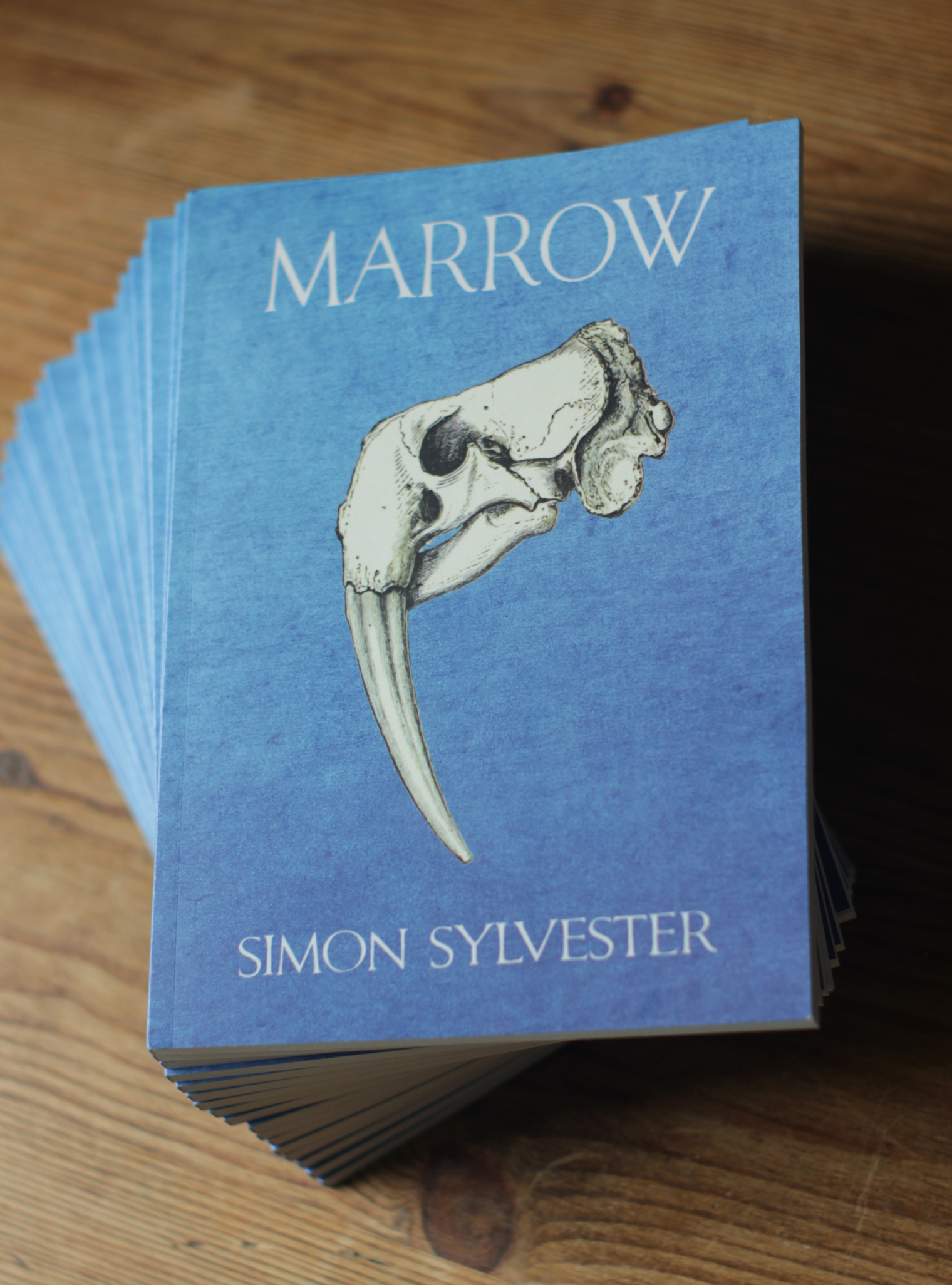
Here it is, folks. After all those late nights of InDesign tutorials, Photoshop forums, calculations, colour swatches, dimensions, budgets, cursing, blurry vision, uploads, downloads and even a little bit of writing, Marrow has arrived. I’m delighted with the print quality – thanks to Inky Little Fingers for a really good little book. Recycled paper, yo.

Marrow is a collection of 28 flash stories ranging from 13 to 1,000 words. Around half have been appeared elsewhere – in Gutter, Fractured West, Valve, Flashtag, Paragraph Planet, Causeway, Smoke, Dark Mountain and others. The stories feature fighter pilots and guinea pigs, wishing trees and wet weekends, untuned pianos, tattoos, voodoo, daydreams, ink and avocados. There are private eyes and talking poppets – lions and lemons – selkies and tsunamis.

I’ve done this so I have something to share at readings – something to hold in the hand. It feels slightly surreal, but good. If you’d like a copy, get in touch. It costs £5, plus another £1 for UK posting. If you’d like to buy one, mosey over here.

Thanks to everyone who helped me out with advice, proofing and redrafting. Couldn’t have done without you.

marrow stack

Scenes from a copy edit

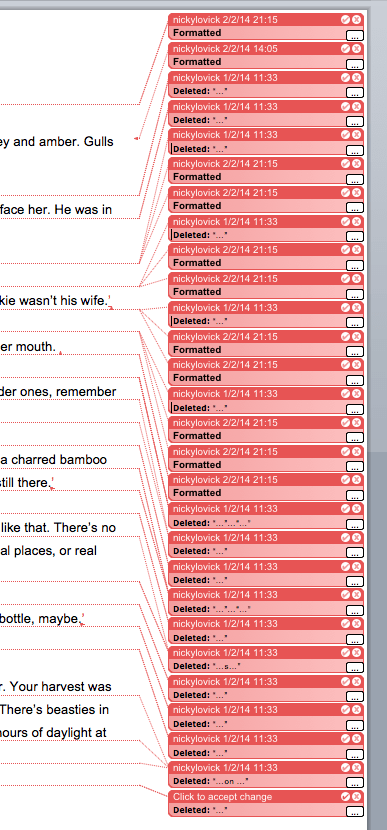
I’ve just finished the first copy edit for The Visitors. Quercus sent the documents over a fortnight ago, but I didn’t have the time until last week to open the files and survey the damage. College has been relentless lately, and I haven’t had a chance to work on my writing in what feels like forever. At first glance, I was devastated at how much work seemed to be required. Every page of the manuscript was scarred with dozens of red marks, like this:

typos

At first glance, my heart shrivelled in my chest. The thought of that all work was painful – not least as my friend Ali Shaw had already warned me of the perils of copy edits. He explained that I’d need flagons of strong cider to get through it, and I was braced for some late nights.

Thankfully, it hasn’t been too bad. On closer inspection, virtually all the changes are simply a matter of house style – thousands and thousands of “double speech marks” have now become ‘single speech marks’. I had no idea they were allowed – I’ll try writing with single speech marks from now on, but it’s going to take quite some unlearning – hitting shift with the quote key has become hardwired into my typing. Similarly, hundreds of ‘alrights’ and ‘okays’ have become ‘all rights’ and ‘OKs’. Again, I didn’t know these were the preferred form. More startling, I hadn’t realised I used those words so often – especially in dialogue. I cut many of these where the copy edit drew my attention to repetition.

As well as those thousands of standardised changes, there were infrequent issues with capitalisation. I disagreed with some of these. I don’t consider ‘Internet’ to be a proper noun, for example – small things, but they all need looking at.

On top of all that, there were two typos where I’d accidentally omitted a word – which isn’t bad in a 93,000 word manuscript – and a few instances where the copy editor felt certain words (always adverbs – be warned!) didn’t gel. I agreed with all of these, and made the changes.

All in all, it’s been a fascinating process. It took me two days, in the end. I’ve huge respect for copy editors – to be so meticulous and so creative all at once is a massive challenge, but I felt the changes were fair and sensitive. That’s now gone back to Quercus.

This is my half-term from college. I have a few goals for this week. As well as some looking after Dora while Mon has her last week painting before an exhibition in London, I want to write some new work for National Flash Fiction Day, submit something to the Flashbang contest and finish my Drowned Villages poem. Most important, I’d like to spend some time with Grisleymires – I’ve had a month away from my novel, and I miss it.

Dreamfired with Kat Quatermass

Last night was my third Dreamfired storynight, and my second reading in support. It was a wild and windswept night in Brigsteer, but a decent crowd of thirty or so had battled through the rain and sleet. The open mic is always good fun, and I was absolutely delighted to see Trev Meaney again – he’s a dazzling slam poet who I’ve seen in action at Lancaster’s Spotlight. He combines breakneck delivery with great comic timing, and his quick-fire poems never fail to impress. Last night he performed several pieces, including the excellent confessional ‘Lancaster to London’, which looks like this:

I was the last of the support acts. For the first time, I was reading from Marrow (because yes! The books turned up on Thursday. I’ll write more about that in the next post). I read The Black And The White Of It, Hutch and After The Rains – sad, dark and joyful, by turns. It seemed to go quite well – I didn’t fully relax until the second story, but then I started to enjoy it, to really take my time with the words. If I can get to that place at the start of a reading, rather than halfway through, I’ll count that a success. I’d love to perform with Trev’s confidence and flair, but I’m still learning to walk. Running comes with time.

Kat Quatermass – who runs Dreamfired – was the headliner. She performed a startlingly original sequence of contemporary fairytales, couched in feminism and queer culture. It was an excellent show. First she painted a modern city, with an abandoned fairground, pebbledash tower blocks, supermarkets and a polluted river – then she populated it with modern kids, kids looking for ways to fit in, ways to escape – ways to survive. Kat then sent her cast of disaffected adolescents into the gritty, fantastical city, where their stories intermingled with talking foxes, golden birds, the months of the year and Hungarian hag Baba Yaga. The stories chop and change and intermingle, played out in a carnival of urban fairytales. The show was equal parts Neil Gaiman, Brothers Grimm and Arcade Fire’s LP ‘The Suburbs’. Kat’s city made me think of my short story Vanishings – that sense that anything can happen in cities when the lights go down and no one’s looking. She explained that this was a work in progress – she plans to refine and develop the show over the next six months. If last night was anything to go by, audiences are in for a real treat over the lifetime of the show.

All in all, another cracker from Dreamfired. Next up, my 20-minute guest slot at Verbalise

To finish, here’s a picture of Baba Yaga’s hut, which walks around on chicken legs, because Baba Yaga is awesome. This is by illustrator Bojana Dimitrovski:

Baba Yaga hut Bojana Dimitrovski freelance illustrator advocate art

Verbalising

This is just a quick post to invite you – yes, you – along to Verbalise at the Brewery on the 22nd February.

It’s going to be ace. The open mic is already packed with talent – I know that short story guru Brindley Hallam Dennis is coming, and so is my photo challenge sparring partner BigCharlie Poet, both of whom are exceptional performers. I feel absolutely honoured to have a guest slot, and I’m really looking forward to getting my teeth stuck into such a long session – I’ve never had 20 minutes to play with before. I’m already planning my stories. I’m definitely going to read Marrow, which is about dubious experiments in home cooking, and Hutch, which is about guinea pigs vanishing from a suburban garden. I’m probably going to read The Black And The White Of It, too. All three are in my flash fiction collection, Marrow, which should – assuming I’ve managed to print it right way up and right side out – be a real buzz to read from. I’m also going to read some new work. I’ve been working on a piece about the dark side of a village bakery competition, and I also want to try running a dozen of my Twitter stories together as a quickfire rattle through relationship disasters. I think I’m going to call that 10 Second Speed Dates, and might even try and read against the clock. If there’s time, I might read a very short flash piece called Real Life, too, which was published by Paragraph Planet last week. I’m going to relish the words – to invest my confidence in these stories I’ve written and endlessly rewritten. After all that time glued to a computer, reading live is where the stories draw breath.

If you can come, it would be great to see you. Compere Ann the Poet tells me that anyone who wants an open mic slot will get one, so roll on up and bring a story…

A quick aside with some good news, too – after a couple of story rejections in January, I’m delighted to have had two acceptances in as many days. I’ve landed flash fiction Circle Stone with the tenth issue of estimable magazine Gutter, and sci-fi short story Patience in an anthology called After The Fall. Go team!

Drowned villages

I’m a little ashamed to say that I nearly didn’t post this. It’s probably the most amazing writing competition I’ve ever seen, and I’m so hungry for it that a purely selfish part of me doesn’t want anyone else to know about it. But that’s not how a writing community functions, and I’d rather the prize-winner was the best possible piece of work. So take a look at this: a brand new poetry competition where the top prize is having your work soundtracked by Mogwai.

In case you missed that, I’ll say it again.

THE TOP PRIZE IS HAVING YOUR WORK SOUNDTRACKED BY MOGWAI.

I’ve written about Mogwai before (here and here). They recorded my favourite ever album, Come On Die Young, and they’ve been one of my favourite bands for well over a decade. It’s no exaggeration to say that they have soundtracked around half my writing output. Although I don’t really count myself a poet, this is too good an opportunity to miss. What’s more, the theme is tight and thrilling: the judges are seeking poems about drowned villages, and this is where the competition gets really interesting. There’s a submerged village in Lanarkshire in Scotland; another in Cumbria in England; and a third in Gwynedd in Wales. The competition is only open to library members of those specific regions. By happy coincidence, I’ve been a member of Cumbria Libraries for years.

The judges are Scottish Makar Liz Lochhead, top poet Ian McMillan and Manic Street Preachers bassist Nicky Wire. I’ve never known a catchment so small for such an intriguing competition, such big judges and such an amazing prize. The theme really sings to me; I’ve written before about my love of French mystery drama The Returned (also soundtracked by Mogwai) which features a drowned village, and I’ve often been haunted by the thought of steeples emerging from Haweswater.

By weird coincidence, I also have the makings of a poem that fits the theme. A year or so ago, I started work on a piece about the landscapes of the Lakes. While I was pleased with the language and form, I couldn’t find a hook to hang it on, and abandoned it unfinished. This competition gives me the hook.

I’ve spent most of today working on the poem, writing and redrafting and always reading – reading it to myself, reading it to the cats – trying new forms, new phrases. I’m pleased with it, as far as it goes, but I’m really unsure about my poetry, and I don’t know how it will fare against stiff competition. I’m going to revisit several more times over the rest of the month, and submit only when it’s as tight as possible.

Soundtracked by Mogwai. A man can dream…

UPDATE – If you want to see my thoughts on the winning poems, mosey over here.

haweswater-2

Kicking monsters down the hall

Improving my spoken word performance is an ongoing mission. There’s no substitute for actually reading live, and I have my first two events of the year booked in for February. First up is a support slot at Dreamfired on Valentine’s Day, and then I’m top of the bill (eek!) for Verbalise at the end of the month.

As well as actual readings, I’ve started looking for workshops. I attended a great Spotlight session in Lancaster with Brindley Hallam Dennis last year. He set the class the truly startling task of having other people read our work. My workshop partner went through my flash piece Marrow at a third of the pace I usually do, really savouring the words, and she made it three times better. That was an important lesson. I’ve also taken a huge amount from veteran performer David Hartley’s tips for spoken word.

I watch a lot of readings, both live and online, to see how other writers project and present their words. I’ve seen some great stuff, and some terrible stuff. This performance by Shane Koyczan is absolutely, completely, one of the very best. I’ve listened to it a dozen times, and it grows ever more wonderful.

Scroobius Pip stole my bicycle

Scroobius Pip photographed for the Observer by Antonio Olmos.

I hardly ever remember my dreams, but I still have lucid recall of the time Scroobius Pip stole my bicycle. I was talking to a friend on the street when he seized the bike and ran off. I chased him into the Foundry, a dingy pub in Shoreditch. Inside, I pursued him through a labyrinth of tiny rooms, narrow corridors and crooked staircases. At every corner, I had to elbow my way through crowds of louche hipsters. Even encumbered by my bicycle, Scroobius Pip melted between them like a shadow. I couldn’t catch him, and then he vanished in the dark.

As well as being an expert ethereal bike thief, he is an exceptional performance poet. Here you’ll find him presenting an hour of spoken word on XFM. Quite aside from the tantalising prospect of a solid hour of poetry on mainstream radio, there are some absolute gems in there. It’s worth the time, so put your feet up and bask like a shark through this sea of lyrical genius.

Flash fiction challenge: Graffiti

Okay, folks. Here’s round three of the writing challenge I’m working on with performance poet Simon Hart, also known in certain Mafia circles as BigCharlie Poet. This is how it goes: we take it in turns to choose a picture, both of us write a response around it, and we post the results up here. Round one was Cathedrals. Round two was Libraries. For round three, it was my turn to pick the image, and I opted for this doozy from my Pinterest short story board:

20131220-223914.jpg

Although I had some inklings, I didn’t entirely know where to go with this at first. I was also embroiled in a marathon redraft of The Visitors, and so the challenge slid by the wayside a bit. Simon was finished in two days, the swine. Anyway, when I had a chance to work on it properly, the ideas came fairly quickly. My first story was well over a thousand words long and barely halfway in when I decided to put it on ice. It’s going to be a good piece, when I’ve time to finish it, but it’s not right for this. My second attempt was finished in a single session, plus a few tweaks the following day. As with my Libraries story, this feels like it could be the start of something much bigger; since finishing it, I’ve been brewing on a full novel about the characters and their situation, and I have some exciting ideas starting to spark. I think I’ll be taking it a lot further in the future.

It’s interesting, as well, that Simon and I had fairly similar responses to the picture. Our work in the first two challenges was quite diverse; I don’t know whether this image is more specific, and therefore limiting, or whether it actually offers more themes, and we simply happened to choose the same one.

Here’s what Simon has to say about the picture:

“What a difference an image makes! Last time out I (we) struggled a bit under the weight of a well-mined seam of creation for us with my choice of a library pic… I’m glad to say that the responsibility of the choice for this challenge came from Mr Sylvester, and, from my perspective at least, I think he should pick them all! To say that the creation of this piece contrasts with the last process would be underselling it somewhat… I also know that despite the complexity of trying to describe this picture to an audience, I really want to perform this.

This poem came about very quickly and with a very clear idea of what I wanted straight away, and I think it has delivered what I wanted from it. Seeing the image for the first time, I was struck how old monsters are never really old monsters, and they always find their way back somehow. They may change their locale and era, but they continue on…”

With that said, here’s Simon Hart’s response to the picture:

Urban Myth
by BigCharlie Poet

I started my life as a hasty scrawl
Daubed in white paint on a houses side wall
An innocuous way for me to be born
Not really planned, just hurriedly drawn
Against the time constraints of another coming dawn,
The sun creeping almost afraid of my form
And boy did I grow!
There was no way that they could ever know
What i would become, the strength i would show
And each feed of paint gave me a new glow
Though my home was a wall, i still reached for the sky
Never once did i ask for the reason why
I became a creature that makes young kids cry
Which the ancient greeks locked in a maze to die
That people turn their heads away hurts, i won’t lie…
But soon i was so big that single cans of paint didn’t suffice
When you’re twenty feet high, with the head of a bull, who do you turn to for advice?
I couldn’t exactly stroll into a restaurant and say “give me whatever’s nice”
So i had to come up with a solution of my own making
And because i couldn’t do any great british baking
I looked around and saw souls, ready for the taking…
I mean, it’s not as if you lot even notice they’re missing
You still stumble through each day like you’re barely living
Not looking away from what your tv is giving
So now, when you try to open your mind
And use your soul for guidance, you suddenly find
Yourself empty, and you don’t know the reason
But you convince yourself it’s because you watched another season
Of “I’m a Celebrity, get me out of here!”
Or you drowned your brain cells in far too much beer
That i am the culprit will never be clear…
So thank you for giving me what i really need
A simple, quick and nourishing feed
But i won’t let myself give in to my greed
I’ll satisfy myself with the odd soul waiting for a bus
The business professional in too much of a rush
The guy who’s become a 3pm lush…
Just enough to keep me going
After all, this wall doesn’t leave much room for me growing…

…and here’s my response:

Vanishings
by Simon Sylvester

We assembled at dusk and waited, scanning the skyline, binoculars flitting between the sunset buildings. Half the squadron wore night vision goggles, for all the good they’d do. It was only my third year with the division, and I was already the oldest. The kids were tense, but they struggled with all-night shifts. By two in the morning, a couple of them had dozed off. Dew glistened on their spray suits.

“Contact! Contact!”

As the radio crackled into life, slumbering officers stumbled to their feet. I checked the chamber on my gun. It was clean.

“Where are they, Jenkins?”

My voice was calmer than I felt.

“Corner of Gresham and Moorgate.”

I could hear her panic.

“Stay calm, Jenkins. We’re on our way n-.”

Even as I spoke, her scream clattered in my earpiece.

I gestured to the others. Grim-faced, we lined up and marched out, trooping along King William Street at a jog. At Bank, I gestured for the squad to slow and break formation. They fanned out, torches sweeping beams of light across the deserted road. I took point, and we stepped in silence through the Old Town.

Halfway along Prince’s Street, prickles ran down my spine. The feeling turned my bones to ice, but I knew better than to ignore it. That feeling had kept me alive for three years. I raised my fist, signalled to freeze. The squad halted at once. Nothing moved but sheets of paper, cartwheeling through the night.

On the wall ahead was a perfect, life-sized painting of Jenkins, caught mid-scream. I grimaced. She’d only been in the division three weeks. Some animal instinct made me raise my torch and scan the buildings above. The cone of light crawled up the wall into darkness.

I peered into the gloom at the edge of the light.

The top third of the building was graffitied with a gigantic white minotaur. It loomed above the street, unmoving, and for a heartbeat, I thought it was already dead. But then the minotaur grinned, and a fist clenched in my guts. Behind me, Stevenson shrieked and loosed a burst of fixative. The minotaur was too quick for him, melting back into the bricks even as the web of glue spattered across the wall. The beast darted around the corner of the building, pouring across the stone, the molecules of paint sliding from brick to brick. Splashes of fixative showered the empty wall.

“Hold your fire!” I bellowed.

The squad gathered closer together. In my earpiece, someone was hyperventilating.

“Shit! Jenkins has gone west.”

“He’s big. He’s big, sir-”

“I’ve seen worse, son. Be calm. Keep your wits about you. He’s somewhere close.”

There was another yell behind me. I spun round to see the minotaur reach out of the building, pour onto the pavement and swing his vast arm across the road, knocking half my squad to their knees. Redmayne lay closest to him. In two dimensions, his paint poured across the tarmac, wrapping around her ankle. She screamed and kicked, but the paint held fast. The minotaur yanked her to the ground, and began hauling her towards the wall. The rest of the squad were firing indiscriminately. Wherever splashes of the fixative caught the minotaur, fragments of paint were trapped within the brick, but he was big enough to shrug them off, leaving patches of himself behind. Redmayne was almost at the wall when I found a clear shot. I raised my gun, aimed and fired off half a tank. The glue showered across the beast in a net of spray, pasting his entire head. He juddered to a halt, mouth fixed in a permanent, silent roar. His painted hands continued to sweep across the bricks, scrabbling for purchase, but his head was stuck fast. One by one, my squad found targets, and soon every part of the monster was stuck to the wall. Redmayne scrambled free, sobbing, and backed into a knot of her comrades. We gathered together and looked up at the beast.

He was easily four storeys tall, made with gallons and gallons of paint. His creator had been a talented artist. Even fixed fast to the wall, the minotaur wriggled with life. His horns came to wicked points, and despite the fixative now coating his body, veins and muscles still pulsed on the brickwork. He must have taken weeks to make, back in the day. In a sense, he was even beautiful.

It was hard to remember a time before the paintings came to life.

The Cleaners arrived within the hour, all dead-eyed and paint-smeared with their mops and detergents. We watched them scrub the minotaur from the building, watched him dissolve into suds and drip into the sewers. Then they washed Jenkins from the wall, too. I didn’t watch that part. When they were done, we walked back to the depot. The new trainees looked shellshocked. The older squaddies looked harder, meaner. Redmayne wasn’t talking. She was one of my best officers, but this would be her ticket out. Poor Jenkins hadn’t even made it this far.

Every step of the way, ghosts watched us from the walls. The Cleaners worked hard, but every day, new faces stared out from the brick. And no matter how hard they worked, they couldn’t wash the faces from my nightmares.
 

‘Selkie’ by Robin Robertson

Thanks to Iain Maloney for sending this poem my way; it’s a cracking wee piece by poet Robin Robertson.

In memory of Michael Donaghy

“I’m not stopping,”
he said, shrugging off his skin
like a wet-suit, then stretching it
on the bodhran’s frame,
“let’s play.”
And he played till dawn:
all the jigs and reels
he knew, before he stood
and drained the last
from his glass, slipped back in
to the seal-skin,
into a new day, saluting us
with that famous grin:
“That’s me away.”

There’s talk of selkies in The Visitors, and this chimes nicely with the last stages of my redraft. It also makes me want to read more of Robertson’s work. Try reading this aloud; the scan is sensational.

A century of…

I realised, after posting this video about a ballerina dancing on butcher knives, that I’d hit a hundred posts on the blog. A century is still pretty arbitrary, really, but it’s as good a place as any to stop and think about why I keep a blog.

I started writing the blog six months ago to track the progress of my novel. The book was called Riptide Heart, back then. It’s now called The Visitors, and it will be published by Quercus Books in 2014. All that has happened in the lifetime of this blog. I’ve tracked my highs and lows and uncertainties throughout the publication process, from finding an agent (a year ago) to signing the contract (last week).

As well as the novel, I’ve written a lot about reading my work live, and the struggles I’ve had with my nerves. Each of my various readings has been painfully revisited, but that return has helped me filter and understand the experience. I’ve also explored my decision to gather my flash fiction into a collection, which is called Marrow, and will almost certainly be self-published, and teaching myself InDesign to lay it out professionally. (More on this soon! As I approach the end of my redraft and clear my backlog of film jobs, I should have the time and space to push ahead and get this wrapped up and printed.) I’ve posted published and unpublished flash fictions, and talked about my writing processes. I’ve written about my film work, and catalogued some of the things that I find inspiring or magical. I’ve posted galleries of the threshold spaces I’m so obsessed with.

All in all, then, my blog has ranged far wider than I ever thought it would. More than anything else, I’ve been surprised at how personally I’ve addressed some of these subjects. When I started, I expected the blog to be fairly analytical, for want of a better word; dry, professional. But in struggling with my live performance readings, and in wrangling my novel redraft, I’ve found myself at times alarmingly open about how I feel about my work. I like that the process of writing has taken me in that direction quite organically.

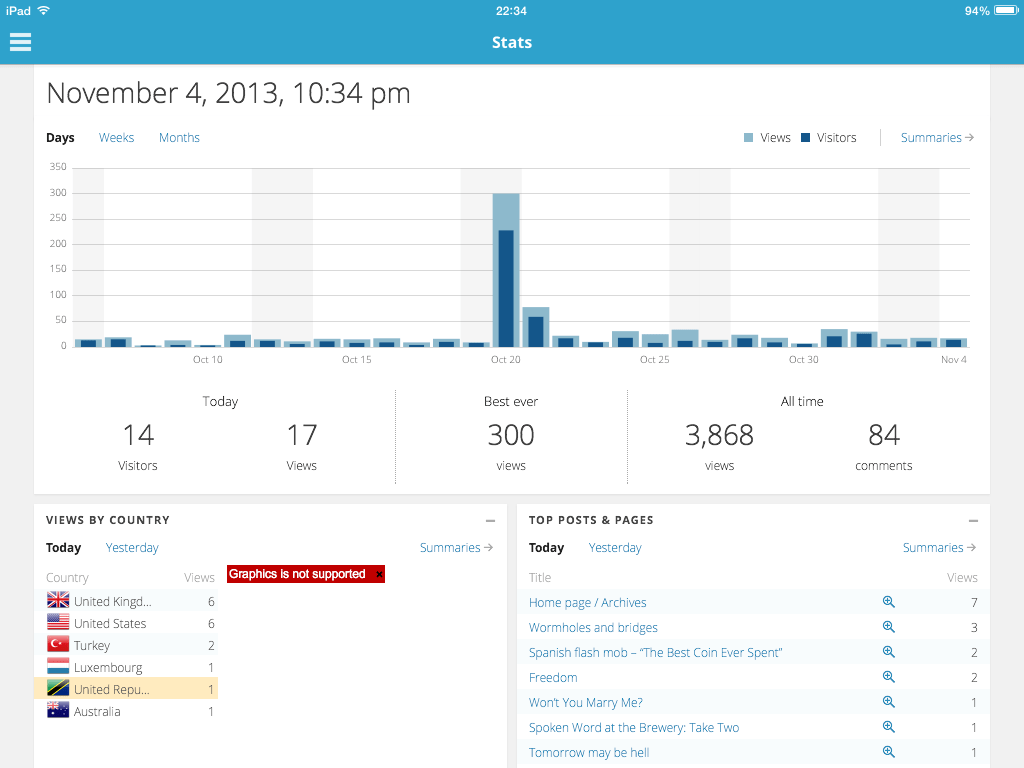
One of the joys of using WordPress is browsing through the stats, which tell me what brings people to the blog, what they look at, and often where they come from. I’ve had visitors from as far afield as Mozambique and Mongolia, searching for everything from devil dogs to gay porn. (Hopefully not everyone will be as disappointed as those two internauts.) I’ve had a week without any views, then hundreds of visitors the day Neil Gaiman retweeted this post about libraries. Have a look at this screen grab and see if you can guess which day that was:

photo

The two things that bring people to the blog most often are on the periphery of my interests; this post about a nursery rhyme and this post about a WW2 fighter pilot preserved in a peatbog. People have searched for Bancree, which is the fictional Scottish island I created for The Visitors, and for novelist friends like Iain Maloney and Ali Shaw. Lots of people come to the blog looking for information about my agent, Sue Armstrong at Conville & Walsh, and my publisher, Jane Wood at Quercus.

More than anything else, though, the blog is for me. It’s how I filter my ideas and monitor what I’m doing. Writing about my life is what I need to live my life.