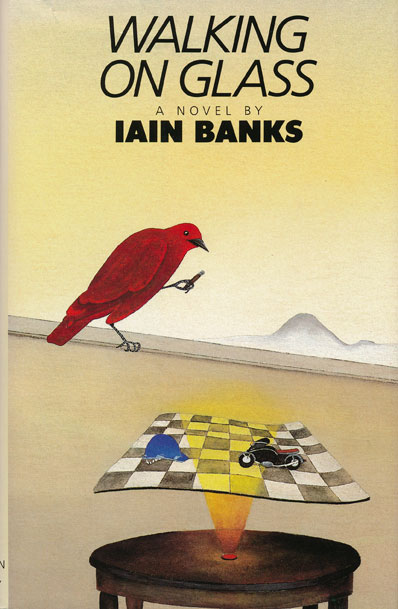
Iain Banks

Image

I was saddened yesterday by the terrible news that Iain Banks, one of my favourite authors, is suffering with terminal cancer. I enjoy his sci-fi novels (written as Iain M. Banks), but his literary fiction in particular has been a huge influence on my reading and my writing.

Three books have stuck with me above all others: Banks’ debut novel The Wasp Factory was the first of his works that I read, and it completely blew me away. Isolated and domestic but universal and thrilling, I think it was probably the first work of contemporary literary fiction I really tackled, and it paved the way for the next decade of my reading. Short and nasty, The Wasp Factory is also incredibly sad. The images in the final pages are impossibly moving. I remember being astonished that the publishers juxtaposed negative reviews – and there were plenty – alongside positive reviews. It was a gigantic two fingers raised to the establishment. Who gets to decide what constitutes literature? It was a sword in the dirt, a statement of intent: HERE I AM.

As much as I love Whit, The Crow Road, Excession, Use of Weapons, Consider Phlebas or Transition, the other two novels which really stand out for me are Walking on Glass and The Bridge. Their intricate layers of narrative, meaning and genre opened my eyes to what literature was capable of. The Bridge maps out loneliness as well as any other novel I’ve read, while Walking on Glass simultaneously combines existential nothingness with predetermined destiny.

It’s sad to think that forthcoming novel The Quarry will also be his last. More than anything else, Banks is a fantastic read, and – like Roberto Bolano, Neil Gaiman, Terry Pratchett, Denis Johnson, Sarah Waters or Jasper Fforde – I return to his books time and time again. There is nothing pompous or pretentious about his work, and like all great writers, he ultimately delivers great stories above all else. I’ve loaned his novels out to friends over the years, and I’m now missing many of my favourites; this sad news makes me want to track them down and read them again.

The Authors’ Post-War Guide

20130403-202330.jpg    20130403-202505.jpg

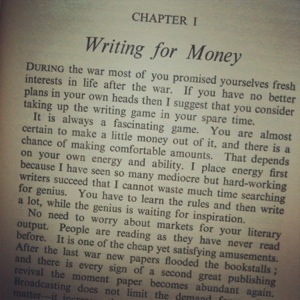
Here’s another of the books I’ve unearthed from charity shops. The ‘Authors’ Post-War Guide’ – published in 1947 – is packed full of handy hints for modern authors. Every page has a new gem. Refreshingly for a writing guide, Lawrence G. Green feels the first thing new authors must learn is “to become extremely suspicious and critical.”

Other nuggets include the useful facts that “Women like reading about jewellery”, and “Sharks have always treated me kindly”. I also like this passage, designed to help focus the mind when writing:

“Put the cat out. For this serious purpose the cat is merely a symbol. The cat may be your wife or child.”

…though it pales when compared to this advice:

“No liquor, no Benzedrine, no coffee. You can have a glass of water if you like. If you smoke, have lots of cigarettes.”

…which almost makes me want to start smoking. The “writing game” seems a lot simpler in 1947.

Books in boxes

IMG_0088       IMG_0090

IMG_0089       IMG_0091

For the last three years, Mon and I have been living with her parents. All of our things have been stored in boxes in the cellar, with the inevitable result that whenever we’ve needed a particular item – a plug adaptor, a passport, a DVD – we’ve had to rummage and excavate our possessions to find the missing thing. Some boxes were needed regularly, and these stayed on the surface. Others were out of sight and out of mind, and they sunk deeper into the mire, their contents forgotten.

We moved into our own house on Christmas Eve. Moving has been a slow process, and it’s only today that we brought across the last of our boxes. As we unpacked and sorted the contents, I was delighted to discover my research books. These are the weird volumes that have grabbed my interest in charity shops and jumble sales. I seldom know exactly why they spark my interest, but they’re always about something peculiar, and they trigger my imagination. After three years, it was a strange feeling, both energising and nostalgic, to unpack this box of forgotten books and browse again through a treasure trove of ideas and inspiration. There are studies of sumo wrestling, devils, tattoos, smuggling, bicycle mechanics, Vikings, saints, medicine, art, juggling and more…

Of the titles pictured here, Whale Nation inspired my long-running novella-in-progress, Year of the Whale, while David Pelham’s Kites (a classic of the kiting genre) and Stephen Turnbull’s Ninja are dripfeeding imagery and history into plans for my next novel. Finally, P.V. Glob’s The Bog People (1971) is research for another story to be written in the distant future, if I ever have the time to write it.

Part of me wishes I was called P.V. Glob.