
Another year, another holiday. A fortnight before our wedding, and with a thousand things to organise, Mon and I have taken Dora for a week on Kefalonia in the Greek Ionian islands. Some people thought we were crazy, leaving so soon before the big day, and others thought we’d done exactly the right thing. It’s been wonderful. Our studio was cheap and cheerful, but had stunning views of the sea. The beach at Lourdas was only a few minutes away. We’ve done as much sunbathing as Dora would allow, and spent the rest of the time building bad sandcastles or splashing in the shallows. We visited Melissina cave, where they filmed The Goonies, and drove round onto the Lixouri peninsula to the secluded beach cove of Petanoi, ringed with sheer white cliffs.
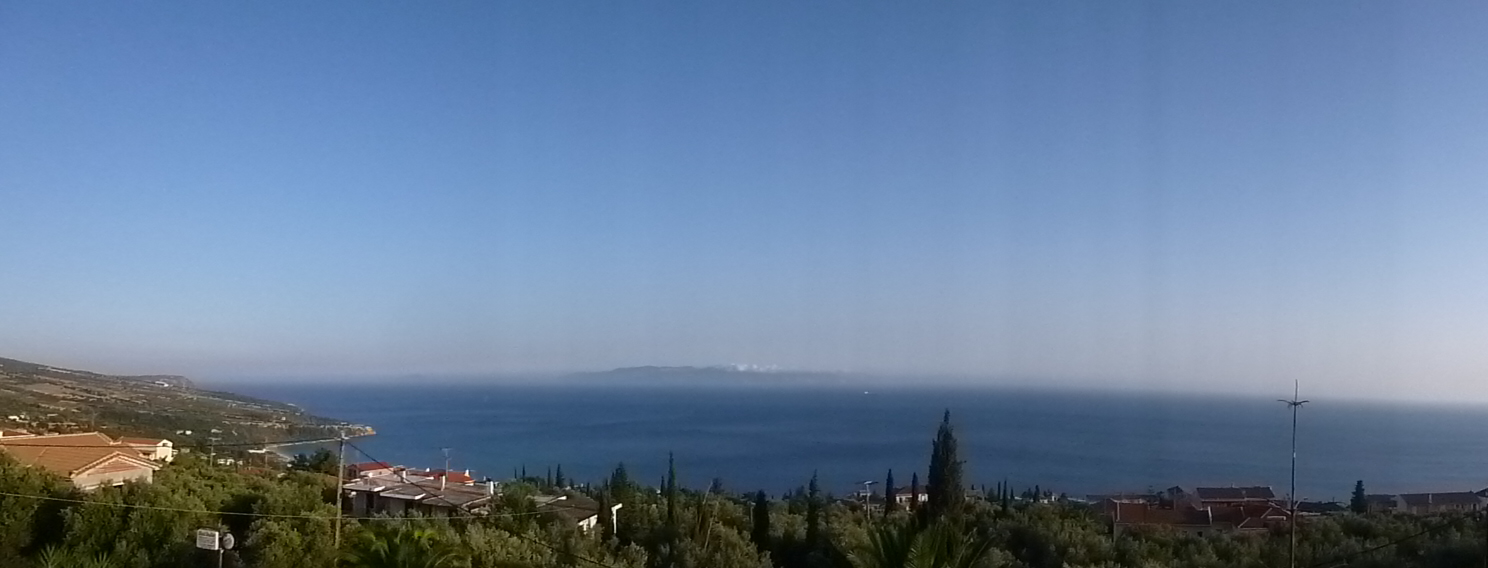 View from our balcony
Kefalonia is intoxicating. Olive trees spill into the verges, and fig trees grow in long-abandoned lots. The cliff-top hairpins are graffitied with faded communist slogans. Goats dawdle as they cross the road in scraggy herds. Each of their bells is tuned slightly differently, so the goatherd knows where each animal is foraging. When they’re hidden by the pines, the bells sound like secret orchestras, playing just for you. Skinny feral kittens bat at grass stalks and dry leaves. Cacti grow on roadsides. Beehives, painted rainbow bright, cling to precipitous hillsides. After lunch, old men sit in the meagre shade of trees and smoke. All the while, the island is alive with cicadas. They chatter all day in a raucous chorus that never stops, resounding all around in a cacophony of tones and clashing rhythms. After a day or two, I learned to tune it out, but occasionally I’d become suddenly, urgently conscious of the racket, and the world would explode again with sound. In the hour either side of sunset, when the heat was exquisite, the evening air grew heady with jasmine and lemon. The jumble of architecture felt strange and at times a little sad. The global crash hit Greece harder than most, and there are abandoned building sites everywhere. The skeletons of these half-formed houses cling to the hills and wrap themselves in vines. It’s an extraordinary place.
One of my favourite things about going on holiday is having the time to read. I’ve been reading a little more often in the last few months – trying not to work so late, and going to bed with a book instead – but on holiday, I can gorge myself. This time round, I went through The End Of Mr Y by Scarlett Thomas, Thursbitch by Alan Garner, Hey Hey Hey Hey Hey Hey Hey Hey by Fat Roland, The Coma by Alex Garland, It’s Lovely To Be Here by James Yorkston, Bring Up The Bodies by Hilary Mantel and The Evil Seed by Joanne Harris.
I love Joanne Harris, but struggled to get into The Evil Seed. As Harris explains in her introduction, it was her first novel, and she doesn’t feel she was firing on all cylinders. I found the regular switch of narrators a little jarring, for all that her writing was as wonderful as ever. Harris is a master, but The Evil Seed simply wasn’t for me. I also struggled with The End Of Mr Y. It started well, with a great premise – in a second-hand bookshop, a research student discovers a novel no one has seen in a hundred years. The book is supposed to be cursed – anyone who reads it will die. What a brilliant idea for a novel! Scarlett Thomas is extremely good at explaining the complex scientific theories that underpin the book, but as the plot unfolds, The End Of Mr Y felt increasingly like a collection of philosophical discussions tacked together with incidental actions. It was too disjointed for me – no flow.
I bought The Coma by Alex Garland years ago, and have been saving it until I finished writing The Year Of The Whale – because Garland’s book is also an illustrated novella, which is how I’d like The Whale to appear, if it ever does. It’s another good premise – a man exploring his own coma for meaning about his life – but one that is better managed in Marabou Stork Nightmares by Irvine Welsh or The Bridge by Iain Banks. Using minimal text, Garland brilliantly navigates his way around the dreamworld of the coma, wonderfully abetted by stark, startling woodcuts, but the final sequences became convoluted and disjointed with exposition, breaking an otherwise immersive experience. It was a shame, on finishing the novella, to realise that it came to a little less than the sum of its excellent parts.
Now we come to Hey Hey Hey Hey Hey Hey Hey Hey, the second collection of flash fiction by Fat Roland. Disclaimer: I know and like Fats. I hope that won’t detract from my review of an excellent collection of shorter stories. Fats tends towards the weird in his work – or the really weird, in fact – often working with the mundane to expose the inherent strangeness of this grand and rolling shambles we call life. And he’s extremely good at it, too. Hey Hey Hey is a generally very strong collection, but some of the stories are exceptional: stand-outs for me were The Listener, and Michael Is A Horse, A Beautiful Horse, which rank amongst the best flash pieces I’ve ever read. I preferred Hey Hey Hey to his first collection; although Andropiean Galactic Lego Set Blues is also good, this second collection feels more assured in its use and abuse of the surreal, more convincing. It’s funny, chilling and thrilling, all at once.
 Several of the stories are about swimming pools, and then I noticed this. Curious, no?
It’s Lovely To Be Here is a collection of James Yorkston’s touring diaries. For those lucky individuals who have still to discover James Yorkston, he sounds like this:
…and he’s one of my favourite musicians. I’ve seen him play three times – by accident at The Raigmore Motel in Inverness back in 2001, I think, supported by Malcolm Middleton, though it may have been the other way round; then with his full band at The Brewery a couple of years ago, which is one my all-time top gigs; and then solo at The Dukes in Lancaster last year. He’s brilliant live, and these diaries – witty, honest, funny, poignant and a little sly – give a compelling insight into the flip side of life as a touring musician. I guess it gave me pause to think of the times I’ve approached him (or other musicians) after a gig, gushing praise and wishing well. Especially now I’ve started performing my stories live (nowhere near the same experience, but in the same universe, I suppose), I better appreciate that sometimes that’s the last thing a performer wants – to be inundated with people, and all the psychic tension and expectations they bring with them, when they’d rather go to bed. These diaries are funny and wickedly honest.
I never planned on reading Bring Up The Bodies by Hilary Mantel. I absolutely hated Beyond Black, the only other Mantel novel I’d tried, and I was therefore cynical about the praise heaped on this book and its precedent, Wolf Hall. But when I’d finished all the books I’d brought with me, I had to turn to the graveyard of dog-eared abandoned holiday reads in the hotel. Bring Up The Bodies was the only one I even halfway fancied, though I started reading with reluctance. And do you know what? It’s magnificent. Set in the court of Henry VIII, it plays out the last few months of the life of Anne Boleyn from the perspective of Thomas Cromwell, the king’s fixer. Bizarrely, Bring Up The Bodies actually gave me what I was expecting, but failed to find, in George R R Martin’s Song Of Ice And Fire – thrilling, page-turning intrigue on the price of power and the rise and fall of dynasties. It reads like The Godfather. Mantel’s Cromwell is an absolutely astounding narrator. I’m definitely going to seek out Wolf Hall, now, and I was delighted to see in the author’s note that she has more plans for Cromwell.
Finally, there’s Thursbitch by Alan Garner. I’m relatively new to Garner, off the back of his wonderful collection of British Fairy Tales and his short novel Strandloper, though I probably read The Owl Service when I was a kid. I’m still digesting Thursbitch. It’s profound and important, but it isn’t much fun. Garner creates worlds real enough to touch. His prose is so sparse, his stories so lean, that it often feels like there’s nothing there at all – as though his work is invisible, and his books are slices in time, windows into centuries when the world was young and hungry, and land still mattered. Thursbitch is about an old magic, a northern magic of white hares and white bulls and bees, of toadstools and snakes. It’s almost voodoo. A magic of the stones and the seasons and the night sky and the bog. It’s a magic of balance – of keeping the land and the people in check, pragmatic, without mysticism or spirituality. It’s heady stuff, and I’m still reeling. Like Strandloper, it’s dense, often using language so archaic it feels alien, and Garner gives nothing for free. I’ll read it again in a few years, I think, and see how it’s changed – how I’ve changed.
Back into pre-wedding mania. The garden has bloomed without us. The Black-eyed Susan has climbed to the top of the trellis, and the Russian vine is turning into a triffid. They remind me of the plants that explode everywhere in Kefalonia, wild and reckless in the dust and dirt. It’s strange to come home. Mon and I talk a lot about living abroad. I get depressed by the daily horrors this government continues to inflict on anyone who isn’t already rich, and I harbour visions of growing my own peppers and onions and garlic and chillies. We talk of Spain and France. Of a simpler life, I suppose, where we’re not drowning in screens and SATs. One where I can write and Mon can paint and Dora can chase katydids in the pear trees. There are times it feels like a boy’s dream, to run away, and times it feels like the brightest, broadest road we could take.
Halfway through the holiday, there was an insect drowning in the pool. It was my turn to rescue it, so I slipped into the water, swam across and scooped it out on the end of one of Dora’s toys. It was a honeybee. It dried in an instant and flew away, and I swam back to the edge of the pool. Just before I clambered out, I spotted something and stopped. It was a speck, no more than three millimetres long, but it was unmistakably a mantis, intricate and perfect as clockwork. I’d never seen one in the wild. I called Mon across to have a look. Even as we watched, it flexed its killer forelegs, snap snap, and marched across the baking tiles, three millimetres tall and a king of the world. The day before, driving back from the cove at Petanoi, Mon saw a golden eagle.
I love Cumbria, but there’s a splinter in my head that says we could be living cleaner, should be living simpler. Living slow.


 Simon Sylvester