
I’m just delighted to share the news that my good friend Iain Maloney has secured a publishing deal for his excellent novel The Wasting Embers. Having been lucky enough to glimpse an early draft, I’m really pleased and excited that this is going to hit the shelves next year.
Tag: writer
Tomorrow may be hell
Further to my recent post on the terrors of redrafting, I’ve just discovered this excellent line from Neil Gaiman:

Freedom
This is another post about editing. Until today, it hasn’t been going very well. A variety of things have built into a general malaise, and I’ve been struggling to get myself out of it. Yesterday, I read this from Matt Haig: “As a writer, you need to have a thick skin. But you also need to be a hypersensitive wreck to write in the first place.”
Well, for the last few days, I’ve been in hypersensitive wreck mode. I swing in and out of these phases. When a novel is going well, I’m buoyed up and float through life, with at least half my mind firmly in my story, and nothing else really gets in the way. But when it’s going badly, I obsess over and over again on all my many failings and how terrible the novel is, convinced that the universe is going to wake up at any moment and realise that I shouldn’t have made it even this far.
This is my half-term from college. Although I’d done a few line edits on The Visitors, I hadn’t had a chance to really get to work until this week, and it began really badly. I started by making the huge, ugly structural changes I was worried about, cutting and pasting and wreaking a sweeping destruction on the first third of my manuscript. And that left me really despondent. I won’t run through all my paranoias here, but I was really wallowing. There seemed an insurmountable amount of work to do, and part of the plot was now back to front. I convinced myself that I’d shattered whatever was good about it in the first place. I spent some time moaning on Twitter, and went to bed feeling very sorry for myself. At the end of the day, I listened to this about twenty times, trying to summon some strength:
…but to little avail. I started today prepared for more of the same. Scared of going back to the manuscript, I farted around on Twitter, and on Facebook, and read the paper, and spent half an hour trying to read all of the internet. I’d made myself quite genuinely scared of the novel, and was looking for distractions to keep myself away from it. Then I remembered reading about something called Freedom. It’s a program which blocks the internet completely, and can’t be disabled without turning your computer off and on again. It cost $10, and I bought it. I installed it, and I set it to run for eight hours. Then I opened the novel, returned to the redraft, and tried to spend the day at work. Here’s how it went:
There are obvious breaks – between chapters, mostly – when I used to check my email. I couldn’t do that. Instead, I had to keep writing. I used to post updates about my progress, or lack thereof – I couldn’t do that. I couldn’t build a Spotify playlist. I couldn’t read my students’ blogs. I couldn’t add to my Pinterest boards. I couldn’t check my bank balance, or look at lenses I can’t afford on eBay. I couldn’t blog about how shitty I was feeling. I could only work, and so I did. I only stopped for cups of tea and to feed the cats. I checked my email at lunchtime on the iPad, but otherwise went without. And it was brilliant. Immersed in the novel, without distractions, I worked hard, fast, and well. I was coming up with good stuff for the first time in a week, building bridges between ripped sections, smoothing out the prose, and even discovering new connections to expand and consolidate the plot. More importantly, I was feeling good about again. That feeling is so important. Without confidence in your story, it’s impossible to write with conviction.
Strange to reflect that I needed technology to rid me of technology. Freedom truly gave me freedom to work. I know it’s daft to spend money on something willpower should do for free, but Freedom even removed the choice. Even after a single session, I believe it’s the best money I’ve ever spent on my writing. To be clear, I don’t have a motivation problem. When I’m in the flow of my story, I can write continually for hours without stopping. But when I’m as full of dread as I was yesterday, I seek any reason to avoid dealing with the thing that causes me dread.
This redraft is hard. I’m making big changes, and some of them have left me feeling a little divorced from the story. One of my characters has changed her name, and it’s taken me a full fortnight to feel like I know her again. As petty as it sounds, I worked with MS Word’s ‘Track Changes’ function for the first few sessions, and it was driving me distracted, churning out balloons and dotted lines for every tiny change. Thankfully, Jane at Quercus gave her blessing for me to move onto a plain document. I know it’s daft, but that’s helped a lot.
I suppose that demolishing parts of the story was always going to be demoralising, and perhaps it’s no surprise I’ve found it so hard to stay positive about the redraft. But now most of the destruction is done, and I’m starting to rebuild, I’m feeling better all the time. When things go well, it gives me a surge of confidence in what I do, and where I want the story to go. I’m not all the way there yet, and there’s still an awful lot to do, but – for now – I’ve turned a corner.
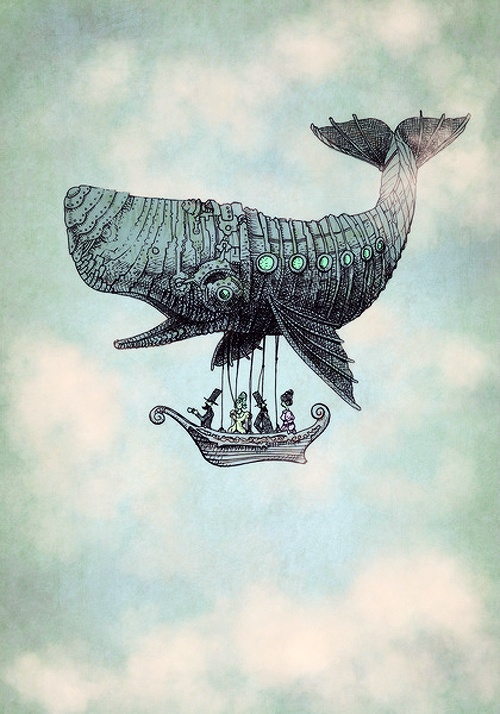
Okay, that’s enough for now. Here’s a picture of a steampunk sperm whale hot air balloon. Writers – get Freedom. It changes everything.
Loki
Well, that’s my first Dreamfired done and dusted. It was a really good night – more people need to know about the Storynights.
First up was banjo virtuoso Bill Lloyd. He’s a legend in Cumbria and the north, and he didn’t disappoint, starting with a haunting ‘Wayfaring Stranger’, and segueing into a range of folk songs from America and Ireland. My storyteller uncle Rich Sylvester had the next slot, relating an anecdote about exploring the London Olympic equestrian venue at midnight with a bellyful of Russian beer. It was very funny. Rich is an extremely affable raconteur, and his stories are always engaging – I haven’t seen his work for a few years, and it was great to be part of the audience.
I was on after Rich. I’d decided to get into the traditional spirit by performing without notes. In the minutes before going onstage, my nerves were worse than ever, but I settled fairly quickly. I read two stories I’ve been practising lately – Circle Stone and The Lion Tamer’s Daughter. I stumbled once in Lion Tamer, and for a moment I thought I would go entirely blank – but I recovered, found my place and delivered the rest without a hitch. Circle Stone is an extremely quick flash piece of only 75 words, and it’s surreal enough to counter the darkness of Lion Tamer. The two work well in combination, but I’m going to semi-retire them now. They’re both destined for my flash fiction collection Marrow, and I’ll try and get them published elsewhere first, but I’ve read them a lot recently, and it’s time for some new material. On reflection, though, the reading went well. I don’t think I’ll make a habit of performing without notes, but Dreamfired was a perfect place to give it a whirl.
After me came a poet, whose name I didn’t catch, who read some playfully nostalgic pieces; and then a story about a 21st century Grim Reaper. Bill Lloyd returned to round off the first part of the night with another couple of songs – his cover of Frankie’s Gun, which I absolutely love – it was Bill who introduced me to the music of The Felice Brothers – and one of his own compositions, a haunting Armenian lament.
This is what Frankie’s Gun looks like:
After the interval came Emily Parrish, aka Scandalmongers. She walked onto the stage singing and beating a drum, and launched without preamble into the Norse creation myth. Her show explores the role of Loki, the trickster god, and all his jealousies and cruelty and fun. What made the show all the more remarkable was the way she entwined Norse mythology with her own childhood. The transitions between the Cotswolds and Asgard were frankly astonishing – from the top of a perfect climbing tree to the horrors whispered into Baldr’s troubled brain. It was lyrical, visceral and intense, and it left the audience stunned.

Loki comes highly recommended from me – catch it if you can.
Thanks, too, to Kat Quatermass, who organises and hosts Dreamfired. Lovely to meet her after months of email contact. I’m definitely going back in November to catch Peter Chand performing Grimm’s Sheesha.
What’s next for me, then? I’ve been thinking about my novel edits for a week or so – a process I refer to as ‘brewing’ – and I’m almost ready to start work. I mentioned in a previous post the structural changes I need to make, and my uncertainty about how to make some of those changes. That has passed. I now know where that character is going to enter the story. Although it means a lot of work, I feel secure in the knowledge of how to do it, so a lot of that worry has eased.
My next booked reading is at the Brewery’s Spoken Word night in February, though I’ll try and land a few more open mic spots before then. Stay tuned. And go to Dreamfired.
Little paranoias
Jane Wood, my editor at Quercus Books, sent her notes on my novel this week. It’s a moment I’ve been dreading and craving in equal measure, and I wanted to take a moment to think about what it means now it’s actually here.
I’ve already done four drafts of The Visitors. Some of the drafts were very heavy, and some were extremely light. Redrafting is essential to all writing – I still, even now, return to stories published years ago to tweak and rework them. I have little paranoias about all my work, and can’t help but return to it. Sometimes I make changes of single words, and other times I excise entire scenes. Sometimes I catch myself totally rewriting published work, and I have to make myself leave it behind – I have to take stock and force myself to walk away.
On the second draft of The Visitors, I pussyfooted around Sue’s notes, making tiny changes, scared of diving in. When I came to a third draft, I made myself stamp on it, brutalising the manuscript with broad changes and moving onto the next alteration, no matter how ugly the massacre I left behind. Then, when it looked like a crime scene, I started rebuilding again. That’s what I’ll do this time, too, no matter how hard I find it. And I’m going to find it hard.
Whenever I come to editing and redrafting, I think there are two broad categories of change:
Cosmetic
These are the easy ones, often little more involved than line edits. Cosmetic changes this time include switching a character’s name, cutting some internal monologue and reconsidering some of the vocabulary used by my main character. I could blitz through that in a day, tops. Unfortunately, the other editing category is:
Structural
…and this is the big stuff. Making structural alterations means redrawing the map of the story while trying to maintain the same emotional trajectory, and that can be difficult to keep in balance. In this case, I have two substantial changes to make. Firstly, a minor character needs to become a major character, and he needs to appear much sooner in the story. I already know this is going to be awkward, because I attempted something similar in the third draft, and I struggled to bump him up the narrative even to his current position. It’s going to be tough to find or create somewhere to introduce him sooner.
The second change initially felt even more challenging, but on reflection perhaps isn’t quite so bad. Jane has suggested a different direction for the ending that I’m really excited about. At first I was really worried about it, but I’m starting to see it as a case of unravelling the current conclusion and retying the strands of story into a different shape of knot. This will involve more writing, but actually it’s less of a challenge – with the current ending gone, I’ll be writing into blank space. That’s a thrilling proposition at this late stage of the manuscript.
While it’s still a skeleton, a novel plot is essentially arbitrary. Things can be changed extremely quickly and easily. New characters come and go, and the story shifts like a dune, blown into organic and occasionally bizarre shapes by the wind of imagination. But the more developed a story becomes, the less arbitrarily it can change. There comes a point where making big alterations means breaking the momentum you’ve fought to generate, then patching up the holes and hoping no-one can tell the difference. That’s where a writer needs to have paranoid convictions about the emotional tone of their work, and strive to make it as cohesive as possible in plot, character, voice and soul, then work it again and again and again, hammering and thrashing and beating and combing through the manuscript until it’s carved against your optic nerve.
Editing is frantic. It’s really hard. Throughout the process, a storm cloud hangs over you, an implicit sense that you didn’t do it well enough the first time. Then there’s the crashing changes you wreak on something you loved. And then there’s the dread that whatever you make to take its place won’t come close to what you had before. It’s an exciting time, too, but the whole process is riven with a crawling, monstrous, excruciating anxiety.
This is mostly my load to carry, but I’m glad I’m not taking the journey alone. I’m now far too close to The Visitors to critically appreciate it, and working with other people helps triangulate my own perspective about the story. I’ve often stated my belief that writing is as much about the community as the individual – not least as it counts for little without a reader. When I write short stories, I read them to Mon, and I send them to writer friends. And I pay attention to what they say, even if I disagree. Working with other people – and working with Jane and Sue, now – has repeatedly shown me the importance of opening myself and my ideas to an audience. I have people I can talk to, and that makes me lucky.
Of course, I say this before actually beginning the edits. Try me in a week.
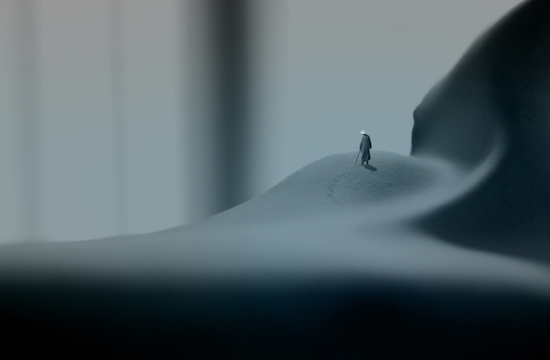
Photo lifted from ‘Minuscule Series’ by Maité Guerrero
What’s in a name…
This post is about names for stories. Sometimes I come up with a title first – I have a story called You Don’t Talk To The Driver, The Driver Talks To You, which developed entirely from the title. And sometimes the title is really obvious – The Lion Tamer’s Daughter couldn’t be anything else. Sometimes it’s lifted from a phrase in the story, like The First Time I Died. Sometimes it evolves after a struggle, like my novella The Year Of The Whale (which I will finish one day). And sometimes, I just can’t think of anything at all. And all this is relevant because we’ve just changed the name of my novel.
I’ve been calling it Riptide for the last six months, but my novel has had dozens of different names. I went through bucketfuls of working titles – occasionally to the point that I was changing it two or three times in a single writing session. Nothing stuck. I’d reached a point where the novel was finished, and I wanted to send it away, but it didn’t have a name. After another few days dedicated only to looking for titles, I called it Riptide Heart because it had to be called something, then sent it to some friends.
“Love the book, mate,” came one of my first responses, “but the title’s balls.”
In the end, a lot of people said pretty much the same thing. But no-one had any better ideas, so I sent it off to Sue as Riptide Heart. I used Dora’s grubby paw to click the send button. A week later, Sue got back to me, and here we are – a year has passed, and once more I’ve been driving myself up the fucking wall looking for a name for the book.
We moved on from Riptide Heart fairly quickly, and I was fine with that. Everyone involved has been calling it Riptide, because that’s better than ‘the book’ or the ‘the novel’. But the closer we’ve moved towards publication, the more important the title has become. Sue and Jane and I have been searching for a month. Churning through endless combinations of possibilities has turned my brain to mush. I’ve ransacked the manuscript half a dozen times and tried literally hundreds of potential titles. Last week it reached a point where not only could I not think of anything better, but I was no longer capable of judging other suggestions. That’s one of the reasons I’m fortunate to be working with such professional people at Quercus and Conville & Walsh. Linking wonderfully to the stunning cover art commissioned by Jane, I’m delighted that we’ve finally settled on a name which I’m happy with – my first novel is now and forevermore called The Visitors.
So, what’s in a name? A rose would smell as sweet, and so on… but a novel is like a child, and you spend so much time with it as it grows, learning what it wants to be, getting to grips with its tantrums and moods, guiding its ambitions, and being constantly surprised and amazed by what it becomes… I can’t imagine Dora by any other name. Knowing that Riptide was a temporary title hasn’t lessened the jolt of losing it; after so many months, it had become Riptide.
The Visitors grows on me by the day. It has the human element I wanted so badly, and it has a ghostly feel which I love. As my friend Iain pointed out, I spent so long looking for The Best Name Of Any Book In The World Ever Ever Ever – which doesn’t exist, of course – that I stopped being able to consider what was right in front of me. I’ve often used the idiom of not seeing the wood for trees when discussing writing – and writing novels in particular – and it’s proved true for this title search as well.
I can barely express my relief of being out of those woods…
Jane’s editorial notes have arrived, and I’m really excited about some of her ideas. Next stop: the final draft.

R.I.P. Elmore Leonard

American crime maestro Elmore Leonard has passed away at the age of 87.
I’ll remember him best for ‘The Tonto Woman and other stories‘, his excellent collection of Western short stories, including the classic ‘Three-ten to Yuma’.
Leonard’s prose became increasingly minimalistic as his work developed, stripping away everything but story. This led to very stark, albeit engrossing, reading. Here are his famous rules for writers. I’m partially guilty of breaking some of these… even though I agree with most of them.
A little light reading
We’ve just returned from a brilliant fortnight in France. We racked up 2,500 miles in a round trip that encompassed Ile de Noirmoutier, which is reached by a two-mile causeway at low tide; Rauzan, where we camped in the shadow of a ruined medieval castle; and Marais Poitevin. This last spot, nicknamed ‘Green Venice’, is one of the most amazing places I’ve ever seen. Centuries ago, it was a vast swamp, but Dutch settlers drained it with a labyrinth of canals and ditches, leaving hundreds of island pastures connected by causeways and bridges. The architecture is just as unique, with balconies and shutters adorning every house, and punts moored to jetties in gardens. Poplars and alders tower into the sky, the canals are thick with lurid green algae. Fat dragonflies zip and pop between shrubs and creepers, and the trees are alive with cicadas. Filtered through high branches and reflected from the water, the light itself is tinted green.

It’s genuinely one of the most incredible landscapes I’ve experienced and, much like Grogport for Riptide, it’s been a real inspiration for my next novel. In the space of a few days, I filled an A4 pad with notes and dialogue, and I feel really excited about starting work. There’s still plenty to do before I can begin, but the foundations now feel firmly set.
The other great thing about the holiday was having time to read. I managed six books, which is no mean feat when juggling a toddler in a campsite. And I had a great run of books – not a single dud:
The Tiger’s Wife by Tea Obreht was bold and convincing, subtly switching a range of voices to make folk myths contemporary through personal memory. I enjoyed it a lot, but found it ever so slightly cold, and wasn’t as blown away as its reputation suggests.
Cumbrian Folk Tales by Taffy Thomas was a fascinating collection of the county’s legends and myths, made all the more immediate through its connections to a landscape I’m starting to know. It was amusing to recognise the names of not just local places, but also local people – people I’ve met, worked with, drunk with. The tales were strongest when connected to geography, giving meaning and history to a witch’s cauldron or a devil’s bridge.
I read The Blackhouse by Peter May – this was a present from Jane Wood, my publisher at Quercus. She thought I’d like a look because, like Riptide, it’s a crime story set in the Hebrides, though it doesn’t have the supernatural elements of my book. I enjoyed it a lot. The plot was dovetail-tight and engrossing, and the landscape was intoxicating.
Next up was I Love You When I’m Drunk by Empar Moliner, Spanish short stories in translation through the tremendous Comma Press. Despite some uncharacteristic typos from an excellent publisher, it’s a solid collection, each story exploring and exploding conceits of modern life. Some of the stories felt a bit like shooting fish in a barrel – taking aim at soft targets of liberal, middle-class pomp – but the writing was good throughout, and there were many outstanding moments.
Moliner’s collection was good, but the next book was astonishing – a class apart. The Dog Of The Marriage gathers Amy Hempel‘s four short story collections into a single volume, and they are consistently superb. There isn’t a single wrong note across dozens of stories. Hempel’s work is voiced through emotionally damaged or stunted narrators, trapped or somehow left behind in their lives, caught between stasis and decay. The stories are not without hope, though, and Hempel writes with unceasing, unfailing humanity. Her sentences and structure are scintillating. I cannot recommend this highly enough. This is the sort of book I buy two copies of, expecting to have one out on loan.

Finally, I read Snake Ropes by Jess Richards. This was another corker. Alternate narrators explore life on a mysterious island, ‘just off the edge of the map’, eventually combining to bring the distinct halves of the story together around a single, long-forgotten trauma. This novel holds trade and barter at its heart, exploring themes of presence and absence, balance and weight; of exchange, and what it means to give and get. It’s a real triumph, made all the more masterful in how Richards weaves the fantastical through the fabric of base human instinct, conjuring talking keys, sentient trees, and a walking doll with a seashell for a heart:

The last fortnight has reminded me, as stupid as it sounds, of how much I love to read, and made it painfully apparent how little reading time my regular schedule affords me. I’m determined – on top of carving out more writing time – to read more. I miss it.
This holiday has been essential. I’ve worked stupidly hard over the last two years without much of a break, and I’ve badly wanted some time off. Looking ahead, the next two months are going to be frantic – but I feel better for a break. I have my next novel blocked out and the sights and scents of a swamp fresh in my mind. One more draft of Riptide to go, and then I’ll be starting my new story.
Stephen King on writing
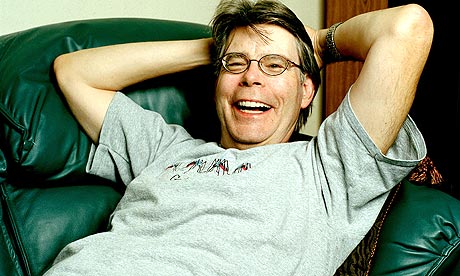
I like this. I like this very much. Here’s an assembly of 20 quotes about writing from horror maestro Stephen King. I like the way he blends a wonder at the world with the coal face, roll your sleeves up, nuts and bolts of writing.
I read most of King’s work when I was 13 or 14, taking them three at a time from the mobile library that did the rounds outside Inverness. Cujo, Carrie, It and The Stand have all stuck in my mind; I recently found a copy of The Stand in a charity shop, and I’m looking forward to rereading it this summer. I’m not sure I could handle another bout of It.
Swamp Thing indahouse

Friends Iona and Ali Shaw stayed with us this week. Ali and I studied English at Lancaster University, many moons ago, long before I started writing and when Ali was already laying the groundwork for his career. He’s a brilliant author, with novels The Girl With Glass Feet and The Man Who Rained winning awards and translations all over the place. I was privileged enough to read an early draft of Glass Feet, and Ali kindly took the time to read through my first draft of Riptide. His subsequent advice, notes and hour-long phonecalls were extremely helpful in shaping my third and final draft. Over the last few months, I’ve leaned heavily on Ali’s experience of being published, and his knowledge has helped me work out some of what I’m doing with the good people at Quercus Books.
Mon and I don’t get to see Ali and Iona very often, so it was fantastic to have a long overdue catch-up. We mostly nattered about babies, but we also discussed our current projects (his new book sounds AMAZING) and some wider publishing news. Ali recommended two things: firstly, that I try Scrivener. It’s a writing program dedicated towards managing large documents, with all kinds of bells and whistles for organising plots, characters, locations and notes. The various features sound extremely useful, and it’s available on a free 30-day trial, so I’ll definitely give it a go.
The second recommendation was for Alan Moore’s Swamp Thing. I was describing my own new work, which is set in a maze of bogs and marshes, and Ali (who reads more graphic novels than me), thought Swamp Thing might be good for inspiration and ideas; another book on my birthday wishlist, then. I enjoy graphic novels, and own several of the real classics (Maus, Watchmen, From Hell, Ghost World, etc.) but seldom know where to begin with trying something new. Good stuff.
 Simon Sylvester