Kicking monsters down the hall

Improving my spoken word performance is an ongoing mission. There’s no substitute for actually reading live, and I have my first two events of the year booked in for February. First up is a support slot at Dreamfired on Valentine’s Day, and then I’m top of the bill (eek!) for Verbalise at the end of the month.

As well as actual readings, I’ve started looking for workshops. I attended a great Spotlight session in Lancaster with Brindley Hallam Dennis last year. He set the class the truly startling task of having other people read our work. My workshop partner went through my flash piece Marrow at a third of the pace I usually do, really savouring the words, and she made it three times better. That was an important lesson. I’ve also taken a huge amount from veteran performer David Hartley’s tips for spoken word.

I watch a lot of readings, both live and online, to see how other writers project and present their words. I’ve seen some great stuff, and some terrible stuff. This performance by Shane Koyczan is absolutely, completely, one of the very best. I’ve listened to it a dozen times, and it grows ever more wonderful.

Inky Little Fingers

Okay. Steady breathing. I’ve finally sent Marrow off to the printers. It’s a nerve-wracking process, especially for a first time. I’ve gone with Inky Little Fingers on the recommendation of Flashtagger Fat Roland. If it goes wrong, I’m blaming him. 

Early in the process, Inky Little Fingers estimate the thickness of the spine from the number of pages involved. That measurement (in this case, 5.6mm) needs to be factored into the dimensions of the custom document created for the cover. Then, when you upload the cover art and contents, they generate an online proof for a final check. I was extremely relieved to see that my measurements were right, as I was certain I’d get everything horribly wrong and have to start again. Then I paid for 100 copies (which didn’t hurt too much, because I’ve been saving for this for a year) and submitted the final order. So there it is. Out of my hands, and into the production queue. The next step is a box of books turning up in a week or so, just in time for my spoken word support slot at February’s DreamfiredI’m looking forward to reading from the book, rather than from the tatty shreds of paper I keep in my back pockets, all crisscrossed with notes and late amendments. I’m also terrified that I’ve missed something really obvious and the cover will be printed upside-down. Something abominable is bound to happen. 

A couple of people have asked if I’m going to have a launch for Marrow, but I don’t think so. It was never supposed to be a big deal – just something to sell at readings, and something to teach me new skills. I’ve learned big chunks of Photoshop and InDesign over the last few weeks. And it’s been fun to oversee the entire process, too. I’m already drafting the next collection, which I think I’m going to call Real Life, after a story about checkers.

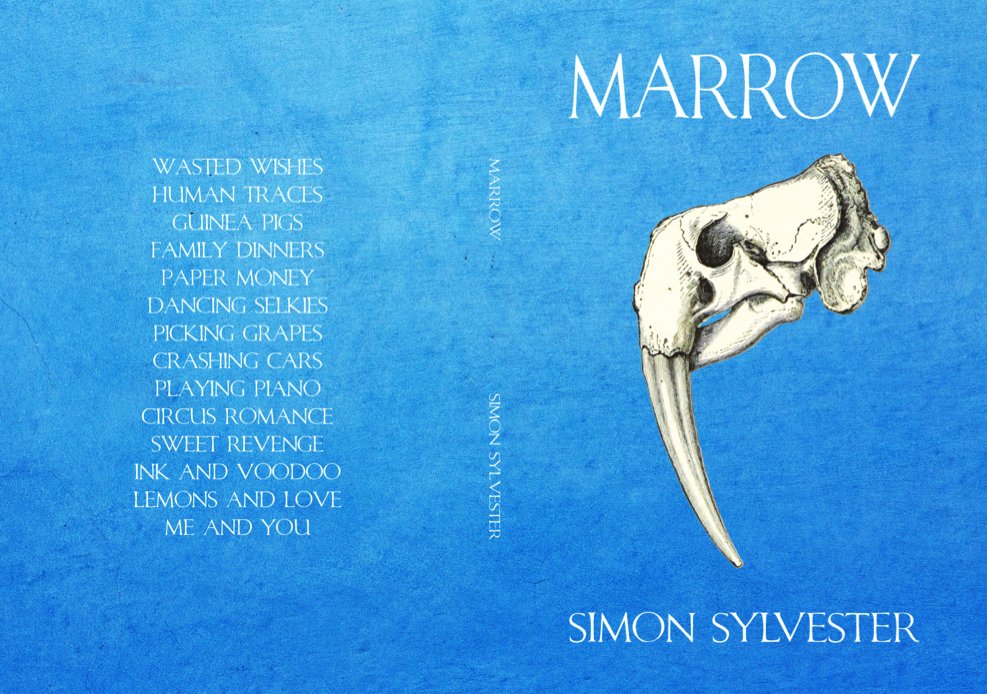
Here’s the final version of the Marrow artwork, with front and back covers.

Marrow full cover low-res


In the belly of a whale

I’ve talked a lot about wanting to get back to my novella The Year Of The Whale, and I’ve just spotted this novella competition judged by the excellent writer Jenn Ashworth. The deadline is distant enough that I think I can get it finished in time, so that’s now a concrete target for me.

In the course of researching and writing The Year Of The Whale, I’ve come across a huge variety of whale material. I’ve seen Medieval whales, drawn as dragons and devils, and countless images of beached whales, spilling themselves in streaks onto the shingle. And then there’s much weirder stuff, like this profoundly sad, surreal animation. It’s about childhood betrayal, I suppose, but there’s a lot of other things going on in there at the same time. I would say ‘Enjoy’, but it’s not that sort of film.

The Blog Tour – answers

I was delighted when Elizabeth Stott invited me to follow her on the blog tour. I’m a fan of Elizabeth’s writing – I bought her short story Touch Me With Your Cold, Hard Fingers from Nightjar Press last year, and was engrossed in the tense, almost existential body horror she conjured in a few short pages. A lot of Elizabeth’s work generates that sense of claustrophobia – another of her stories, Mrs Wetherby, delivers simmering sexual tension amongst uptight ex-pats in the setting of a baking Gulf. Have a read – highly recommended.

Many thanks to Elizabeth for the invitation – here are her answers to the blog tour questions – and here are mine:

What am I working on?

More than I can handle! Foremost is new novel Grisleymires. Whenever possible, I’m trying to guide my rare writing days towards this; it’s the story of a man who loses his memories, and the woman who goes to find them. It’s set in a huge swamp, which is great fun to write, and I’m really excited by the characters and how they’re evolving. The issue is finding time to write around my other projects. I’ve been working on a novella called The Year Of The Whale for about five years (though I haven’t touched it for the last two). That’s about a whale beached in Morecambe Bay. It’s about 20,000 words finished, with only another 5 or 10k to go, but novels are taking precedence. I’d love to finish it soon, though – my partner Monica wants to make a series of linocut prints to illustrate it, and I think that could look fantastic – something like Alex Garland’s novella The Coma.

I’m also putting the finishing touches to my first flash fiction collection, Marrow, and starting to draft the second, which might be called Real Life. Around all this, I’m periodically developing my future novels – I already have plans for another four or five after Grisleymires. I’d love to write more often, but I struggle for time around my teaching and film jobs.

The final thing I’m working on is the copy edit of my first novel, The Visitors. The editor’s notes are due back next week, and I’ll need to go through those slowly and carefully (and with flagons of cider, according to Ali Shaw).

How does my work differ from others in its genre?

This is a difficult question to answer, as I believe all writers differ from others – that’s part of the wonderful polyphony of writing. As soon as a writer begins to speak in the first words of their own voice, they’re different. Genres are useful for sifting and gathering – I use genre far more as a reader than a writer.

That said, I guess I’m moving increasingly towards low fantasy. That’s where I can best tell the stories I want to tell. If my stories are in any way unique, it’s because of the themes I work in and the juxtapositions I explore. When I walk through woodlands, I worry about velociraptors. When I visit London, I imagine minotaurs haunt the Underground, dodging Tube trains as they roam beneath the city. There are doppelgängers watching from rooftops, waiting to make the switch. There are secret societies of pigeon fanciers that keep the internet alive, and kelpies working for the local council. I try to infuse my work with the same sense of magic I find in the world. I think every writer tries to do that. I’m interested in memories, and walking, and the idea of threshold spaces. I’m interested in myths and especially in folk tales. I’m interested in the breakdown in gender and what it is to be alive. Ultimately, though, lots of writers are interested in those things. What makes my work different is that it’s mine.

Why do I write what I do?

Writing brings me comfort through escapism, I suppose. I’m an army brat – we didn’t settle in one place until I started secondary school in Inverness, and I’ve often struggled to feel at home. Books and stories have been havens for as long as I can remember, and it was probably only a matter of time before I tried to create my own. As for the actual topics I write about – that’s evolved wildly over the six or seven years that I’ve been writing fiction. I started with experimental, deliberately obscure literary pieces, aping the styles of challenging writers like Hubert Selby Jnr and William S. Burroughs. After finishing my first attempt at a novel, which took me to some personally unpleasant places, I started to rediscover my love of stories that took me on adventures, rather than stories that were flayed to the bone. I reread David Mitchell and Sarah Waters and Jasper Fforde and Neil Gaiman – and I realised that those were the worlds that sang loudest to me. And so I started again, near enough, finding new ways to tell my stories. The more I’ve worked in this vein, the more I’ve enjoyed my writing.

How does my writing process work?

My ideas tend to arrive as acorns – I stumble upon them everywhere, buried in mud or blown into gutters. Some of those ideas never escape my notebook – and others explode, branching and sprouting into completely new directions. I can’t explain how an idea arrives already fully formed, but my best stories are already bristling with life. They evolve as I write. I know I’m working with strong characters when they start doing things I don’t expect; when it becomes inevitable, no matter what I’ve planned, that they’re going to do something else.

Landscape and place are important to the way I work – I like those strong characters to be in landscapes that I care about, so the air fills my lungs and I can feel the ground beneath my feet. In good locations, the story is a drop of water, taking the most organic route to ground. Place is as important to me as character, plot and emotion – when I write, I try to keep all those strands of story entwined together. Writing is a holistic process, following disparate elements all at once. That’s one of the things that makes extensive redrafting so hard. It’s easy for the fabric of the story to become tangled. When my stories are in a muddle, so am I.

Because I have so little time to work, I tend to write in fierce bursts. If I’m on a roll, I can manage more than 10,000 words a day, but that’s rare. A good writing day is 2,000-3,000 words I’m really pleased with. When I’m not writing, I think about my work constantly. I’m often awake at night, staring into darkness, tracing my way through story strands, trying to work out where they run to, where they meet. More often than not, I fall asleep without working it out – but sometimes I have to turn the light back on and write them down.

I’m also an helpless tinkerer. I can’t let go of my stories, and I return to them obsessively – even years after they’ve been published – to develop the story and tweak the prose. My flash fiction collection Marrow is typical of this – of the 28 pieces, around half have been published elsewhere – but in preparing the collected manuscript, I’ve spent months compulsively redrafting them. Some no longer bear any relation to the original. I can’t help myself. That tweaking and revising comes into first drafts, too. My stories are probably one third writing, two-thirds editing.

Another of the keys to my workflow is reading aloud – as I write, I constantly read, lips moving, shaping the phrases to find the most organic flow, and then reworking it on the page. On the rare occasions I’ve been asked for writing advice, that’s my first suggestion. Nothing has done as much for developing my work as reading aloud. My second suggestion is to carry a notebook. You never know when those acorns will tumble from the sky.

***

So there we have it. If anyone’s still reading, these are some of the things that go into my work. I’m now passing the baton on to David Hartley and Iain Maloney, who’ll publish their blog tour answers on Monday 3rd February. In their own words, they’re a bit like this:

David Hartley is a story botherer and blog tickler based in Manchester whose debut collection of flash fiction ‘Threshold’ was published by Gumbo Press precisely a year ago. He is one fifth of the writing collective Flashtag and can be regularly seen haunting the open mic stages of the North West. He blogs at http://davidhartleywriter.blogspot.co.uk/ and tweets at @DHartleyWriter

Iain Maloney was born in Aberdeen, Scotland and now lives in Komaki, Japan. A widely published writer of fiction, non-fiction and poetry, his debut novel, First Time Solo, a story of World War 2 RAF pilots and jazz, will be published be Freight Books in June 2014. He blogs at http://iainmaloney.wordpress.com
Thanks for reading.

Blog tour

Just a quick post to say that I’ve been invited to join the blog tour by the excellent writer Elizabeth Stott. The idea is that writers post answers to the same four questions, then pass the baton to another writer. If you trace it back, there are dozens of fascinating responses around the idea of what it is to write. Here are Elizabeth’s answers, which are a tough act to follow.

I’m due to post my responses on Monday 27th January. These are the questions in question:

  1. What am I working on?
  2. How does my work differ from others in its genre?
  3. Why do I write what I do?
  4. How does my writing process work?

There’s quite a bit to get through in there, but I’ll try extremely hard not to be boring.

I’d also like to introduce David Hartley and Iain Maloney, the writers who’ll follow me on the blog tour. David is an intimidatingly prolific writer of scintillating flash fiction and short stories, and he’s working on his first novel, which is pretty cool. Already looking forward to what he has to say about writing.

David Hartley is a story botherer and blog tickler based in Manchester whose debut collection of flash fiction ‘Threshold’ was published by Gumbo Press precisely a year ago. He is one fifth of the writing collective Flashtag and can be regularly seen haunting the open mic stages of the North West. He blogs at http://davidhartleywriter.blogspot.co.uk/ and tweets at @DHartleyWriter

Iain is an old friend of mine. We’ve been reading each other’s work for seven or eight years, and I’ve learned a lot about writing from him. He has broad interests, from haiku to historical fiction, and I’m especially eager to see his thoughts on genre.

Iain Maloney was born in Aberdeen, Scotland and now lives in Komaki, Japan. A widely published writer of fiction, non-fiction and poetry, his debut novel, First Time Solo, a story of World War 2 RAF pilots and jazz, will be published be Freight Books in June 2014. He blogs at http://iainmaloney.wordpress.com


Fenland wyrdly

I’ve lived in England for thirteen years, on and off, with stints in Edinburgh, Inverness and Australia. Aside from Cumbria, which is the closest thing to home I’ve felt in my adult life, and London, which is a bubble, I often feel a stranger here. Despite moving around so often, there are big chunks of the country I’ve never seen. East Anglia is one of them. We spent this weekend exploring the area as research for my next novel, which is called Grisleymires. On Friday we drove down a smart diagonal sweep across the country from Burneside in Cumbria to Kirby Cross, almost on the Naze, and stayed the night with friends. On Saturday morning we jagged back up to Wisbech, stopping at Wicken and Ely. For the first time, I’ve been to the Fens.

Grisleymires has been in the back of my head for a while. From the beginning, I knew that it was set in a swamp – the earliest incarnation of the story was essentially Time Bandits with bog bodies. It’s evolved massively since then, but the marsh has been a constant: I want to write about mud and water. I’m now quite secure in the plot, but the location has been troubling me. Location is crucial to the way I write, and I didn’t feel confident in my knowledge of any British bogs. I picked the Fens on instinct, and decided to find out more from there.

The first person I spoke to about Fenland felt so negatively about it that he could only laugh hysterically. He’s one of the most articulate people I’ve ever met, and he simply couldn’t formulate words to describe how powerfully it repelled him. That was exactly the sort of start I was hoping for. Since then, people have told me that the Fens are creepy, strange, powerful and weird. Everyone talks about ‘big skies’. Now that I’ve driven through them, I can understand why. It’s the flattest landscape I’ve ever seen. The horizon is broader, the perspective unnerving, the sky an impossible bowl. There are miles at a time without undulation – miles without trees. Ditches run in straight lines to vanishing points. In places, roads run lower than canals, with dykes and bridges guiding the contours. It’s especially strange near the coast, where the horizon is curtailed by the shore.

We stopped at Wicken Fen, where I stood in the blustering wind and stared into the winter sun. Tall grass became an ocean and hissed at me in waves. I never expected so much noise from emptiness. The sun turned orange, and the dusk turned blue, and pylons hung like giants against the scraps of cirrus. At one point, we drove along beneath a dyke for a mile or more. The road turned sharply up the bank and at the top, blinded by sunset, the world opened up like Noah’s flood – the entire horizon drowned in water, withered trees and battered shrubs emerging in silhouette against the sun. That was the road to Wisbech, submerged in wetlands.

sunset1

We drove the alternative route to Wisbech on undulating single track roads lined with Nissen huts and broken hedgerows, tumbledown houses and gigantic piles of sugar beet, surrounded all the while by thousands upon thousands of acres of thick, turned loam.

Wisbech was a strange town. The B&B was huge and empty. When we went to look for food, we found ourselves in what seemed to be a red light district. Drunken Polish men yelled at each other across the street, while girls on corners danced to techno on CD stereos. On Friday night, above the Naze, the stars were clearer than I’d seen in years; on Saturday, the sky was full of murk. On Sunday morning, we drove on Droves – lumpy roads, arrow straight for five miles or more, then zigzagging madly to meet the next. They separate broad strips of industrial agriculture, riven with canals, ditches and soakaways. All the trees wear killing coats of ivy. For the most part, we drove in silence, occasionally pointing things out to each other. The landscape was relentless without becoming monotonous.

The Fens is witchcraft and weak bridges; rotten thatch and revolution; gallows and windmills. At one point, we passed a narrowboat moored beneath a sickly weeping willow. It looked like it was about to break in half and sink. It was small, and covered with lichen, but I could still make out the name: it was called Icarus.

I don’t know if the Fens are creepy, but they are profoundly strange. We felt edgy all the time. We’re used to the cradle of the mountains, a constant presence in our peripheral vision. It’s incredibly strange to be without that subconscious company. Mon pointed out that the sheer amount of space makes you feel exposed – vulnerable. We didn’t find it creepy, so much as missing. It’s an absence, a nothing, a void. It felt like a sort of purgatory; fields unfolding endlessly, stretching on forever.

I went on this trip hoping for a sort of Green Venice, but that’s not what the Fens are about. They aren’t what I expected, or what I wanted, but maybe this trip has been exactly what I need, and here’s why:

I invented Bancree for The Visitors. It’s an amalgam of Islay, Jura, Gigha, Kintyre and the Black Isle, plus a host of other Scottish spots; and I’m already planning a novel set in a fictional city, based around my short story Vanishings. The point is this: I thought nothing of creating an island, and I can’t wait to write a city. I don’t know why it’s taken me this long to consider inventing a Fenland of my own. Writing a new region into an existing geography feels more daunting than something as self-contained as an island, but that would give me the perfect environment for Grisleymires.

I’ve only started considering this today, but it’s already gathering weight. It would let me combine the heat and life of Green Venice with the sodden bogs of Islay and the upland Cumbrian basin mires with the Fens and Norfolk Broads. I could do as I pleased with accents and geography and culture, and that’s a real magnet for me. I’d be sad to leave or even dilute the Fenland folklore, though – I’ve grown attached to Tiddy Mun and Old Shuck.

As a research trip, it’s thrown up more questions than it’s answered. But that, in itself, is part of the journey.

pylons1

Visitors book cover

It is with tremendous pleasure that I share the cover to The Visitors. It looks like this:

untitled

…and I’m utterly thrilled with it. The artist, an outstanding book designer called Leo Nickolls, has captured so many elements of the story in his design. I love the composition, the style, the palette – everything about it.

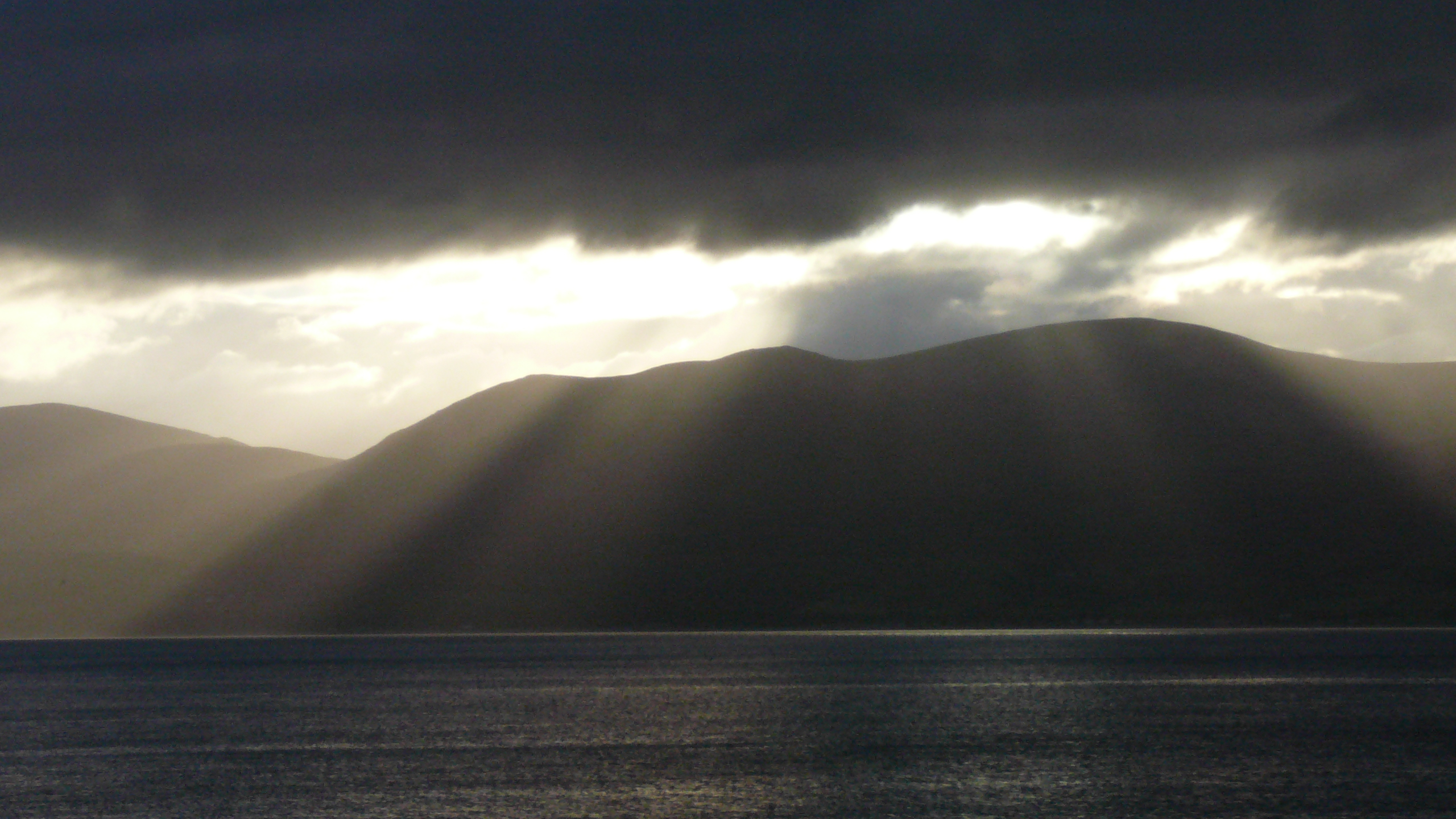
Most of the story of The Visitors fell into my head while on holiday in Grogport on Kintyre. It’s connected to the Scottish mainland by a narrow isthmus, but it feels like an island. From Tarbert, it’s a thirty or forty minute drive along weaving single track roads to the tiny village of Grogport, which is no more than ten houses and a beach. It was our first holiday as a new family, and we stayed there for a week. Dora was only five months old, and she was unsettled by the change in her surroundings. After sleeping late for most of the previous month, she started waking early – at four or five in the morning. On one of those bleary mornings, we sat in awed silence and watched the sun crest behind humpback Arran, the island pitched into shadow beneath titanic columns of light. I took some pictures. They looked like this:

P1050513

The first time I saw Leo’s cover, this image came to me as a jolt. Memories shivered at me; the cold tiles underfoot, the grit in the coffee and the grit in my eyes, the herons on the beach. Even now, I feel a little unnerved at the similarity in the mountains. I scribbled out the plot of The Visitors no more than a day either side of this picture. Unheimlich.

Seeing the cover has been amongst the most surreal parts of this crazy journey. The closer I come to publication, the further I feel from reality. Being so immersed in redrafts and work, this often feels as though it’s happening to someone else.

Resolve

I’ve always been a little dismissive of New Year’s Resolutions, because if I want to make a change in my life, that can happen any time I choose. That remains true, but there are things I want to do differently going into 2014. Post-Christmas binging is a natural place to draw a line and make a start, and I quite like the idea of formalising the changes I want to make. So here’s what’s going to happen this year:

Exercise

Because I don’t really do any, other than the odd Lakes walk and the exhaustive mania of teaching. I’ve already started walking the 2 miles to work – which I enjoy for the headspace as much as the activity – but I miss my bike and I miss my climbing. So I’m going to start cycling the long way to work and back. That’s only about 6 miles a day, so it’s not a great deal really, but it’s more than I’m doing at the moment. I’m also really keen to get back to my climbing. When I lived in London, I climbed four or five times a week. Now it’s four or five times a year. I’m going to start going for a few hours at least once a week. That, supplemented by some pull-ups at home and the cycling, should be steps in the right direction. I might even join Mon for the odd yoga, too.

Writing

The best I can hope for here is more of the same, I think. I crave more time to write, but the day jobs don’t allow it. In a good week, I get two days and two nights on my stories every week. Within that, I have specific aims for 2014. First and most important, I want Grisleymires finished in a year. This is a big ask, but it’s well planned, I’m excited by the story, and I can do it if I work hard. Research trip to the Fens in January!

Second, I want to have my flash fiction collection Marrow typeset and printed by the end of February. I’m reading at Spoken Word at the Brewery on Saturday 22nd, and I want it in my hands by then. This isn’t as big a deal as it seems; the stories are written and redrafted ten times over, and having typeset it once already as practice, I know glimmers of InDesign. With some guidance from knowledgeable friends and a few late nights, I think I can send the manuscript off to Inky Little Fingers in a few weeks. I’ve already saved most of the £225 it’ll cost to print 100 copies, so that’s not going to hurt my wallet too much.

Third, I want to keep on performing. 2013 was a turning point for me in reading my work aloud, and I want to push that as far as I can. Reading live brings an entirely new aspect to the way I write, and this is something I want to keep developing – pushing towards more theatrical performance where my confidence allows it.

Fourth, I want to submit my work to more competitions. I’ve never entered any of the big short story competitions before now, and I’m going to try and start this year. And I want to write new pieces, too, if the ideas keep coming to me. I’m not going to rehash old stories. I’ve pretty much drawn a line under my older work, but for two particular pieces: the excellent people at Comma Press have been considering my short story Every State In America for their delayed Reveal anthology for a couple of years. They’ll have first refusal on it for as long as it takes; being published by Comma would be an incredible honour. The other piece is called Art Is Long, Life Is Short, which is perhaps three years old and freshly redrafted for the BBC Radio 4 Opening Lines strand. That’s ready to go when the submission window opens in January.

Fifth, I want to finish Year Of The Whale, my long-running novella about a whale beached in Morecambe Bay. It’s been work in progress for three or four years, and it’s overdue. But writing resolutions one through four come first.

That’s lots of resolutions wrapped up in two strands, really. Writing and exercise. I’m only going to buy the time for everything else if I start saying no to low-paid film jobs, so I’m not doing any freebies/cheapies this year unless they have a clear benefit further down the line. I’m also going to try and rein in my irrational compulsion to reply to emails RIGHT THIS SECOND. I just don’t have the time. Most of the email I receive can probably wait until I’m ready. The point of all of this is to spend more quality time with Mon and Dora. Unless deadlines get in the way for either of us, we’re generally good at keeping weekends as family time, and I want that set in stone. There are a host of other things I can do towards this – less time online, for a start – and turning off the computer on free evenings. I want to read more, too.

I guess I’ve picked out goals, rather than resolutions, but it’s all the same in the end. I haven’t kept a blog to monitor resolutions before; I’m curious to see to whether writing about my success or lack thereof will impact on my success or lack thereof. Gazing into the void and so on.

2013 was a great year in many ways. Here’s to 2014, people. Be safe, be happy. Here’s a 1921 picture of a cat and a goblin in a tree:

goblin