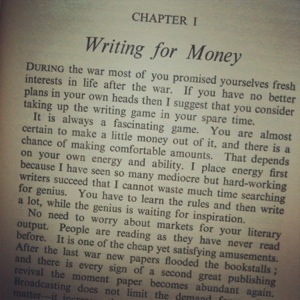
The Authors’ Post-War Guide

20130403-202330.jpg    20130403-202505.jpg

Here’s another of the books I’ve unearthed from charity shops. The ‘Authors’ Post-War Guide’ – published in 1947 – is packed full of handy hints for modern authors. Every page has a new gem. Refreshingly for a writing guide, Lawrence G. Green feels the first thing new authors must learn is “to become extremely suspicious and critical.”

Other nuggets include the useful facts that “Women like reading about jewellery”, and “Sharks have always treated me kindly”. I also like this passage, designed to help focus the mind when writing:

“Put the cat out. For this serious purpose the cat is merely a symbol. The cat may be your wife or child.”

…though it pales when compared to this advice:

“No liquor, no Benzedrine, no coffee. You can have a glass of water if you like. If you smoke, have lots of cigarettes.”

…which almost makes me want to start smoking. The “writing game” seems a lot simpler in 1947.

Books in boxes

IMG_0088       IMG_0090

IMG_0089       IMG_0091

For the last three years, Mon and I have been living with her parents. All of our things have been stored in boxes in the cellar, with the inevitable result that whenever we’ve needed a particular item – a plug adaptor, a passport, a DVD – we’ve had to rummage and excavate our possessions to find the missing thing. Some boxes were needed regularly, and these stayed on the surface. Others were out of sight and out of mind, and they sunk deeper into the mire, their contents forgotten.

We moved into our own house on Christmas Eve. Moving has been a slow process, and it’s only today that we brought across the last of our boxes. As we unpacked and sorted the contents, I was delighted to discover my research books. These are the weird volumes that have grabbed my interest in charity shops and jumble sales. I seldom know exactly why they spark my interest, but they’re always about something peculiar, and they trigger my imagination. After three years, it was a strange feeling, both energising and nostalgic, to unpack this box of forgotten books and browse again through a treasure trove of ideas and inspiration. There are studies of sumo wrestling, devils, tattoos, smuggling, bicycle mechanics, Vikings, saints, medicine, art, juggling and more…

Of the titles pictured here, Whale Nation inspired my long-running novella-in-progress, Year of the Whale, while David Pelham’s Kites (a classic of the kiting genre) and Stephen Turnbull’s Ninja are dripfeeding imagery and history into plans for my next novel. Finally, P.V. Glob’s The Bog People (1971) is research for another story to be written in the distant future, if I ever have the time to write it.

Part of me wishes I was called P.V. Glob.

14-hour Third Draft Self-doubt Blues

At 11.45 last night, after 14 hours of damn-near nonstop work, I finally sent off the third draft of Riptide Heart. It’s taken me so long because I hit a horrible stumbling block. For the first time with this novel, I didn’t know how to develop the story, and for the last week I’ve thought of little else. The stumbling block was as follows:

  1. Character A discovers a piece of information.
  2. Character A tells Character B the piece of information.
  3. Not enough time has elapsed between point 1 and point 2 to be convincing.
  4. Point 1 can’t be moved any earlier in the narrative without gigantic structural changes.
  5. Point 2 can’t be moved any later in the narrative without gigantic structural changes.
  6. Points 1 and 2 are too integrated to be separated without gigantic structural changes.
  7. I was unwilling to make any gigantic structural changes.

I turned it inside out looking for a solution. I tried rewrites, alterations, moving entire chapters – everything. But no matter which way I turned it, I couldn’t make it gel. Nothing felt right, and nothing was working. It made me miserable.

On Monday morning, lovely agent Sue dropped me an email, asking if the manuscript was ready. It wasn’t, but even as I replied, the block dropped away completely. Out of nowhere, I knew exactly what to do.

Yesterday morning, when I started work at 9am, I went straight to point 1, and deleted it. Then I went to point 2, and deleted it. Points 3 through 7 promptly became redundant. After a miserable week of stress spent questioning the novel, questioning myself and questioning the universe, this took me about 20 minutes. I simply hadn’t considered that as an option, and I’d wracked myself hollow trying to find alternatives. With joy in my heart, I set about tidying up the loose ends. My old flow came back in a heartbeat; rather than excising point 1 altogether, a brilliant alternative started shouting from the back of my brain. I made the switch. It worked.

With the last of my structural changes complete, I started, once again, the painstaking process of passing through the novel from start to finish. There’s no short cut to this, but I do it two or three times on every draft. It’s the fine-tuning and the rephrasing – the last check for chronology, for sense, for pace.

I could barely focus by the time I sent the manuscript away. My brain now feels like toffee and I have RSI in my right little finger (which, curiously, is the only finger I don’t use at all in typing, and consequently hovers under tension over the keyboard at all times), but after a week of anxiety, self-doubt and stress over such a small issue, I’m pretty happy with it.

Next up: Sue’s response. We’re getting closer to London Book Fair all the time. If I need to do another draft, it may not be ready for the fair, and I’m so keen for Riptide Heart to be a part. That said, I’d prefer it to be right, rather than merely on time. It’s fantastic to have such a strong editorial input from Conville & Walsh – their constructive, critical feedback is what energises my redrafts. Writing feeds on community, discussion and development.

A flock of Fire Cranes

A flock of Fire Cranes

Here’s issue 2 of The Fire Crane, a magazine from New Writing Cumbria, which includes my short story ‘Nash the Mole’ as well as a selection of superb poetry, photography and landscape writing. The theme for this issue was ‘No Signal’, asking writers to question how we construct our understanding of the countryside.

I’d been thinking for some time about the traditional practice of hanging dead moles on a fence. This was how the molecatcher proved how many he’d caught, and then the land-owner would pay by the mole. The image had stuck with me for months; when I read the ‘No Signal’ brief, I knew I’d found a destination.

The magazine, which is printed as a newspaper, is available in libraries, museums and some bookstores throughout the county, and it’s free like a bee. Editor Mick North sent me not one but ten copies, which I plan to hide in random places. I’ll pop a link to the online version in the ‘Read a story’ page.

Kill yr. darlings

I set about the third draft of Riptide Heart last night, and cut out massive swathes of work. When I worked on the second draft, back in January, the greatest challenge was to actually start making changes to scenes I’d spent days or even weeks creating. I found myself pussyfooting around them, tentatively reshaping phrases and changing single words, rather than digging in to make structural changes. It was weeks before I stopped being so precious about redrafting. The third draft has therefore been strangely empowering – to simply blitz through the manuscript in one go, cutting paragraphs, pages and even entire chapters.

The third draft is now riddled with holes and littered with notes and reminders, but it was cathartic to do all the destruction in one swoop. Everything from here is rebuilding.

Redraft: take two

Redraft: take two

Today’s post brought the manuscript of my second draft, including Sue’s notes. Much like the ramshackle clutter of the Conville & Walsh office, this is exactly how I imagined it should look. 307 pages of rumpled, tea-stained paper is much cooler than revisions in Word.