The Blog Tour – answers

I was delighted when Elizabeth Stott invited me to follow her on the blog tour. I’m a fan of Elizabeth’s writing – I bought her short story Touch Me With Your Cold, Hard Fingers from Nightjar Press last year, and was engrossed in the tense, almost existential body horror she conjured in a few short pages. A lot of Elizabeth’s work generates that sense of claustrophobia – another of her stories, Mrs Wetherby, delivers simmering sexual tension amongst uptight ex-pats in the setting of a baking Gulf. Have a read – highly recommended.

Many thanks to Elizabeth for the invitation – here are her answers to the blog tour questions – and here are mine:

What am I working on?

More than I can handle! Foremost is new novel Grisleymires. Whenever possible, I’m trying to guide my rare writing days towards this; it’s the story of a man who loses his memories, and the woman who goes to find them. It’s set in a huge swamp, which is great fun to write, and I’m really excited by the characters and how they’re evolving. The issue is finding time to write around my other projects. I’ve been working on a novella called The Year Of The Whale for about five years (though I haven’t touched it for the last two). That’s about a whale beached in Morecambe Bay. It’s about 20,000 words finished, with only another 5 or 10k to go, but novels are taking precedence. I’d love to finish it soon, though – my partner Monica wants to make a series of linocut prints to illustrate it, and I think that could look fantastic – something like Alex Garland’s novella The Coma.

I’m also putting the finishing touches to my first flash fiction collection, Marrow, and starting to draft the second, which might be called Real Life. Around all this, I’m periodically developing my future novels – I already have plans for another four or five after Grisleymires. I’d love to write more often, but I struggle for time around my teaching and film jobs.

The final thing I’m working on is the copy edit of my first novel, The Visitors. The editor’s notes are due back next week, and I’ll need to go through those slowly and carefully (and with flagons of cider, according to Ali Shaw).

How does my work differ from others in its genre?

This is a difficult question to answer, as I believe all writers differ from others – that’s part of the wonderful polyphony of writing. As soon as a writer begins to speak in the first words of their own voice, they’re different. Genres are useful for sifting and gathering – I use genre far more as a reader than a writer.

That said, I guess I’m moving increasingly towards low fantasy. That’s where I can best tell the stories I want to tell. If my stories are in any way unique, it’s because of the themes I work in and the juxtapositions I explore. When I walk through woodlands, I worry about velociraptors. When I visit London, I imagine minotaurs haunt the Underground, dodging Tube trains as they roam beneath the city. There are doppelgängers watching from rooftops, waiting to make the switch. There are secret societies of pigeon fanciers that keep the internet alive, and kelpies working for the local council. I try to infuse my work with the same sense of magic I find in the world. I think every writer tries to do that. I’m interested in memories, and walking, and the idea of threshold spaces. I’m interested in myths and especially in folk tales. I’m interested in the breakdown in gender and what it is to be alive. Ultimately, though, lots of writers are interested in those things. What makes my work different is that it’s mine.

Why do I write what I do?

Writing brings me comfort through escapism, I suppose. I’m an army brat – we didn’t settle in one place until I started secondary school in Inverness, and I’ve often struggled to feel at home. Books and stories have been havens for as long as I can remember, and it was probably only a matter of time before I tried to create my own. As for the actual topics I write about – that’s evolved wildly over the six or seven years that I’ve been writing fiction. I started with experimental, deliberately obscure literary pieces, aping the styles of challenging writers like Hubert Selby Jnr and William S. Burroughs. After finishing my first attempt at a novel, which took me to some personally unpleasant places, I started to rediscover my love of stories that took me on adventures, rather than stories that were flayed to the bone. I reread David Mitchell and Sarah Waters and Jasper Fforde and Neil Gaiman – and I realised that those were the worlds that sang loudest to me. And so I started again, near enough, finding new ways to tell my stories. The more I’ve worked in this vein, the more I’ve enjoyed my writing.

How does my writing process work?

My ideas tend to arrive as acorns – I stumble upon them everywhere, buried in mud or blown into gutters. Some of those ideas never escape my notebook – and others explode, branching and sprouting into completely new directions. I can’t explain how an idea arrives already fully formed, but my best stories are already bristling with life. They evolve as I write. I know I’m working with strong characters when they start doing things I don’t expect; when it becomes inevitable, no matter what I’ve planned, that they’re going to do something else.

Landscape and place are important to the way I work – I like those strong characters to be in landscapes that I care about, so the air fills my lungs and I can feel the ground beneath my feet. In good locations, the story is a drop of water, taking the most organic route to ground. Place is as important to me as character, plot and emotion – when I write, I try to keep all those strands of story entwined together. Writing is a holistic process, following disparate elements all at once. That’s one of the things that makes extensive redrafting so hard. It’s easy for the fabric of the story to become tangled. When my stories are in a muddle, so am I.

Because I have so little time to work, I tend to write in fierce bursts. If I’m on a roll, I can manage more than 10,000 words a day, but that’s rare. A good writing day is 2,000-3,000 words I’m really pleased with. When I’m not writing, I think about my work constantly. I’m often awake at night, staring into darkness, tracing my way through story strands, trying to work out where they run to, where they meet. More often than not, I fall asleep without working it out – but sometimes I have to turn the light back on and write them down.

I’m also an helpless tinkerer. I can’t let go of my stories, and I return to them obsessively – even years after they’ve been published – to develop the story and tweak the prose. My flash fiction collection Marrow is typical of this – of the 28 pieces, around half have been published elsewhere – but in preparing the collected manuscript, I’ve spent months compulsively redrafting them. Some no longer bear any relation to the original. I can’t help myself. That tweaking and revising comes into first drafts, too. My stories are probably one third writing, two-thirds editing.

Another of the keys to my workflow is reading aloud – as I write, I constantly read, lips moving, shaping the phrases to find the most organic flow, and then reworking it on the page. On the rare occasions I’ve been asked for writing advice, that’s my first suggestion. Nothing has done as much for developing my work as reading aloud. My second suggestion is to carry a notebook. You never know when those acorns will tumble from the sky.

***

So there we have it. If anyone’s still reading, these are some of the things that go into my work. I’m now passing the baton on to David Hartley and Iain Maloney, who’ll publish their blog tour answers on Monday 3rd February. In their own words, they’re a bit like this:

David Hartley is a story botherer and blog tickler based in Manchester whose debut collection of flash fiction ‘Threshold’ was published by Gumbo Press precisely a year ago. He is one fifth of the writing collective Flashtag and can be regularly seen haunting the open mic stages of the North West. He blogs at http://davidhartleywriter.blogspot.co.uk/ and tweets at @DHartleyWriter

Iain Maloney was born in Aberdeen, Scotland and now lives in Komaki, Japan. A widely published writer of fiction, non-fiction and poetry, his debut novel, First Time Solo, a story of World War 2 RAF pilots and jazz, will be published be Freight Books in June 2014. He blogs at http://iainmaloney.wordpress.com
Thanks for reading.

Resolve

I’ve always been a little dismissive of New Year’s Resolutions, because if I want to make a change in my life, that can happen any time I choose. That remains true, but there are things I want to do differently going into 2014. Post-Christmas binging is a natural place to draw a line and make a start, and I quite like the idea of formalising the changes I want to make. So here’s what’s going to happen this year:

Exercise

Because I don’t really do any, other than the odd Lakes walk and the exhaustive mania of teaching. I’ve already started walking the 2 miles to work – which I enjoy for the headspace as much as the activity – but I miss my bike and I miss my climbing. So I’m going to start cycling the long way to work and back. That’s only about 6 miles a day, so it’s not a great deal really, but it’s more than I’m doing at the moment. I’m also really keen to get back to my climbing. When I lived in London, I climbed four or five times a week. Now it’s four or five times a year. I’m going to start going for a few hours at least once a week. That, supplemented by some pull-ups at home and the cycling, should be steps in the right direction. I might even join Mon for the odd yoga, too.

Writing

The best I can hope for here is more of the same, I think. I crave more time to write, but the day jobs don’t allow it. In a good week, I get two days and two nights on my stories every week. Within that, I have specific aims for 2014. First and most important, I want Grisleymires finished in a year. This is a big ask, but it’s well planned, I’m excited by the story, and I can do it if I work hard. Research trip to the Fens in January!

Second, I want to have my flash fiction collection Marrow typeset and printed by the end of February. I’m reading at Spoken Word at the Brewery on Saturday 22nd, and I want it in my hands by then. This isn’t as big a deal as it seems; the stories are written and redrafted ten times over, and having typeset it once already as practice, I know glimmers of InDesign. With some guidance from knowledgeable friends and a few late nights, I think I can send the manuscript off to Inky Little Fingers in a few weeks. I’ve already saved most of the £225 it’ll cost to print 100 copies, so that’s not going to hurt my wallet too much.

Third, I want to keep on performing. 2013 was a turning point for me in reading my work aloud, and I want to push that as far as I can. Reading live brings an entirely new aspect to the way I write, and this is something I want to keep developing – pushing towards more theatrical performance where my confidence allows it.

Fourth, I want to submit my work to more competitions. I’ve never entered any of the big short story competitions before now, and I’m going to try and start this year. And I want to write new pieces, too, if the ideas keep coming to me. I’m not going to rehash old stories. I’ve pretty much drawn a line under my older work, but for two particular pieces: the excellent people at Comma Press have been considering my short story Every State In America for their delayed Reveal anthology for a couple of years. They’ll have first refusal on it for as long as it takes; being published by Comma would be an incredible honour. The other piece is called Art Is Long, Life Is Short, which is perhaps three years old and freshly redrafted for the BBC Radio 4 Opening Lines strand. That’s ready to go when the submission window opens in January.

Fifth, I want to finish Year Of The Whale, my long-running novella about a whale beached in Morecambe Bay. It’s been work in progress for three or four years, and it’s overdue. But writing resolutions one through four come first.

That’s lots of resolutions wrapped up in two strands, really. Writing and exercise. I’m only going to buy the time for everything else if I start saying no to low-paid film jobs, so I’m not doing any freebies/cheapies this year unless they have a clear benefit further down the line. I’m also going to try and rein in my irrational compulsion to reply to emails RIGHT THIS SECOND. I just don’t have the time. Most of the email I receive can probably wait until I’m ready. The point of all of this is to spend more quality time with Mon and Dora. Unless deadlines get in the way for either of us, we’re generally good at keeping weekends as family time, and I want that set in stone. There are a host of other things I can do towards this – less time online, for a start – and turning off the computer on free evenings. I want to read more, too.

I guess I’ve picked out goals, rather than resolutions, but it’s all the same in the end. I haven’t kept a blog to monitor resolutions before; I’m curious to see to whether writing about my success or lack thereof will impact on my success or lack thereof. Gazing into the void and so on.

2013 was a great year in many ways. Here’s to 2014, people. Be safe, be happy. Here’s a 1921 picture of a cat and a goblin in a tree:

goblin

A century of…

I realised, after posting this video about a ballerina dancing on butcher knives, that I’d hit a hundred posts on the blog. A century is still pretty arbitrary, really, but it’s as good a place as any to stop and think about why I keep a blog.

I started writing the blog six months ago to track the progress of my novel. The book was called Riptide Heart, back then. It’s now called The Visitors, and it will be published by Quercus Books in 2014. All that has happened in the lifetime of this blog. I’ve tracked my highs and lows and uncertainties throughout the publication process, from finding an agent (a year ago) to signing the contract (last week).

As well as the novel, I’ve written a lot about reading my work live, and the struggles I’ve had with my nerves. Each of my various readings has been painfully revisited, but that return has helped me filter and understand the experience. I’ve also explored my decision to gather my flash fiction into a collection, which is called Marrow, and will almost certainly be self-published, and teaching myself InDesign to lay it out professionally. (More on this soon! As I approach the end of my redraft and clear my backlog of film jobs, I should have the time and space to push ahead and get this wrapped up and printed.) I’ve posted published and unpublished flash fictions, and talked about my writing processes. I’ve written about my film work, and catalogued some of the things that I find inspiring or magical. I’ve posted galleries of the threshold spaces I’m so obsessed with.

All in all, then, my blog has ranged far wider than I ever thought it would. More than anything else, I’ve been surprised at how personally I’ve addressed some of these subjects. When I started, I expected the blog to be fairly analytical, for want of a better word; dry, professional. But in struggling with my live performance readings, and in wrangling my novel redraft, I’ve found myself at times alarmingly open about how I feel about my work. I like that the process of writing has taken me in that direction quite organically.

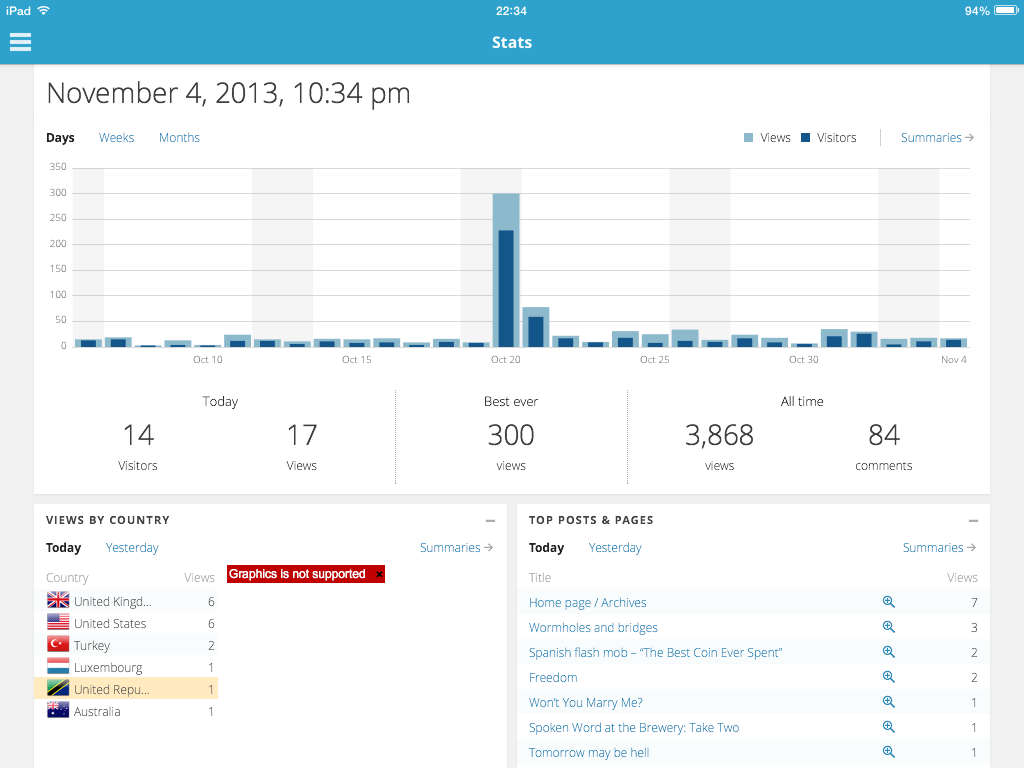
One of the joys of using WordPress is browsing through the stats, which tell me what brings people to the blog, what they look at, and often where they come from. I’ve had visitors from as far afield as Mozambique and Mongolia, searching for everything from devil dogs to gay porn. (Hopefully not everyone will be as disappointed as those two internauts.) I’ve had a week without any views, then hundreds of visitors the day Neil Gaiman retweeted this post about libraries. Have a look at this screen grab and see if you can guess which day that was:

photo

The two things that bring people to the blog most often are on the periphery of my interests; this post about a nursery rhyme and this post about a WW2 fighter pilot preserved in a peatbog. People have searched for Bancree, which is the fictional Scottish island I created for The Visitors, and for novelist friends like Iain Maloney and Ali Shaw. Lots of people come to the blog looking for information about my agent, Sue Armstrong at Conville & Walsh, and my publisher, Jane Wood at Quercus.

More than anything else, though, the blog is for me. It’s how I filter my ideas and monitor what I’m doing. Writing about my life is what I need to live my life.

What’s in a name…

This post is about names for stories. Sometimes I come up with a title first – I have a story called You Don’t Talk To The Driver, The Driver Talks To You, which developed entirely from the title. And sometimes the title is really obvious – The Lion Tamer’s Daughter couldn’t be anything else. Sometimes it’s lifted from a phrase in the story, like The First Time I Died. Sometimes it evolves after a struggle, like my novella The Year Of The Whale (which I will finish one day). And sometimes, I just can’t think of anything at all. And all this is relevant because we’ve just changed the name of my novel.

I’ve been calling it Riptide for the last six months, but my novel has had dozens of different names. I went through bucketfuls of working titles – occasionally to the point that I was changing it two or three times in a single writing session. Nothing stuck. I’d reached a point where the novel was finished, and I wanted to send it away, but it didn’t have a name. After another few days dedicated only to looking for titles, I called it Riptide Heart because it had to be called something, then sent it to some friends.

“Love the book, mate,” came one of my first responses, “but the title’s balls.”

In the end, a lot of people said pretty much the same thing. But no-one had any better ideas, so I sent it off to Sue as Riptide Heart. I used Dora’s grubby paw to click the send button. A week later, Sue got back to me, and here we are – a year has passed, and once more I’ve been driving myself up the fucking wall looking for a name for the book.

We moved on from Riptide Heart fairly quickly, and I was fine with that. Everyone involved has been calling it Riptide, because that’s better than ‘the book’ or the ‘the novel’. But the closer we’ve moved towards publication, the more important the title has become. Sue and Jane and I have been searching for a month. Churning through endless combinations of possibilities has turned my brain to mush. I’ve ransacked the manuscript half a dozen times and tried literally hundreds of potential titles. Last week it reached a point where not only could I not think of anything better, but I was no longer capable of judging other suggestions. That’s one of the reasons I’m fortunate to be working with such professional people at Quercus and Conville & Walsh. Linking wonderfully to the stunning cover art commissioned by Jane, I’m delighted that we’ve finally settled on a name which I’m happy with – my first novel is now and forevermore called The Visitors.

So, what’s in a name? A rose would smell as sweet, and so on… but a novel is like a child, and you spend so much time with it as it grows, learning what it wants to be, getting to grips with its tantrums and moods, guiding its ambitions, and being constantly surprised and amazed by what it becomes… I can’t imagine Dora by any other name. Knowing that Riptide was a temporary title hasn’t lessened the jolt of losing it; after so many months, it had become Riptide.

The Visitors grows on me by the day. It has the human element I wanted so badly, and it has a ghostly feel which I love. As my friend Iain pointed out, I spent so long looking for The Best Name Of Any Book In The World Ever Ever Ever – which doesn’t exist, of course – that I stopped being able to consider what was right in front of me. I’ve often used the idiom of not seeing the wood for trees when discussing writing – and writing novels in particular – and it’s proved true for this title search as well.

I can barely express my relief of being out of those woods…

Jane’s editorial notes have arrived, and I’m really excited about some of her ideas. Next stop: the final draft.

trees

Who likes short shorts?

I’m between novels – making notes for the second while working on edits for the first – and as a result of this fairly disjointed workflow, I’ve also been writing a lot of flash fiction. I write flash fiction for three reasons. In order of importance, these are:

1. To keep my writing and imagination ticking over.
2. As a depository for the ideas I haven’t time to develop.
3. To create short sharp stories for readings.

However you feel about flash fiction – and there are a lot of people who deem it totally irrelevant – these reasons are good enough for me. Number one, in particular, is very important to me when I’m so busy. I can’t work on a novel if I have a spare hour – I need more space in my head – but I can write flash. For me, flash fiction is a fun and constructive way to write more often (notwithstanding J. Robert Lennon’s excellent ‘ass-in-the-chair canard’, of course).

Like most writers, I suppose, I started learning my craft with short stories. In the first two years, almost all of them fell between 1,500 and 2,500 words. This wasn’t deliberate – I was simply writing stories that told themselves in that sort of space. As my writing developed, the scope of my ambition widened; I wrote Meat (mentioned briefly here), abandoned a subsequent novel at 50,000 words, and started work on my extremely long-running novella The Year of The Whale, which I had almost finished when Riptide exploded in my life. Over the following year, Riptide was pretty much the only thing I worked on. By this point, my longer pieces had absorbed any time for short story writing, with flash fiction increasingly fitting into the small hours between proper writing sessions.

In essence, then, I’d stopped writing short stories. But I’ve had an idea nagging me for a while, and it clearly wanted to be a short story. I decided to make it a little more considered than my older shorts, and spend more time letting the character paint the world around her. I finally settled down to work on it last week, and I finished a first draft last night. In my head, I expected it to be about 5,000 words, which is easily double the length of my next-longest short story. It has been a very strange space to work in, especially after so long away from the form.

Some flash fiction packs a conventional narrative into a smaller space, and some flash fiction snatches at a single moment, a single voice – a heartbeat – and gives the reader just enough to fill in the blanks themselves. The short story expands on those themes (obviously), giving them greater room to grow, but for the form to have an inherent function, it needs to achieve more than simply stretching out those moments – more than filling in some of those blanks.

I seem to recall a quote – possibly by Chekhov, though I can’t find a source – declaring that all short stories are the end of longer stories. I think there’s something in that, and I like the abstraction inherent to the form. My best short stories – the ones I personally consider most successful – are the ones where I’ve managed to hardwire some sense of trajectory. I want my writing to have momentum. I aspire to a ferocity, a certainty of narrative. I don’t know how well I achieve that, but it’s what I’m working towards.

I have now finished this new piece, and I think it’s come the closest yet to what I’m trying to create. It’s abstract and a little dangerous, but I think I’ve generated the emotional whirlpool I strive for, with discontiguous strands of story focused to a single point. After so much time away from the medium, I found it quite difficult to write. Although I knew my character’s voice right away, and I knew what I wanted to achieve in the story, it took me a long time to untangle the threads and find my way. I’ve been plodding through it, whisky in hand, on odd nights for a couple of weeks. Last night I finally had the breakthrough, which involved redrafting the whole thing from present into past tense, cutting a couple of sections and writing a new scene. I’m now going to take a day or two away from it, and see if a little distance helps with the redraft. Happily, the first draft came to 5,220 words.

I’m now waiting for feedback from a couple of readers, but I wanted to write this post before talking to anyone about the story; I needed to get my own thoughts in order. At some point I’m going to write more about my ultra-flash fiction on Twitter, but I wanted to use my first short story in a year to have a think about why I don’t write them any more.

Kingfisher

Image  Image

I used to go climbing several nights a week, but I haven’t the time any more. And when we lived in the old house, I cycled to work; now my wife drops me off at the college before she goes to paint. In short, I don’t do any exercise. I’m constantly zipping about at a thousand miles an hour, juggling my different jobs, but that’s hardly a substitute.

Walking is the only activity I can really make time for. Mon and I both love walking. We’re lucky enough to live in an amazing part of the planet, and our little corner of it has some excellent trails. We can walk from our wee cottage in Burneside to see friends in town – or strike out in any other direction to find open countryside.

I’m not a purist about the countryside. I like edgelands and places of threshold where the natural and the man-made have grown old together. Yesterday, we walked to Staveley in Kentmere and back. It’s a great walk for rusted farm machinery, gnarly stiles, fallen trees and tumbledown barns. There’s a troll bridge with missing slats, and a beech tree strangled by a noose of barbed wire. The tree’s bark has enveloped the wire completely, lapping over it like the slowest wooden wave. In one spot, a fence has been mended with an old iron bedhead. It’s lambing season – we passed new lambs, minutes old. I saw my first ever kingfisher.

Walking gives me more than physical exercise. It’s a source of constant, ever-changing inspiration. Walking around London fuelled my first short stories. My walks on Islay, Gigha and Kintyre fed into Riptide Heart and the fictional island of Bancree. My longstanding work-in-progress, Year of the Whale, is about walking – and the need to walk. Location is crucial to the way I write, and walking in real places fires my imagination. I try to create a geography – physical, atmospheric and emotional – that I believe in. When I get it right, my characters play out the story in that environment like a drop of water on a slope, finding the simplest route to ground.

Walking is good for the soul.

I’m calling a character in my next novel Kingfisher.

Books in boxes

IMG_0088       IMG_0090

IMG_0089       IMG_0091

For the last three years, Mon and I have been living with her parents. All of our things have been stored in boxes in the cellar, with the inevitable result that whenever we’ve needed a particular item – a plug adaptor, a passport, a DVD – we’ve had to rummage and excavate our possessions to find the missing thing. Some boxes were needed regularly, and these stayed on the surface. Others were out of sight and out of mind, and they sunk deeper into the mire, their contents forgotten.

We moved into our own house on Christmas Eve. Moving has been a slow process, and it’s only today that we brought across the last of our boxes. As we unpacked and sorted the contents, I was delighted to discover my research books. These are the weird volumes that have grabbed my interest in charity shops and jumble sales. I seldom know exactly why they spark my interest, but they’re always about something peculiar, and they trigger my imagination. After three years, it was a strange feeling, both energising and nostalgic, to unpack this box of forgotten books and browse again through a treasure trove of ideas and inspiration. There are studies of sumo wrestling, devils, tattoos, smuggling, bicycle mechanics, Vikings, saints, medicine, art, juggling and more…

Of the titles pictured here, Whale Nation inspired my long-running novella-in-progress, Year of the Whale, while David Pelham’s Kites (a classic of the kiting genre) and Stephen Turnbull’s Ninja are dripfeeding imagery and history into plans for my next novel. Finally, P.V. Glob’s The Bog People (1971) is research for another story to be written in the distant future, if I ever have the time to write it.

Part of me wishes I was called P.V. Glob.