2013 and all that

Obviously, the end of every year gives pause for reflection. For me, this used to manifest itself in a range of Top Tens – films, albums, books, gigs – but these days I don’t really do enough of any of those things to justify it. So here’s my combined Top Ten of 2013 instead. They’re not in order.

1. Getting a book deal with Quercus

Securing a publishing deal with the wonderful Quercus Books has been one of the most amazing things to ever happen to me. I’m still waiting for someone to pull the rug out from under my feet, but until they do, I’ll keep enjoying every moment of this exhilarating, terrifying, extraordinary rollercoaster. I feel bowled over by the support for my writing, even as I feel a massive weight of pressure to deliver. I started the year with a manuscript called Riptide Heart; I finished with a rigorous redraft, now called The Visitors. Working with Quercus editor Jane Wood has made my writing tighter and my story much stronger. It has also given me a real hunger to push on with my work – I now have half-a-dozen novel ideas clamouring for my time.

This wouldn’t have happened without the hard work of my awesome agent, Sue Armstrong at Conville & Walsh, and the support of my amazing partner Monica. That brings me to the second thing on the list:

2. New work from Monica Metsers

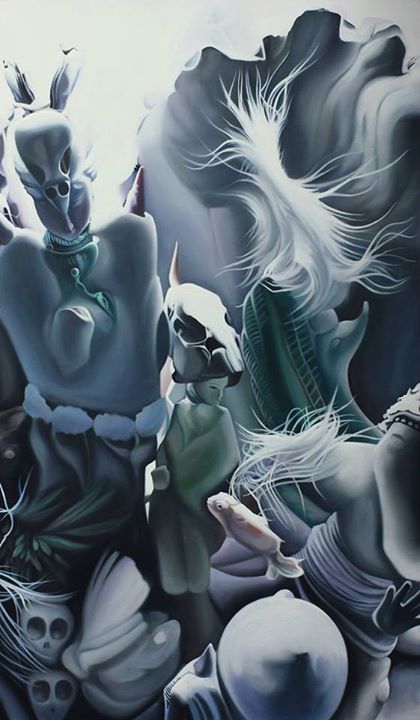
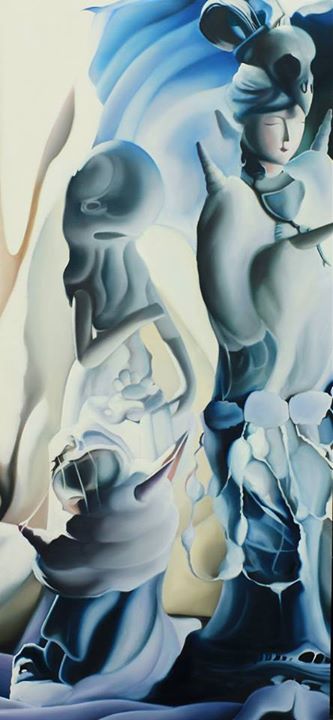
While she was pregnant, and in the first year of Dora’s life, Mon took time away from her painting. 2013 was the year she really started again, and the results have been amazing. She has a solo show in London next year, and as well as a few smaller paintings and a range of drawings, she’s made these two stunning large-scale paintings, which I think are amongst the best work she’s ever done:

BATALLA DE LOS GIGANTES                                                          BALLENA Y GEISHA

BATALLA DE LOS GIGANTES   ballena y geisha

2013 also marked our five-year anniversary – it’s been a blast.

3. Performing live

I’ve never been good at public reading, and this year I set myself the challenge of improving. I went on to read my work twice at Spotlight in Lancaster, once at Kendal’s Spoken Word, once (performing from memory) at Dreamfired in Brigsteer, and once at the Flashtag 2013 writing competition in Manchester, where I won second place. My confidence grew with each reading, though I still feel I’ve a way to go.

I also attended a spoken word workshop run by the excellent Brindley Hallam Dennis. One of the activities he set has changed everything: he had other members of the workshop read our stories. The lady who read my flash piece ‘Marrow’ performed it at a third of the pace I do. She relished every word, and it was three times better as a result. I haven’t performed since then, but I’m going to practice reading with that sort of gusto at the next opportunity. I’m booked in for a 20-minute slot at Spoken Word in February, and I’d like another couple of events under my belt by then. My goal has evolved a little, too: what I’m aiming for now is something closer to outright performance than simply reading. That will come with confidence, and confidence will come from practice.

4. Seven Seals – Plan of Salvation

After a whopping 18 months, I finally finished making this music video for amazing psychedelic synth punks Seven Seals. They’re an extraordinary band, and it was an honour to be involved. They’re working on new material, which will hopefully be available in 2014 for their ten-year anniversary gigs.


5. Amy Hempel – The Dog of the Marriage

Quite simply, the finest collection of short stories I’ve ever read. Hempel’s writing is so sensitive, so honest, that it infuses her stories with devastating grace. Unmissable.

6. Les Revenants

This French drama is the best thing I’ve seen on television in years, remarkable for its intrigue, restraint and power. It delivers on every level, exploring an extraordinary narrative without needless exposition to unravel the mysteries of the Returned, all of whom are troubled in different but connected ways. The locations and cinematography are stunning, while the soundtrack by Mogwai is my album of the year. There’s a startlingly surreal lucidity to the conclusion, and I think they could have left it there; but I’m delighted to see a second series in the works. Here’s the trailer for season one:

In TV terms, an honorable mention also goes to Game Of Thrones. Tyrion Lannister might be the finest character ever committed to screen, and the Red Wedding haunts me even now.

7. Success for friends

It’s been a good year for many of my friends and peers, too. Iain Maloney landed an agent and a book deal with Freight, Kirstin Innes found an agent, Anneliese Mackintosh got a book deal, Kirsty Logan landed a book deal and won everything in the world. Friends Andy and Gemma had a baby boy called Miles, and Ali and Iona had a little girl called Inka. There have been a lot of richly deserved congratulations this year. Good work, team.

8. Cats

Yup. Two of them. I wasn’t sure, at first, but then we met these two cats in the Wainwright Animal Rescue Centre, and it was an easy decision. They came to us with the names Remus and Teddy, which we’ve kept. They’re brothers, about three years old, and half-Persian. They’ve been an amazing addition to our house. They are incredibly relaxed and friendly, and they actively seek our company. That’s especially welcome when I’m having a writing day alone at home.

1174754_10153244876455551_211086219_n

9. Holiday in France

We were overdue a break, and this fortnight in France was exactly what we needed. We camped in half-a-dozen places, the best of which was Green Venice, a vast network of canals, ditches and overgrown waterways, crawling with vines and willows, alive with dragonflies and katydids. It was an extraordinary landscape. I read more in that fortnight than I’d managed in four months. Best of all, the holiday gave me enough mental space to plan my next novel, which will be called Grisleymires. That’s now blocked out on Scrivener, waiting for my next writing day.

10. Another year with Dora.

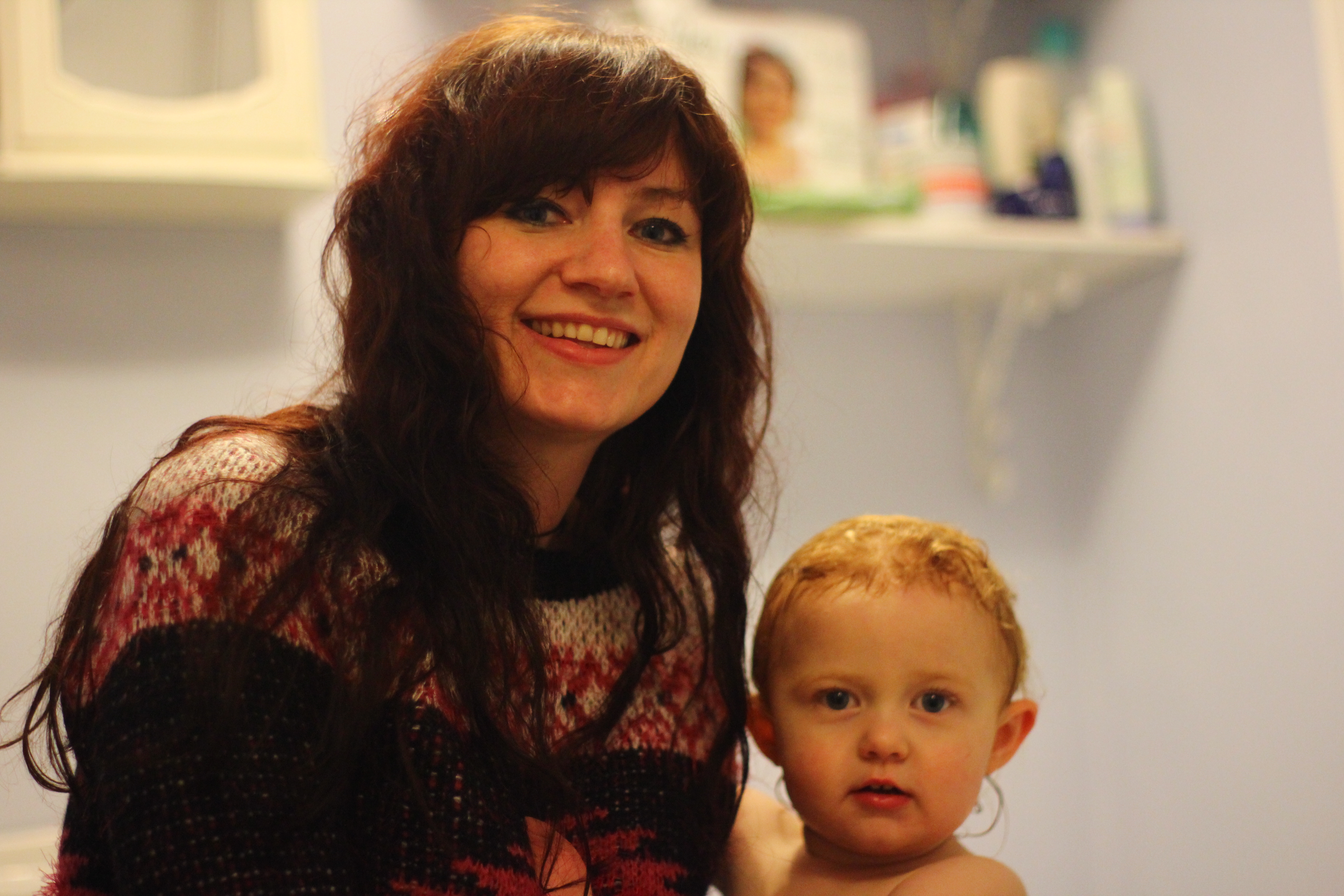
In their first year, babies are basically little puddings. Awesome little puddings, but puddings nonetheless. In their second year, they gather the basic tools to discover the world. And in year three, that toolkit expands exponentially; physically, vocally, intellectually and emotionally. Going through that with Dora has been nothing short of a joy. Seeing the world through her eyes has made me reevaluate so many things for myself. Her conversations leave me in stitches, and everything about her makes me smile. And she hasn’t been to A&E this year, which I consider something of a triumph. Though there’s still a week of 2013 left.

IMG_4758

So that’s my Top Ten. It’s been a good year, and 2014 is alive with possibilities. I might even pop some resolutions up in a few days.

RedraftredraftBRAINMELT

For the last eight weeks, this has what my life has looked like:

RedraftredraftredraftredraftredraftredraftredraftredraftredraftredraftredraftredraftredraftredraftredraftredraftredraftredraftredraftredraftredraftredraftredraftredraftredraftredraftredraftredraftredraftredraftredraftredraftredraftredraftredraftredraftredraftredraftredraftredraftredraftredraftredraftredraftredraftredraftredraftredraftredraftredraftredraftredraftredraftredraftredraftredraftredraftredraftredraftredraftredraftredraftredraftredraftredraftredraftredraftredraftredraftredraftredraftredraftredraftredraftredraftredraftredraftredraftredraftredraftredraftBRAINMELT.

In case you hadn’t noticed from my incessant moaning, I’ve been redrafting my novel. Again. It’s been a vast job, because – following discussions with Jane Wood, my amazing editor at Quercus – we decided to change the ending quite substantially. This isn’t as simple as knocking off the last few chapters and rewriting, alas; to make the climax and conclusion fit, organically and emotionally, the threads of the plot need to extend a long way back into the story. Because The Visitors is already woven rather tight, unravelling the narrative to make the new ending fit has been tough. Around college and film jobs, I’ve been working on it in evenings and spare days since mid-October. After the first fortnight, I took to saving the manuscript as a new document at the end of each session. This is what the folder looks like:

redraft of death

That’s right. It’s called the REDRAFT OF DEATH.

But check it out, humans; I have actually finished. I sent the new draft off to editor Jane and agent Sue late last night, along with a summary of everything I’ve changed. On reflection, it’s been a massive rewrite. As well as the new ending, I’ve changed names, moved locations, cut chapters, written new chapters, tightened dialogue, tightened prose, and – perhaps biggest of all – introduced an important character at the start of the story, rather than halfway through. Maintaining his presence from this early beginning meant a light rewrite of the entire first third. I’ve also made a big change in the death of another character, which brought a new angle to the idea of ‘killing your darlings’.

Dealing with the sheer volume of information is what causes brainmelt. Trying to keep everything in perspective – emotion, story, plot, character, description, geography, chronology – is exhausting. To help manage the changes, I riddled the manuscript with notes to myself, so I wouldn’t lose track of the things that needed work. It was quite telling to come across these messages, later on, and reflect on my thought processes. Here’s an example:

“Move the distillery to the island where it should have been from the beginning, you dick.”

So yeah, it’s been tough. I’m expecting another round of line edits, at the least, but hopefully the bigger structural stuff is now finished. I would have worked quicker but for the day jobs. Trying to switch into a more creative mode and recover a spark is tough. There have been times I’ve sought out any distraction to keep me from inflicting more destruction on my work. That’s where Freedom has really helped. I can’t recommend it to writers (and other procrastinators – YOU KNOW WHO YOU ARE) highly enough.

For all the effort, I still wouldn’t be doing anything else. I saw a great quote the other day. Though I can’t remember who said it, it was something like, “For all that writing is incredibly tough, it’s worth remembering that it’s still making up stuff for fun.”

True dat. More than anything else, I’m increasingly looking forward towards my next novel. It’s called The Hollows. It’s mostly planned, and I’m champing at the bit to start work. Now term is almost finished, I’m going to give myself a few days off to clear my backlog of video jobs, then try and take a day or two over Christmas to get writing.

After dealing so exhaustively with a manuscript of 94,500 words, it’s very strange to be faced again with all the promise and terror of a blank, white page.

A century of…

I realised, after posting this video about a ballerina dancing on butcher knives, that I’d hit a hundred posts on the blog. A century is still pretty arbitrary, really, but it’s as good a place as any to stop and think about why I keep a blog.

I started writing the blog six months ago to track the progress of my novel. The book was called Riptide Heart, back then. It’s now called The Visitors, and it will be published by Quercus Books in 2014. All that has happened in the lifetime of this blog. I’ve tracked my highs and lows and uncertainties throughout the publication process, from finding an agent (a year ago) to signing the contract (last week).

As well as the novel, I’ve written a lot about reading my work live, and the struggles I’ve had with my nerves. Each of my various readings has been painfully revisited, but that return has helped me filter and understand the experience. I’ve also explored my decision to gather my flash fiction into a collection, which is called Marrow, and will almost certainly be self-published, and teaching myself InDesign to lay it out professionally. (More on this soon! As I approach the end of my redraft and clear my backlog of film jobs, I should have the time and space to push ahead and get this wrapped up and printed.) I’ve posted published and unpublished flash fictions, and talked about my writing processes. I’ve written about my film work, and catalogued some of the things that I find inspiring or magical. I’ve posted galleries of the threshold spaces I’m so obsessed with.

All in all, then, my blog has ranged far wider than I ever thought it would. More than anything else, I’ve been surprised at how personally I’ve addressed some of these subjects. When I started, I expected the blog to be fairly analytical, for want of a better word; dry, professional. But in struggling with my live performance readings, and in wrangling my novel redraft, I’ve found myself at times alarmingly open about how I feel about my work. I like that the process of writing has taken me in that direction quite organically.

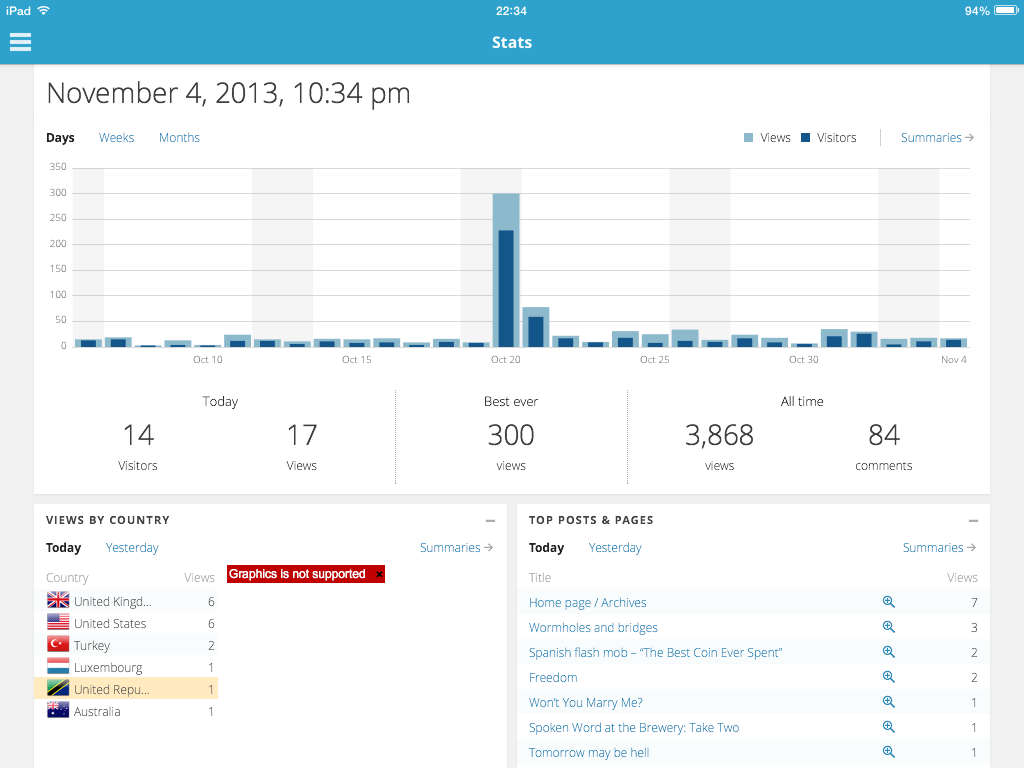
One of the joys of using WordPress is browsing through the stats, which tell me what brings people to the blog, what they look at, and often where they come from. I’ve had visitors from as far afield as Mozambique and Mongolia, searching for everything from devil dogs to gay porn. (Hopefully not everyone will be as disappointed as those two internauts.) I’ve had a week without any views, then hundreds of visitors the day Neil Gaiman retweeted this post about libraries. Have a look at this screen grab and see if you can guess which day that was:

photo

The two things that bring people to the blog most often are on the periphery of my interests; this post about a nursery rhyme and this post about a WW2 fighter pilot preserved in a peatbog. People have searched for Bancree, which is the fictional Scottish island I created for The Visitors, and for novelist friends like Iain Maloney and Ali Shaw. Lots of people come to the blog looking for information about my agent, Sue Armstrong at Conville & Walsh, and my publisher, Jane Wood at Quercus.

More than anything else, though, the blog is for me. It’s how I filter my ideas and monitor what I’m doing. Writing about my life is what I need to live my life.

A Monster Calls

monster

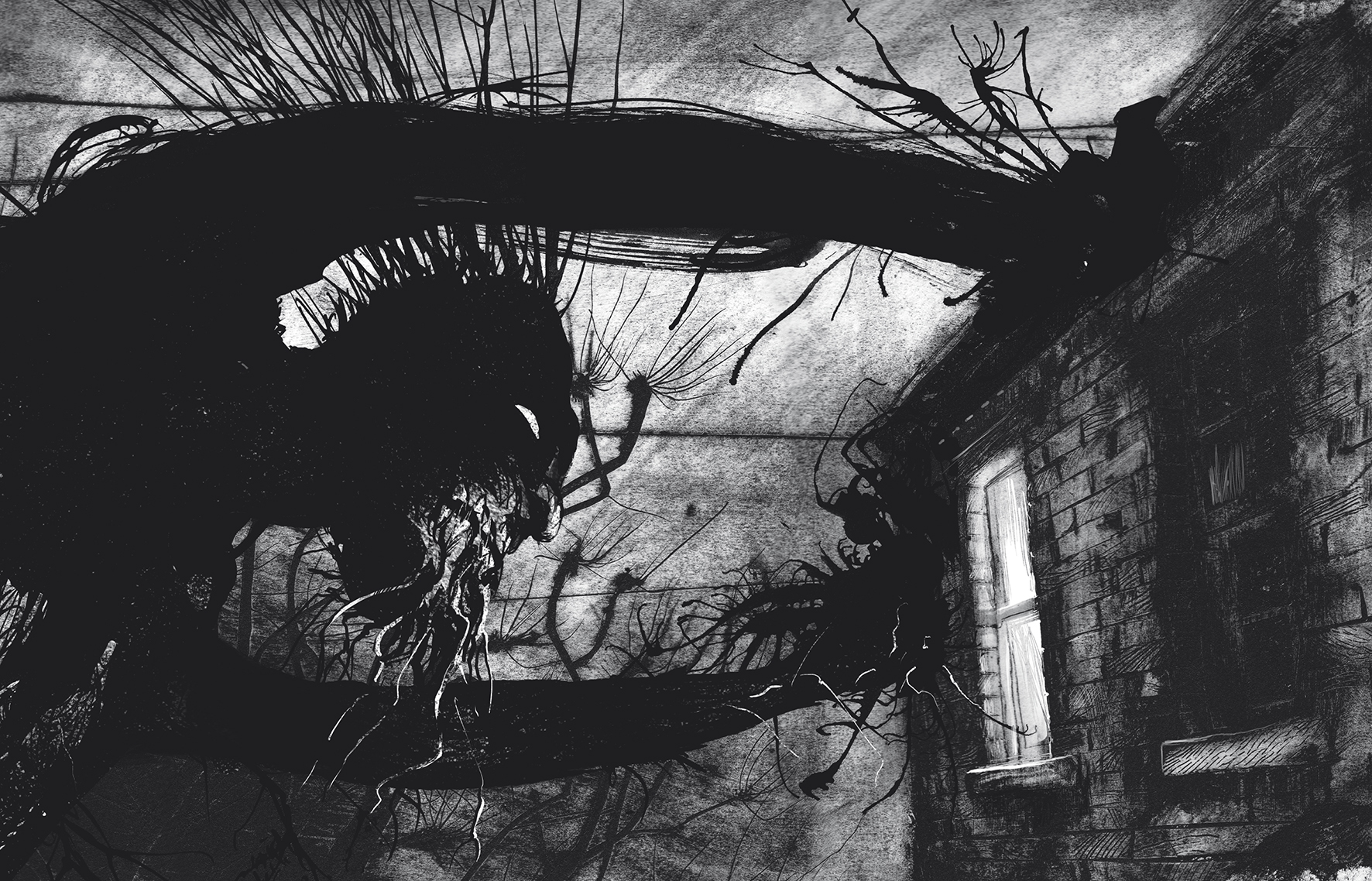
Okay. So I’m late to the Patrick Ness party, but delighted to be here at last. Agent Sue recommended the Chaos Walking trilogy to me earlier this year, which I read and loved; then my excellent wife Monica gave me A Monster Calls for my birthday. It’s one of the most beautiful books I’ve ever owned, and I’ve been saving it for a time I’m marginally less stressed. I planned to read a chapter or two each night, and really savour it. In the end, I devoured it in a single sitting. It’s one of the most striking, compelling, heartbreaking books I’ve read in a very long time. Jim Kay‘s illustrations – bringing almost every page to life – are sumptuously perfect, and Patrick Ness writes with power, precision and grace. The intertwining of artist and writer blurs the boundaries between novels and graphic novels. I think this is also the first book I’ve read that utterly defies ebooks. The story would be the same on a Kindle or Nook, of course, but there’s no way of electronically mapping this sort of paper book; the weight, the feel of the paper, the shape of the book, the stark integration of a full-page illustration with a page of a text. It’s an experience, and it’s simply beautiful. Read it.

Wormholes and bridges

Here’s an exhilarating lecture by Neil Gaiman, exploring what it means to read. This essay has all the passion, humanity and humour of his fiction.

When my dad was stationed in Germany, I had to attend a boarding school in Edinburgh for a year. I remember virtually nothing of those few terms – only scattered memories of finding a flat iron in a tree root, and of crawling down a tunnel that older students used for shooting practice. But I do remember the library, and I remember reading. Reading a lot. I can’t recall all the titles, but I know I read King Solomon’s Mines, the Biggles books – which probably explains my unforgivable weakness for adverbs (he thought, wistfully) – and all the Hardy Boys books over and over again. I’m pretty sure I started on Steven King around then, too. I was eight or nine at the time, which might explain a few things.

Anyway – the library is my only memory of that time that’s even halfway to concrete. It was a refuge for me, and I’ve loved libraries ever since. When we lived outside Inverness, the mobile library van was a highlight of my fortnight: visits from Desmond Bagley, Terry Pratchett, Ernest Hemingway. The librarian was a Brummie expat with gigantic muttonchops. It was like swapping books with Noddy Holder. When I was seventeen, I applied for a job driving the mobile library on the Black Isle. I didn’t get it.

I’ve been a member of libraries in Inverness, Bristol, Lancaster, London, Manchester and now Kendal. Libraries have given me a place to read, a place to study, a place to work, a place to think and, when I was at my poorest, a place to be warm. Libraries are portals to parallel universes. They are circuses, space stations and sunken ships. They are deserts and cities and jungles. They are wormholes and bridges. They record the past, and they tell the future, and they record every scrap of human experience.

Libraries are important, and we’re losing them. Government cuts have brutalised already very modest library budgets. As Michael Rosen has pointed out, coalition rhetoric expounds the need for reading, while quietly removing the places to read.

Neil Gaiman’s essay voices all this far more eloquently than me. It’s beautifully written, of course, but a real thrill, too: immediate, passionate and compelling. Please read it – worth every word. And then go and get something from your library.

20131020-094950.jpg

Little paranoias

Jane Wood, my editor at Quercus Books, sent her notes on my novel this week. It’s a moment I’ve been dreading and craving in equal measure, and I wanted to take a moment to think about what it means now it’s actually here.

I’ve already done four drafts of The Visitors. Some of the drafts were very heavy, and some were extremely light. Redrafting is essential to all writing – I still, even now, return to stories published years ago to tweak and rework them. I have little paranoias about all my work, and can’t help but return to it. Sometimes I make changes of single words, and other times I excise entire scenes. Sometimes I catch myself totally rewriting published work, and I have to make myself leave it behind – I have to take stock and force myself to walk away.

On the second draft of The Visitors, I pussyfooted around Sue’s notes, making tiny changes, scared of diving in. When I came to a third draft, I made myself stamp on it, brutalising the manuscript with broad changes and moving onto the next alteration, no matter how ugly the massacre I left behind. Then, when it looked like a crime scene, I started rebuilding again. That’s what I’ll do this time, too, no matter how hard I find it. And I’m going to find it hard.

Whenever I come to editing and redrafting, I think there are two broad categories of change:

Cosmetic

These are the easy ones, often little more involved than line edits. Cosmetic changes this time include switching a character’s name, cutting some internal monologue and reconsidering some of the vocabulary used by my main character. I could blitz through that in a day, tops. Unfortunately, the other editing category is:

Structural

…and this is the big stuff. Making structural alterations means redrawing the map of the story while trying to maintain the same emotional trajectory, and that can be difficult to keep in balance. In this case, I have two substantial changes to make. Firstly, a minor character needs to become a major character, and he needs to appear much sooner in the story. I already know this is going to be awkward, because I attempted something similar in the third draft, and I struggled to bump him up the narrative even to his current position. It’s going to be tough to find or create somewhere to introduce him sooner.

The second change initially felt even more challenging, but on reflection perhaps isn’t quite so bad. Jane has suggested a different direction for the ending that I’m really excited about. At first I was really worried about it, but I’m starting to see it as a case of unravelling the current conclusion and retying the strands of story into a different shape of knot. This will involve more writing, but actually it’s less of a challenge – with the current ending gone, I’ll be writing into blank space. That’s a thrilling proposition at this late stage of the manuscript.

While it’s still a skeleton, a novel plot is essentially arbitrary. Things can be changed extremely quickly and easily. New characters come and go, and the story shifts like a dune, blown into organic and occasionally bizarre shapes by the wind of imagination. But the more developed a story becomes, the less arbitrarily it can change. There comes a point where making big alterations means breaking the momentum you’ve fought to generate, then patching up the holes and hoping no-one can tell the difference. That’s where a writer needs to have paranoid convictions about the emotional tone of their work, and strive to make it as cohesive as possible in plot, character, voice and soul, then work it again and again and again, hammering and thrashing and beating and combing through the manuscript until it’s carved against your optic nerve.

Editing is frantic. It’s really hard. Throughout the process, a storm cloud hangs over you, an implicit sense that you didn’t do it well enough the first time. Then there’s the crashing changes you wreak on something you loved. And then there’s the dread that whatever you make to take its place won’t come close to what you had before. It’s an exciting time, too, but the whole process is riven with a crawling, monstrous, excruciating anxiety.

This is mostly my load to carry, but I’m glad I’m not taking the journey alone. I’m now far too close to The Visitors to critically appreciate it, and working with other people helps triangulate my own perspective about the story. I’ve often stated my belief that writing is as much about the community as the individual – not least as it counts for little without a reader. When I write short stories, I read them to Mon, and I send them to writer friends. And I pay attention to what they say, even if I disagree. Working with other people – and working with Jane and Sue, now – has repeatedly shown me the importance of opening myself and my ideas to an audience. I have people I can talk to, and that makes me lucky.

Of course, I say this before actually beginning the edits. Try me in a week.

miniscule

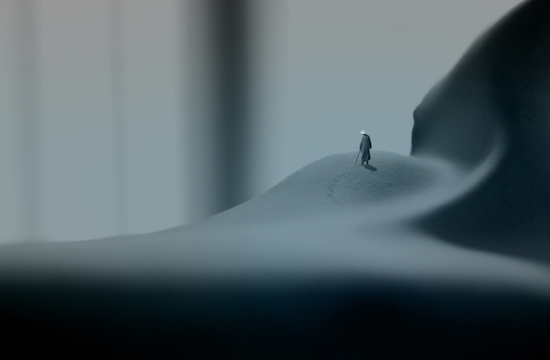
Photo lifted from ‘Minuscule Series’ by Maité Guerrero

The horizon

What a couple of weeks. The start of college has been a bit rough, but we’re getting there. I’m spread fairly thin at the moment, and it doesn’t feel like I’m getting much done… but in the background I’ve completely redrafted my flash fiction collection Marrow, so that’s ready for typesetting when I find the time to get to grips with InDesign. Paragraph Planet published a 75-word story from that collection last week, too, which is pretty cool. I’ve also redrafted the longer short story I talked about in my last post, and started blocking out my new novel in the excellent Scrivener.

Even more exciting, Riptide is beginning to gather pace. I’m expecting notes from my editor this week, so I can start work on what should be the final draft, and I’ve just had a sneak peek at a rough of the cover art, which is scintillating. While I’ve been so busy drowning in real life, just trying to stay afloat, seeing the cover has been a timely reminder of what I’m working towards. The artwork is simply perfect, but I’ll wait for a final version before I share it.

paddy

The 200th Spotlight Club in Lancaster is looming on the horizon. It feels like only last week I was reading at their open mic night. I’m excited about performing there again, and hopefully catching up with old friends Rich Turner, Dan Haywood and Paddy Garrigan (pictured above) – Paddy’s playing out the night, which should be a blast. I have two or three new pieces lined up. I’m going to start with a short story about guinea pigs, and finish with a very short 75-word piece about avocados. I think there’s probably time for another story in between, but I haven’t decided what just yet.

After Spotlight comes the Brewery open mic, if I can get a spot, and then Dreamfired in October. By happy coincidence, my storytelling uncle Rich Sylvester is up from London that night. I don’t get to see Rich very often, so if we’re organised enough, I’ll try and knock up a quick video of one of his stories.

OLYMPUS DIGITAL CAMERA

R.I.P. Elmore Leonard

leonard

American crime maestro Elmore Leonard has passed away at the age of 87.

I’ll remember him best for ‘The Tonto Woman and other stories‘, his excellent collection of Western short stories, including the classic ‘Three-ten to Yuma’.

Leonard’s prose became increasingly minimalistic as his work developed, stripping away everything but story. This led to very stark, albeit engrossing, reading. Here are his famous rules for writers. I’m partially guilty of breaking some of these… even though I agree with most of them.