A little light reading

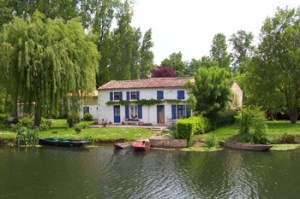
We’ve just returned from a brilliant fortnight in France. We racked up 2,500 miles in a round trip that encompassed Ile de Noirmoutier, which is reached by a two-mile causeway at low tide; Rauzan, where we camped in the shadow of a ruined medieval castle; and Marais Poitevin. This last spot, nicknamed ‘Green Venice’, is one of the most amazing places I’ve ever seen. Centuries ago, it was a vast swamp, but Dutch settlers drained it with a labyrinth of canals and ditches, leaving hundreds of island pastures connected by causeways and bridges. The architecture is just as unique, with balconies and shutters adorning every house, and punts moored to jetties in gardens. Poplars and alders tower into the sky, the canals are thick with lurid green algae. Fat dragonflies zip and pop between shrubs and creepers, and the trees are alive with cicadas. Filtered through high branches and reflected from the water, the light itself is tinted green.

marais_poitevin bluehouse

It’s genuinely one of the most incredible landscapes I’ve experienced and, much like Grogport for Riptide, it’s been a real inspiration for my next novel. In the space of a few days, I filled an A4 pad with notes and dialogue, and I feel really excited about starting work. There’s still plenty to do before I can begin, but the foundations now feel firmly set.

The other great thing about the holiday was having time to read. I managed six books, which is no mean feat when juggling a toddler in a campsite. And I had a great run of books – not a single dud:

The Tiger’s Wife by Tea Obreht was bold and convincing, subtly switching a range of voices to make folk myths contemporary through personal memory. I enjoyed it a lot, but found it ever so slightly cold, and wasn’t as blown away as its reputation suggests.

Cumbrian Folk Tales by Taffy Thomas was a fascinating collection of the county’s legends and myths, made all the more immediate through its connections to a landscape I’m starting to know. It was amusing to recognise the names of not just local places, but also local people – people I’ve met, worked with, drunk with. The tales were strongest when connected to geography, giving meaning and history to a witch’s cauldron or a devil’s bridge.

I read The Blackhouse by Peter May – this was a present from Jane Wood, my publisher at Quercus. She thought I’d like a look because, like Riptide, it’s a crime story set in the Hebrides, though it doesn’t have the supernatural elements of my book. I enjoyed it a lot. The plot was dovetail-tight and engrossing, and the landscape was intoxicating.

Next up was I Love You When I’m Drunk by Empar Moliner, Spanish short stories in translation through the tremendous Comma Press. Despite some uncharacteristic typos from an excellent publisher, it’s a solid collection, each story exploring and exploding conceits of modern life. Some of the stories felt a bit like shooting fish in a barrel – taking aim at soft targets of liberal, middle-class pomp – but the writing was good throughout, and there were many outstanding moments.

Moliner’s collection was good, but the next book was astonishing – a class apart. The Dog Of The Marriage gathers Amy Hempel‘s four short story collections into a single volume, and they are consistently superb. There isn’t a single wrong note across dozens of stories. Hempel’s work is voiced through emotionally damaged or stunted narrators, trapped or somehow left behind in their lives, caught between stasis and decay. The stories are not without hope, though, and Hempel writes with unceasing, unfailing humanity. Her sentences and structure are scintillating. I cannot recommend this highly enough. This is the sort of book I buy two copies of, expecting to have one out on loan.

the_dog_of_the_marriage.large

Finally, I read Snake Ropes by Jess Richards. This was another corker. Alternate narrators explore life on a mysterious island, ‘just off the edge of the map’, eventually combining to bring the distinct halves of the story together around a single, long-forgotten trauma. This novel holds trade and barter at its heart, exploring themes of presence and absence, balance and weight; of exchange, and what it means to give and get. It’s a real triumph, made all the more masterful in how Richards weaves the fantastical through the fabric of base human instinct, conjuring talking keys, sentient trees, and a walking doll with a seashell for a heart:

Moppet2

The last fortnight has reminded me, as stupid as it sounds, of how much I love to read, and made it painfully apparent how little reading time my regular schedule affords me. I’m determined – on top of carving out more writing time – to read more. I miss it.

This holiday has been essential. I’ve worked stupidly hard over the last two years without much of a break, and I’ve badly wanted some time off. Looking ahead, the next two months are going to be frantic – but I feel better for a break. I have my next novel blocked out and the sights and scents of a swamp fresh in my mind. One more draft of Riptide to go, and then I’ll be starting my new story.

‘The software of our minds’

This is a fascinating article, examining the quasi-neurological process through which stories develop emotional punch. I’ve long believed that empathy is the quality a writer needs more than other; this article seems to give my belief a little foundation. Put simply, stories engage readers through exploiting our empathy with the character and their situation. Writers therefore need to assume the mantle of that empathy and project it onto their characters.

Read on:

Six Ways to Make Sure Your Reader’s Brain Syncs with Your Protagonist’s Brain.

Stephen King on writing

Image

I like this. I like this very much. Here’s an assembly of 20 quotes about writing from horror maestro Stephen King. I like the way he blends a wonder at the world with the coal face, roll your sleeves up, nuts and bolts of writing.

I read most of King’s work when I was 13 or 14, taking them three at a time from the mobile library that did the rounds outside Inverness. Cujo, Carrie, It and The Stand have all stuck in my mind; I recently found a copy of The Stand in a charity shop, and I’m looking forward to rereading it this summer. I’m not sure I could handle another bout of It.

Swamp Thing indahouse

Image

Friends Iona and Ali Shaw stayed with us this week. Ali and I studied English at Lancaster University, many moons ago, long before I started writing and when Ali was already laying the groundwork for his career. He’s a brilliant author, with novels The Girl With Glass Feet and The Man Who Rained winning awards and translations all over the place. I was privileged enough to read an early draft of Glass Feet, and Ali kindly took the time to read through my first draft of Riptide. His subsequent advice, notes and hour-long phonecalls were extremely helpful in shaping my third and final draft. Over the last few months, I’ve leaned heavily on Ali’s experience of being published, and his knowledge has helped me work out some of what I’m doing with the good people at Quercus Books.

Mon and I don’t get to see Ali and Iona very often, so it was fantastic to have a long overdue catch-up. We mostly nattered about babies, but we also discussed our current projects (his new book sounds AMAZING) and some wider publishing news. Ali recommended two things: firstly, that I try Scrivener. It’s a writing program dedicated towards managing large documents, with all kinds of bells and whistles for organising plots, characters, locations and notes. The various features sound extremely useful, and it’s available on a free 30-day trial, so I’ll definitely give it a go.

The second recommendation was for Alan Moore’s Swamp Thing. I was describing my own new work, which is set in a maze of bogs and marshes, and Ali (who reads more graphic novels than me), thought Swamp Thing might be good for inspiration and ideas; another book on my birthday wishlist, then. I enjoy graphic novels, and own several of the real classics (Maus, Watchmen, From Hell, Ghost World, etc.) but seldom know where to begin with trying something new. Good stuff.

R.I.P. Iain Banks

R.I.P. Iain Banks

Iain Banks has died at the age of 59, barely two months after announcing his terminal cancer. He’s been one of my favourite writers since I was about 15. He was a ferocious, consummate story-teller. I never met him, but somehow, the knowledge that his books will survive doesn’t shake the sadness of having lost one of the good guys:

“Fuck every cause that ends in murder and children crying.”

Quercus Books

Now then, people: I’m pleased to be writing with some extremely good news. After weeks of turmoil and torment, I am utterly delighted to announce that my first novel will be published by Quercus Books in 2014. The last month has been something of a rollercoaster, to say the least, but I’m just blown away to have landed Riptide with such an amazing publisher. It’s still sinking in, but I’m starting to believe it.

My editor, Jane Wood, is really enthusiastic about the novel, and I can’t wait to work with her on the manuscript. I’m just home from meeting with Jane and Sue, my brilliant agent with the bodacious Conville & Walsh team. It was an incredibly surreal experience to talk about release dates, discuss options for the cover art and explore where I’d like to go with my next few novels. I have three solid ideas plotted out and ready for writing; I know what I want to do with the stories, but it was very odd to expose them to publishing professionals for the first time, as I hadn’t had to vocalise or pitch them before.

So what happens next? For now, it’s business as usual: I’m working on a number of films for Cumbria Wildlife Trust, and college is about to go ballistic with end of term projects and paperwork. I’ll have the summer holidays to get my teeth stuck into another draft of Riptide, then we’ll be looking at proofs in Autumn, and publication in Spring 2014. Around all that, I’m keen to get my head down and start making progress on my second novel. The bogs and marshes idea I mentioned last month is shouting louder and louder – I think I’m going to work on that one next. It’s great to have the ideas lined up – it’ll take me years to complete them all – but now I need to carve out some defined, scheduled writing time. I don’t know where that time is going to come from, but I’ll find it. The further I take my writing, the further I want it to go.

I’ve worked hard to reach these early stages, and I feel extremely humble to have had that work embraced by such amazing people. It makes me want to strive even harder with my stories. I wouldn’t have come this far without the support from Sue, from writer friends Ali Shaw, Iain Maloney and Steven John Malcolm, and most of all from my wonderful wife Monica – and my daughter Dora, in her own way – because this is all for her. I’m fortunate and grateful to have such incredible people in my life.

It’s a sunny day in the Lake District, and I’m going to have a wee celebration – time to take the family for some cider in the park…

Magpie

Image

In odd hours and half-hours, I’ve been chipping away at Heaven. I’m writing and rewriting the first chapter, combing through it over and over again, settling on a style and language that feels right. It’s starting to work, and the first draft of that first chapter is pretty much finished. My main character’s voice rings true, I can envisage the geography exactly, and I’m happy with the plot.

The biggest stumbling point so far has been the need to invent a religion. When I was blocking out the story, this wasn’t an obvious problem – I drifted past the religion that pervades the culture of my story. Now I’ve reached a point where it matters, and I’ve had to take a step back and consider details. I’ve always imagined this religion blending Buddhist and Hindu iconography with a militarised Catholic Inquisition attitude – almost like a junta, woven into the fabric of the culture. So far, so good… but now I need specific rituals, and the actual wording of prayers. That’s going to take a little time to make concrete, though it will develop as I go. Like most successful religions, I’ll be a magpie, stealing, adapting and borrowing from others on the way. So far I’m thinking shrines, tributes, sacrifices, tithes, prayer wheels, prayer flags, wind chimes, omniscience, monks, robes, bindis and torture.

Not much to report on the manuscript submissions so far. It’s hard to focus while that’s bubbling away in the background, but I’m making myself sit down with the new novel whenever I can. It’s a strange feeling, at once intimidating and exciting, to look ahead and see the rest of the story stretched out like an endless ladder, ready to be climbed.

Beginnings

When Monica was pregnant, we didn’t tell anyone the baby’s name. We had a funny idea that telling someone else might jinx it, so Dora’s name remained a secret until the moment she was born.

It sounds daft, but I feel the same way about the title of my new novel. I know what it’s going to be called, but I’m not ready to talk about it just yet. I have this strange sense that I don’t want people to know. So, for the moment, I’ll use another name. This was actually the first title I thought of, but decided was a bit of a mouthful; it’ll do for now. When I talk about the new novel, I’ll call it ‘We Are Always Reaching Out For Heaven’.

I mention this because I started writing today. I didn’t think it would happen so quickly, because I’ve been stewing on the idea for months, but this morning I divided the story into chapters and blocked out the scenes, then copied the whole plan into a new document. Each of the chapters has a summary of the action, ready to go, so I can work on whichever part of the story shouts the loudest without losing sight of the whole. This method worked nicely for me with Riptide Heart, as I seldom write in chronological order (I like to write my ending early on – it gives me a destination to work towards).

Then I simply started writing. The first line was quick, and the rest of the paragraph took me an hour, trying sentences, rephrasing them, deleting them, rewriting them…. and it evolved, slowly, feeling out the words, building a story. It’ll take a while to settle on a voice and a vocabulary that works for this story – and to keep it distinct from Riptide Heart, which is still fresh in my mind after such intense redrafts.

So there it is – the first 500 words of my new novel, down on paper. It’s an odd sensation to be in a triple figure word count after dealing with a redraft of 105,000 words, but I’m quietly excited about it. And I need something to keep my mind off Riptide Heart while agent Sue starts the nerve-shredding process of submitting the manuscript to publishers.