I’m delighted to share the news that my 100-word story Dare has been Highly Commended in the National Flash Fiction Day writing competition. You can read it, along with the rest of the winners and commended stories, right here.
To reach the top 10 against such strong competition has really made my day. I’m also delighted to see Cathy Lennon take top spot with her story Never Let Me Go, because Cathy is lovely and her story is fantastic.
Someone landed on my blog a few days ago with the search term ‘is flash fiction a proper noun’. I’ve been giving that some thought, and the answer is no. But I love that flash fiction is becoming more established. It’s the perfect counterpart to my novel writing, and it keeps me keen. More thoughts on flash fiction to come soon, I think. I’ve written a host of shorter stories lately, and I want to take the time to explore what the format means to me.
In celebration, I’m off to see international storytelling superstar Fred Versonnen perform at Dreamfired tonight; and even more exciting, tomorrow I’m off to Arnside to attend his clowning workshop. I’m hugely excited about what clowning could do for my performance, and seeing Fred tell his stories is a perfect start.
Oh wow! I’ve just discovered that my 100-word story Dare has made a shortlist of 26 for the National Flash Fiction Day writing competition!
The full shortlist is here, but I’m keeping good company with Tania Hershman, Cathy Lennon, Natalie Bowers, Clare Kirwan, Allie Rogers, Jane Roberts and the mighty Brindley Hallam Dennis, amongst many others. Apparently there were almost 400 entries, so I’m delighted to make it this far. Final results on Friday. Phew. I’ve earned my beer tonight.
I’ve just been emailed the list of all the contestants for the FlashtagShort Short Story Slam. If I wasn’t nervous before – which I was, actually – I certainly am now. Here’s the dirty dozen:
Ros Ballinger
Ailish Breen
Joe Daly
Joy France
Abi Hynes
Thomas Jennings
Mark Powell
Mark Mace Smith
Trisha Starbrook
Sarah Stuart
Simon Sylvester
Geriant Thomas
Joy France read at the open mic before my Verbalise guest spot, and she was amazing. I saw Ros Ballinger read some blinding poems at Lancaster Spotlight last year, and she was also very good. I know Mark Mace Smith and Trisha Starbrook by reputation – Trisha won last year’s slam, having never read in public before, and Mark is a noted slammer and favourite of my friend Ann The Poet. Some online stalking reveals the others to be an intimidatingly talented bunch of comedians, poets, theatre performers and practiced improvisers. Oof. We’ll be paired at random in the first round, reading a 150-word story head to head. The audience votes for their favourite to proceed into the second round. Round two cuts six readers with 200-word stories down to three, and the final trio read a 250-word story for top spot.
In the last week, I’ve written five or six new flash pieces, though none of them are quite right for the slam; they’ve either been too short or too long. I’m struggling especially with the first story and that 150 limit; I have a multitude of pieces of that length, but most are either abstract or downers, and I want something both bawdier and more focused for the slam. While I’m really happy with the story I’d read if I made it to the final three, getting through rounds one and two is becoming a real worry; it’s pretty much all I’m thinking about. I’m sure the right ideas will come, but I wish they would hurry up.
If you want to see me drop like a domino – and who wouldn’t? – the slam costs a measly £1 and should be a blast, so no excuses. Here’s the skinny:
I’m a bit behind on my blogging, so here’s a quick round-up while I have the time to do some rounding.
I’ve barely written a word for two months. A combination of college, gardening and film jobs has demanded every scrap of time, and my writing has taken a unfortunate but unavoidable back seat. That makes me ache. I’m not right when I’m not writing. I’ve only recently become aware of how writing relaxes me; and that not writing is one of the things that stresses me out. I’ve also noticed that ideas are more of a struggle when I’m not writing with any regularity. When I’m working often, I’m flooded with plots and characters and lines of dialogue. Not having that internal chatter makes me anxious, and I haven’t been feeling quite myself; this has been exacerbated by pushing myself to come up with new work for the Flashtag Short Short Story Slam, which is only a fortnight away. I think I have the three pieces now, but they’ve been hard work, and I’m not yet convinced they are the right stories.
I travelled to London last week to meet my agent Sue, editor Jane and publicist Margot. The amazing Quercus building feels like something from a James Bond film; everything is glass and aluminium, with automated barriers and security cards. It’s a far cry from my little house, where starlings and sparrows have started nesting in the slate walls. We popped down from the Quercus office to a quiet bar called Hardy’s, and we drank wine and talked about publicity for The Visitors. There’s an idea to offer short stories or flashes as bonus material with the book – and I might make a couple of short films about how it came to life, too. We also talked about some of my future ideas, including current work-in-progress The Hollows. It was a great meeting, and I left it feeling really enthused. With all the chaos of my day jobs, it’s easy to lose sight of the novel. It’s everything I’ve dreamed of for five years, and it’s actually happening. Sometimes I forget.
What else? I’ve written a post for Thievery, Kirsty Logan’s fascinating series of story inspirations. I decided to confess about a novel I started in 2009, but abandoned at 50,000 words (though I recovered the central strand for my novella Year Of The Whale – I really, really need to finish that). My Thievery post will be up in May – I’ll post links when it’s live.
Although I’ve not been writing as much as I’d like, I have been thinking a lot. The Hollows is never far from me, and though I haven’t even opened the document for three weeks, in my head, I’m streamlining it all the time. I’ve learned so much from writing and especially redrafting The Visitors, and I’m determined to make The Hollows a better first draft. In the background to my day jobs, characters have been changing everything from hair colour to their reasons to be alive. The plot is essentially unchanged, but how the characters arrive there is evolving all the time. I found this with The Visitors, too; even as I developed the threads of the manuscript, I returned constantly to the early chapters, forming and reforming them. This is like the twist of a rope; the threads need to be right at the start, or the rope tangles and disintegrates. I’m filming throughout this coming weekend, but next week I should be able to sit down and start making the changes.
Two nights ago, after a long and stressful day at work, I turned out the lights and tried to sleep. From nowhere, my head was thronged with ideas. I had to get up and write them down; first of all, three flash fiction ideas at once, about taxidermy, trains and cheating, and then, a few minutes later, the setting, start and main character of another novel – which looks like being number five in my current queue of books to write, after The Hollows, We Are Always Reaching Out For Heaven, Vanishings and Black Horse. I’m already really excited about it. Which is just as well, really; if I wasn’t excited about the story, I couldn’t expect anyone else to be. You need to be excited about a story to spend so long with it – both the hundreds of hours staring at a computer screen, writing and writing and thinking that I should get up and make a tea, just another minute, one more minute until I make a cup of tea, as soon as I finish the sentence, the paragraph, the chapter – and the time in the world of the book, observing and conversing with the characters, exploring the map of their world, listening to the crunch of dry grass beneath their feet – and back to the computer to sculpt it all together, working until you realise it’s cold and you forgot to find that other jumper two hours ago, and is there any wine left?
The other piece of big news is that in May, Iain Maloney and I will be co-headliners for legendary Manchester spoken word night Bad Language. I’ve known Iain since 1998. We’ve been bouncing work off each other for the last five or six years, and his excellent debut novel First Time Solo is out through Freight at the same time as The Visitors. Iain lives in Japan, but he’s in the UK for a whistle-stop book tour. I’m delighted to be sharing a stage with him for the first time.
Finally, another writer friend, the outrageously imaginative Ali Shaw, has sent me a draft of his next novel. I devoured the first chapter. It’s going to be really, really, really good. I’m currently taking a sabbatical from A Song Of Ice And Fire, and almost at the end of Third Reich by Roberto Bolano (which is also extremely good), and I can’t wait to read the rest of Ali’s book.
Like some crazy storytelling masochist, I’ve signed myself up for the Flashtag short short story slam. This is another level in terms of live performance – take a look at the highlights reel from last year to see a far more explosive, intimate and vociferous gig that I’m used to:
I think I’m going to write some new stories for this – I have something involving a hat in mind for the third round, if I’m lucky enough to make it that far, but I’m not really happy with any of my other shorter pieces. I have work that is elegiac or lyrical, but none of them feel quite right for the slam. That gives me five weeks to write two new pieces with teeth. When I get knocked out, I want to go down swinging.
I’m a little ashamed to say that I nearly didn’t post this. It’s probably the most amazing writing competition I’ve ever seen, and I’m so hungry for it that a purely selfish part of me doesn’t want anyone else to know about it. But that’s not how a writing community functions, and I’d rather the prize-winner was the best possible piece of work. So take a look at this: a brand new poetry competition where the top prize is having your work soundtracked by Mogwai.
In case you missed that, I’ll say it again.
THE TOP PRIZE IS HAVING YOUR WORK SOUNDTRACKED BY MOGWAI.
I’ve written about Mogwai before (here and here). They recorded my favourite ever album, Come On Die Young, and they’ve been one of my favourite bands for well over a decade. It’s no exaggeration to say that they have soundtracked around half my writing output. Although I don’t really count myself a poet, this is too good an opportunity to miss. What’s more, the theme is tight and thrilling: the judges are seeking poems about drowned villages, and this is where the competition gets really interesting. There’s a submerged village in Lanarkshire in Scotland; another in Cumbria in England; and a third in Gwynedd in Wales. The competition is only open to library members of those specific regions. By happy coincidence, I’ve been a member of Cumbria Libraries for years.
The judges are Scottish Makar Liz Lochhead, top poet Ian McMillan and Manic Street Preachers bassist Nicky Wire. I’ve never known a catchment so small for such an intriguing competition, such big judges and such an amazing prize. The theme really sings to me; I’ve written before about my love of French mystery drama The Returned (also soundtracked by Mogwai) which features a drowned village, and I’ve often been haunted by the thought of steeples emerging from Haweswater.
By weird coincidence, I also have the makings of a poem that fits the theme. A year or so ago, I started work on a piece about the landscapes of the Lakes. While I was pleased with the language and form, I couldn’t find a hook to hang it on, and abandoned it unfinished. This competition gives me the hook.
I’ve spent most of today working on the poem, writing and redrafting and always reading – reading it to myself, reading it to the cats – trying new forms, new phrases. I’m pleased with it, as far as it goes, but I’m really unsure about my poetry, and I don’t know how it will fare against stiff competition. I’m going to revisit several more times over the rest of the month, and submit only when it’s as tight as possible.
Soundtracked by Mogwai. A man can dream…
UPDATE – If you want to see my thoughts on the winning poems, mosey over here.
I’ve talked a lot about wanting to get back to my novella The Year Of The Whale, and I’ve just spotted this novella competition judged by the excellent writer Jenn Ashworth. The deadline is distant enough that I think I can get it finished in time, so that’s now a concrete target for me.
In the course of researching and writing The Year Of The Whale, I’ve come across a huge variety of whale material. I’ve seen Medieval whales, drawn as dragons and devils, and countless images of beached whales, spilling themselves in streaks onto the shingle. And then there’s much weirder stuff, like this profoundly sad, surreal animation. It’s about childhood betrayal, I suppose, but there’s a lot of other things going on in there at the same time. I would say ‘Enjoy’, but it’s not that sort of film.
I’ve always been a little dismissive of New Year’s Resolutions, because if I want to make a change in my life, that can happen any time I choose. That remains true, but there are things I want to do differently going into 2014. Post-Christmas binging is a natural place to draw a line and make a start, and I quite like the idea of formalising the changes I want to make. So here’s what’s going to happen this year:
Exercise
Because I don’t really do any, other than the odd Lakes walk and the exhaustive mania of teaching. I’ve already started walking the 2 miles to work – which I enjoy for the headspace as much as the activity – but I miss my bike and I miss my climbing. So I’m going to start cycling the long way to work and back. That’s only about 6 miles a day, so it’s not a great deal really, but it’s more than I’m doing at the moment. I’m also really keen to get back to my climbing. When I lived in London, I climbed four or five times a week. Now it’s four or five times a year. I’m going to start going for a few hours at least once a week. That, supplemented by some pull-ups at home and the cycling, should be steps in the right direction. I might even join Mon for the odd yoga, too.
Writing
The best I can hope for here is more of the same, I think. I crave more time to write, but the day jobs don’t allow it. In a good week, I get two days and two nights on my stories every week. Within that, I have specific aims for 2014. First and most important, I want Grisleymires finished in a year. This is a big ask, but it’s well planned, I’m excited by the story, and I can do it if I work hard. Research trip to the Fens in January!
Second, I want to have my flash fiction collection Marrow typeset and printed by the end of February. I’m reading at Spoken Word at the Brewery on Saturday 22nd, and I want it in my hands by then. This isn’t as big a deal as it seems; the stories are written and redrafted ten times over, and having typeset it once already as practice, I know glimmers of InDesign. With some guidance from knowledgeable friends and a few late nights, I think I can send the manuscript off to Inky Little Fingers in a few weeks. I’ve already saved most of the £225 it’ll cost to print 100 copies, so that’s not going to hurt my wallet too much.
Third, I want to keep on performing. 2013 was a turning point for me in reading my work aloud, and I want to push that as far as I can. Reading live brings an entirely new aspect to the way I write, and this is something I want to keep developing – pushing towards more theatrical performance where my confidence allows it.
Fourth, I want to submit my work to more competitions. I’ve never entered any of the big short story competitions before now, and I’m going to try and start this year. And I want to write new pieces, too, if the ideas keep coming to me. I’m not going to rehash old stories. I’ve pretty much drawn a line under my older work, but for two particular pieces: the excellent people at Comma Press have been considering my short story Every State In America for their delayed Reveal anthology for a couple of years. They’ll have first refusal on it for as long as it takes; being published by Comma would be an incredible honour. The other piece is called Art Is Long, Life Is Short, which is perhaps three years old and freshly redrafted for the BBC Radio 4 Opening Lines strand. That’s ready to go when the submission window opens in January.
Fifth, I want to finish Year Of The Whale, my long-running novella about a whale beached in Morecambe Bay. It’s been work in progress for three or four years, and it’s overdue. But writing resolutions one through four come first.
That’s lots of resolutions wrapped up in two strands, really. Writing and exercise. I’m only going to buy the time for everything else if I start saying no to low-paid film jobs, so I’m not doing any freebies/cheapies this year unless they have a clear benefit further down the line. I’m also going to try and rein in my irrational compulsion to reply to emails RIGHT THIS SECOND. I just don’t have the time. Most of the email I receive can probably wait until I’m ready. The point of all of this is to spend more quality time with Mon and Dora. Unless deadlines get in the way for either of us, we’re generally good at keeping weekends as family time, and I want that set in stone. There are a host of other things I can do towards this – less time online, for a start – and turning off the computer on free evenings. I want to read more, too.
I guess I’ve picked out goals, rather than resolutions, but it’s all the same in the end. I haven’t kept a blog to monitor resolutions before; I’m curious to see to whether writing about my success or lack thereof will impact on my success or lack thereof. Gazing into the void and so on.
Obviously, the end of every year gives pause for reflection. For me, this used to manifest itself in a range of Top Tens – films, albums, books, gigs – but these days I don’t really do enough of any of those things to justify it. So here’s my combined Top Ten of 2013 instead. They’re not in order.
Securing a publishing deal with the wonderful Quercus Books has been one of the most amazing things to ever happen to me. I’m still waiting for someone to pull the rug out from under my feet, but until they do, I’ll keep enjoying every moment of this exhilarating, terrifying, extraordinary rollercoaster. I feel bowled over by the support for my writing, even as I feel a massive weight of pressure to deliver. I started the year with a manuscript called Riptide Heart; I finished with a rigorous redraft, now called The Visitors. Working with Quercus editor Jane Wood has made my writing tighter and my story much stronger. It has also given me a real hunger to push on with my work – I now have half-a-dozen novel ideas clamouring for my time.
This wouldn’t have happened without the hard work of my awesome agent, Sue Armstrong at Conville & Walsh, and the support of my amazing partner Monica. That brings me to the second thing on the list:
2. New work from Monica Metsers
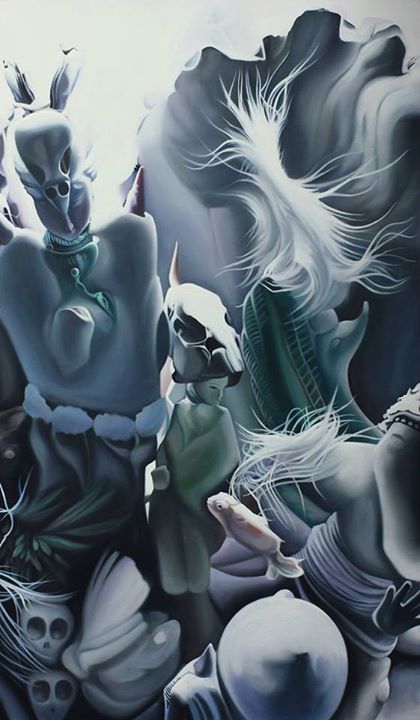
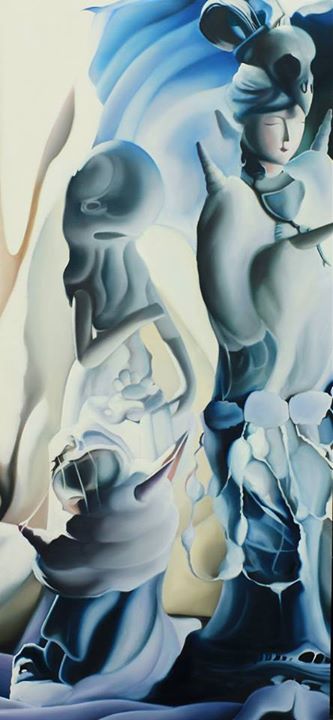
While she was pregnant, and in the first year of Dora’s life, Mon took time away from her painting. 2013 was the year she really started again, and the results have been amazing. She has a solo show in London next year, and as well as a few smaller paintings and a range of drawings, she’s made these two stunning large-scale paintings, which I think are amongst the best work she’s ever done:
I’ve never been good at public reading, and this year I set myself the challenge of improving. I went on to read my work twice at Spotlight in Lancaster, once at Kendal’s Spoken Word, once (performing from memory) at Dreamfired in Brigsteer, and once at the Flashtag 2013 writing competition in Manchester, where I won second place. My confidence grew with each reading, though I still feel I’ve a way to go.
I also attended a spoken word workshop run by the excellent Brindley Hallam Dennis. One of the activities he set has changed everything: he had other members of the workshop read our stories. The lady who read my flash piece ‘Marrow’ performed it at a third of the pace I do. She relished every word, and it was three times better as a result. I haven’t performed since then, but I’m going to practice reading with that sort of gusto at the next opportunity. I’m booked in for a 20-minute slot at Spoken Word in February, and I’d like another couple of events under my belt by then. My goal has evolved a little, too: what I’m aiming for now is something closer to outright performance than simply reading. That will come with confidence, and confidence will come from practice.
4. Seven Seals – Plan of Salvation
After a whopping 18 months, I finally finished making this music video for amazing psychedelic synth punks Seven Seals. They’re an extraordinary band, and it was an honour to be involved. They’re working on new material, which will hopefully be available in 2014 for their ten-year anniversary gigs.
Quite simply, the finest collection of short stories I’ve ever read. Hempel’s writing is so sensitive, so honest, that it infuses her stories with devastating grace. Unmissable.
6. Les Revenants
This French drama is the best thing I’ve seen on television in years, remarkable for its intrigue, restraint and power. It delivers on every level, exploring an extraordinary narrative without needless exposition to unravel the mysteries of the Returned, all of whom are troubled in different but connected ways. The locations and cinematography are stunning, while the soundtrack by Mogwai is my album of the year. There’s a startlingly surreal lucidity to the conclusion, and I think they could have left it there; but I’m delighted to see a second series in the works. Here’s the trailer for season one:
In TV terms, an honorable mention also goes to Game Of Thrones. Tyrion Lannister might be the finest character ever committed to screen, and the Red Wedding haunts me even now.
7. Success for friends
It’s been a good year for many of my friends and peers, too. Iain Maloney landed an agent and a book deal with Freight, Kirstin Innes found an agent, Anneliese Mackintosh got a book deal, Kirsty Logan landed a book deal and won everything in the world. Friends Andy and Gemma had a baby boy called Miles, and Ali and Iona had a little girl called Inka. There have been a lot of richly deserved congratulations this year. Good work, team.
8. Cats
Yup. Two of them. I wasn’t sure, at first, but then we met these two cats in the Wainwright Animal Rescue Centre, and it was an easy decision. They came to us with the names Remus and Teddy, which we’ve kept. They’re brothers, about three years old, and half-Persian. They’ve been an amazing addition to our house. They are incredibly relaxed and friendly, and they actively seek our company. That’s especially welcome when I’m having a writing day alone at home.
We were overdue a break, and this fortnight in France was exactly what we needed. We camped in half-a-dozen places, the best of which was Green Venice, a vast network of canals, ditches and overgrown waterways, crawling with vines and willows, alive with dragonflies and katydids. It was an extraordinary landscape. I read more in that fortnight than I’d managed in four months. Best of all, the holiday gave me enough mental space to plan my next novel, which will be called Grisleymires. That’s now blocked out on Scrivener, waiting for my next writing day.
10. Another year with Dora.
In their first year, babies are basically little puddings. Awesome little puddings, but puddings nonetheless. In their second year, they gather the basic tools to discover the world. And in year three, that toolkit expands exponentially; physically, vocally, intellectually and emotionally. Going through that with Dora has been nothing short of a joy. Seeing the world through her eyes has made me reevaluate so many things for myself. Her conversations leave me in stitches, and everything about her makes me smile. And she hasn’t been to A&E this year, which I consider something of a triumph. Though there’s still a week of 2013 left.
So that’s my Top Ten. It’s been a good year, and 2014 is alive with possibilities. I might even pop some resolutions up in a few days.
BigCharlie Poet (the nom de guerre of Simon Hart) and I have been trying out a picture-based flash fiction vs. poetry writing challenge. In case you missed it, here’s round one: Cathedrals.
It was Simon’s turn to choose a picture, this time, and this is what he chose:
I found this one very difficult. With Cathedrals, I had the story in an instant, and writing was a cruise, but this has taken some working around. I guess that’s the way with writing. I can’t turn it on like a tap. Sometimes the stories shimmer into view as though they’d been there all along, and sometimes they come word by word, kicking and fighting, refusing to stay on the page. This one’s been a toughie, and I’ve tried it three times. My first attempt was an illiterate dystopia where an old man found a book he couldn’t read. It spiralled very quickly, and I abandoned it at 600 words. My second attempt was about a haunted library, and that was a little better – I think I can rescue it for a short story – but it wasn’t good enough for this, and I hadn’t the heart to stick at it.
I have written a previous piece that fits this picture exactly, which doesn’t help. The abandoned library is a perfect representation of one of my Twitter shorts. Struggling to get that story out of my head, I posted it again in the hope of exorcising the blasted thing. It looks like this:
Having sent that back out into the big wide world, I did feel a little freer, but it wasn’t until I discussed the picture with Mon that I came up with my final idea. She imagined the books dropping away into nothingness, and that was the spark I needed. Time and time again, Mon reminds me of the stories I like to tell the most. She keeps me on track when I’m getting lost. With that image in my head, I sat down and wrote the final piece fairly quickly. It’s the middle of something much bigger, I think. I can see this growing into a novella or even a novel, given time. I’m not done with the characters.
Simon Hart found this one tricky, too, which is a relief. It’s taken both of us longer than the fortnight we’d agreed, but then, hell; we’re busy people. This is what Simon has to say about it:
“Well, it’s finally been written and this has been difficult! I saw the picture and thought it was interesting, suggested it and went ahead with it as the challenge piece… ignoring the fact I have written creatively about libraries before. What it has meant is that those pieces of work have been clamouring at my brain to be let out again. I have refused them, and eventually created this new poem, but not without help. The title and line relating to it come from my Dad pitching me a line far greater than anything my feable mind was coming up with, and I finished only because I cheated and read Simon’s excellent entry on the same photo. Cheers gents.”
Here’s Simon’s response to that troublesome picture:
Engines of Thought
by BigCharlie Poet
There were books strewn everywhere
Left without much apparent care
Though some were in bundles, others in stacks
Most were just left to cover the cracks
In the old dead library’s floor
The words on the pages, scattered like dust
Engines of thought now turned to rust
Childhood stories being lost by the hour
The Tempest losing so much of its power
From the old dead library’s floor
The shelves have been looted for perceived greater worth
And the paper that’s left returns to the earth
The knowledge inside no longer at hand
The words pour away like loose grains of sand
Through the old dead library’s floor
They once taught us magic, and fanciful tales
Told us stories of mad Captains hunting white whales
Taught that being obsessed was a kind of disease
That carried you away on angry dark seas
Not the old dead library’s floor
But now they do nothing, we won’t let them teach us
And where they sit they will struggle to reach us
Abandoned and now out of our sight
They are doomed to their own perpetual night
On the old dead library’s floor
And here’s my response:
Books Like Grains Of Sand
The creature stepped out of the darkness and into the candlelight. It was smaller and far slighter than Morag, and carried itself daintily, as though it was frightened of breaking a limb. Its tiny eyes were black pinheads in the cloth. It had a ragged hole for a mouth. It smelled like coal sheds.
It led her to a door.
“In here, my pet,” it lisped. When it talked, stuffing spilled from the corners of its mouth.
In jerky, spastic movements, it opened the door to the library, and daylight spilled into the gloom. Squinting in the light, Morag peered beyond the creature and saw a vast room. The floor was entirely carpeted in books. Books, books and more books, gathered in loose stacks, strewn by the dozen, piled up in the corners.
“All of them?” she whispered.
The creature’s smile wrapped around its head. Morag heard stitches popping as it grinned.
“All of them,” it said.
It turned the hourglass again, and the sand began to flow.
Morag slung her knapsack, took a deep breath and brushed past the creature into the library. She stumbled to the top of a nearby stack and surveyed the room. The door creaked shut behind her, and the creature’s smile receded to a single line as it melted into darkness.
She was alone in the library. Before her, books lay scattered in their thousands.
“But where to start?” she murmured.
She took a single step, and then she heard the slithering. It was so faint at first, ghostly whispers, but gathered to a rush. Morag scanned the room. The books in the middle were moving. They revolved, and more volumes fell inwards as they shifted, gathering momentum. They spiralled, forming a circle and starting to drop into the floor. It was spreading outwards, increasing speed. It was a whirlpool. With a jolt, the stack beneath her shifted, throwing her to the ground. Morag fell headlong into the torrent.
The daylight closed overhead, grey and fluttering with loose pages. Books battered and struck her as they ground and jumbled in the gyre. The movement was inexorable, dragging her down, dragging her into the centre. Her feet lost contact with the floor and then it all dropped away and Morag was falling, flying, plunging into nothing as the books tumbled all around her. She panicked, flailing and groping for contact, anything to arrest her fall. There was nothing to hold on to. The space beneath her and around her was empty entirely, a sea of nothingness stretching on forever. Books fell around her like rain, covers flapping and pages rippling. As they fell, Morag realised they looked exactly like the sand in the timer.
In a heartbeat, she remembered what Badger told her: about time. About the creature. About this place.
She took a deep breath, shut her eyes, and reached out. Her hand closed around a book. Still falling, she opened her eyes, and turned to the first page. Morag began to read.







 Simon Sylvester