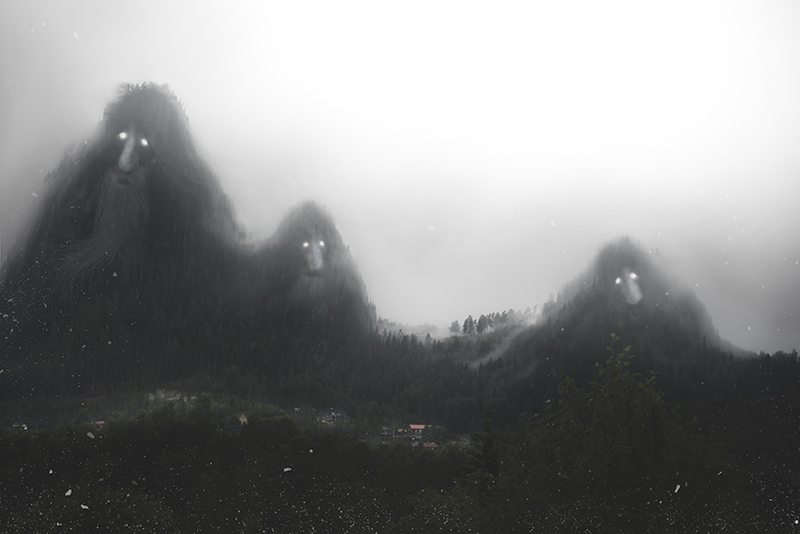
Fox Woman

Another tale, another telling; at my last story circle, I performed a Siberian folktale called The One-Eyed Man & The Fox Woman from a wonderful collection called The Sun Maiden And The Crescent Moon by James Riordan. It’s a story I first heard on a podcast told by Daniel Deardorff. By way of drums and dreams he seized me by the scruff and never let me go; when I started storytelling, The Fox Woman was right at the top of my list of pieces to learn. It’s longer than Gobbleknoll or The Talking Skull, about 20 minutes or so, and I’ve been working my way up to it by way of shorter tales.

There’s an otherworldiness to this one. The titular One-Eyed Man is a pretty small part of the story – the journey belongs entirely to the Fox Woman – her anger, her longing, her choices, her consequences. It holds at its heart a crystal truth about moving through life; about what a person should tolerate, and what they cannot. It’s about ageing, changing, desire, belonging and peace. It’s vast and it’s wild.

The Siberian stories are strong. I’m currently reading The Turnip Princess by Franz Xaver Von Schonwerth: 72 folktales and fairy stories collected roughly in parallel to the Grimms, then lost for over a century in a city archive. As with my recent reading of some Russian stories, I’ve been struck by how many of them are structurally quite weak; elements appear at random with successions of unconvincing ‘and thens’ disconnected from what’s already happened. What I admire in the Siberian stories (as with Inuit stories) is that most elements of the story happen because of something else – the magic remains wild and vital, but the threads of story are causal and connected, rather than consecutive – at times almost random. As a side note, it’s fascinating to see the movement of stories through time and place – there are quite obviously elements of Grimms throughout The Turnip Princess, then what crops up but half of Three Golden Heads Of The Well? (Another story high on my list to learn.)

I’m off topic. Back to Siberia. The stories are rich in blood and fat and sinew. Eating, not eating; animals that talk to people; the Moon sneaking down by night to steal a bride; clayman, raven, elk. Animals are completely and vitally integrated with people – survival depends on food, and food is meat, and meat is animals, and animals is hunting. This is the prism through which almost every story plays out; from the mythic to the domestic, tales of tooth and blade and fur and fire. Odd thing for a vegetarian to say, but count me in. I’m there.

Telling The Fox Woman went well, I think, I hope. Ten of us met in an old Quaker graveyard high on Fellside, looking out across the town, with a large ginger cat slinking through the long grass, and the last of the summer swifts high overhead, and a robin ferreting through wild blackberries. I brought in repeated motifs to bookend the story, and that seemed to go well; one of the jokes didn’t land at all, but the other landed superbly. I extended the scene with the baskets of skins, which felt to me to make sense to the story, and I removed the scene with the reflection in the pool. I managed not to rush – to slow down and relish the flow of words. I’m increasingly drawing on my well of prose and poetry when conjuring the images. I still have a very long way to go in using my body and voice and face, and this is something to work on.

Next telling is at the Brewery open mic supporting Rose Condo – either a Zen koan called Two Tigers & A Strawberry or Queen Albine, depending on how angry I am on the night about English nationalism. Chances are I’ll be quite angry.

The Talking Skull

A quick storytelling post on the back of another Verbalise at the Brewery Arts Centre. The slots are 4 minutes, and I’d struggled to find a piece I liked that fit that time frame – despite having loads at 1-2 minutes and several at 5-6 minutes. Eventually I settled on The Talking Skull; originally from Cameroon, I think, and a story I’d known for a long time before I started telling any myself – and one I heard completely reinvented by Nick Hennessey when I was on the storytelling course.

While keeping the structure the same, Nick moved the action to the gibbets and heaths of old England, bookending it with singing and drums and a clutch of corbies. I’m nowhere near drumming and I’ll never be a singer, but his translocation of the story was so deft and absolutely something to learn from. I shifted mine to the mosses of south Lakeland and used a Baron of Kendal for the villain. It’s a fantastic wee piece and I loved telling it – and I loved exploring how the bones of a story can hang with different skins. That’s something to remember.

My son drew the backdrop for the projector – much obliged that lad – and many thanks to Ann The Poet for the photo.

Gobbleknoll

.

There was a great grey lump of a hill that ate people

…and Rabbit’s Grandmother told him never to go there, and Rabbit being Rabbit he went there as soon as he could, and he thundered his paw on the flank of that hill and called out, ‘Ho! Ho, Gobbleknoll! Open up! Show yourself! I want a word with you…’

…but Gobbleknoll knew Rabbit was trouble, and Gobbleknoll stayed shut.

So begins Gobbleknoll, a short folktale I came across in an Alan Garner collection and originally from the Sioux people. I performed it at the Brewery open mic last night, making for my first public telling, and first time performing since the Stealing Thunder storytelling course.

I added some bits and removed some bits – an extra beat in the middle, and a tweak to the end. Stories evolve. They flow like water from person to person to person, always changing and yet always water. I loved giving the story space to breathe – feeling it settle into the contours and corners of the room. It seemed to go over okay – lots of people spoke to me at the interval or after – most simply stating how good it was to hear a folktale. Adults aren’t given many opportunities to be children, and that’s one of the great gifts of storytelling. Storytelling shuts the door on the scream of life, if only for a moment.

Next up I’m reuniting with my peers from the story course… we’re forming informally, meeting irregularly in a circle to share new work. I’m preparing a story called The Magic Bowls for that one – it has the most wonderful twist.

Storytelling then. Feels like I’ve begun. If I get the chance, I’ll record my take on Gobbleknoll and pop the audio on here.

Open up.

I want a word with you.

Script Lab Longlist

Just a quick note to share the news that I’ve made the longlist for a BFI Film Hub North scheme called the Northern Exposure Short Film Script Lab, offering professional development for northern writers. It’s a long longlist of 60 hopeful writers, from which ten ideas will be taken into development.

My story has a working title of A Whisper Of Wrens — it’s about a squabbling couple visiting a huge northern marsh, only to find that it isn’t as empty as it was supposed to be. It’s very much in the tradition of modern gothic, or folk horror, or urban fairytale, or low fantasy — whatever you choose to call it. This thread runs through almost all my work, drawing on contemporary things like The Loney or Midsommar or the music of The Antlers, way back to some of my earliest and biggest influences — Roald Dahl’s short stories, Link’s Awakening, the soundscapes of Godspeed You Black Emperor.

Will write more as I have it — I’m throwing lots of things into the aether at the moment, hoping some of them come back. Fingers crossed!

In The Night Garden

Day 45 in the Night Garden. How have I survived six weeks in this dreadful place? I ate the last of the Pontypines yesterday, and already I grow weak with hunger. I must leave soon to forage food. Worst of all, the Haahoos have discovered where I’m hiding. Their monstrous shadows wash across the windows of my refuge. I hold Macca Pacca’s corpse to the window and wave his skeletal hand on a stick, but they are becoming ever more suspicious. Why doesn’t he venture out with his soap? Why isn’t he washing faces? Because I ate his heart in a cassoulet. Once — long ago — I would have been cruelly shamed by my crimes, but all morality dies in this place. I survive by becoming one of… them. Yes. My name is Iggle Piggle. I am a monster. But it was the Garden made me this way — the Garden. I now wish only for sleep — perchance to dream. Dreams are my haven from these waking horrors. As I drift, I hear the words, as though whispered from the deepest parts of my skull…

The night is black
And the stars are bright
And the sea is dark and deep.
Take the little sail down
Light the little light
This is the way to the Garden of the night.

Iggle wiggle diggle wiggle woo. God help me. God help us all. 

tomarum_midvinterglod

The Old Man Of The Sea

Help me, internet.

When I was a kid, I remember reading a short story, possibly from a book of short stories, that finished with the Old Man Of The Sea swimming away in a furious huff. He was seething because his plans had been somehow thwarted. I remember the illustration in particular — the old man, long hair swamped by the sea, low down and mean in the waves.

I’m now trying to find this book, but haven’t a clue what it’s called or who wrote it. I’m fairly sure it’s not the Grimms or Andersen, and we’ve also now discounted The Water Babies, Rupert the Bear, Sinbad, and The Old Man Of Lochnagar.

Dora loaned me her good pencils so I could draw an approximation of the old man in his grump. Here he is — any ideas?

old-man-of-the-sea

What’s For You Won’t Pass You By

Well, I could scarcely be more pleased with this: the mighty Liar’s League of London have accepted another of my short stories. After Carrie Cohen did such a fine job with Art Is Long, Life Is Short, I’m absolutely delighted to share this brilliant reading of What’s For You Won’t Pass You By.

The actor, Cliff Chapman, has transformed the story. The dull-witted violence I imagined for the farmer is gone — and in its place something far more human, far more visceral, and far more frightening. The farmer has become more downtrodden, more wounded, sadder and more reactive, and the character is all the stronger for it. I’d imagined him as Irish or Scottish, but Cliff’s West Country realisation is absolutely perfect — it’s better than my version. This is the second time Liar’s League have transformed one of my stories, and I absolutely love seeing what these talented actors bring to my work — on each occasion, they’ve elevated my story and made it into something bigger.

Here, then, and nicely in time for Hallowe’en, is my short story What’s For You Won’t Pass You By, read by Cliff Chapman for Liar’s League.


Cellar steps

Last night, more or less six months since I started, I gave the first draft of The Hollows to Mon to read, and I sent it to my amazing agent Sue. Mon and I took Dora out to tea, then she started reading. Sixty pages in and she hasn’t ditched it in a flurry of disgust, so there’s hope for me yet.

I thought it would easier to let go of the second book, but I was wrong. I thought I’d feel more confident, more certain. I don’t. If anything, the stakes feel higher. What if I’ve moved backwards? What if no one likes the story, the characters, the writing? I’m happier with this story than anything I’ve done before, but what if I’m wrong? What if I’ve got worse?

I didn’t entirely understand the proverb about not seeing the wood for the trees until I started writing novels. When I’m so immersed in my work, in my worlds, it’s easy to lose perspective on whether it’s actually any good. My own, personal instinct for story is stronger than ever, and getting stronger still; but there’s nothing on Earth to say it’s actually right. There’s no way to triangulate what happens in my heart with the world around me. In that sense, every novel – and I’ve written three of them now – is a first novel, feeling in the dark for cellar steps. Maybe it gets better in time. Maybe it gets easier. But I can’t imagine what that feels like, how that would be. It’s strange to be so terrified of the only thing I want to do. As Mon was reading, I glanced across at her every thirty seconds, every minute: which page is she on? What happens there? Oh lord, is that all right? Does that dialogue work? Do I believe it? Will she believe it?

Dora woke at 4.30am this morning, claiming it was too dark to sleep. I put her back to bed, where she fell asleep in moments, but then I couldn’t because, ahahaha, it was too light. So I’ve been up for hours, listening to songs I love, making a Mogwai mixtape for a friend, catching up on email, gazing out the window and thinking, thinking. There’s no light quite like the glow of dawn. The world is luminous, and then it turns to gold, and it sleeps on into the rising sun. No one knows but foxes, cats and milkmen. I imagined what it must look like on the river Kent between Burneside and Staveley right now, right now, with no one there at all, only the swallows and the martins flitting on the river, vapours coiling on the water, sun sliding sideways through the trees, a hidden valley with half the world in shadow and half the world on fire.

I know what my next four or five novels look like, and I have fourteen flash stories to write. Today, though, I’m taking my daughter swimming. She’ll be Peso the penguin and I’ll be Kwazi the cat, and we’ll look for treasure and help sick sea creatures along the way. Dora loves swimming, but she’s scared of having water on her head – she won’t jump in, and hates being splashed. But today, for the first time, we’re going to see how things go with goggles. Maybe – with some support, some courage, and some curiosity, today will be the day she looks underwater, the day she discovers there are other worlds, other places, other ways to see. Letting go is hard. Feeling for that cellar step is hard. Maybe all of us need to be brave.

Dora’s dream

I woke early and spent a few minutes listening to the sparrows, then made a cup of tea and settled down to work. With a first draft complete, The Hollows is off to one side, ready for a redraft when it has finished steeping. At something of a loss for what to do, I worked on an older piece, making some overdue tweaks. It was slow, frustrating progress and I was relieved, an hour or so later, when Dora thundered on the ceiling overhead. She clattered down the stairs and burst into the room, as she does every morning, and threw herself at me.

‘Morning sweetheart. It’s good to see you. Did you have any dreams?’

‘Yes.’

‘Good dreams or bad dreams?’

‘It was a bad dream.’

‘Oh no. What happened?’

Her face fuzzled as she remembered it.

‘There was a big swamp. And a little girl went into the swamp, and she stole a ribbon.’

I frowned. This reminded me of something. Dora continued:

‘And the little girl was chased in the swamp by a very bad man.’

I realised what she was saying. I knew what she would say next. My skin began to tingle, crawling upwards from my ankles.

‘And the bad man took the ribbon, and he took the little girl as well, and then there was nothing but the swamp.’

My four-year-old daughter had just relayed to me the plot of the first chapter of The Hollows. Which would be fine, except for the fact that no one else knows it but me. I haven’t shared it with anyone. No one has read it, and I’m the only person in the entire world who knows what happens.

I’ve been ransacking my brain to work out what happened. I’ve never told Dora any part of the story, and she can’t read for herself. Mon hasn’t seen it yet, so she couldn’t have told Dora either, and no one else has access to my computer. I have no idea how she knew this part of the plot. There must be a rational explanation, but I can’t work it out.

There’s just no way. There is simply no way it could have happened.

And yet it did.

A woman always, always tripped on the bottom tread of the stairs in her new house, her muscle memory convinced and compelled to make an extra step for a stair that wasn’t there. This happened for years. When the house was renovated, and the floor was lifted, the builders discovered an extra step at the bottom of the flight. People wake from comas speaking Latin, or dream across a continent of their brother drowning at sea, and wake to bad news on the phone.

I don’t believe in ghosts as sentient beings. I don’t believe in the supernatural as an anthropology. But human imagination is an engine of staggering power, and we are utterly corruptible. The weight of human history drops away below our feet, and we walk in the shadows and the hollows of what has gone before. Like crossing a clay field after the rain, it sticks to our feet in clumps.

Holloways are ancient droving roads. The weight of carts and cattle through the roads caused the ground below to erode and sink, even as the verges to the side of the road stayed the same. Protected from the passing herds, trees grew on the verges and knotted overhead, while below, the path continued to erode, ground away by centuries of cattle, and so, over time, the roads became tunnels: hollow ways.

That’s where we are, all of us. The trees have been cut and the verges levelled and all of it coated with tarmac, but we still walk along the holloways. A sideways glimpse is all it takes to see the fleeting, teeming strata of the lives we’ve lived before.

ttf-french-holloway1

Radio silence

My blogging has been exceptionally poor since returning from Thailand. And I’d apologise for such awful radio silence, were it not for the fact that I’ve done exactly what I wanted to do, which is to get my head down in The Hollows and write my ass off. Five months later, I have no ass left. It’s completely gone. That’s how much writing I’ve done. No ass.

Last night, I finished a very first, very rough draft of The Hollows. It comes in at just over 101,000 words. I started in February, and couldn’t work in May (because of this). If I add up my two days a week of writing time, and the myriad mornings of sentences and paragraphs, I estimate the draft has taken me a total of approximately 35 days. That’s a ludicrously short space of time, and I’m still not sure how it happened. The Visitors took me near enough six months, I think, while my first (and thankfully forever unpublished) novel demanded a year of full-time work. I don’t think I’m getting any faster, though the muscle memory will be there – this chair, this keyboard, this notebook, this pen – but perhaps I’m believing a little more in what I want to do, where I want to go.

After spending all of 2014 torturously writing the wrong book, I’ve reached the conclusion that the key to writing is writing the right damn book. And The Hollows is right – right for me. I know it to my fibres. Even though there are weeks or months of editing still to come before I’ll feel ready to share it with my wife, I’m pleased with it. My first instinct for this story revolved around memories and mud, and while it has taken a roundabout route to get here, morphing through a dozen incarnations, it has finally come around, finally delivered what I wanted. My heart broke when I realised I was writing someone else’s story. The subsequent weeks spent with a notebook and a pen were some of the most productive of my life, but none of it could have happened without setting off along the wrong path. Sometimes it takes the wrong path to find the right one. Right? Write.

So there it is. We write to the universe. Sometimes it writes back.

I have a full week of college work to come, then ten days camping on Tiree and Coll with my wife and daughter. I’m going to print my rough draft and take a bag of pens, and read through the manuscript while the sea hushes in the simmer dim. Then comes the edit. See you on the other side.