A couple of months ago, I posted about the Drowned Villages Poetry Competition. There are flooded villages in Cumbria, Gwynned and Lanarkshire; the competition was open to poets within those library regions, working with that theme. The top prize was having your poem soundtracked by Mogwai. I’m very guarded about my poetry, but Mogwai are one of my favourite ever bands and creators of my all-time favourite album, and so I entered the contest.
Rounding up what’s been an astonishing month for me, I’m both delighted and devastated to reveal that I won the regional contest for Cumbria. I’m absolutely elated that the judges enjoyed my work. I’m still brewing, awestruck, on the momentous thought that Liz Lochhead, Ian McMillan and Nicky Wire have read my poem. But I’m also utterly gutted that having come so close, top prize went to the contestant from North Lanarkshire.
I feel bad even writing that. The first place piece, Never Come Home, is a really striking poem, and I’m sincerely happy for winning writer Catherine Baird. I didn’t expect to feature in the competition at all, so taking a place as runner-up is excruciatingly bittersweet. Having Mogwai do something with my work would have been astonishing – I can’t even frame the shape of it in my mind. I can’t articulate the joy I would have felt. Coming so close has turned me upside-down. I’m genuinely thrilled for Catherine Baird, and delighted with my own poem doing so well, but this one hurts. So near, and yet so far.
I know this sounds churlish. I don’t mean it to. But I discovered Come On Die Young in 1999, and Mogwai have soundtracked the last fifteen years of my life. Without exaggeration, Mogwai’s music has accompanied at least half of my entire writing output. I feel ecstatic to have come so close, and I feel heartbroken to have come so close.
For Facebook users, here’s the winning poem by Catherine Baird. My heartfelt congratulations to Catherine, and I can’t wait to hear the finished song. Like all of Mogwai’s work, it will be extraordinary.
When I was writing the poem, I played Hungry Face from Les Revenants on repeat in the background, hour after hour. I’m listening to Come On Die Young as I write this blog post. May Nothing But Happiness Come Through Your Door is playing. It’s the pivotal point in the album. Next comes the calm before the storm of Oh! How The Dogs Stack Up, and then the astonishing, burning, towering trio of Ex-Cowboy, Chocky and Christmas Steps. I will never stop listening to this album – or the others – the otherworldly Rock Action, the ferocious Happy Songs For Happy People, the dreamworld EP+6, the snarling Young Team, the smouldering Les Revenants, the muscular Hardcore Will Never Die, the reflective Hawk Is Howling, the utter majesty of Government Commissions, the blistering uppercut of Rave Tapes.
I will never stop listening to Mogwai, and I will never, ever stop wondering what if…
The Visitors is a little bit about selkies. Selkies are seals, and they are also people. They have a fur coat that allows them to take the form of a seal. When they step out of the coat, they become human. Selkies can be men or women, but they are always extraordinarily beautiful.
There are a multitude of selkie stories, but the most common starts with a selkie woman removing her coat and dancing on the shore. A young man – usually a fisherman or crofter – spies her dancing, and steals the coat. With her fur held hostage, the selkie has no choice but to marry the man. They live together for a while, but then the selkie finds her skin and escapes back into the sea. The man is left to nurse a broken heart. Often, the couple have children. In some stories, it is a child that finds the coat, and returns it to the mother. Sometimes the selkie takes her children back into the ocean, and sometimes they are left behind. In that version of the story, the mother and children meet in the surf to play.
In the other typical selkie story, an island woman cries seven tears into the sea to attract a selkie mate. Selkie men give children to barren women.
I love the idea of selkies, but I struggle with some aspects of these traditional stories. They crush female independence. In the first, the selkie is kidnapped and loses years of her life to captivity. The man takes what he wants, and is punished only by the accident of her escape. In the second story, the male selkie is a god, and the woman summons him on bended knee. Either human men dominate supernatural women, or supernatural men dominate human women. Both men and women mean more to me than that. When I started writing The Visitors, I wanted something different from selkie stories. I wanted equality. That’s been my guiding light for the novel, from start to finish. John and Izzy share traditional tales, but Ailsa and Flora question the validity of that tradition, and take a closer look at what it means to be a selkie.
Selkies are special. I watched the seals hunting in the bay at Grogport, and saw them bask and splash in Portnahaven harbour. There is life and knowledge in their eyes. When you look at them, they look back. On Kintyre, we walked the coast around Skipness on a grey, steely day, and we were followed by a seal. For half a mile or more, as we skirted the coast, the seal stayed twenty or thirty yards away from us. It seemed to move without locomotion, so that dark snub head simply kept pace with us, looking towards the shore. We sat on old stones to eat our lunch, and the seal bobbed and ducked at one end of the headland. It didn’t move away until we struck back inland, and then it vanished in a wink. I looked back to seek it out, but the seal had gone.
I asked my friends about seals and selkies, and they swamped me with stories. Chris gave his first pocket money to Save The Seals. Tom talked to the seals in a sealife centre, and the seals talked back. Dan’s friend confused swallows for seals in a dream, so he drew her a picture of a swallow with a seal’s head. Kirstin’s father whistled to the seals in Shetland, and they popped to the surface to see what all the fuss was about. Jon was kissed by a sealion. Sakina can’t shake the tale of the seal maiden. Ross works in Copenhagen, and daydreams that commuters with sealskin coats are modern-day selkies. Amy holidayed on Mull when she was seven, and spent the summer playing with a selkie called Della.
Why do we give seals such humanity? They are manifestly foreign to us, but the connection is overwhelming.
When I was 25 or 26, I spent a year working and backpacking in Australia. I remember snorkelling on Ningaloo Reef, diving as far down as I could go. I looked up exactly as the sun dropped behind a cloud. The water turned suddenly cold and pressed against me, and I felt very afraid, scared of the deep and the dark and the cold and the blue. When I think of selkies, they are underwater, floating with perfect neutral buoyancy, and shafts of sunlight sway woozy on the surface above. The darkness drops away behind them, and the selkie exists in two places: as a seal, utterly unafraid, and as a human, drawn against the current, compelled to the surface. Selkies live in thresholds. The selkie woman, when she escapes, returns to embrace her children in the surf. The shoreline, changing always with the tide, is where seals and people meet as selkies. It is a nowhere place, and yet it is all they have.
A hunter doesn’t know his wife is a selkie. While hunting, he sees her as a seal, and harpoons her. She becomes human, and dies in his arms.
The crofter is left heartbroken on the shore, and his selkie wife returns by stealth to see her children.
This selkie is allowed only one night of the year to be human.
Two lovers share a single skin, so that they can never be together in the same form; always one as a seal, and one as a human.
Selkies are born from the souls of drowned sailors.
Selkies are cousins to the muc-sheilche, the kelpie, the nokken, the finfolk. Those creatures are killers and enemies to men. So what makes the seal a victim? A romance? A tragedy?
When we visited Islay, we drove out to Portnhaven. We clambered across the rocks to the weedy edge of the harbour, and we watched the seals. Half a stone’s throw across the water, they gathered to sunbathe by the dozen. They winked as though the Atlantic was a hot tub. They flickered in the water, phantoms bound in straps of kelp. They came so close that I found myself laughing aloud – laughing in wonder, joy and disbelief.
When I started writing The Visitors, I wanted to explore that connection with the seals, that projection of knowledge, and emotion, and empathy. I don’t know if I succeeded, but I’ve fallen more in love with seals and selkies.
My wife found this picture of a seal. It was taken in California, rather than Coll, but it’s the way I see a selkie. Curious and cautious, incredibly close, and impossibly distant.
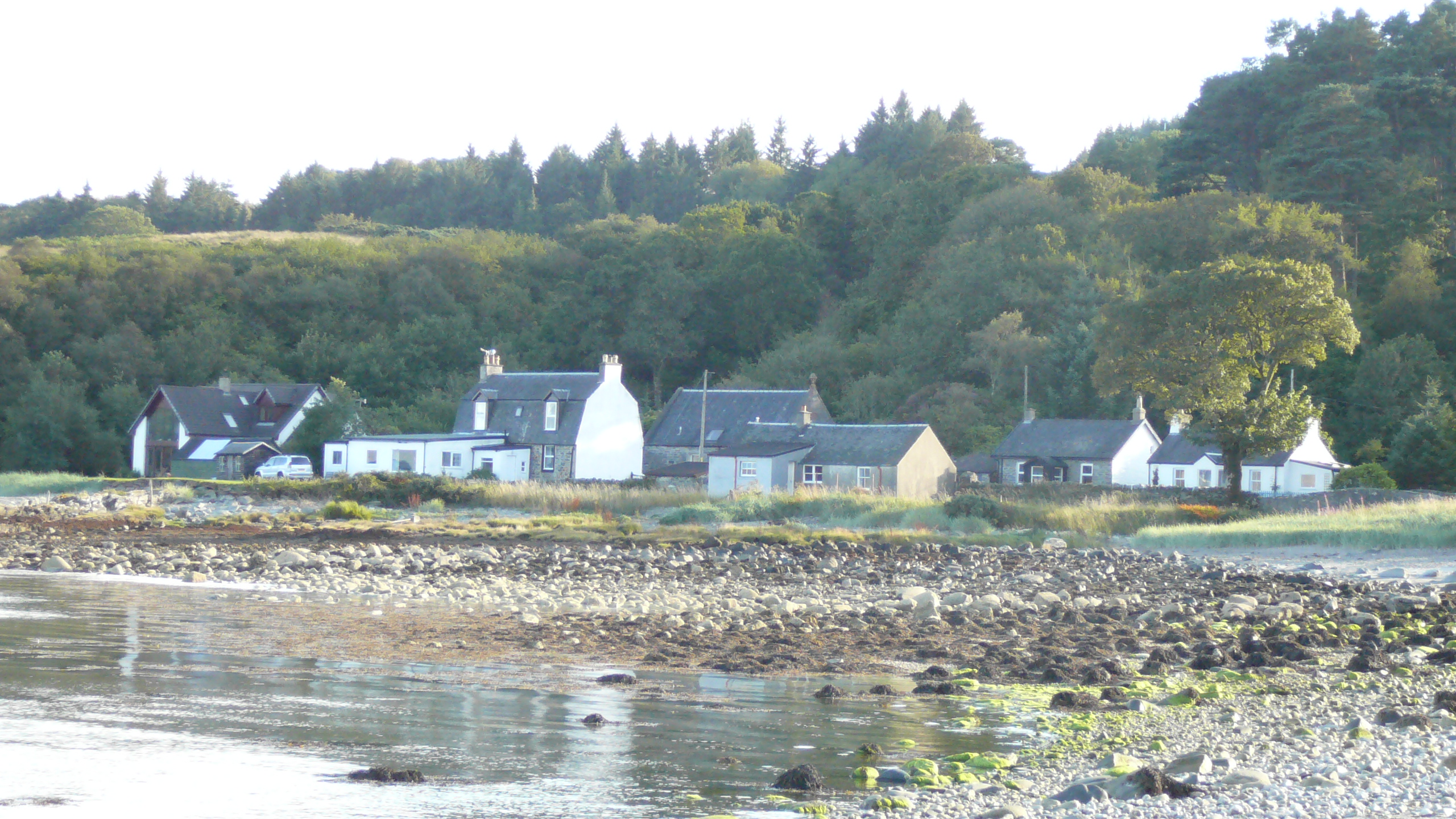
The idea for The Visitors fell into my head almost fully formed while on holiday in Grogport, a tiny hamlet on the east coast of the Kintyre peninsula. It’s connected to the mainland by a narrow isthmus, and it feels like an island. The beaches are sandy and studded with pebbles. Hills rise steeply from the shore and narrow roads wind around the coast, ducking inland to skirt the inlets. To the east, Arran lurks like a beached whale, and Gigha is smudge in the haze on the horizon to the west. Abandoned crofts explode with rowans, and in places the ferns fall into the road, wet and green.
My daughter was three months old, and the long drive from Cumbria had unsettled her. She started waking early – around five in the morning – and wouldn’t go back to sleep. My wife and I made coffee and watched the sun rise over Arran, casting blue light on the millpond Kilbrannan Sound. From the kitchen window, we saw herons stalk the surf, lashing down on crabs or minnows. Seals hunted in the bay every evening, and an otter dismembered fish on the shoreline. The garden thronged with little birds, and at one point I saw a kestrel sitting on the washing line, no more than five yards from the house. When we walked around the island, there were butterflies in the gorse, spiders on the sand, bees in the grass, gulls wheeling on the updrafts. I was shaken, at times, by how much life was around me, living as it always had, as though the land itself was alive and conscious. In so many places, it looked as though people, civilisation, had simply given up and moved elsewhere. It felt as though the land was waking after centuries of slumber, and just beginning to stretch.
On the third or fourth morning, watching a seal swim like quicksilver in the bay, the spark of a story flared brightly inside me. It caught fast, and began to smoulder. That story became The Visitors. Selkies, living in Grogport. A murder mystery. A young girl, desperate to leave an island. And it would be an island, I decided; the Kintyre peninsula was beautiful, but didn’t do everything I wanted for the story. I started drafting a sense of what the island looked like. I called it Bancree. As I began to write the story, the island evolved too, morphing into something real enough to touch.
Bancree is a scrapbook of my Scotland. I grew up in Inverness, where I could see Ben Wyvis from my bedroom window. We walked our dogs on the shingle beach at Ardersier and through the sodden plantations of Culloden. I’ve been canoeing and camping on Loch Maree in torrential rain, and climbed the boulder fields of Torridon and Glen Nevis. I’ve been to the top of Schiehallion, and walked on the clifftops of Dumfries, and fallen out of bars on Tobermory, and seen friends crash cars by the shore of Loch Ness. I’ve taken the train from Edinburgh to Inverness so many times that the journey is engrained in my memory. From the top of Glen Affric, with June snowmelt still feeding the burns, I’ve seen both coasts glitter in the sun. Scotland has a hundred landscapes that sing to me, and I collected something from each of them to build Bancree.
The island is my love letter to Islay, Jura, Gigha, Mull, Iona, Ullapool, the Highlands, the Black Isle, Moray and the Great Glen – to the landscapes I grew up in, the landscapes I love. I’ve never tried to sketch Bancree or make a map. I know what it looks like, and where to find Grogport, and Tighna, and Izzy’s hut, and the windfarm on the Ben. But more importantly, I can drive the road around Bancree simply by closing my eyes. I can feel the scrunch of shingle underfoot, and the batter and bluster of the Atlantic coast. There is dew sagging on spiderwebs, spun between the thorns of gorse, and rafts of flotsam hefted on the beaches. Dead, empty crabs still scuttle on the breeze. The twiggy scratch of heather, the rivulets of water in the bracken. Titanic clouds, dark and warm and scudding low enough to touch. The fluttering machair, alive with bees. Fog that swallows the tops of trees and telegraph poles. The water in the bog pools, dark with peat, staining all the world around, pouring brown from every tap. Sands that hiss and sing as the wind rolls across the beach in waves.
Bancree is as real as a dream to me. It is vivid and bursting with life. I can feel the rub of sand between my fingers, but there is no map to go there.
On Friday night, Fred Versonnen performed ‘The Elephant Story’ at Dreamfired, and it was magnificent. The open mic night was as interesting as ever, but one of the scheduled performers couldn’t make it – and so Fred agreed to do another 10-minute spot before the interval. Fred is Belgian. He started by apologising for his (obviously excellent) English, and then announced that he was going to sing a nursery rhyme – ‘A song in my own language,’ he said, which is a phrase I’ve been unable to shift. And then he sang.
I don’t know a word of Belgian, but in that minute, or maybe two, Fred managed to generate genuine laughter and even a sense of the bittersweet, entirely through action, expression and body language. It was remarkable. I later discovered the song was about the birth of seven cats – six big and one very small – and all the mice running away.
He then performed a story I’d heard before, about a young monk who goes out into the world, tasked with discovering the meaning of life. Although I’d come across it before, Fred piled farce upon farce on the poor monk, earning howls of laughter from the audience – again using expression, the shape of his body, and most especially – pauses. (I’ll have a lot more to say about Fred, and pauses, and Fred’s pauses, when I’ve finished thinking about them, but that’s for another post.)
After the interval came The Elephant Story. This was my first experience of storytelling that did not have conventional myth or fairytale at its core; from Emily Parrish performing Loki, to Peter Chand’s Punjabi Grimm tales, to Kat Quatermass and her queer fairytale city, all the amazing storytellers I’ve witnessed have drawn at least a little something from our shared bank of generational stories – the lexicon of myth that has been passed around firesides and whispered over cribs for centuries.
Fred’s story was different. His background is in clowning and the circus, and the story was a love letter to a way of life long gone. Set at the start of the 20th Century, the story follows a little boy called George ‘Slim’ Louis, who falls in love with elephants and runs away to join the travelling circus. Over the years, he experiences cruelty and compassion, cutthroats and camaraderie. His story is remarkable, but made amazing by the way Fred ties it to the stories of the elephants themselves – anecdotes of their strength, and intelligence, and suffering, and occasional violence. There are moments of unbearable barbarity and tragedy, and moments of hysterical joy. The Elephant Story is a parable of all animals in captivity and a truly exceptional show.
Fred is a very physical storyteller. I don’t mean that he moves around a lot, but rather that his movements are measured and completely organic in developing, exploring and reinforcing the power of the story. His ability to hold a neutral expression conveys extraordinary meaning to his words, and that gives an audience space to reflect, savour, empathise and drown – in sadness, in humour, in understanding.
The next day, I attended Fred’s clowning workshop. It was held a hall in Arnside. By some dumb coincidence, there were elephants in the windows. I learned a great deal in the workshop, though I also found it very challenging. I’m going to write about that another time, because I’m still making sense of the things I learned, still processing some of the questions it raised. For now, here’s a picture of a boy and a circus elephant.
I’m delighted to share the news that my 100-word story Dare has been Highly Commended in the National Flash Fiction Day writing competition. You can read it, along with the rest of the winners and commended stories, right here.
To reach the top 10 against such strong competition has really made my day. I’m also delighted to see Cathy Lennon take top spot with her story Never Let Me Go, because Cathy is lovely and her story is fantastic.
Someone landed on my blog a few days ago with the search term ‘is flash fiction a proper noun’. I’ve been giving that some thought, and the answer is no. But I love that flash fiction is becoming more established. It’s the perfect counterpart to my novel writing, and it keeps me keen. More thoughts on flash fiction to come soon, I think. I’ve written a host of shorter stories lately, and I want to take the time to explore what the format means to me.
In celebration, I’m off to see international storytelling superstar Fred Versonnen perform at Dreamfired tonight; and even more exciting, tomorrow I’m off to Arnside to attend his clowning workshop. I’m hugely excited about what clowning could do for my performance, and seeing Fred tell his stories is a perfect start.
I’m a bit behind on my blogging, so here’s a quick round-up while I have the time to do some rounding.
I’ve barely written a word for two months. A combination of college, gardening and film jobs has demanded every scrap of time, and my writing has taken a unfortunate but unavoidable back seat. That makes me ache. I’m not right when I’m not writing. I’ve only recently become aware of how writing relaxes me; and that not writing is one of the things that stresses me out. I’ve also noticed that ideas are more of a struggle when I’m not writing with any regularity. When I’m working often, I’m flooded with plots and characters and lines of dialogue. Not having that internal chatter makes me anxious, and I haven’t been feeling quite myself; this has been exacerbated by pushing myself to come up with new work for the Flashtag Short Short Story Slam, which is only a fortnight away. I think I have the three pieces now, but they’ve been hard work, and I’m not yet convinced they are the right stories.
I travelled to London last week to meet my agent Sue, editor Jane and publicist Margot. The amazing Quercus building feels like something from a James Bond film; everything is glass and aluminium, with automated barriers and security cards. It’s a far cry from my little house, where starlings and sparrows have started nesting in the slate walls. We popped down from the Quercus office to a quiet bar called Hardy’s, and we drank wine and talked about publicity for The Visitors. There’s an idea to offer short stories or flashes as bonus material with the book – and I might make a couple of short films about how it came to life, too. We also talked about some of my future ideas, including current work-in-progress The Hollows. It was a great meeting, and I left it feeling really enthused. With all the chaos of my day jobs, it’s easy to lose sight of the novel. It’s everything I’ve dreamed of for five years, and it’s actually happening. Sometimes I forget.
What else? I’ve written a post for Thievery, Kirsty Logan’s fascinating series of story inspirations. I decided to confess about a novel I started in 2009, but abandoned at 50,000 words (though I recovered the central strand for my novella Year Of The Whale – I really, really need to finish that). My Thievery post will be up in May – I’ll post links when it’s live.
Although I’ve not been writing as much as I’d like, I have been thinking a lot. The Hollows is never far from me, and though I haven’t even opened the document for three weeks, in my head, I’m streamlining it all the time. I’ve learned so much from writing and especially redrafting The Visitors, and I’m determined to make The Hollows a better first draft. In the background to my day jobs, characters have been changing everything from hair colour to their reasons to be alive. The plot is essentially unchanged, but how the characters arrive there is evolving all the time. I found this with The Visitors, too; even as I developed the threads of the manuscript, I returned constantly to the early chapters, forming and reforming them. This is like the twist of a rope; the threads need to be right at the start, or the rope tangles and disintegrates. I’m filming throughout this coming weekend, but next week I should be able to sit down and start making the changes.
Two nights ago, after a long and stressful day at work, I turned out the lights and tried to sleep. From nowhere, my head was thronged with ideas. I had to get up and write them down; first of all, three flash fiction ideas at once, about taxidermy, trains and cheating, and then, a few minutes later, the setting, start and main character of another novel – which looks like being number five in my current queue of books to write, after The Hollows, We Are Always Reaching Out For Heaven, Vanishings and Black Horse. I’m already really excited about it. Which is just as well, really; if I wasn’t excited about the story, I couldn’t expect anyone else to be. You need to be excited about a story to spend so long with it – both the hundreds of hours staring at a computer screen, writing and writing and thinking that I should get up and make a tea, just another minute, one more minute until I make a cup of tea, as soon as I finish the sentence, the paragraph, the chapter – and the time in the world of the book, observing and conversing with the characters, exploring the map of their world, listening to the crunch of dry grass beneath their feet – and back to the computer to sculpt it all together, working until you realise it’s cold and you forgot to find that other jumper two hours ago, and is there any wine left?
The other piece of big news is that in May, Iain Maloney and I will be co-headliners for legendary Manchester spoken word night Bad Language. I’ve known Iain since 1998. We’ve been bouncing work off each other for the last five or six years, and his excellent debut novel First Time Solo is out through Freight at the same time as The Visitors. Iain lives in Japan, but he’s in the UK for a whistle-stop book tour. I’m delighted to be sharing a stage with him for the first time.
Finally, another writer friend, the outrageously imaginative Ali Shaw, has sent me a draft of his next novel. I devoured the first chapter. It’s going to be really, really, really good. I’m currently taking a sabbatical from A Song Of Ice And Fire, and almost at the end of Third Reich by Roberto Bolano (which is also extremely good), and I can’t wait to read the rest of Ali’s book.
Last night was my third Dreamfired storynight, and my second reading in support. It was a wild and windswept night in Brigsteer, but a decent crowd of thirty or so had battled through the rain and sleet. The open mic is always good fun, and I was absolutely delighted to see Trev Meaney again – he’s a dazzling slam poet who I’ve seen in action at Lancaster’s Spotlight. He combines breakneck delivery with great comic timing, and his quick-fire poems never fail to impress. Last night he performed several pieces, including the excellent confessional ‘Lancaster to London’, which looks like this:
I was the last of the support acts. For the first time, I was reading from Marrow (because yes! The books turned up on Thursday. I’ll write more about that in the next post). I read The Black And The White Of It, Hutch and After The Rains – sad, dark and joyful, by turns. It seemed to go quite well – I didn’t fully relax until the second story, but then I started to enjoy it, to really take my time with the words. If I can get to that place at the start of a reading, rather than halfway through, I’ll count that a success. I’d love to perform with Trev’s confidence and flair, but I’m still learning to walk. Running comes with time.
Kat Quatermass – who runs Dreamfired – was the headliner. She performed a startlingly original sequence of contemporary fairytales, couched in feminism and queer culture. It was an excellent show. First she painted a modern city, with an abandoned fairground, pebbledash tower blocks, supermarkets and a polluted river – then she populated it with modern kids, kids looking for ways to fit in, ways to escape – ways to survive. Kat then sent her cast of disaffected adolescents into the gritty, fantastical city, where their stories intermingled with talking foxes, golden birds, the months of the year and Hungarian hag Baba Yaga. The stories chop and change and intermingle, played out in a carnival of urban fairytales. The show was equal parts Neil Gaiman, Brothers Grimm and Arcade Fire’s LP ‘The Suburbs’. Kat’s city made me think of my short story Vanishings – that sense that anything can happen in cities when the lights go down and no one’s looking. She explained that this was a work in progress – she plans to refine and develop the show over the next six months. If last night was anything to go by, audiences are in for a real treat over the lifetime of the show.
All in all, another cracker from Dreamfired. Next up, my 20-minute guest slot at Verbalise…
To finish, here’s a picture of Baba Yaga’s hut, which walks around on chicken legs, because Baba Yaga is awesome. This is by illustrator Bojana Dimitrovski:
This is one of my favourite songs. I’ve been sharing it a lot lately, but I wanted to pop it on the blog as well. Passionate, decadent, shambolic, elegant, glorious and unashamed. It makes me want to take my wife and my daughter round Europe and drink pastis in cafes.






 Simon Sylvester