Resolve

I’ve always been a little dismissive of New Year’s Resolutions, because if I want to make a change in my life, that can happen any time I choose. That remains true, but there are things I want to do differently going into 2014. Post-Christmas binging is a natural place to draw a line and make a start, and I quite like the idea of formalising the changes I want to make. So here’s what’s going to happen this year:

Exercise

Because I don’t really do any, other than the odd Lakes walk and the exhaustive mania of teaching. I’ve already started walking the 2 miles to work – which I enjoy for the headspace as much as the activity – but I miss my bike and I miss my climbing. So I’m going to start cycling the long way to work and back. That’s only about 6 miles a day, so it’s not a great deal really, but it’s more than I’m doing at the moment. I’m also really keen to get back to my climbing. When I lived in London, I climbed four or five times a week. Now it’s four or five times a year. I’m going to start going for a few hours at least once a week. That, supplemented by some pull-ups at home and the cycling, should be steps in the right direction. I might even join Mon for the odd yoga, too.

Writing

The best I can hope for here is more of the same, I think. I crave more time to write, but the day jobs don’t allow it. In a good week, I get two days and two nights on my stories every week. Within that, I have specific aims for 2014. First and most important, I want Grisleymires finished in a year. This is a big ask, but it’s well planned, I’m excited by the story, and I can do it if I work hard. Research trip to the Fens in January!

Second, I want to have my flash fiction collection Marrow typeset and printed by the end of February. I’m reading at Spoken Word at the Brewery on Saturday 22nd, and I want it in my hands by then. This isn’t as big a deal as it seems; the stories are written and redrafted ten times over, and having typeset it once already as practice, I know glimmers of InDesign. With some guidance from knowledgeable friends and a few late nights, I think I can send the manuscript off to Inky Little Fingers in a few weeks. I’ve already saved most of the £225 it’ll cost to print 100 copies, so that’s not going to hurt my wallet too much.

Third, I want to keep on performing. 2013 was a turning point for me in reading my work aloud, and I want to push that as far as I can. Reading live brings an entirely new aspect to the way I write, and this is something I want to keep developing – pushing towards more theatrical performance where my confidence allows it.

Fourth, I want to submit my work to more competitions. I’ve never entered any of the big short story competitions before now, and I’m going to try and start this year. And I want to write new pieces, too, if the ideas keep coming to me. I’m not going to rehash old stories. I’ve pretty much drawn a line under my older work, but for two particular pieces: the excellent people at Comma Press have been considering my short story Every State In America for their delayed Reveal anthology for a couple of years. They’ll have first refusal on it for as long as it takes; being published by Comma would be an incredible honour. The other piece is called Art Is Long, Life Is Short, which is perhaps three years old and freshly redrafted for the BBC Radio 4 Opening Lines strand. That’s ready to go when the submission window opens in January.

Fifth, I want to finish Year Of The Whale, my long-running novella about a whale beached in Morecambe Bay. It’s been work in progress for three or four years, and it’s overdue. But writing resolutions one through four come first.

That’s lots of resolutions wrapped up in two strands, really. Writing and exercise. I’m only going to buy the time for everything else if I start saying no to low-paid film jobs, so I’m not doing any freebies/cheapies this year unless they have a clear benefit further down the line. I’m also going to try and rein in my irrational compulsion to reply to emails RIGHT THIS SECOND. I just don’t have the time. Most of the email I receive can probably wait until I’m ready. The point of all of this is to spend more quality time with Mon and Dora. Unless deadlines get in the way for either of us, we’re generally good at keeping weekends as family time, and I want that set in stone. There are a host of other things I can do towards this – less time online, for a start – and turning off the computer on free evenings. I want to read more, too.

I guess I’ve picked out goals, rather than resolutions, but it’s all the same in the end. I haven’t kept a blog to monitor resolutions before; I’m curious to see to whether writing about my success or lack thereof will impact on my success or lack thereof. Gazing into the void and so on.

2013 was a great year in many ways. Here’s to 2014, people. Be safe, be happy. Here’s a 1921 picture of a cat and a goblin in a tree:

goblin

2013 and all that

Obviously, the end of every year gives pause for reflection. For me, this used to manifest itself in a range of Top Tens – films, albums, books, gigs – but these days I don’t really do enough of any of those things to justify it. So here’s my combined Top Ten of 2013 instead. They’re not in order.

1. Getting a book deal with Quercus

Securing a publishing deal with the wonderful Quercus Books has been one of the most amazing things to ever happen to me. I’m still waiting for someone to pull the rug out from under my feet, but until they do, I’ll keep enjoying every moment of this exhilarating, terrifying, extraordinary rollercoaster. I feel bowled over by the support for my writing, even as I feel a massive weight of pressure to deliver. I started the year with a manuscript called Riptide Heart; I finished with a rigorous redraft, now called The Visitors. Working with Quercus editor Jane Wood has made my writing tighter and my story much stronger. It has also given me a real hunger to push on with my work – I now have half-a-dozen novel ideas clamouring for my time.

This wouldn’t have happened without the hard work of my awesome agent, Sue Armstrong at Conville & Walsh, and the support of my amazing partner Monica. That brings me to the second thing on the list:

2. New work from Monica Metsers

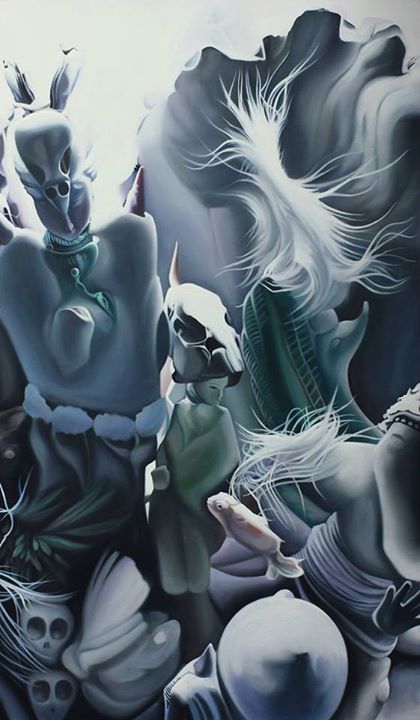
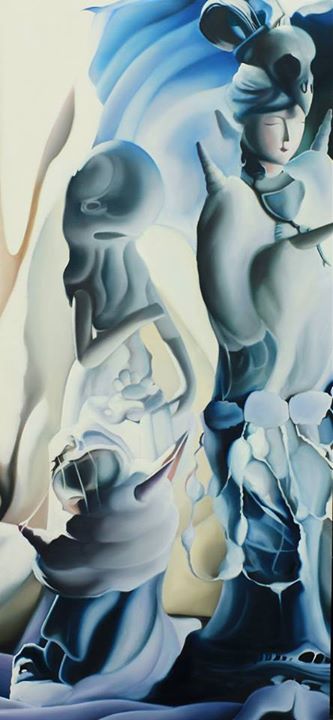
While she was pregnant, and in the first year of Dora’s life, Mon took time away from her painting. 2013 was the year she really started again, and the results have been amazing. She has a solo show in London next year, and as well as a few smaller paintings and a range of drawings, she’s made these two stunning large-scale paintings, which I think are amongst the best work she’s ever done:

BATALLA DE LOS GIGANTES                                                          BALLENA Y GEISHA

BATALLA DE LOS GIGANTES   ballena y geisha

2013 also marked our five-year anniversary – it’s been a blast.

3. Performing live

I’ve never been good at public reading, and this year I set myself the challenge of improving. I went on to read my work twice at Spotlight in Lancaster, once at Kendal’s Spoken Word, once (performing from memory) at Dreamfired in Brigsteer, and once at the Flashtag 2013 writing competition in Manchester, where I won second place. My confidence grew with each reading, though I still feel I’ve a way to go.

I also attended a spoken word workshop run by the excellent Brindley Hallam Dennis. One of the activities he set has changed everything: he had other members of the workshop read our stories. The lady who read my flash piece ‘Marrow’ performed it at a third of the pace I do. She relished every word, and it was three times better as a result. I haven’t performed since then, but I’m going to practice reading with that sort of gusto at the next opportunity. I’m booked in for a 20-minute slot at Spoken Word in February, and I’d like another couple of events under my belt by then. My goal has evolved a little, too: what I’m aiming for now is something closer to outright performance than simply reading. That will come with confidence, and confidence will come from practice.

4. Seven Seals – Plan of Salvation

After a whopping 18 months, I finally finished making this music video for amazing psychedelic synth punks Seven Seals. They’re an extraordinary band, and it was an honour to be involved. They’re working on new material, which will hopefully be available in 2014 for their ten-year anniversary gigs.


5. Amy Hempel – The Dog of the Marriage

Quite simply, the finest collection of short stories I’ve ever read. Hempel’s writing is so sensitive, so honest, that it infuses her stories with devastating grace. Unmissable.

6. Les Revenants

This French drama is the best thing I’ve seen on television in years, remarkable for its intrigue, restraint and power. It delivers on every level, exploring an extraordinary narrative without needless exposition to unravel the mysteries of the Returned, all of whom are troubled in different but connected ways. The locations and cinematography are stunning, while the soundtrack by Mogwai is my album of the year. There’s a startlingly surreal lucidity to the conclusion, and I think they could have left it there; but I’m delighted to see a second series in the works. Here’s the trailer for season one:

In TV terms, an honorable mention also goes to Game Of Thrones. Tyrion Lannister might be the finest character ever committed to screen, and the Red Wedding haunts me even now.

7. Success for friends

It’s been a good year for many of my friends and peers, too. Iain Maloney landed an agent and a book deal with Freight, Kirstin Innes found an agent, Anneliese Mackintosh got a book deal, Kirsty Logan landed a book deal and won everything in the world. Friends Andy and Gemma had a baby boy called Miles, and Ali and Iona had a little girl called Inka. There have been a lot of richly deserved congratulations this year. Good work, team.

8. Cats

Yup. Two of them. I wasn’t sure, at first, but then we met these two cats in the Wainwright Animal Rescue Centre, and it was an easy decision. They came to us with the names Remus and Teddy, which we’ve kept. They’re brothers, about three years old, and half-Persian. They’ve been an amazing addition to our house. They are incredibly relaxed and friendly, and they actively seek our company. That’s especially welcome when I’m having a writing day alone at home.

1174754_10153244876455551_211086219_n

9. Holiday in France

We were overdue a break, and this fortnight in France was exactly what we needed. We camped in half-a-dozen places, the best of which was Green Venice, a vast network of canals, ditches and overgrown waterways, crawling with vines and willows, alive with dragonflies and katydids. It was an extraordinary landscape. I read more in that fortnight than I’d managed in four months. Best of all, the holiday gave me enough mental space to plan my next novel, which will be called Grisleymires. That’s now blocked out on Scrivener, waiting for my next writing day.

10. Another year with Dora.

In their first year, babies are basically little puddings. Awesome little puddings, but puddings nonetheless. In their second year, they gather the basic tools to discover the world. And in year three, that toolkit expands exponentially; physically, vocally, intellectually and emotionally. Going through that with Dora has been nothing short of a joy. Seeing the world through her eyes has made me reevaluate so many things for myself. Her conversations leave me in stitches, and everything about her makes me smile. And she hasn’t been to A&E this year, which I consider something of a triumph. Though there’s still a week of 2013 left.

IMG_4758

So that’s my Top Ten. It’s been a good year, and 2014 is alive with possibilities. I might even pop some resolutions up in a few days.

A century of…

I realised, after posting this video about a ballerina dancing on butcher knives, that I’d hit a hundred posts on the blog. A century is still pretty arbitrary, really, but it’s as good a place as any to stop and think about why I keep a blog.

I started writing the blog six months ago to track the progress of my novel. The book was called Riptide Heart, back then. It’s now called The Visitors, and it will be published by Quercus Books in 2014. All that has happened in the lifetime of this blog. I’ve tracked my highs and lows and uncertainties throughout the publication process, from finding an agent (a year ago) to signing the contract (last week).

As well as the novel, I’ve written a lot about reading my work live, and the struggles I’ve had with my nerves. Each of my various readings has been painfully revisited, but that return has helped me filter and understand the experience. I’ve also explored my decision to gather my flash fiction into a collection, which is called Marrow, and will almost certainly be self-published, and teaching myself InDesign to lay it out professionally. (More on this soon! As I approach the end of my redraft and clear my backlog of film jobs, I should have the time and space to push ahead and get this wrapped up and printed.) I’ve posted published and unpublished flash fictions, and talked about my writing processes. I’ve written about my film work, and catalogued some of the things that I find inspiring or magical. I’ve posted galleries of the threshold spaces I’m so obsessed with.

All in all, then, my blog has ranged far wider than I ever thought it would. More than anything else, I’ve been surprised at how personally I’ve addressed some of these subjects. When I started, I expected the blog to be fairly analytical, for want of a better word; dry, professional. But in struggling with my live performance readings, and in wrangling my novel redraft, I’ve found myself at times alarmingly open about how I feel about my work. I like that the process of writing has taken me in that direction quite organically.

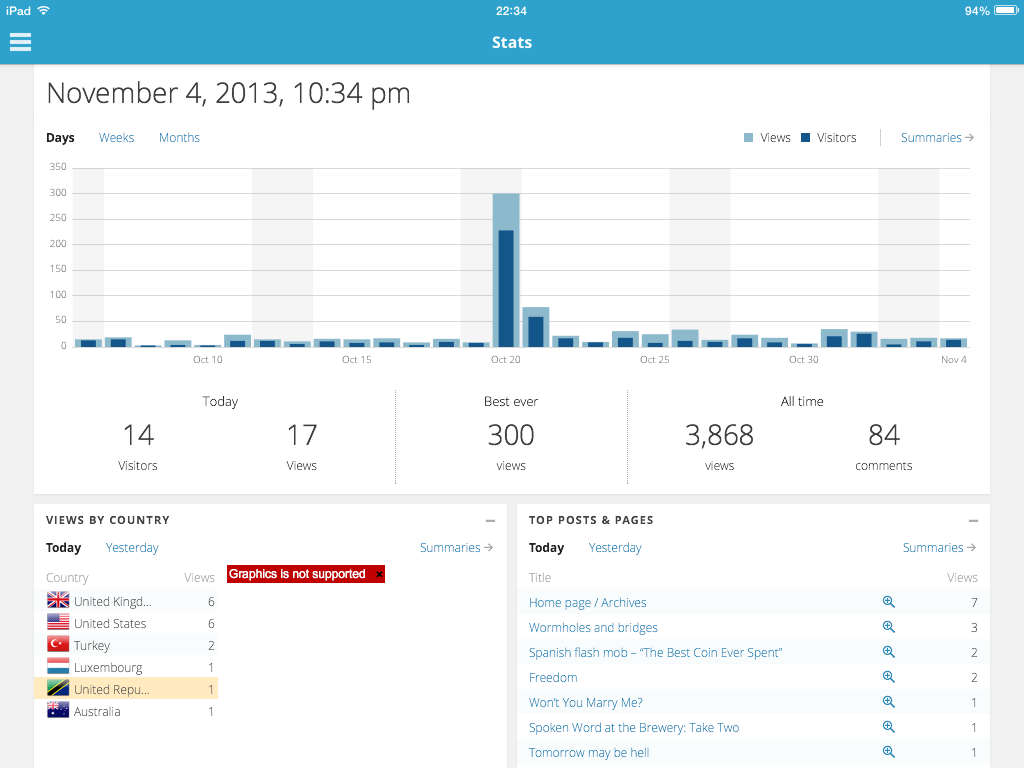
One of the joys of using WordPress is browsing through the stats, which tell me what brings people to the blog, what they look at, and often where they come from. I’ve had visitors from as far afield as Mozambique and Mongolia, searching for everything from devil dogs to gay porn. (Hopefully not everyone will be as disappointed as those two internauts.) I’ve had a week without any views, then hundreds of visitors the day Neil Gaiman retweeted this post about libraries. Have a look at this screen grab and see if you can guess which day that was:

photo

The two things that bring people to the blog most often are on the periphery of my interests; this post about a nursery rhyme and this post about a WW2 fighter pilot preserved in a peatbog. People have searched for Bancree, which is the fictional Scottish island I created for The Visitors, and for novelist friends like Iain Maloney and Ali Shaw. Lots of people come to the blog looking for information about my agent, Sue Armstrong at Conville & Walsh, and my publisher, Jane Wood at Quercus.

More than anything else, though, the blog is for me. It’s how I filter my ideas and monitor what I’m doing. Writing about my life is what I need to live my life.

Wormholes and bridges

Here’s an exhilarating lecture by Neil Gaiman, exploring what it means to read. This essay has all the passion, humanity and humour of his fiction.

When my dad was stationed in Germany, I had to attend a boarding school in Edinburgh for a year. I remember virtually nothing of those few terms – only scattered memories of finding a flat iron in a tree root, and of crawling down a tunnel that older students used for shooting practice. But I do remember the library, and I remember reading. Reading a lot. I can’t recall all the titles, but I know I read King Solomon’s Mines, the Biggles books – which probably explains my unforgivable weakness for adverbs (he thought, wistfully) – and all the Hardy Boys books over and over again. I’m pretty sure I started on Steven King around then, too. I was eight or nine at the time, which might explain a few things.

Anyway – the library is my only memory of that time that’s even halfway to concrete. It was a refuge for me, and I’ve loved libraries ever since. When we lived outside Inverness, the mobile library van was a highlight of my fortnight: visits from Desmond Bagley, Terry Pratchett, Ernest Hemingway. The librarian was a Brummie expat with gigantic muttonchops. It was like swapping books with Noddy Holder. When I was seventeen, I applied for a job driving the mobile library on the Black Isle. I didn’t get it.

I’ve been a member of libraries in Inverness, Bristol, Lancaster, London, Manchester and now Kendal. Libraries have given me a place to read, a place to study, a place to work, a place to think and, when I was at my poorest, a place to be warm. Libraries are portals to parallel universes. They are circuses, space stations and sunken ships. They are deserts and cities and jungles. They are wormholes and bridges. They record the past, and they tell the future, and they record every scrap of human experience.

Libraries are important, and we’re losing them. Government cuts have brutalised already very modest library budgets. As Michael Rosen has pointed out, coalition rhetoric expounds the need for reading, while quietly removing the places to read.

Neil Gaiman’s essay voices all this far more eloquently than me. It’s beautifully written, of course, but a real thrill, too: immediate, passionate and compelling. Please read it – worth every word. And then go and get something from your library.

20131020-094950.jpg

Loki

Well, that’s my first Dreamfired done and dusted. It was a really good night – more people need to know about the Storynights.

First up was banjo virtuoso Bill Lloyd. He’s a legend in Cumbria and the north, and he didn’t disappoint, starting with a haunting ‘Wayfaring Stranger’, and segueing into a range of folk songs from America and Ireland. My storyteller uncle Rich Sylvester had the next slot, relating an anecdote about exploring the London Olympic equestrian venue at midnight with a bellyful of Russian beer. It was very funny. Rich is an extremely affable raconteur, and his stories are always engaging – I haven’t seen his work for a few years, and it was great to be part of the audience.

I was on after Rich. I’d decided to get into the traditional spirit by performing without notes. In the minutes before going onstage, my nerves were worse than ever, but I settled fairly quickly.  I read two stories I’ve been practising lately – Circle Stone and The Lion Tamer’s Daughter.  I stumbled once in Lion Tamer, and for a moment I thought I would go entirely blank – but I recovered, found my place and delivered the rest without a hitch. Circle Stone is an extremely quick flash piece of only 75 words, and it’s surreal enough to counter the darkness of Lion Tamer. The two work well in combination, but I’m going to semi-retire them now. They’re both destined for my flash fiction collection Marrow, and I’ll try and get them published elsewhere first, but I’ve read them a lot recently, and it’s time for some new material. On reflection, though, the reading went well. I don’t think I’ll make a habit of performing without notes, but Dreamfired was a perfect place to give it a whirl.

After me came a poet, whose name I didn’t catch, who read some playfully nostalgic pieces; and then a story about a 21st century Grim Reaper. Bill Lloyd returned to round off the first part of the night with another couple of songs – his cover of Frankie’s Gun, which I absolutely love – it was Bill who introduced me to the music of The Felice Brothers – and one of his own compositions, a haunting Armenian lament.

This is what Frankie’s Gun looks like:

After the interval came Emily Parrish, aka Scandalmongers. She walked onto the stage singing and beating a drum, and launched without preamble into the Norse creation myth. Her show explores the role of Loki, the trickster god, and all his jealousies and cruelty and fun. What made the show all the more remarkable was the way she entwined Norse mythology with her own childhood. The transitions between the Cotswolds and Asgard were frankly astonishing – from the top of a perfect climbing tree to the horrors whispered into Baldr’s troubled brain. It was lyrical, visceral and intense, and it left the audience stunned.

emily-loki

Loki comes highly recommended from me – catch it if you can.

Thanks, too, to Kat Quatermass, who organises and hosts Dreamfired. Lovely to meet her after months of email contact. I’m definitely going back in November to catch Peter Chand performing Grimm’s Sheesha.

What’s next for me, then? I’ve been thinking about my novel edits for a week or so – a process I refer to as ‘brewing’ – and I’m almost ready to start work. I mentioned in a previous post the structural changes I need to make, and my uncertainty about how to make some of those changes. That has passed. I now know where that character is going to enter the story. Although it means a lot of work, I feel secure in the knowledge of how to do it, so a lot of that worry has eased.

My next booked reading is at the Brewery’s Spoken Word night in February, though I’ll try and land a few more open mic spots before then. Stay tuned. And go to Dreamfired.

What’s in a font?

Quick on the uptake, as ever, but I’ve just caught this excellent video on the history of typography:

It’s funny how much the right font matters. There are some fonts I cannot abide to work with, and others I’ll use fleetingly but intensively. More than once, I’ve given up on reading a book because I found the font so unpleasant. When I first started writing, I only used Courier. With the benefit of hindsight, this was pretty much exactly as juvenile as my early stories. Then, after working in Times New Roman for years, I switched to Arial for The Visitors. I’ve started my new novel in Baskerville, which I love. At college, I use Gill Sans for all my planning documents, and in my video work I tend to use Century Gothic or Mrs Strange, which could scarcely be further apart.

The more I discover about fonts, the more I come to appreciate the vast psychology behind typography. It’s a gigantic field, and I tend to stick to knowing what I like.

One of my Twitter very short stories is about fonts:

She was Arial Black. He was Wingdings. “Why can’t you take anything seriously?” she wept. “Maybe you need to lighten up,” he snarled.

Any favourite fonts out there? I’m assuming, of course, that everyone avoids Comic Sans.


Dreamfired

Loki-norse-mythology-loki-30846883-570-732

On Friday 11th October, Dreamfired takes over Brigsteer village hall for a night of traditional music and storytelling. I’ve managed to land one of the support slots for headliner Emily Parrish, aka Scandalmongers. She’s retelling the classic Norse myth of Loki, the trickster and troublemaker at Odin’s court. Her show has received amazing reviews, and I’m really excited about seeing her perform live.

I’ll be reading two short pieces I’ve been practising live – Circle Stone and The Lion Tamer’s Daughter. I wanted to get into the spirit of the night by performing from memory: no notes, no paper. Reading them at Spotlight and Spoken Word has been good for practising their delivery. I already know Circle Stone by heart, and I’m four-fifths of the way there with Lion Tamer. The prospect of reading live is not yet as scary as it will be on Friday afternoon.

By dumb chance, my storytelling uncle Rich Sylvester is up in the Lakes for a workshop that weekend, so he’s coming along too – and I’ve just discovered that legendary Cumbrian singer, songwriter and banjo maestro Bill Lloyd is playing as well. It’s a blinding line-up, and I feel a little overawed to be reading at such a great event. I’m looking forward to sharing my stories, then sitting back with a beer to enjoy a great night of tall tales and folk music…


Spoken Word at the Brewery: Take Two

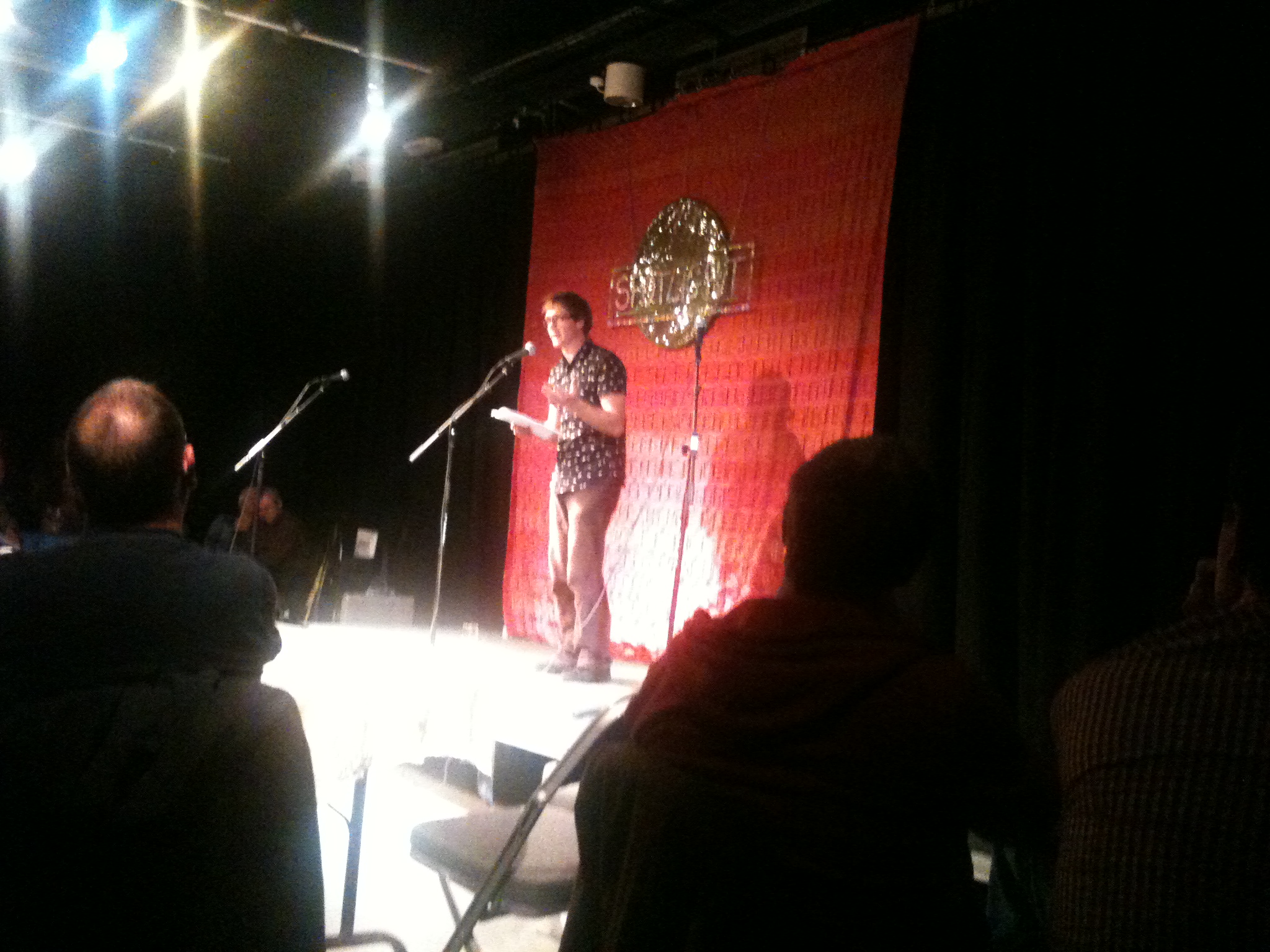
For one reason or another, something has arisen on the last Saturday of the month – every month – for well over a year. And that’s a real shame, because Spoken Word is on at the Brewery Arts Centre in Kendal on those last Saturdays, and I’ve therefore missed well over a dozen of my local literature night. Yesterday, however – at last – I was able to make it across town to the Brew, and I read at the open mic.

This won’t mean anything to anyone but me, but Spoken Word was also the place of my first ever live reading, more than three years ago. That’s why this post is called Take Two. It was curiously satisfying to take to the stage again and remember how I was shredded with nerves back then. And another first for me, this time round – I’ve never read without Monica in the audience. I missed her. It’s much easier to perform knowing at least one person out there is absolutely rooting for you.

I was first to sign up to the open mic, so I was first onstage after excellent compere Ann the Poet had introduced the night and read a couple of her poems. I always enjoy Ann’s work – it’s witty, it’s wise, it has energy, and her poems tell stories about people. For me, that’s what all this is about. She’s also a very funny host. She looks like this:

annuke

It was weird being the first reader onstage. There hadn’t been a chance to gauge the audience, and so I didn’t know entirely how to pitch my work. With a five-minute slot to play with, I read The Lion Tamer’s Daughter and Circle Stone. I didn’t exactly pick up where I left my last reading in terms of confidence, but I tried to invest a little more faith in my stories. They seemed to go down quite well, and Circle Stone found a bigger laugh than at Spotlight.

The other open mic readers were brilliant – I especially enjoyed poet Kate Davies. She had polio as a child, and her second piece was a stunning juxtaposition of that experience with a car maintenance manual; the more of an automaton she made the child, the more human she became. It was mesmerising.

After the break, Luke Brown read two of his short stories. He’s a young writer of great reputation round Cumbria, so I was really excited to see him live – and he didn’t disappoint. His work was engrossing, and both his stories had killer, killer pay-offs. I really hope I can see him again. I haven’t found a website for him yet, but if I do, I’ll update the blog.

Second headliner Louise Mary Martin topped out the bill. I’ve come across her work before – she’s the singer in South Lakes reggae group Righteous Bees, and my brother-in-law Ben Metsers has used her vocals in some of his work. Last night she played four songs – two bluesy Americana/alt.country covers, played with guitar, and two extraordinary songs in which she used live loops of her vocals in dense layers, beautifully timed to create a stunning collage of sound. I’ve seen it before from Adam Stafford:

…but it was quite something else to watch live. The focus and the timing required is amazing. Just astonishing stuff.

It was a great night, with one slight downer. During the interlude, while I was chatting with Kate Davies, a man I didn’t know joined us. He was perfectly friendly, but our conversation left me feeling strange. He told me that the trouble with my story was the moment he knew it was about lion tamers (i.e., from the title), he thought of a news article from the 1960s about a lion tamer who was attacked by his own lion – and he thought of that instead of my piece. Which I guess is fine, but I don’t know how any writer can future-proof their work against audience association. Indeed, writers need audiences to bring their own associations with them; it’s a reader’s empathy that brings a story to life. Anything less would be exposition. The man also thought I was self-conscious during my reading. Maybe I was, a little, but I was a goddamn powerhouse compared to a year ago. That was a bit of a funny one to leave me with.

I wanted to talk to Luke Brown afterwards and congratulate him on such a great show, but he was swamped with other people wishing him well, and I had to go. I walked home through Kendal listening to a playlist I’m making for Monica. As I headed out of town, taking the back road to Burneside, the last streetlight made a giant of my shadow, casting it far up the road into the night. The further I went, the dimmer the streetlamp, until my shadow and I were absorbed entirely by the darkness. It was a clear night, but there was no moon. My eyes adjusted to the gloom and I walked a mile or so lit only by stars, pinpricks of light lifting the path half a shade above the vegetation.

I thought a lot about my reading, and about what the man said. By the time I reached my house, my mind was clear. Different opinions are how we know ourselves as individuals, and I’m sure I’ll hear much worse when The Visitors hits the shelves. I can’t do anything about an audience’s associations, and nor would I want to. And if I seemed self-conscious, then that’s partly because I am, and it’s something I need to keep working on. I do want to improve my performance even further, to be bolder, to be more technically confident in how I speak into a microphone, to relax into my stories, to try different voices. And I’ve another date in the diary to aim towards, now: Ann has asked me back to read as one of the guest slots for February’s Spoken Word. I feel deeply honoured to have that as something to work towards. I’ll go back to the open mic whenever I can, too, and I’ll keep trying new stories. Because I have to.

Spotlight take two

IMG_2903

I performed four stories at the 200th Spotlight Club in Lancaster last night, and it was great. I’ve talked before about how nervous I get before a reading, and yesterday was no exception; I spent the whole day oscillating between calm and stomach-churning tension. It’s always terrifying to put my work before another person: the fear that they’ll hate it never goes away. I get worried whenever I show a new story to Monica, who is always my first reader, and I’m just as nervous when I send it on to Sue and writer friends like Iain Maloney and Steven John Malcolm. Any happiness at having a story published is matched by the anxiety that people will realise I’m making it up as I go along.

Performing live takes those concerns to a different place altogether. My heart thrums in my solar plexus, and my throat goes tight. Last night was the biggest audience I’d ever read to, of fifty or sixty or seventy people, and I was scheduled quite late on the bill. As the night rolled on, more and more people joined the crowd – and the more nervous I became – not least as the bar was set extremely high right from the first performance.

Big Charlie Poet (a.k.a. Simon Hart) kicked off the open mic with an extremely brave, extremely good poem about bullying. I really like Simon’s work and I’ll definitely try to catch him again. I also really enjoyed Ros Ballinger’s poems – tight, witty work about one-night stands and more.

After the open mic came musician Kriss Foster & Friend. All I knew of this act was that Kriss wore a homemade leopard onesie – it turns out they are Lancaster’s equivalent of Flight of the Conchords. They combined a great stage show with three songs about our wee corner of the north-west, and had the audience in stitches. Their first song was from the point of view of a taxidermied seabird in Kendal Museum:

Then came the tragedy of a blind date gone wrong in Rivington motorway services, before they finished with a love song to Morecambe. Brilliant.

They would have been a hard act to follow, so I’m glad there was an interlude before the next slot. The first performer after the break was Italian poet Carla Scarano. Her poems about portraits married intricacy to power – and the last two, about Francis of Assisi and Beowulf, were simply magnificent.

Carla

Then it was my turn. On Mon’s suggestion, I started with the Lion Tamer’s Daughter, and I’m pleased to say it went down quite well – I followed with The Black And The White Of It, then Hutch, and finished with new flash piece Circle Stone. I had twelve minutes, which is probably the longest slot I’ve had to work with. About halfway through I was surprised to realise that the nerves had gone. The good reaction from the audience helped, without a doubt, and gave me greater confidence in my stories. That in turn helped me relax and enjoy the reading, and I think that improved my performance. I don’t know if there’s some secret to starting a reading with that attitude – I suspect it needs to be earned at each new event. Anyway – I loved it. It was my best reading by a mile. If anything, it made me want to write more flash fiction for live events.

I was followed by performance poet Miss P, who managed to combine memory and incisive observation with humour and relentless energy. It seemed to be a bittersweet show for her – she’s moving to Oxford, and this was her last gig in Lancaster. Large sections of the audience had come to support her, and the reaction to her work was explosive and good-humoured.

Paddy Garrigan finished the night with half-a-dozen of his excellent songs. I really like Paddy’s stuff, and it was so good to see him live for the first time. My favourite song was loosely about cathedrals – or, more accurately, our notions of what makes something important. I can’t find it online to share, unfortunately, but it was sumptuous. If I can track it down, I’ll update the post; for now, here’s another of his gigs, playing ‘Where Do The Dead Go When They Die’ with his full band:

Thanks go to compere Simon Baker, too. He was a generous and very funny host. There was a great atmosphere around the occasion of Spotlight’s 200th event, a real sense of community and history. I’m always impressed at how eclectic the performers are, and it’s an honour to be part of something so embracing. It reaffirmed to me how important it is to share my work with others – to validate what I do away from a computer screen.

I signed up to compete at their annual Slam next month, so I’ll be back to Spotlight in October. I haven’t done a slam event before. Hopefully I won’t disintegrate. Each of twenty contestants has a three-minute slot. It’s not a lot of time, but I already have a few ideas brewing away about how I can make best use of it…

Spotlight turns 200

Now then, humans. I’m off to Lancaster tonight for the 200th Spotlight Club at the Storey Institute. I’m really excited to be reading again at such a great event – I have four flash stories lined up for my 10 minute slot, and the other performers look a brilliant crew. Please come if you can – all the details are right here.

Curiously, I’m not terrified yet. That will probably kick in about 4 or 5 in the afternoon, when the stories I’ve worked on for weeks and weeks spontaneously turn into this:

house-falling-apart