Les Revenants

returned1_A2

I’ve finally caught up with The Returned, which has not just maintained the quality of the first episode, but consistently improved across the series, growing in confidence, becoming ever stranger, madder, sadder. It’s the most exciting thing I’ve watched on television for a very long time: it’s Lynch without the hysteria; it’s Lost without the sensationalist cliffhangers. When a show is this good, eight episodes is not enough, and I’m glad there’s a second series on the way.

That said…

There’s a habit in these long-running ensemble shows – and increasingly in big-budget films, too – of ‘concluding’ with threads left untied – or introducing tantalising new story strands. Sequels and follow-ups have therefore become implicit. The gradual switch from ‘series’ to ‘season’ is an ingenious use of weasel words; season implies annual regularity, and makes the show a fixture, part of an ongoing narrative, integrated into the cycle of the year. New instalments are seen as part of a continuum; rather than stand-alone, self-contained sequences. This has clear drawbacks: I loved Lost, but the final conclusion to the show was incredibly weak. It felt increasingly apparent, as the show expanded, that they had started without knowing how it would end, and that each successive series was created to generate the next, rather than conclude the previous. With such a weight of expectation piled onto the final episodes, it was always going to fall short. The conclusion of Lost was less than the sum of its many, flawed, dazzling parts.

With a little courage, I think The Returned could probably have finished at the end of the first series, even with so many questions still unanswered. It would have been bold, but the last sight of the flooded town would have made the metaphor of the draining dam all the more apparent… but we have expectations of closed narratives, and there’s too much still unsaid. And when it is so incredibly well-made, a second series will be very welcome. Now it’s just a matter of waiting until November next year – and what’s 18 months for the best thing on television?

In the meantime, I’ll console myself with the breathtaking Mogwai soundtrack. I reckon it’s their best work since Come On Die Young. You can listen to some of the songs here, but you’d better get the real thing, just to be on the safe side.

To Do: Part Two

Okay, back to work. College returns in three weeks, which feels frighteningly imminent. I’ve films to finish for Cumbria Wildlife Trust, Three Dimensional Tanx and Seven Seals, some short stories to write, the Riptide edits to complete for Quercus, Scrivener to learn, family and friends coming to stay, a log store to build, readings to practice, paperwork as deep as my hand, and Marrow to edit and complete.

Head down. Press on. Fail better.

miranda3a

A little light reading

We’ve just returned from a brilliant fortnight in France. We racked up 2,500 miles in a round trip that encompassed Ile de Noirmoutier, which is reached by a two-mile causeway at low tide; Rauzan, where we camped in the shadow of a ruined medieval castle; and Marais Poitevin. This last spot, nicknamed ‘Green Venice’, is one of the most amazing places I’ve ever seen. Centuries ago, it was a vast swamp, but Dutch settlers drained it with a labyrinth of canals and ditches, leaving hundreds of island pastures connected by causeways and bridges. The architecture is just as unique, with balconies and shutters adorning every house, and punts moored to jetties in gardens. Poplars and alders tower into the sky, the canals are thick with lurid green algae. Fat dragonflies zip and pop between shrubs and creepers, and the trees are alive with cicadas. Filtered through high branches and reflected from the water, the light itself is tinted green.

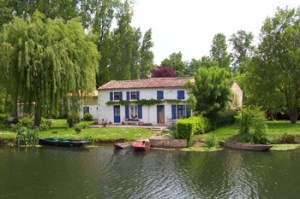
marais_poitevin bluehouse

It’s genuinely one of the most incredible landscapes I’ve experienced and, much like Grogport for Riptide, it’s been a real inspiration for my next novel. In the space of a few days, I filled an A4 pad with notes and dialogue, and I feel really excited about starting work. There’s still plenty to do before I can begin, but the foundations now feel firmly set.

The other great thing about the holiday was having time to read. I managed six books, which is no mean feat when juggling a toddler in a campsite. And I had a great run of books – not a single dud:

The Tiger’s Wife by Tea Obreht was bold and convincing, subtly switching a range of voices to make folk myths contemporary through personal memory. I enjoyed it a lot, but found it ever so slightly cold, and wasn’t as blown away as its reputation suggests.

Cumbrian Folk Tales by Taffy Thomas was a fascinating collection of the county’s legends and myths, made all the more immediate through its connections to a landscape I’m starting to know. It was amusing to recognise the names of not just local places, but also local people – people I’ve met, worked with, drunk with. The tales were strongest when connected to geography, giving meaning and history to a witch’s cauldron or a devil’s bridge.

I read The Blackhouse by Peter May – this was a present from Jane Wood, my publisher at Quercus. She thought I’d like a look because, like Riptide, it’s a crime story set in the Hebrides, though it doesn’t have the supernatural elements of my book. I enjoyed it a lot. The plot was dovetail-tight and engrossing, and the landscape was intoxicating.

Next up was I Love You When I’m Drunk by Empar Moliner, Spanish short stories in translation through the tremendous Comma Press. Despite some uncharacteristic typos from an excellent publisher, it’s a solid collection, each story exploring and exploding conceits of modern life. Some of the stories felt a bit like shooting fish in a barrel – taking aim at soft targets of liberal, middle-class pomp – but the writing was good throughout, and there were many outstanding moments.

Moliner’s collection was good, but the next book was astonishing – a class apart. The Dog Of The Marriage gathers Amy Hempel‘s four short story collections into a single volume, and they are consistently superb. There isn’t a single wrong note across dozens of stories. Hempel’s work is voiced through emotionally damaged or stunted narrators, trapped or somehow left behind in their lives, caught between stasis and decay. The stories are not without hope, though, and Hempel writes with unceasing, unfailing humanity. Her sentences and structure are scintillating. I cannot recommend this highly enough. This is the sort of book I buy two copies of, expecting to have one out on loan.
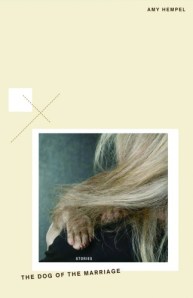
the_dog_of_the_marriage.large

Finally, I read Snake Ropes by Jess Richards. This was another corker. Alternate narrators explore life on a mysterious island, ‘just off the edge of the map’, eventually combining to bring the distinct halves of the story together around a single, long-forgotten trauma. This novel holds trade and barter at its heart, exploring themes of presence and absence, balance and weight; of exchange, and what it means to give and get. It’s a real triumph, made all the more masterful in how Richards weaves the fantastical through the fabric of base human instinct, conjuring talking keys, sentient trees, and a walking doll with a seashell for a heart:

Moppet2

The last fortnight has reminded me, as stupid as it sounds, of how much I love to read, and made it painfully apparent how little reading time my regular schedule affords me. I’m determined – on top of carving out more writing time – to read more. I miss it.

This holiday has been essential. I’ve worked stupidly hard over the last two years without much of a break, and I’ve badly wanted some time off. Looking ahead, the next two months are going to be frantic – but I feel better for a break. I have my next novel blocked out and the sights and scents of a swamp fresh in my mind. One more draft of Riptide to go, and then I’ll be starting my new story.

In the Spotlight

Last night I read two stories at the excellent Spotlight Club in Lancaster. Perhaps unsurprisingly, given the heat, it was a fairly sparse audience of only twenty people, but the wealth of talent was inspiring. I’d booked one of the open mic slots that open the show. The first two performers were Edward Fahey, reading from his novel The Mourning After, and poet Simon Hart a.k.a Big Charlie Poet. I was on third, and read two new short stories – one about home cooking gone wrong, and one about living in an umbrella. I’m pleased to say they went down fairly well. As ever, I felt wretched with nerves. When I’m reading live, I can feel my pulse pounding in my stomach, beating so violently that I’m certain people will notice – but then, when I’m settled, I start to enjoy the reading, to relax into the story and to remember why I wrote it in the first place. Reading aloud is engrained in my writing workflow. When I’m writing, I constantly read my work aloud, lips moving nonstop, speaking and repeating the phrases, looking for the way the words flow best, seeking out an organic rhythm to the story. It’s thrilling to take that back to a stage and a microphone. I’ll never be as good as performers like Alan Bissett, but I’m starting, at last, to really enjoy reading live.

Back to Spotlight: the open mic slots were followed by ‘ethnomusicologist of the imagination’ Deep Cabaret. He conjured incredible sounds from an apparently homemade instrument of wood and wire wrapped around a tin can (Steve Lewis, the man behind the music, has since been in touch to reveal that it’s not a DIY contraption, but a Delta Wedge, and manufactured right here – although it is based on the homemade instruments of early Bluesmen). With this extraordinary device, Deep Cabaret explored the music of a fictional world based on the fantastical fictions of Jorge Luis Borges. It was a truly original and engrossing performance.

Rosa Lucy Rogers followed with a series of haunting, abstract poems exploring emotional and physical space. Then came multi-slam-winning performance poet Trevor Meaney. He kicked off with a piece about Chris Huhne and Vicky Pryce entitled ‘Baby you can drive my car’, which gives you an idea about his work; excellent and very funny. Short story writer Scott Hammell gave us a dying man’s last moments, before veteran punk-poet Nick O’Neill delivered his tight, intense rhymes, taking on big themes with disarming simplicity.

The night was finished by acoustic guitarist and singer-songwriter David Kelly. There are some guitarists who seem in total mastery of their instrument, knowing exactly how it works, never out of control for even a moment – David was not one of those guitarists. He was the sort where the guitar seems to play him, using him as a fulcrum, his body all angles and awkwardness, legs twisted against one another, tapping out mad rhythms, shoulders hunched, head down. It was brilliant. His voice had a raw, urgent quality, and his songs were a little James Yorkston, a little Conor Oberst, all cracked and lo-fi, thrilling and real. I’ll definitely be keeping an ear out for more of his music. I can’t find a website for him, but he looks like this:

IMG_0474

As we made to leave, the organisers asked if I’d come back to read again in September. Spotlight has been going for 17 years, and September will be their 200th show. I’m honoured to have been asked, and I gratefully accepted the invitation. I’ll have a 10-minute slot, so I can try a slightly longer story – but I’ll definitely be reading a variety of pieces again, too. Hopefully my DIY flash fiction collection Marrow will be ready by then. I’m delighted to have been invited back, and it was a great way to finish the show.

On the streets outside, Lancaster felt like London, the streets buzzing with people. We walked back to the car through one of the glorious Mediterranean nights this heatwave has delivered: warm, soft breezes, and dim bands of blue to the west.

The Lion-tamer’s Daughter

Image

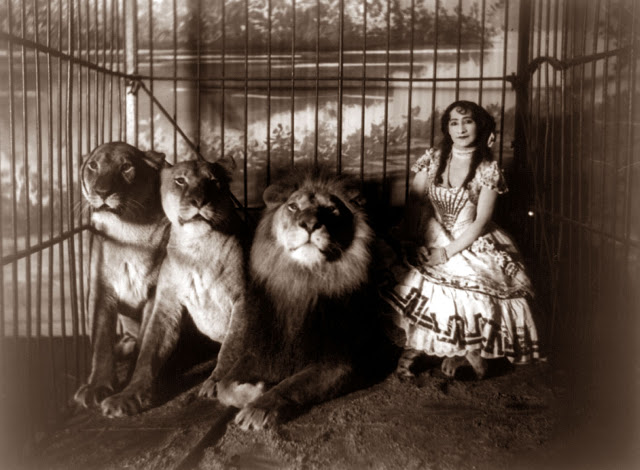
Back from a grand night at the Dentdale Beer & Music Festival, unpacked with a mild hangover, wrote a new short story about a lion tamer and completely rewrote an old story about a boy who climbs lampposts, then cut both stories into my flash fiction collection ‘Marrow’… which leaves me just about ready for a bruising week of marking, course planning, meetings, filming, editing and building a fence. See you on the other side. Hopefully.

Les Malheureux in Kendal

Image

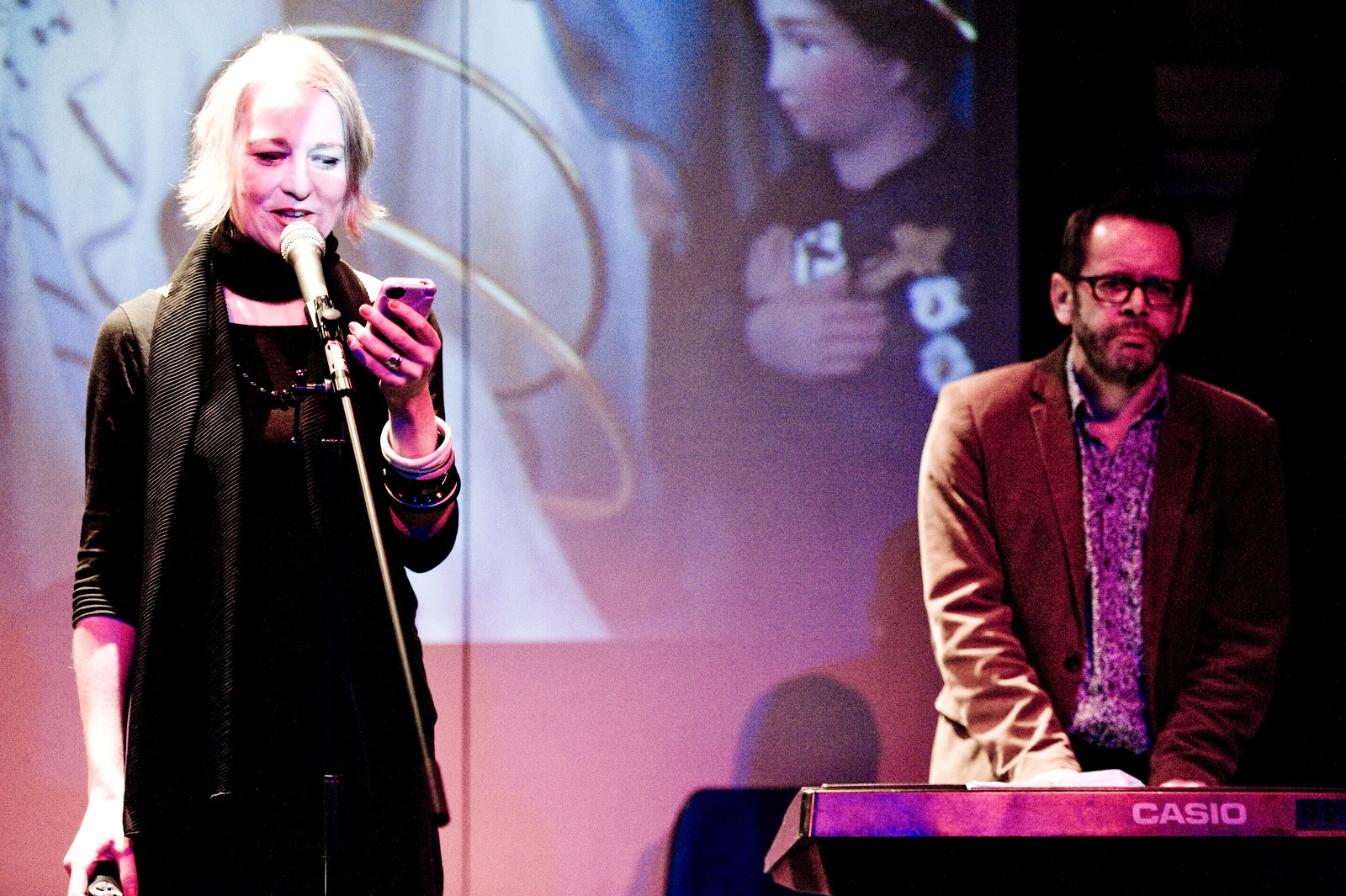
I popped out last night to see Les Malheureux (a.k.a writers Sarah-Clare Conlon and David Gaffney) performing at the Lakes Alive Mintfest fundraiser in Kendal Town Hall.

It was a brilliant little show, with Sarah-Clare reading flash fiction accompanied by David’s Wurlitzer-style noodlings and extremely funny PowerPoint presentations switching slides in the background. The stories were fantastic – by turns poignant, reflective and darkly comic.

I especially loved the story about Eggborough power station, where the narrator paints the chimney stacks – and ‘Little Jan’, which is a perfect slice of poisonous office politics.

It was also great to see Sarah-Clare and David so soon after Flashtag – with the swifts soaring overhead and the sunset tinged pink over the Lakes, we had a balmy chat about day jobs, notebooks, Italy, the amazing Scottish literary scene and the quest for decent pubs in Kendal. (If you want an answer to the last point, there are three: Burgundy’s, the Brewery, and the Rifleman’s Arms.)

Before they turned up, I sat scribbling in my notebook. After a mini-brainwave about the protagonist in my new novel, I now know what she’s called and what she does for a living; and that in turn revealed another layer to the story which I’m really excited about. I also worked through some potential titles, though nothing stuck. I’m going to be flat-out on film jobs and college for the next month, but I’m starting to assemble more notes and ideas all the time.

This Kitten I Knew

Here’s my short story from the Flashtag writing contest, in case anyone wants to read it:

This Kitten I Knew

My heartbeat rings a funeral:

dumb

dumb

dumb.

The tramp of feet, the pulse a memo: dumb, dumb, dumb, building from the distance, seeping closer, clinging to the timber frames and oozing in the cobbles.

You’ll love it, he said. The architecture. The history. The food.

In the rough-hewn gutter, a mottled kitten bats a leaf. Not even a kitten, but a scrawny juvenile, gawky and underfed. In the car, his hand rests on my knee, pulling it towards him, easing my legs apart. Gently, barely a suggestion: open up. A wedding band on his ring finger, and I taste of someone else’s toothpaste.

You’ll love it, he said. The music. The landscape.

I’d asked a neighbour to feed my cat. She’s younger than me, but we wear the same clothes.

Dumb, dumb, a bass drum. A marching beat. A cymbal, hissing wind through trees and tiles.

You’ll love it, he said. Just us two. A business trip. All expenses. Even Duty Free.

I put his fingers in my mouth. The wedding ring licked salty sharp.

The procession rounds a corner into view. Accordion and trumpet, clarinet and drum, and they sound the dirge as one: dumb, dumb, dumb. The coffin rolls haphazardly on a sea of bodies, the mourners packed too close together. They reach out to touch the box, shuffling and catching ankles. They wear black that is not black, grained with dust, and patches on the patches. The coffin is too big for a child, too small for an adult.

You’ll love it, he said. The people. The paisans. They’re such characters.

A mute hand on my knee; more than a suggestion. I let it fall, open wide. He bought me a necklace that costs more than some old ring.

We watch the procession from the rental car. Ragtag men, walnut women, carrying their coffin and looking in the window. They know every inch of us, now and in the days to come. The hem of my skirt, our breath in trickles on the glass. Rituals for peasants. A hand on my knee. A smirk on his lips. A kitten batting leaves along the gutter, skipping blind towards the graveyard. There’s nothing on my finger.

Listen, he said. This time, I’m going to leave my wife.

Dumb, dumb, dumb.

Flashtag at The Nook & Cranny

Mon and I drove down to Manchester on Wednesday night for the live final of the Flashtag writing competition. Flashtag Writers are a five-strong collective of flash fiction devotees, organising and performing their work across Manchester, the northwest and beyond. This writing contest was part of Chorlton Arts Festival. Downstairs at the Nook & Cranny pub was the perfect place for my first reading in three years – small, close, and dark. It reminded me a little of Twin Peaks. I think the brightest thing in there was my shirt.

images-1      cache_2410604838

With eight writers on the shortlist, four Flashtaggers (plus a few of Benjamin Judge‘s excellent ‘Very Short Stories About Very Good Writers‘ read out in his absence – check out the blog – they’re brilliant. My favourite so far is Haruki Murakami…) and headlined by yer actual flash fiction titan David Gaffney, there was an astounding breadth and depth of storytelling on offer. I’m consistently delighted with the sensations and stories that can be conveyed in remarkably few words: Allie Rodgers gave us a dystopia without printed books; Dale Lately perfectly captured the melancholy of an empty nightclub after hours; Sarah Butler told the tale of a girl who lived on a bus stop. Michael Conley read my favourite story – ‘Looking for an Astrolabe’ was perfect flash fiction, bundling the profound into the darkly comic. David Gaffney’s piece conjured an infestation of acoustic singer-songrwriters, and blamed it all on Badly Drawn Boy. I also loved the work of Flashtaggers Sarah Clare Conlon, Fat Roland, Tom Mason and David Hartley.

I was the last of the shortlisted writers to perform, and – as ever – I was terrified. But the reading went quite well, the audience were very generous and it left me craving more live events. Despite the fear, I always end up enjoying myself. I’d like to think that a few more readings might settle my nerves, but maybe they’re there to stay. Ach weel.

Up against consistently strong competition, I was genuinely blown away to be awarded second place for ‘This Kitten I Knew‘. That was really humbling. I was delighted that Michael’s ‘Astrolabe’ won first prize – it was easily my favourite on the night, and I feel honoured to come second against such a great story.

More than anything else, it was truly uplifting to have some social contact centred around writing. Facing a late drive back to Kendal, we couldn’t stay very long, but it was a real thrill to stop and chat with the audience, the Flashtaggers, the shortlistees and Mr Gaffney. It’s strange, sometimes, to live in relative isolation halfway between the vibrant literary scenes of Manchester and Glasgow. Nights like Wednesday help me remember that other people are excited by stories – by writing and reading.

Speakeasy

Image

Over the last few weeks, I’ve become increasingly conscious of how much I miss reading my stories aloud. It’s been more than two years since I’ve performed at an open mic; back in 2011, I read for Words Per Minute in Glasgow, for Gutter magazine at the National Library of Scotland, and at my local open mic night in the Brewery.

It’s an excruciating experience to expose my stories for strangers, but incredibly rewarding, and I believe firmly that stories should be read aloud as much as read on the page. Each time, I was riven with nerves before the reading… but each time, once I’d finished, I wanted to get back onstage and tell another story.

Well, be careful what you wish for. The good news that I’ve made the shortlist for the Manchester Flashtag writing competition also means that I’ll be performing live rather sooner than I’d thought: I’ll be reading my story at the awards event in Chorlton on 22nd May. I’m already nervous, not least as the story is an internal, claustrophobic piece with a polyphony of tense and voice, and it’s a bugger for reading aloud. I’d better start rehearsing.

Any tips appreciated….

Shap Fell Road

Image

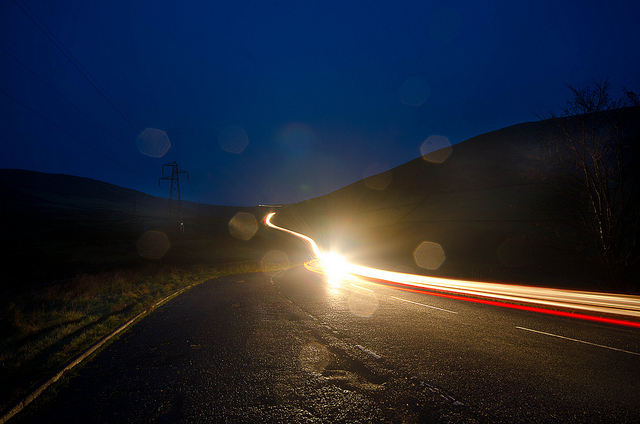
I had a few hours to write, yesterday, and managed to burn through the first draft of a 2,500 word ghost story. It’s set on the drive between Kendal and Shap on the surprisingly desolate A6 – a road I’ve driven hundreds of times when working in Great Strickland. This atmospheric photo, pinched from a very talented photographer called Richard Berry, shows the pylons that stalk the route just visible against the dusk. It’s a phenomenally stark landscape, with sections of the road blasted through steep slate hillside, and gigantic quarried cliffs glaring dark against a backdrop of the Lakes. Perfect for a foggy day and a haunting…

Mon read the story last night and gave me some great ideas for developing it further – obvious tweaks that I don’t always see on a first draft. Looking forward to working through a second draft and thinking about submission.