Flash fiction challenge: Libraries

BigCharlie Poet (the nom de guerre of Simon Hart) and I have been trying out a picture-based flash fiction vs. poetry writing challenge. In case you missed it, here’s round one: Cathedrals.

It was Simon’s turn to choose a picture, this time, and this is what he chose:

libraries

I found this one very difficult. With Cathedrals, I had the story in an instant, and writing was a cruise, but this has taken some working around. I guess that’s the way with writing. I can’t turn it on like a tap. Sometimes the stories shimmer into view as though they’d been there all along, and sometimes they come word by word, kicking and fighting, refusing to stay on the page. This one’s been a toughie, and I’ve tried it three times. My first attempt was an illiterate dystopia where an old man found a book he couldn’t read. It spiralled very quickly, and I abandoned it at 600 words. My second attempt was about a haunted library, and that was a little better – I think I can rescue it for a short story – but it wasn’t good enough for this, and I hadn’t the heart to stick at it.

I have written a previous piece that fits this picture exactly, which doesn’t help. The abandoned library is a perfect representation of one of my Twitter shorts. Struggling to get that story out of my head, I posted it again in the hope of exorcising the blasted thing. It looks like this:

Screen Shot 2013-11-03 at 11.49.06

Having sent that back out into the big wide world, I did feel a little freer, but it wasn’t until I discussed the picture with Mon that I came up with my final idea. She imagined the books dropping away into nothingness, and that was the spark I needed. Time and time again, Mon reminds me of the stories I like to tell the most. She keeps me on track when I’m getting lost. With that image in my head, I sat down and wrote the final piece fairly quickly. It’s the middle of something much bigger, I think. I can see this growing into a novella or even a novel, given time. I’m not done with the characters.

Simon Hart found this one tricky, too, which is a relief. It’s taken both of us longer than the fortnight we’d agreed, but then, hell; we’re busy people. This is what Simon has to say about it:

“Well, it’s finally been written and this has been difficult! I saw the picture and thought it was interesting, suggested it and went ahead with it as the challenge piece… ignoring the fact I have written creatively about libraries before. What it has meant is that those pieces of work have been clamouring at my brain to be let out again. I have refused them, and eventually created this new poem, but not without help. The title and line relating to it come from my Dad pitching me a line far greater than anything my feable mind was coming up with, and I finished only because I cheated and read Simon’s excellent entry on the same photo. Cheers gents.”

Here’s Simon’s response to that troublesome picture:

Engines of Thought

by BigCharlie Poet

There were books strewn everywhere
Left without much apparent care
Though some were in bundles, others in stacks
Most were just left to cover the cracks
In the old dead library’s floor

The words on the pages, scattered like dust
Engines of thought now turned to rust
Childhood stories being lost by the hour
The Tempest losing so much of its power
From the old dead library’s floor

The shelves have been looted for perceived greater worth
And the paper that’s left returns to the earth
The knowledge inside no longer at hand
The words pour away like loose grains of sand
Through the old dead library’s floor

They once taught us magic, and fanciful tales
Told us stories of mad Captains hunting white whales
Taught that being obsessed was a kind of disease
That carried you away on angry dark seas
Not the old dead library’s floor

But now they do nothing, we won’t let them teach us
And where they sit they will struggle to reach us
Abandoned and now out of our sight
They are doomed to their own perpetual night
On the old dead library’s floor

And here’s my response:

Books Like Grains Of Sand

The creature stepped out of the darkness and into the candlelight. It was smaller and far slighter than Morag, and carried itself daintily, as though it was frightened of breaking a limb. Its tiny eyes were black pinheads in the cloth. It had a ragged hole for a mouth. It smelled like coal sheds.

It led her to a door.

“In here, my pet,” it lisped. When it talked, stuffing spilled from the corners of its mouth.

In jerky, spastic movements, it opened the door to the library, and daylight spilled into the gloom. Squinting in the light, Morag peered beyond the creature and saw a vast room. The floor was entirely carpeted in books. Books, books and more books, gathered in loose stacks, strewn by the dozen, piled up in the corners.

“All of them?” she whispered.

The creature’s smile wrapped around its head. Morag heard stitches popping as it grinned.

“All of them,” it said.

It turned the hourglass again, and the sand began to flow.

Morag slung her knapsack, took a deep breath and brushed past the creature into the library. She stumbled to the top of a nearby stack and surveyed the room. The door creaked shut behind her, and the creature’s smile receded to a single line as it melted into darkness.

She was alone in the library. Before her, books lay scattered in their thousands.

“But where to start?” she murmured.

She took a single step, and then she heard the slithering. It was so faint at first, ghostly whispers, but gathered to a rush. Morag scanned the room. The books in the middle were moving. They revolved, and more volumes fell inwards as they shifted, gathering momentum. They spiralled, forming a circle and starting to drop into the floor. It was spreading outwards, increasing speed. It was a whirlpool. With a jolt, the stack beneath her shifted, throwing her to the ground. Morag fell headlong into the torrent.

The daylight closed overhead, grey and fluttering with loose pages. Books battered and struck her as they ground and jumbled in the gyre. The movement was inexorable, dragging her down, dragging her into the centre. Her feet lost contact with the floor and then it all dropped away and Morag was falling, flying, plunging into nothing as the books tumbled all around her. She panicked, flailing and groping for contact, anything to arrest her fall. There was nothing to hold on to. The space beneath her and around her was empty entirely, a sea of nothingness stretching on forever. Books fell around her like rain, covers flapping and pages rippling. As they fell, Morag realised they looked exactly like the sand in the timer.

In a heartbeat, she remembered what Badger told her: about time. About the creature. About this place.

She took a deep breath, shut her eyes, and reached out. Her hand closed around a book. Still falling, she opened her eyes, and turned to the first page. Morag began to read.
Flash fiction challenge: The Cathedral

Simon Hart (a.k.a. BigCharlie Poet) and I have taken on a challenge. We thought we’d each try writing a piece inspired by the same picture and see what we came up with. We’ve had a week or so to work on something; Simon’s poem is called ‘Empty’, and my story is called ‘If All We Ever See Is Cathedrals’ (which I pinched from a Paddy Garrigan lyric I can’t stop thinking about). Paddy sort of makes an appearance in the story, too. Sorry, Paddy.

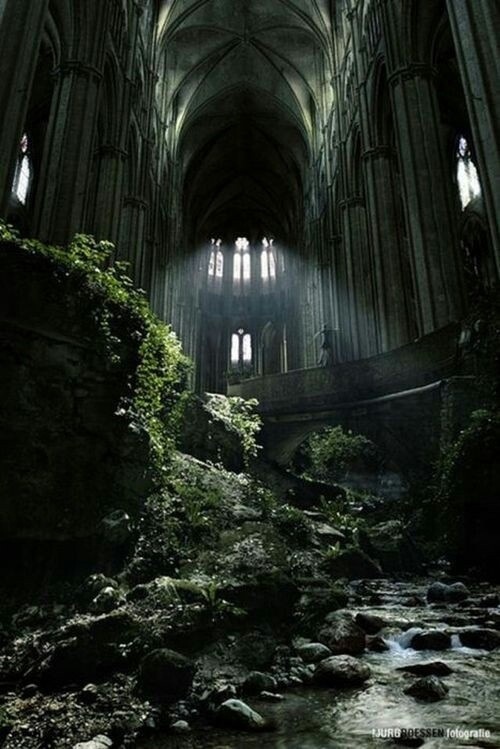
This is the picture, which I found on Pinterest:

20131020-110046.jpg

And here’s Simon’s response to it:

Empty

by BigCharlie Poet

He stands alone inside the ruined shell
Watches the water flow in a place that once, he thinks, housed God as well
And he tries to convince himself that he is at peace
That he is free from everything, has achieved a release
From the torments of his daily life
The soul destroying work, the unfeeling distant wife
But there is a feeling he cannot seem to shake
Like someone is encouraging him to return to a state
Of conciousness, where he needs to open his eyes
Where he needs to breathe again, before his body dies
So he dulls the uncomfortable feeling by watching the water flow
Sees the plants as they find a way to grow
Through the abandoned cathedrals fallen floor
“Sam! Wake up…” this time he’s sure
That the prescence is more than just his mind
Is positive that someone is trying to find
A way to break into this place of calm
Where God heard raised to the Heavens many different psalms
“Open your eyes for me Sam!” he hears the voice again
And as he hears it, he notices the light shine through the pane
Of glass flash so brightly that it causes him to stumble
“C’mon Sam! Open those eyes” the voice now a calm but insistent rumble
The next flash of light brings a jolt to his chest
He sees briefly a world he thought he had left
He tries to return to where the calm water is flowing
But with each passing second he knows he is going
Back to a place he can’t seem to escape
He wakes to the question “Sam, what did you take?
What did you take, Sam? I need you to say,
Was it pills that made you this way?
If it was pills, can you give me a nod?”
And as his head moves he thinks, “why not this time, God?”

And here’s my response:

If All We Ever See Is Cathedrals

by Simon Sylvester

It was no more than a hairline, running between two tiles, but as the year progressed, the fracture spread into a delta and ran between the squares of the mosaic. Father Garrigan glared, then called in builders. They lifted the mosaic for restoration, and discovered a network of cracks hidden beneath the rotten grout. Upon closer examination, damage was found all over the cathedral. Uneven lines formed between the huge, half-ton coins that split the annex from the nave. By the end of that autumn, it became plain that the pillars were subsiding.

The Father stood in his cathedral, framed by the huge window arches. Surveyors and scaffolders scurried around him, making ruin of the House of the Lord. The cathedral was closed for a fortnight, and then for six months – and then for a year. Whenever repairs were completed, new faults were discovered. One night, while the foundations were being electronically monitored for vibrations, the floor fell in. Father Garrigan found the cathedral exposed from the sepulchre to the vaulted dome. There was a stream running directly through the building, bubbling up from between the broken flags. The cost of repair became prohibitive. The building was condemned and desanctified. The builders withdrew. The cathedral was abandoned.

With time, slates began to slide from the rafters and shatter on the rocks. Birds and bats roosted on the lip around the dome. A tapestry of moss explored the walls, creeping into alcoves where statues used to stand. The light shone green with algae, and the cathedral dreamed to the music of the stream. Everyone had gone.

Almost everyone had gone.

Louder than ever, now, Father Garrigan hears the voice of God. It echoes from the walls. It sounds like water, and it sounds like the wind. It sounds just a little like laughter.

Dreamfired

Loki-norse-mythology-loki-30846883-570-732

On Friday 11th October, Dreamfired takes over Brigsteer village hall for a night of traditional music and storytelling. I’ve managed to land one of the support slots for headliner Emily Parrish, aka Scandalmongers. She’s retelling the classic Norse myth of Loki, the trickster and troublemaker at Odin’s court. Her show has received amazing reviews, and I’m really excited about seeing her perform live.

I’ll be reading two short pieces I’ve been practising live – Circle Stone and The Lion Tamer’s Daughter. I wanted to get into the spirit of the night by performing from memory: no notes, no paper. Reading them at Spotlight and Spoken Word has been good for practising their delivery. I already know Circle Stone by heart, and I’m four-fifths of the way there with Lion Tamer. The prospect of reading live is not yet as scary as it will be on Friday afternoon.

By dumb chance, my storytelling uncle Rich Sylvester is up in the Lakes for a workshop that weekend, so he’s coming along too – and I’ve just discovered that legendary Cumbrian singer, songwriter and banjo maestro Bill Lloyd is playing as well. It’s a blinding line-up, and I feel a little overawed to be reading at such a great event. I’m looking forward to sharing my stories, then sitting back with a beer to enjoy a great night of tall tales and folk music…


Spotlight take two

IMG_2903

I performed four stories at the 200th Spotlight Club in Lancaster last night, and it was great. I’ve talked before about how nervous I get before a reading, and yesterday was no exception; I spent the whole day oscillating between calm and stomach-churning tension. It’s always terrifying to put my work before another person: the fear that they’ll hate it never goes away. I get worried whenever I show a new story to Monica, who is always my first reader, and I’m just as nervous when I send it on to Sue and writer friends like Iain Maloney and Steven John Malcolm. Any happiness at having a story published is matched by the anxiety that people will realise I’m making it up as I go along.

Performing live takes those concerns to a different place altogether. My heart thrums in my solar plexus, and my throat goes tight. Last night was the biggest audience I’d ever read to, of fifty or sixty or seventy people, and I was scheduled quite late on the bill. As the night rolled on, more and more people joined the crowd – and the more nervous I became – not least as the bar was set extremely high right from the first performance.

Big Charlie Poet (a.k.a. Simon Hart) kicked off the open mic with an extremely brave, extremely good poem about bullying. I really like Simon’s work and I’ll definitely try to catch him again. I also really enjoyed Ros Ballinger’s poems – tight, witty work about one-night stands and more.

After the open mic came musician Kriss Foster & Friend. All I knew of this act was that Kriss wore a homemade leopard onesie – it turns out they are Lancaster’s equivalent of Flight of the Conchords. They combined a great stage show with three songs about our wee corner of the north-west, and had the audience in stitches. Their first song was from the point of view of a taxidermied seabird in Kendal Museum:

Then came the tragedy of a blind date gone wrong in Rivington motorway services, before they finished with a love song to Morecambe. Brilliant.

They would have been a hard act to follow, so I’m glad there was an interlude before the next slot. The first performer after the break was Italian poet Carla Scarano. Her poems about portraits married intricacy to power – and the last two, about Francis of Assisi and Beowulf, were simply magnificent.

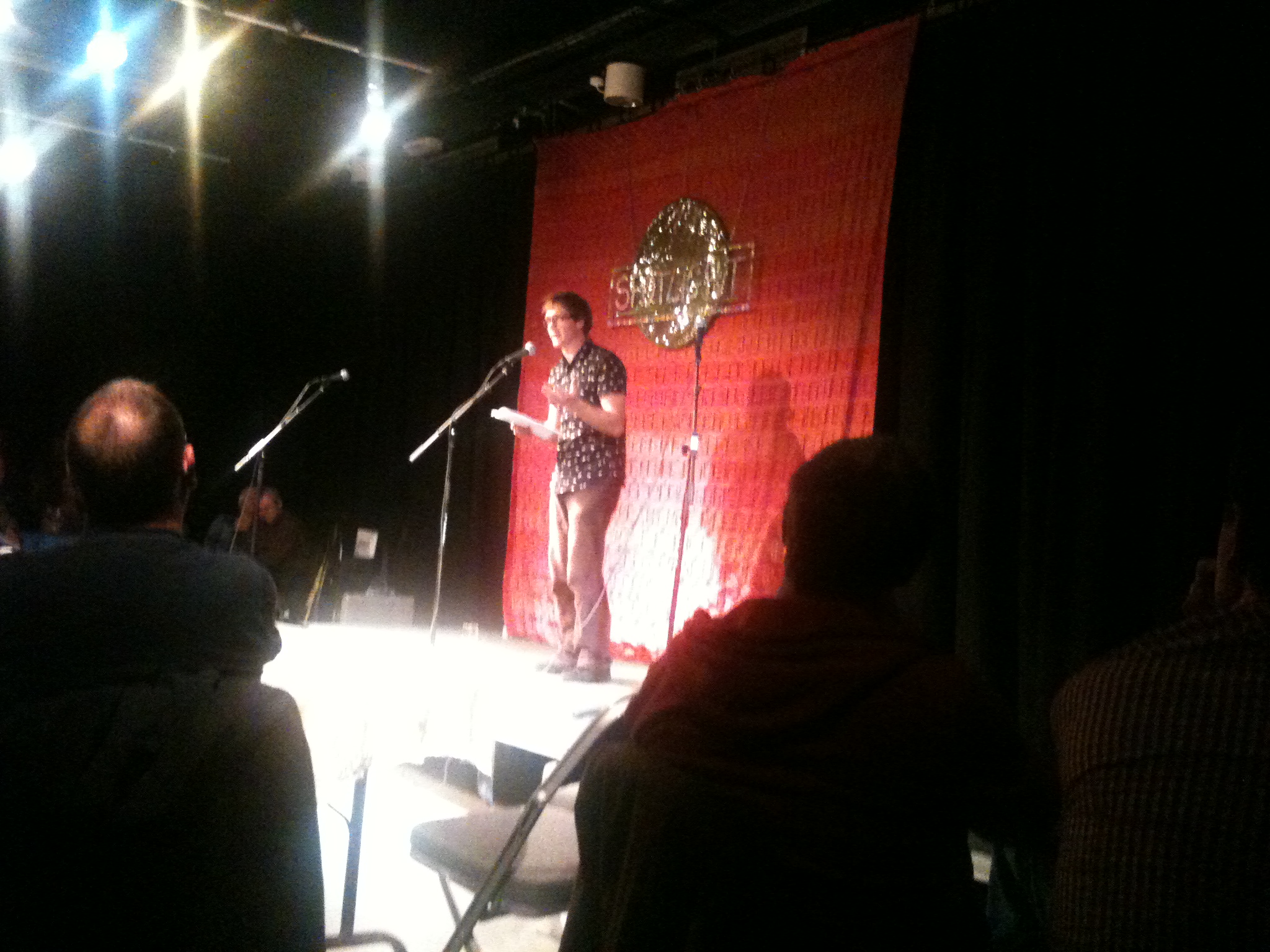
Carla

Then it was my turn. On Mon’s suggestion, I started with the Lion Tamer’s Daughter, and I’m pleased to say it went down quite well – I followed with The Black And The White Of It, then Hutch, and finished with new flash piece Circle Stone. I had twelve minutes, which is probably the longest slot I’ve had to work with. About halfway through I was surprised to realise that the nerves had gone. The good reaction from the audience helped, without a doubt, and gave me greater confidence in my stories. That in turn helped me relax and enjoy the reading, and I think that improved my performance. I don’t know if there’s some secret to starting a reading with that attitude – I suspect it needs to be earned at each new event. Anyway – I loved it. It was my best reading by a mile. If anything, it made me want to write more flash fiction for live events.

I was followed by performance poet Miss P, who managed to combine memory and incisive observation with humour and relentless energy. It seemed to be a bittersweet show for her – she’s moving to Oxford, and this was her last gig in Lancaster. Large sections of the audience had come to support her, and the reaction to her work was explosive and good-humoured.

Paddy Garrigan finished the night with half-a-dozen of his excellent songs. I really like Paddy’s stuff, and it was so good to see him live for the first time. My favourite song was loosely about cathedrals – or, more accurately, our notions of what makes something important. I can’t find it online to share, unfortunately, but it was sumptuous. If I can track it down, I’ll update the post; for now, here’s another of his gigs, playing ‘Where Do The Dead Go When They Die’ with his full band:

Thanks go to compere Simon Baker, too. He was a generous and very funny host. There was a great atmosphere around the occasion of Spotlight’s 200th event, a real sense of community and history. I’m always impressed at how eclectic the performers are, and it’s an honour to be part of something so embracing. It reaffirmed to me how important it is to share my work with others – to validate what I do away from a computer screen.

I signed up to compete at their annual Slam next month, so I’ll be back to Spotlight in October. I haven’t done a slam event before. Hopefully I won’t disintegrate. Each of twenty contestants has a three-minute slot. It’s not a lot of time, but I already have a few ideas brewing away about how I can make best use of it…

Spotlight turns 200

Now then, humans. I’m off to Lancaster tonight for the 200th Spotlight Club at the Storey Institute. I’m really excited to be reading again at such a great event – I have four flash stories lined up for my 10 minute slot, and the other performers look a brilliant crew. Please come if you can – all the details are right here.

Curiously, I’m not terrified yet. That will probably kick in about 4 or 5 in the afternoon, when the stories I’ve worked on for weeks and weeks spontaneously turn into this:

house-falling-apart

The horizon

What a couple of weeks. The start of college has been a bit rough, but we’re getting there. I’m spread fairly thin at the moment, and it doesn’t feel like I’m getting much done… but in the background I’ve completely redrafted my flash fiction collection Marrow, so that’s ready for typesetting when I find the time to get to grips with InDesign. Paragraph Planet published a 75-word story from that collection last week, too, which is pretty cool. I’ve also redrafted the longer short story I talked about in my last post, and started blocking out my new novel in the excellent Scrivener.

Even more exciting, Riptide is beginning to gather pace. I’m expecting notes from my editor this week, so I can start work on what should be the final draft, and I’ve just had a sneak peek at a rough of the cover art, which is scintillating. While I’ve been so busy drowning in real life, just trying to stay afloat, seeing the cover has been a timely reminder of what I’m working towards. The artwork is simply perfect, but I’ll wait for a final version before I share it.

paddy

The 200th Spotlight Club in Lancaster is looming on the horizon. It feels like only last week I was reading at their open mic night. I’m excited about performing there again, and hopefully catching up with old friends Rich Turner, Dan Haywood and Paddy Garrigan (pictured above) – Paddy’s playing out the night, which should be a blast. I have two or three new pieces lined up. I’m going to start with a short story about guinea pigs, and finish with a very short 75-word piece about avocados. I think there’s probably time for another story in between, but I haven’t decided what just yet.

After Spotlight comes the Brewery open mic, if I can get a spot, and then Dreamfired in October. By happy coincidence, my storytelling uncle Rich Sylvester is up from London that night. I don’t get to see Rich very often, so if we’re organised enough, I’ll try and knock up a quick video of one of his stories.

OLYMPUS DIGITAL CAMERA

In the Spotlight

Last night I read two stories at the excellent Spotlight Club in Lancaster. Perhaps unsurprisingly, given the heat, it was a fairly sparse audience of only twenty people, but the wealth of talent was inspiring. I’d booked one of the open mic slots that open the show. The first two performers were Edward Fahey, reading from his novel The Mourning After, and poet Simon Hart a.k.a Big Charlie Poet. I was on third, and read two new short stories – one about home cooking gone wrong, and one about living in an umbrella. I’m pleased to say they went down fairly well. As ever, I felt wretched with nerves. When I’m reading live, I can feel my pulse pounding in my stomach, beating so violently that I’m certain people will notice – but then, when I’m settled, I start to enjoy the reading, to relax into the story and to remember why I wrote it in the first place. Reading aloud is engrained in my writing workflow. When I’m writing, I constantly read my work aloud, lips moving nonstop, speaking and repeating the phrases, looking for the way the words flow best, seeking out an organic rhythm to the story. It’s thrilling to take that back to a stage and a microphone. I’ll never be as good as performers like Alan Bissett, but I’m starting, at last, to really enjoy reading live.

Back to Spotlight: the open mic slots were followed by ‘ethnomusicologist of the imagination’ Deep Cabaret. He conjured incredible sounds from an apparently homemade instrument of wood and wire wrapped around a tin can (Steve Lewis, the man behind the music, has since been in touch to reveal that it’s not a DIY contraption, but a Delta Wedge, and manufactured right here – although it is based on the homemade instruments of early Bluesmen). With this extraordinary device, Deep Cabaret explored the music of a fictional world based on the fantastical fictions of Jorge Luis Borges. It was a truly original and engrossing performance.

Rosa Lucy Rogers followed with a series of haunting, abstract poems exploring emotional and physical space. Then came multi-slam-winning performance poet Trevor Meaney. He kicked off with a piece about Chris Huhne and Vicky Pryce entitled ‘Baby you can drive my car’, which gives you an idea about his work; excellent and very funny. Short story writer Scott Hammell gave us a dying man’s last moments, before veteran punk-poet Nick O’Neill delivered his tight, intense rhymes, taking on big themes with disarming simplicity.

The night was finished by acoustic guitarist and singer-songwriter David Kelly. There are some guitarists who seem in total mastery of their instrument, knowing exactly how it works, never out of control for even a moment – David was not one of those guitarists. He was the sort where the guitar seems to play him, using him as a fulcrum, his body all angles and awkwardness, legs twisted against one another, tapping out mad rhythms, shoulders hunched, head down. It was brilliant. His voice had a raw, urgent quality, and his songs were a little James Yorkston, a little Conor Oberst, all cracked and lo-fi, thrilling and real. I’ll definitely be keeping an ear out for more of his music. I can’t find a website for him, but he looks like this:

IMG_0474

As we made to leave, the organisers asked if I’d come back to read again in September. Spotlight has been going for 17 years, and September will be their 200th show. I’m honoured to have been asked, and I gratefully accepted the invitation. I’ll have a 10-minute slot, so I can try a slightly longer story – but I’ll definitely be reading a variety of pieces again, too. Hopefully my DIY flash fiction collection Marrow will be ready by then. I’m delighted to have been invited back, and it was a great way to finish the show.

On the streets outside, Lancaster felt like London, the streets buzzing with people. We walked back to the car through one of the glorious Mediterranean nights this heatwave has delivered: warm, soft breezes, and dim bands of blue to the west.