Last night, with slightly more than an hour to go before the deadline of the MMU Novella Competition, I finally finished my novella The Year of the Whale. The image above is a randomised cloud of the most common words in the manuscript, which is a really satisfying way to look back on what I’ve made.
I started writing it in 2009, and it has spent entire years untouched, waiting for attention in the dusty recesses of my hard drive. It’s written in first person with a very particular voice, and it’s been strange to return to it so sporadically over the years, and take up the mantle of that voice again. I’ve wanted to finish it for a long time – it was one of my New Year’s resolutions, no less – and I’m thankful to the competition for giving me the spark to get it done. I don’t expect anything to come of it – that way madness lies – but I’m thrilled to have wrapped it up last.
The Year of the Whale is the story of a man called Henry Cowx. He is a fisherman and walking guide in Morecambe Bay, riddled with arthritis and wracked with guilt. His story explores that guilt, and gives some quiet thought to what it means to remember. It’s about walking and place and ghosts and folk tales, and our connections with the land. It’s at the heart of my obsession with threshold spaces. It’s a meditative, elegiac story, and a long way from where I’d like to develop my work – but Henry has never been far from my mind, and I’m glad to give him closure at last.
I discussed some of the genesis of the story in my Thievery post for Kirsty Logan.
I’m working my way through some film jobs at the moment, but it’s almost time to get back into The Hollows.
I’m honoured and delighted to have contributed a post to Kirsty Logan‘s long-running series of story inspirations, Thievery. It’s entirely possible to drown yourself in the wealth of stories Kirsty has curated, and I thoroughly recommend you do.
For my post, I confessed about a novel I abandoned at 50,000 words, because I no longer knew what it was about. One day, it will be reborn as The Year Of The Whale.
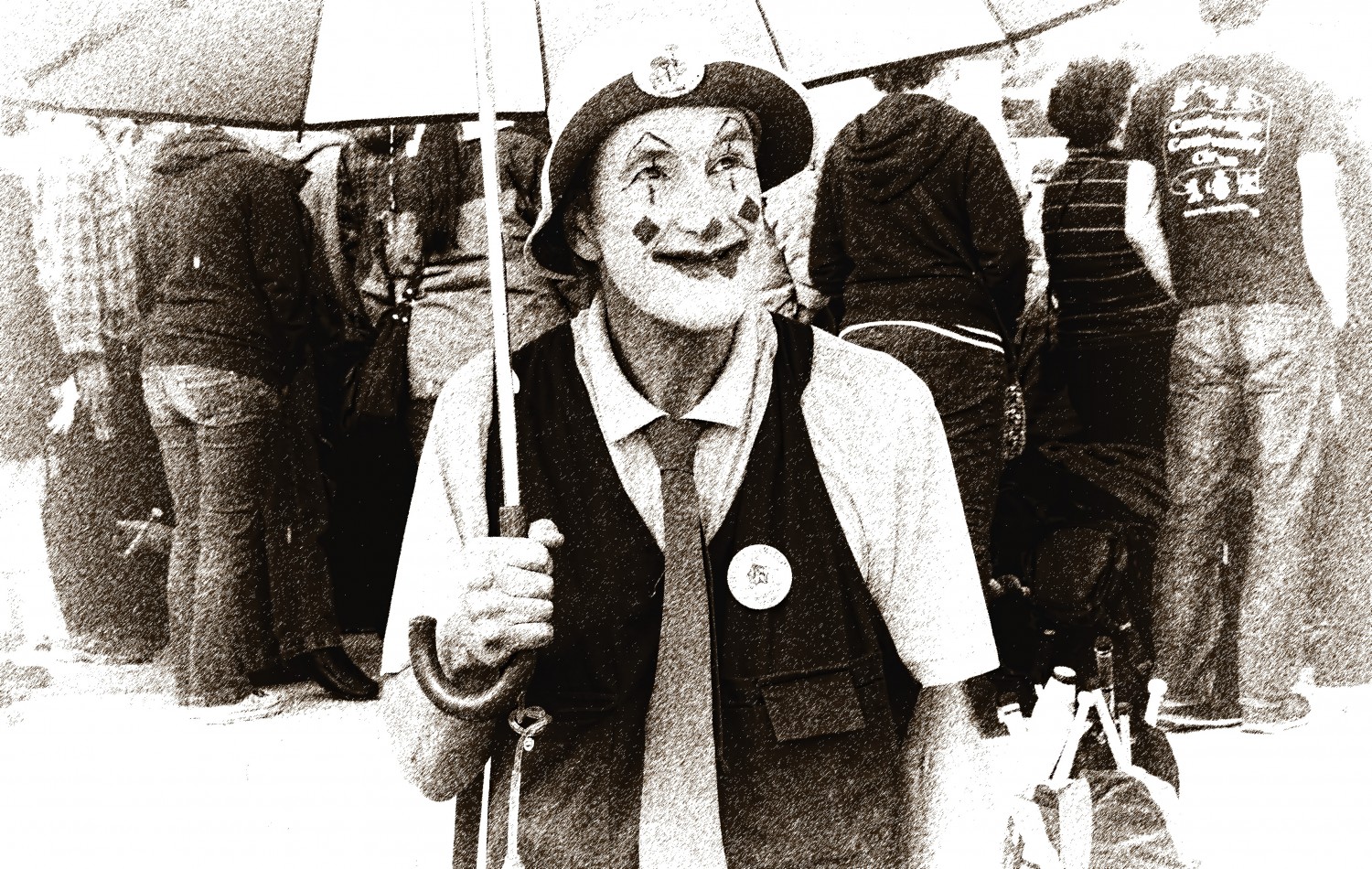
Last month, at Dreamfired, I saw storyteller Fred Versonnen perform the amazing Elephant Story. The next morning, I attended his clowning workshop in Arnside. This had almost nothing to do with the stereotypical idea of clowning – no silly noses, no silly shoes – and was essentially a 101 on delivery, performance and body language.
Fred warned us at the start of the session that it might take us to some uncomfortable places. I didn’t believe him, but he was right. It’s taken me this entire month to process some of the things that happened in that class. I’m not sure I’ll ever totally get to grips with it, but at the same time, I no longer think I need to. I just wanted to record a few thoughts on what clowning means to me.
I’m not going to talk about the specific activities Fred led us through. They were plentiful, varied, invigorating, intense and brilliantly useful, but they will mean different things to each person who attended, and I don’t feel the need to dissect the actual workshop. I want to talk about what I learned.
I learned that I’m frightened of embarrassment. Most of us are, probably. During the workshop, we performed tasks specifically designed to undermine dignity and strip away the topmost layers of self-respect. I found myself trying to rationalise the embarrassment by imposing a narrative upon it, but every time, Fred forced me to confront it.
‘For a clown, embarrassment is a gift,’ he said.
In this way, I learned that clowns are truly fearless.
I also learned to wait.
In a world consumed with noise and signals, the clown is silent. She waits, absorbing everything, and then she waits some more, until the wait itself becomes excruciating – until the pause itself becomes the embarrassment – and then she responds. In that pause, the clown is naked. Every part of her is laid open for the world to see. The clown waits long enough for the audience to connect, to project their own feelings onto the situation, to drown in empathy, to cringe in anticipation. Every part of them is laid wide open. This is the tragedy of the clown, and the triumph. It has nothing to do with face paint or comedy trousers. Laurel and Hardy are clowns, and Pennywise is not.
I couldn’t live that way, but I’m trying to bring some of it into in my own readings. At the Flashtag story slam, I made myself pause, and wait, then wait some more. I took a stupid hat onstage for my final story, and I forced myself to wear it. I tried to share anticipation of what was coming next with the audience. It was, without a doubt, the happiest I’ve ever been with my performance – the best I’ve ever read my stories. For everything I learned, I’m not sure I’ll ever know how to apply it properly. But I think I understand, now, that not knowing is itself part of clowning. It is Zen – pure action, without thought. I think too much.
At the start of this post, I said that the workshop had nothing to do with silly noses. That isn’t entirely true. At the very start of the session, as people were still arriving, we gathered in the kitchen to wait. Fred began to ransack the drawers, looking for props to use in the workshop. He found an orange ping pong ball. In a single, fluid motion, he spun to face me, bringing the ball to his nose, and he grinned. Just as quickly, he replaced the ball and closed the drawer. But in that second, or half a second, he’d become a clown. His face changed, his body changed – with the sheer, magnificent, wondrous joy of finding a ping pong ball in a kitchen drawer.
I don’t think I’ll ever be able to articulate what happened in that workshop. I don’t need to articulate it, of course, but I want to; and that is why I will never be a true clown. A clown wouldn’t need to analyse it, because they wouldn’t be scared of it. A clown would simply shrug, smile, and turn to embrace the vastness of this mad, sad, glorious thing that we call life.
I love this: my friend Dom has been filming the grassroots Cumbrian folk scene. Last summer he gathered dozens of people for a campfire session at Sprint Mill, and this was the result – young musicians, sharing their songs by firelight. The sessions so far can be found right here, but I’ll leave you with Paddy Rogan and The Way You Used To Do…
The Visitors is a little bit about selkies. Selkies are seals, and they are also people. They have a fur coat that allows them to take the form of a seal. When they step out of the coat, they become human. Selkies can be men or women, but they are always extraordinarily beautiful.
There are a multitude of selkie stories, but the most common starts with a selkie woman removing her coat and dancing on the shore. A young man – usually a fisherman or crofter – spies her dancing, and steals the coat. With her fur held hostage, the selkie has no choice but to marry the man. They live together for a while, but then the selkie finds her skin and escapes back into the sea. The man is left to nurse a broken heart. Often, the couple have children. In some stories, it is a child that finds the coat, and returns it to the mother. Sometimes the selkie takes her children back into the ocean, and sometimes they are left behind. In that version of the story, the mother and children meet in the surf to play.
In the other typical selkie story, an island woman cries seven tears into the sea to attract a selkie mate. Selkie men give children to barren women.
I love the idea of selkies, but I struggle with some aspects of these traditional stories. They crush female independence. In the first, the selkie is kidnapped and loses years of her life to captivity. The man takes what he wants, and is punished only by the accident of her escape. In the second story, the male selkie is a god, and the woman summons him on bended knee. Either human men dominate supernatural women, or supernatural men dominate human women. Both men and women mean more to me than that. When I started writing The Visitors, I wanted something different from selkie stories. I wanted equality. That’s been my guiding light for the novel, from start to finish. John and Izzy share traditional tales, but Ailsa and Flora question the validity of that tradition, and take a closer look at what it means to be a selkie.
Selkies are special. I watched the seals hunting in the bay at Grogport, and saw them bask and splash in Portnahaven harbour. There is life and knowledge in their eyes. When you look at them, they look back. On Kintyre, we walked the coast around Skipness on a grey, steely day, and we were followed by a seal. For half a mile or more, as we skirted the coast, the seal stayed twenty or thirty yards away from us. It seemed to move without locomotion, so that dark snub head simply kept pace with us, looking towards the shore. We sat on old stones to eat our lunch, and the seal bobbed and ducked at one end of the headland. It didn’t move away until we struck back inland, and then it vanished in a wink. I looked back to seek it out, but the seal had gone.
I asked my friends about seals and selkies, and they swamped me with stories. Chris gave his first pocket money to Save The Seals. Tom talked to the seals in a sealife centre, and the seals talked back. Dan’s friend confused swallows for seals in a dream, so he drew her a picture of a swallow with a seal’s head. Kirstin’s father whistled to the seals in Shetland, and they popped to the surface to see what all the fuss was about. Jon was kissed by a sealion. Sakina can’t shake the tale of the seal maiden. Ross works in Copenhagen, and daydreams that commuters with sealskin coats are modern-day selkies. Amy holidayed on Mull when she was seven, and spent the summer playing with a selkie called Della.
Why do we give seals such humanity? They are manifestly foreign to us, but the connection is overwhelming.
When I was 25 or 26, I spent a year working and backpacking in Australia. I remember snorkelling on Ningaloo Reef, diving as far down as I could go. I looked up exactly as the sun dropped behind a cloud. The water turned suddenly cold and pressed against me, and I felt very afraid, scared of the deep and the dark and the cold and the blue. When I think of selkies, they are underwater, floating with perfect neutral buoyancy, and shafts of sunlight sway woozy on the surface above. The darkness drops away behind them, and the selkie exists in two places: as a seal, utterly unafraid, and as a human, drawn against the current, compelled to the surface. Selkies live in thresholds. The selkie woman, when she escapes, returns to embrace her children in the surf. The shoreline, changing always with the tide, is where seals and people meet as selkies. It is a nowhere place, and yet it is all they have.
A hunter doesn’t know his wife is a selkie. While hunting, he sees her as a seal, and harpoons her. She becomes human, and dies in his arms.
The crofter is left heartbroken on the shore, and his selkie wife returns by stealth to see her children.
This selkie is allowed only one night of the year to be human.
Two lovers share a single skin, so that they can never be together in the same form; always one as a seal, and one as a human.
Selkies are born from the souls of drowned sailors.
Selkies are cousins to the muc-sheilche, the kelpie, the nokken, the finfolk. Those creatures are killers and enemies to men. So what makes the seal a victim? A romance? A tragedy?
When we visited Islay, we drove out to Portnhaven. We clambered across the rocks to the weedy edge of the harbour, and we watched the seals. Half a stone’s throw across the water, they gathered to sunbathe by the dozen. They winked as though the Atlantic was a hot tub. They flickered in the water, phantoms bound in straps of kelp. They came so close that I found myself laughing aloud – laughing in wonder, joy and disbelief.
When I started writing The Visitors, I wanted to explore that connection with the seals, that projection of knowledge, and emotion, and empathy. I don’t know if I succeeded, but I’ve fallen more in love with seals and selkies.
My wife found this picture of a seal. It was taken in California, rather than Coll, but it’s the way I see a selkie. Curious and cautious, incredibly close, and impossibly distant.
On Friday night, Fred Versonnen performed ‘The Elephant Story’ at Dreamfired, and it was magnificent. The open mic night was as interesting as ever, but one of the scheduled performers couldn’t make it – and so Fred agreed to do another 10-minute spot before the interval. Fred is Belgian. He started by apologising for his (obviously excellent) English, and then announced that he was going to sing a nursery rhyme – ‘A song in my own language,’ he said, which is a phrase I’ve been unable to shift. And then he sang.
I don’t know a word of Belgian, but in that minute, or maybe two, Fred managed to generate genuine laughter and even a sense of the bittersweet, entirely through action, expression and body language. It was remarkable. I later discovered the song was about the birth of seven cats – six big and one very small – and all the mice running away.
He then performed a story I’d heard before, about a young monk who goes out into the world, tasked with discovering the meaning of life. Although I’d come across it before, Fred piled farce upon farce on the poor monk, earning howls of laughter from the audience – again using expression, the shape of his body, and most especially – pauses. (I’ll have a lot more to say about Fred, and pauses, and Fred’s pauses, when I’ve finished thinking about them, but that’s for another post.)
After the interval came The Elephant Story. This was my first experience of storytelling that did not have conventional myth or fairytale at its core; from Emily Parrish performing Loki, to Peter Chand’s Punjabi Grimm tales, to Kat Quatermass and her queer fairytale city, all the amazing storytellers I’ve witnessed have drawn at least a little something from our shared bank of generational stories – the lexicon of myth that has been passed around firesides and whispered over cribs for centuries.
Fred’s story was different. His background is in clowning and the circus, and the story was a love letter to a way of life long gone. Set at the start of the 20th Century, the story follows a little boy called George ‘Slim’ Louis, who falls in love with elephants and runs away to join the travelling circus. Over the years, he experiences cruelty and compassion, cutthroats and camaraderie. His story is remarkable, but made amazing by the way Fred ties it to the stories of the elephants themselves – anecdotes of their strength, and intelligence, and suffering, and occasional violence. There are moments of unbearable barbarity and tragedy, and moments of hysterical joy. The Elephant Story is a parable of all animals in captivity and a truly exceptional show.
Fred is a very physical storyteller. I don’t mean that he moves around a lot, but rather that his movements are measured and completely organic in developing, exploring and reinforcing the power of the story. His ability to hold a neutral expression conveys extraordinary meaning to his words, and that gives an audience space to reflect, savour, empathise and drown – in sadness, in humour, in understanding.
The next day, I attended Fred’s clowning workshop. It was held a hall in Arnside. By some dumb coincidence, there were elephants in the windows. I learned a great deal in the workshop, though I also found it very challenging. I’m going to write about that another time, because I’m still making sense of the things I learned, still processing some of the questions it raised. For now, here’s a picture of a boy and a circus elephant.
I’m delighted to share the news that my 100-word story Dare has been Highly Commended in the National Flash Fiction Day writing competition. You can read it, along with the rest of the winners and commended stories, right here.
To reach the top 10 against such strong competition has really made my day. I’m also delighted to see Cathy Lennon take top spot with her story Never Let Me Go, because Cathy is lovely and her story is fantastic.
Someone landed on my blog a few days ago with the search term ‘is flash fiction a proper noun’. I’ve been giving that some thought, and the answer is no. But I love that flash fiction is becoming more established. It’s the perfect counterpart to my novel writing, and it keeps me keen. More thoughts on flash fiction to come soon, I think. I’ve written a host of shorter stories lately, and I want to take the time to explore what the format means to me.
In celebration, I’m off to see international storytelling superstar Fred Versonnen perform at Dreamfired tonight; and even more exciting, tomorrow I’m off to Arnside to attend his clowning workshop. I’m hugely excited about what clowning could do for my performance, and seeing Fred tell his stories is a perfect start.
I’ve just been emailed the list of all the contestants for the FlashtagShort Short Story Slam. If I wasn’t nervous before – which I was, actually – I certainly am now. Here’s the dirty dozen:
Ros Ballinger
Ailish Breen
Joe Daly
Joy France
Abi Hynes
Thomas Jennings
Mark Powell
Mark Mace Smith
Trisha Starbrook
Sarah Stuart
Simon Sylvester
Geriant Thomas
Joy France read at the open mic before my Verbalise guest spot, and she was amazing. I saw Ros Ballinger read some blinding poems at Lancaster Spotlight last year, and she was also very good. I know Mark Mace Smith and Trisha Starbrook by reputation – Trisha won last year’s slam, having never read in public before, and Mark is a noted slammer and favourite of my friend Ann The Poet. Some online stalking reveals the others to be an intimidatingly talented bunch of comedians, poets, theatre performers and practiced improvisers. Oof. We’ll be paired at random in the first round, reading a 150-word story head to head. The audience votes for their favourite to proceed into the second round. Round two cuts six readers with 200-word stories down to three, and the final trio read a 250-word story for top spot.
In the last week, I’ve written five or six new flash pieces, though none of them are quite right for the slam; they’ve either been too short or too long. I’m struggling especially with the first story and that 150 limit; I have a multitude of pieces of that length, but most are either abstract or downers, and I want something both bawdier and more focused for the slam. While I’m really happy with the story I’d read if I made it to the final three, getting through rounds one and two is becoming a real worry; it’s pretty much all I’m thinking about. I’m sure the right ideas will come, but I wish they would hurry up.
If you want to see me drop like a domino – and who wouldn’t? – the slam costs a measly £1 and should be a blast, so no excuses. Here’s the skinny:
I’m a bit behind on my blogging, so here’s a quick round-up while I have the time to do some rounding.
I’ve barely written a word for two months. A combination of college, gardening and film jobs has demanded every scrap of time, and my writing has taken a unfortunate but unavoidable back seat. That makes me ache. I’m not right when I’m not writing. I’ve only recently become aware of how writing relaxes me; and that not writing is one of the things that stresses me out. I’ve also noticed that ideas are more of a struggle when I’m not writing with any regularity. When I’m working often, I’m flooded with plots and characters and lines of dialogue. Not having that internal chatter makes me anxious, and I haven’t been feeling quite myself; this has been exacerbated by pushing myself to come up with new work for the Flashtag Short Short Story Slam, which is only a fortnight away. I think I have the three pieces now, but they’ve been hard work, and I’m not yet convinced they are the right stories.
I travelled to London last week to meet my agent Sue, editor Jane and publicist Margot. The amazing Quercus building feels like something from a James Bond film; everything is glass and aluminium, with automated barriers and security cards. It’s a far cry from my little house, where starlings and sparrows have started nesting in the slate walls. We popped down from the Quercus office to a quiet bar called Hardy’s, and we drank wine and talked about publicity for The Visitors. There’s an idea to offer short stories or flashes as bonus material with the book – and I might make a couple of short films about how it came to life, too. We also talked about some of my future ideas, including current work-in-progress The Hollows. It was a great meeting, and I left it feeling really enthused. With all the chaos of my day jobs, it’s easy to lose sight of the novel. It’s everything I’ve dreamed of for five years, and it’s actually happening. Sometimes I forget.
What else? I’ve written a post for Thievery, Kirsty Logan’s fascinating series of story inspirations. I decided to confess about a novel I started in 2009, but abandoned at 50,000 words (though I recovered the central strand for my novella Year Of The Whale – I really, really need to finish that). My Thievery post will be up in May – I’ll post links when it’s live.
Although I’ve not been writing as much as I’d like, I have been thinking a lot. The Hollows is never far from me, and though I haven’t even opened the document for three weeks, in my head, I’m streamlining it all the time. I’ve learned so much from writing and especially redrafting The Visitors, and I’m determined to make The Hollows a better first draft. In the background to my day jobs, characters have been changing everything from hair colour to their reasons to be alive. The plot is essentially unchanged, but how the characters arrive there is evolving all the time. I found this with The Visitors, too; even as I developed the threads of the manuscript, I returned constantly to the early chapters, forming and reforming them. This is like the twist of a rope; the threads need to be right at the start, or the rope tangles and disintegrates. I’m filming throughout this coming weekend, but next week I should be able to sit down and start making the changes.
Two nights ago, after a long and stressful day at work, I turned out the lights and tried to sleep. From nowhere, my head was thronged with ideas. I had to get up and write them down; first of all, three flash fiction ideas at once, about taxidermy, trains and cheating, and then, a few minutes later, the setting, start and main character of another novel – which looks like being number five in my current queue of books to write, after The Hollows, We Are Always Reaching Out For Heaven, Vanishings and Black Horse. I’m already really excited about it. Which is just as well, really; if I wasn’t excited about the story, I couldn’t expect anyone else to be. You need to be excited about a story to spend so long with it – both the hundreds of hours staring at a computer screen, writing and writing and thinking that I should get up and make a tea, just another minute, one more minute until I make a cup of tea, as soon as I finish the sentence, the paragraph, the chapter – and the time in the world of the book, observing and conversing with the characters, exploring the map of their world, listening to the crunch of dry grass beneath their feet – and back to the computer to sculpt it all together, working until you realise it’s cold and you forgot to find that other jumper two hours ago, and is there any wine left?
The other piece of big news is that in May, Iain Maloney and I will be co-headliners for legendary Manchester spoken word night Bad Language. I’ve known Iain since 1998. We’ve been bouncing work off each other for the last five or six years, and his excellent debut novel First Time Solo is out through Freight at the same time as The Visitors. Iain lives in Japan, but he’s in the UK for a whistle-stop book tour. I’m delighted to be sharing a stage with him for the first time.
Finally, another writer friend, the outrageously imaginative Ali Shaw, has sent me a draft of his next novel. I devoured the first chapter. It’s going to be really, really, really good. I’m currently taking a sabbatical from A Song Of Ice And Fire, and almost at the end of Third Reich by Roberto Bolano (which is also extremely good), and I can’t wait to read the rest of Ali’s book.
I’ve just realised that my blog is one year old. I had no idea when I wrote my first post, about Quitting Writing, that I’d be blogging so often. It’s become the space in which I organise my thoughts, and rationalise this topsy-turvy journey to publication. A year ago, I had an agent and the first draft of a manuscript called Riptide Heart. A year later, the novel is called The Visitors. I’ve completed multiple marathon redrafts, worked myself into exhaustion on insane strings of 11pm finishes, and spent hundreds of hours thinking about the book. Looking back, finishing the first draft feels like one of the smallest steps on a road that doesn’t truly finish – once the book is out there, it will continue the journey without me.
The proof copies should be going out any day, which is terrifying and exhilarating all at once. Because my day job remains so frantic, my experience of publishing tends to occur to milestones. I’ve been incredibly lucky, but I sometimes wish I had more space to enjoy it. It feels like I lurch from one deadline to the next, and seldom savour the completion of a job. The blog has therefore become essential to me personally: in sharing and formalising the milestones, I’ve created my own map of the voyage. Thanks to everyone who’s visited.
I’ve really enjoyed sharing some of the sights along the way. Of all the things I’ve posted to the blog, I think this is the one that’s stuck with me the most. Enjoy:






 Simon Sylvester