The Curse of White Paper

There are few things as scary to me as blank white paper. Gorgons live in blank paper. A ream of paper holds universes. The infinite weight of that potential is a terror.

I’ve been shying away from it for weeks, claiming other jobs and seeking different priorities, but yesterday I finally started work on Grisleymires. It’s been roughly planned for months (the plan gets vaguer towards the end, allowing for inevitable mutation, but it’s all there). Yesterday, at last, I had the brain space AND the opportunity to sit down and start work. I’m still expecting another draft of The Visitors, but hopefully that should be fairly light, and this novel has been clamouring at me. I didn’t want to wait any more.

Working in the wonderful Scrivener, I sat down and blasted through most of the first chapter. 2,750 words, which is pretty good for a disjointed day. A dozen words came easily, and the word count raced to the first hundred. From there, progress slowed. The thousands took hours, and tens of thousands will take weeks or months. A hundred thousand might take me a year, around my various jobs, and that’s how it goes.

To be clear, I don’t think word counts are important to anyone but the person counting. It’s not something to boast about, and it in no way measures the quality of those words. I’ve had great writing days when I’ve written 11,500 words in twelve hours, great writing days where I’ve written a single sentence, and great writing days when I’ve deleted 10,000 words over a pint of beer. I’ve also had a stupendous amount of terrible writing days, where every word is a breeze block.

I think it was Graham Greene who advocated writing no more than 500 words a day. I guess the idea was to make sure those words were perfect, and to be fresh the next day. That doesn’t work for me. I need a word processor, I need to copy and paste and cut as I work. I need to work fast if it suits, or to dawdle over minutiae, depending on what the story wants from me. When I worked as a feature writer for a magazine, I wrote well over 10,000 words of published copy each month, not counting the blogs, the emails, the phone calls or the coffee run. Word counts became the way I managed my work. I had deadlines, and I hit them fast, because that was what paid the bills. When I started writing fiction, looking for a way to save some of my sanity, I brought the same workflow into my stories. Workflow is an interesting word. The flow is one of the things that generates the work. I’m talking about immersion; I’m talking about drowning in a story, and writing as though words are air. Anthony Burgess wrote A Clockwork Orange in a month.

I count climbing grades, too, when I go bouldering. Like writing, climbing is a competition of one. And exactly like the grades of rock climbing routes, word counts measure personal progress. In other words, they exist for me alone.

So, why share them? That comes back to my feeling that writing is a profoundly lonely thing to do – not simply being shut away for the time it takes to actually get words on paper, but to be lost in another world, to know characters better than best friends, to be so buried in a story that big chunks of real life feel like something to endure between writing sessions. Counterintuitively, this is also the good stuff – this is why I write. Redrafting makes something worth reading, but that first draft is where the magic is. Sharing the progress of a story is how I connect with the world outside – how I remember that there is a world outside.

2013 and all that

Obviously, the end of every year gives pause for reflection. For me, this used to manifest itself in a range of Top Tens – films, albums, books, gigs – but these days I don’t really do enough of any of those things to justify it. So here’s my combined Top Ten of 2013 instead. They’re not in order.

1. Getting a book deal with Quercus

Securing a publishing deal with the wonderful Quercus Books has been one of the most amazing things to ever happen to me. I’m still waiting for someone to pull the rug out from under my feet, but until they do, I’ll keep enjoying every moment of this exhilarating, terrifying, extraordinary rollercoaster. I feel bowled over by the support for my writing, even as I feel a massive weight of pressure to deliver. I started the year with a manuscript called Riptide Heart; I finished with a rigorous redraft, now called The Visitors. Working with Quercus editor Jane Wood has made my writing tighter and my story much stronger. It has also given me a real hunger to push on with my work – I now have half-a-dozen novel ideas clamouring for my time.

This wouldn’t have happened without the hard work of my awesome agent, Sue Armstrong at Conville & Walsh, and the support of my amazing partner Monica. That brings me to the second thing on the list:

2. New work from Monica Metsers

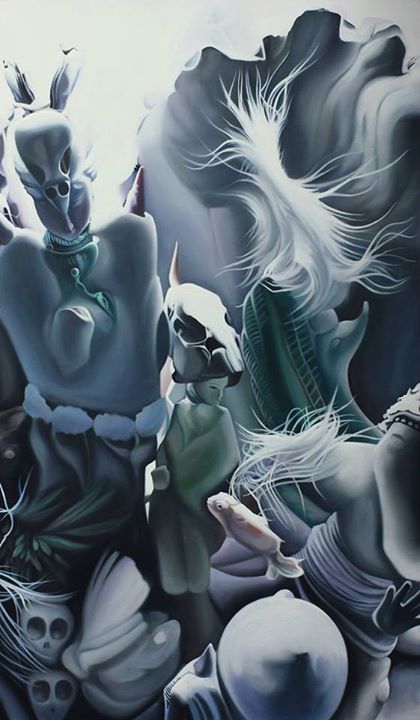
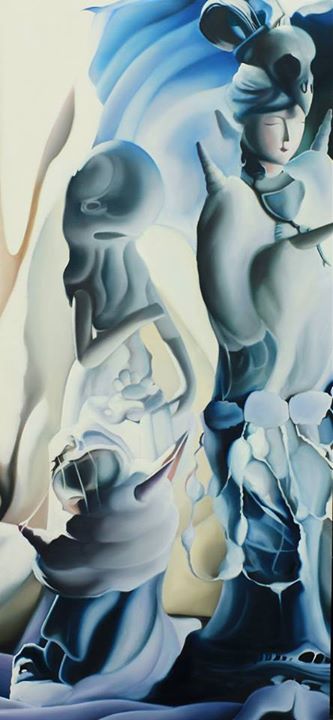
While she was pregnant, and in the first year of Dora’s life, Mon took time away from her painting. 2013 was the year she really started again, and the results have been amazing. She has a solo show in London next year, and as well as a few smaller paintings and a range of drawings, she’s made these two stunning large-scale paintings, which I think are amongst the best work she’s ever done:

BATALLA DE LOS GIGANTES                                                          BALLENA Y GEISHA

BATALLA DE LOS GIGANTES   ballena y geisha

2013 also marked our five-year anniversary – it’s been a blast.

3. Performing live

I’ve never been good at public reading, and this year I set myself the challenge of improving. I went on to read my work twice at Spotlight in Lancaster, once at Kendal’s Spoken Word, once (performing from memory) at Dreamfired in Brigsteer, and once at the Flashtag 2013 writing competition in Manchester, where I won second place. My confidence grew with each reading, though I still feel I’ve a way to go.

I also attended a spoken word workshop run by the excellent Brindley Hallam Dennis. One of the activities he set has changed everything: he had other members of the workshop read our stories. The lady who read my flash piece ‘Marrow’ performed it at a third of the pace I do. She relished every word, and it was three times better as a result. I haven’t performed since then, but I’m going to practice reading with that sort of gusto at the next opportunity. I’m booked in for a 20-minute slot at Spoken Word in February, and I’d like another couple of events under my belt by then. My goal has evolved a little, too: what I’m aiming for now is something closer to outright performance than simply reading. That will come with confidence, and confidence will come from practice.

4. Seven Seals – Plan of Salvation

After a whopping 18 months, I finally finished making this music video for amazing psychedelic synth punks Seven Seals. They’re an extraordinary band, and it was an honour to be involved. They’re working on new material, which will hopefully be available in 2014 for their ten-year anniversary gigs.


5. Amy Hempel – The Dog of the Marriage

Quite simply, the finest collection of short stories I’ve ever read. Hempel’s writing is so sensitive, so honest, that it infuses her stories with devastating grace. Unmissable.

6. Les Revenants

This French drama is the best thing I’ve seen on television in years, remarkable for its intrigue, restraint and power. It delivers on every level, exploring an extraordinary narrative without needless exposition to unravel the mysteries of the Returned, all of whom are troubled in different but connected ways. The locations and cinematography are stunning, while the soundtrack by Mogwai is my album of the year. There’s a startlingly surreal lucidity to the conclusion, and I think they could have left it there; but I’m delighted to see a second series in the works. Here’s the trailer for season one:

In TV terms, an honorable mention also goes to Game Of Thrones. Tyrion Lannister might be the finest character ever committed to screen, and the Red Wedding haunts me even now.

7. Success for friends

It’s been a good year for many of my friends and peers, too. Iain Maloney landed an agent and a book deal with Freight, Kirstin Innes found an agent, Anneliese Mackintosh got a book deal, Kirsty Logan landed a book deal and won everything in the world. Friends Andy and Gemma had a baby boy called Miles, and Ali and Iona had a little girl called Inka. There have been a lot of richly deserved congratulations this year. Good work, team.

8. Cats

Yup. Two of them. I wasn’t sure, at first, but then we met these two cats in the Wainwright Animal Rescue Centre, and it was an easy decision. They came to us with the names Remus and Teddy, which we’ve kept. They’re brothers, about three years old, and half-Persian. They’ve been an amazing addition to our house. They are incredibly relaxed and friendly, and they actively seek our company. That’s especially welcome when I’m having a writing day alone at home.

1174754_10153244876455551_211086219_n

9. Holiday in France

We were overdue a break, and this fortnight in France was exactly what we needed. We camped in half-a-dozen places, the best of which was Green Venice, a vast network of canals, ditches and overgrown waterways, crawling with vines and willows, alive with dragonflies and katydids. It was an extraordinary landscape. I read more in that fortnight than I’d managed in four months. Best of all, the holiday gave me enough mental space to plan my next novel, which will be called Grisleymires. That’s now blocked out on Scrivener, waiting for my next writing day.

10. Another year with Dora.

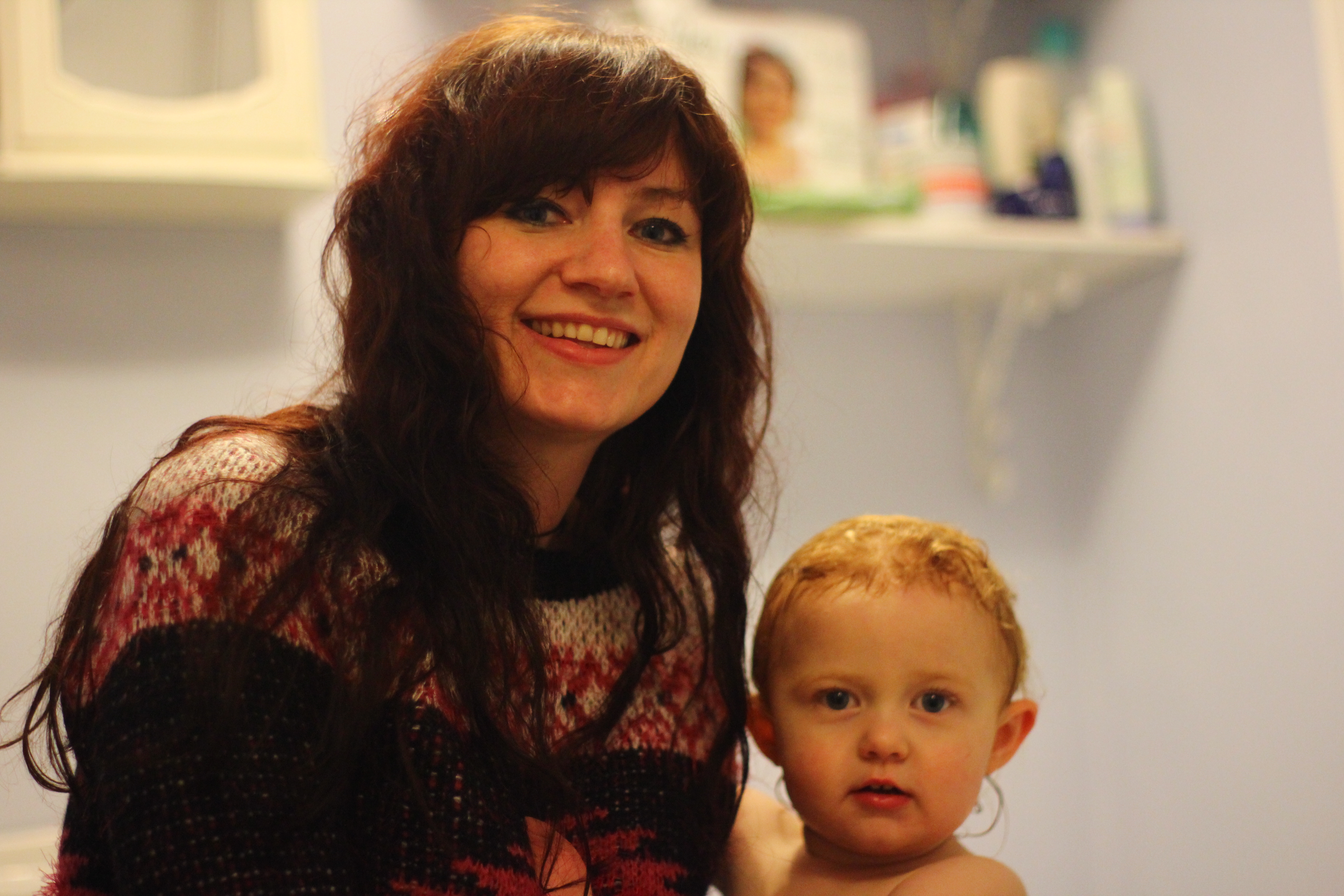
In their first year, babies are basically little puddings. Awesome little puddings, but puddings nonetheless. In their second year, they gather the basic tools to discover the world. And in year three, that toolkit expands exponentially; physically, vocally, intellectually and emotionally. Going through that with Dora has been nothing short of a joy. Seeing the world through her eyes has made me reevaluate so many things for myself. Her conversations leave me in stitches, and everything about her makes me smile. And she hasn’t been to A&E this year, which I consider something of a triumph. Though there’s still a week of 2013 left.

IMG_4758

So that’s my Top Ten. It’s been a good year, and 2014 is alive with possibilities. I might even pop some resolutions up in a few days.

Flash fiction challenge: Graffiti

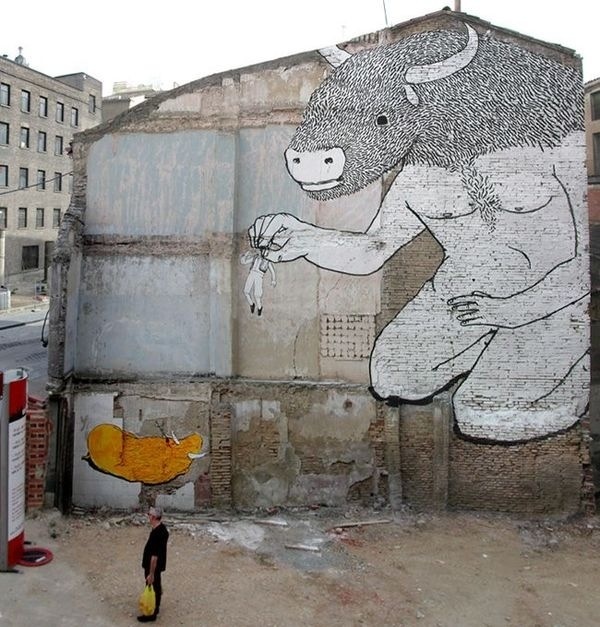
Okay, folks. Here’s round three of the writing challenge I’m working on with performance poet Simon Hart, also known in certain Mafia circles as BigCharlie Poet. This is how it goes: we take it in turns to choose a picture, both of us write a response around it, and we post the results up here. Round one was Cathedrals. Round two was Libraries. For round three, it was my turn to pick the image, and I opted for this doozy from my Pinterest short story board:

20131220-223914.jpg

Although I had some inklings, I didn’t entirely know where to go with this at first. I was also embroiled in a marathon redraft of The Visitors, and so the challenge slid by the wayside a bit. Simon was finished in two days, the swine. Anyway, when I had a chance to work on it properly, the ideas came fairly quickly. My first story was well over a thousand words long and barely halfway in when I decided to put it on ice. It’s going to be a good piece, when I’ve time to finish it, but it’s not right for this. My second attempt was finished in a single session, plus a few tweaks the following day. As with my Libraries story, this feels like it could be the start of something much bigger; since finishing it, I’ve been brewing on a full novel about the characters and their situation, and I have some exciting ideas starting to spark. I think I’ll be taking it a lot further in the future.

It’s interesting, as well, that Simon and I had fairly similar responses to the picture. Our work in the first two challenges was quite diverse; I don’t know whether this image is more specific, and therefore limiting, or whether it actually offers more themes, and we simply happened to choose the same one.

Here’s what Simon has to say about the picture:

“What a difference an image makes! Last time out I (we) struggled a bit under the weight of a well-mined seam of creation for us with my choice of a library pic… I’m glad to say that the responsibility of the choice for this challenge came from Mr Sylvester, and, from my perspective at least, I think he should pick them all! To say that the creation of this piece contrasts with the last process would be underselling it somewhat… I also know that despite the complexity of trying to describe this picture to an audience, I really want to perform this.

This poem came about very quickly and with a very clear idea of what I wanted straight away, and I think it has delivered what I wanted from it. Seeing the image for the first time, I was struck how old monsters are never really old monsters, and they always find their way back somehow. They may change their locale and era, but they continue on…”

With that said, here’s Simon Hart’s response to the picture:

Urban Myth
by BigCharlie Poet

I started my life as a hasty scrawl
Daubed in white paint on a houses side wall
An innocuous way for me to be born
Not really planned, just hurriedly drawn
Against the time constraints of another coming dawn,
The sun creeping almost afraid of my form
And boy did I grow!
There was no way that they could ever know
What i would become, the strength i would show
And each feed of paint gave me a new glow
Though my home was a wall, i still reached for the sky
Never once did i ask for the reason why
I became a creature that makes young kids cry
Which the ancient greeks locked in a maze to die
That people turn their heads away hurts, i won’t lie…
But soon i was so big that single cans of paint didn’t suffice
When you’re twenty feet high, with the head of a bull, who do you turn to for advice?
I couldn’t exactly stroll into a restaurant and say “give me whatever’s nice”
So i had to come up with a solution of my own making
And because i couldn’t do any great british baking
I looked around and saw souls, ready for the taking…
I mean, it’s not as if you lot even notice they’re missing
You still stumble through each day like you’re barely living
Not looking away from what your tv is giving
So now, when you try to open your mind
And use your soul for guidance, you suddenly find
Yourself empty, and you don’t know the reason
But you convince yourself it’s because you watched another season
Of “I’m a Celebrity, get me out of here!”
Or you drowned your brain cells in far too much beer
That i am the culprit will never be clear…
So thank you for giving me what i really need
A simple, quick and nourishing feed
But i won’t let myself give in to my greed
I’ll satisfy myself with the odd soul waiting for a bus
The business professional in too much of a rush
The guy who’s become a 3pm lush…
Just enough to keep me going
After all, this wall doesn’t leave much room for me growing…

…and here’s my response:

Vanishings
by Simon Sylvester

We assembled at dusk and waited, scanning the skyline, binoculars flitting between the sunset buildings. Half the squadron wore night vision goggles, for all the good they’d do. It was only my third year with the division, and I was already the oldest. The kids were tense, but they struggled with all-night shifts. By two in the morning, a couple of them had dozed off. Dew glistened on their spray suits.

“Contact! Contact!”

As the radio crackled into life, slumbering officers stumbled to their feet. I checked the chamber on my gun. It was clean.

“Where are they, Jenkins?”

My voice was calmer than I felt.

“Corner of Gresham and Moorgate.”

I could hear her panic.

“Stay calm, Jenkins. We’re on our way n-.”

Even as I spoke, her scream clattered in my earpiece.

I gestured to the others. Grim-faced, we lined up and marched out, trooping along King William Street at a jog. At Bank, I gestured for the squad to slow and break formation. They fanned out, torches sweeping beams of light across the deserted road. I took point, and we stepped in silence through the Old Town.

Halfway along Prince’s Street, prickles ran down my spine. The feeling turned my bones to ice, but I knew better than to ignore it. That feeling had kept me alive for three years. I raised my fist, signalled to freeze. The squad halted at once. Nothing moved but sheets of paper, cartwheeling through the night.

On the wall ahead was a perfect, life-sized painting of Jenkins, caught mid-scream. I grimaced. She’d only been in the division three weeks. Some animal instinct made me raise my torch and scan the buildings above. The cone of light crawled up the wall into darkness.

I peered into the gloom at the edge of the light.

The top third of the building was graffitied with a gigantic white minotaur. It loomed above the street, unmoving, and for a heartbeat, I thought it was already dead. But then the minotaur grinned, and a fist clenched in my guts. Behind me, Stevenson shrieked and loosed a burst of fixative. The minotaur was too quick for him, melting back into the bricks even as the web of glue spattered across the wall. The beast darted around the corner of the building, pouring across the stone, the molecules of paint sliding from brick to brick. Splashes of fixative showered the empty wall.

“Hold your fire!” I bellowed.

The squad gathered closer together. In my earpiece, someone was hyperventilating.

“Shit! Jenkins has gone west.”

“He’s big. He’s big, sir-”

“I’ve seen worse, son. Be calm. Keep your wits about you. He’s somewhere close.”

There was another yell behind me. I spun round to see the minotaur reach out of the building, pour onto the pavement and swing his vast arm across the road, knocking half my squad to their knees. Redmayne lay closest to him. In two dimensions, his paint poured across the tarmac, wrapping around her ankle. She screamed and kicked, but the paint held fast. The minotaur yanked her to the ground, and began hauling her towards the wall. The rest of the squad were firing indiscriminately. Wherever splashes of the fixative caught the minotaur, fragments of paint were trapped within the brick, but he was big enough to shrug them off, leaving patches of himself behind. Redmayne was almost at the wall when I found a clear shot. I raised my gun, aimed and fired off half a tank. The glue showered across the beast in a net of spray, pasting his entire head. He juddered to a halt, mouth fixed in a permanent, silent roar. His painted hands continued to sweep across the bricks, scrabbling for purchase, but his head was stuck fast. One by one, my squad found targets, and soon every part of the monster was stuck to the wall. Redmayne scrambled free, sobbing, and backed into a knot of her comrades. We gathered together and looked up at the beast.

He was easily four storeys tall, made with gallons and gallons of paint. His creator had been a talented artist. Even fixed fast to the wall, the minotaur wriggled with life. His horns came to wicked points, and despite the fixative now coating his body, veins and muscles still pulsed on the brickwork. He must have taken weeks to make, back in the day. In a sense, he was even beautiful.

It was hard to remember a time before the paintings came to life.

The Cleaners arrived within the hour, all dead-eyed and paint-smeared with their mops and detergents. We watched them scrub the minotaur from the building, watched him dissolve into suds and drip into the sewers. Then they washed Jenkins from the wall, too. I didn’t watch that part. When they were done, we walked back to the depot. The new trainees looked shellshocked. The older squaddies looked harder, meaner. Redmayne wasn’t talking. She was one of my best officers, but this would be her ticket out. Poor Jenkins hadn’t even made it this far.

Every step of the way, ghosts watched us from the walls. The Cleaners worked hard, but every day, new faces stared out from the brick. And no matter how hard they worked, they couldn’t wash the faces from my nightmares.


RedraftredraftBRAINMELT

For the last eight weeks, this has what my life has looked like:

RedraftredraftredraftredraftredraftredraftredraftredraftredraftredraftredraftredraftredraftredraftredraftredraftredraftredraftredraftredraftredraftredraftredraftredraftredraftredraftredraftredraftredraftredraftredraftredraftredraftredraftredraftredraftredraftredraftredraftredraftredraftredraftredraftredraftredraftredraftredraftredraftredraftredraftredraftredraftredraftredraftredraftredraftredraftredraftredraftredraftredraftredraftredraftredraftredraftredraftredraftredraftredraftredraftredraftredraftredraftredraftredraftredraftredraftredraftredraftredraftredraftBRAINMELT.

In case you hadn’t noticed from my incessant moaning, I’ve been redrafting my novel. Again. It’s been a vast job, because – following discussions with Jane Wood, my amazing editor at Quercus – we decided to change the ending quite substantially. This isn’t as simple as knocking off the last few chapters and rewriting, alas; to make the climax and conclusion fit, organically and emotionally, the threads of the plot need to extend a long way back into the story. Because The Visitors is already woven rather tight, unravelling the narrative to make the new ending fit has been tough. Around college and film jobs, I’ve been working on it in evenings and spare days since mid-October. After the first fortnight, I took to saving the manuscript as a new document at the end of each session. This is what the folder looks like:

redraft of death

That’s right. It’s called the REDRAFT OF DEATH.

But check it out, humans; I have actually finished. I sent the new draft off to editor Jane and agent Sue late last night, along with a summary of everything I’ve changed. On reflection, it’s been a massive rewrite. As well as the new ending, I’ve changed names, moved locations, cut chapters, written new chapters, tightened dialogue, tightened prose, and – perhaps biggest of all – introduced an important character at the start of the story, rather than halfway through. Maintaining his presence from this early beginning meant a light rewrite of the entire first third. I’ve also made a big change in the death of another character, which brought a new angle to the idea of ‘killing your darlings’.

Dealing with the sheer volume of information is what causes brainmelt. Trying to keep everything in perspective – emotion, story, plot, character, description, geography, chronology – is exhausting. To help manage the changes, I riddled the manuscript with notes to myself, so I wouldn’t lose track of the things that needed work. It was quite telling to come across these messages, later on, and reflect on my thought processes. Here’s an example:

“Move the distillery to the island where it should have been from the beginning, you dick.”

So yeah, it’s been tough. I’m expecting another round of line edits, at the least, but hopefully the bigger structural stuff is now finished. I would have worked quicker but for the day jobs. Trying to switch into a more creative mode and recover a spark is tough. There have been times I’ve sought out any distraction to keep me from inflicting more destruction on my work. That’s where Freedom has really helped. I can’t recommend it to writers (and other procrastinators – YOU KNOW WHO YOU ARE) highly enough.

For all the effort, I still wouldn’t be doing anything else. I saw a great quote the other day. Though I can’t remember who said it, it was something like, “For all that writing is incredibly tough, it’s worth remembering that it’s still making up stuff for fun.”

True dat. More than anything else, I’m increasingly looking forward towards my next novel. It’s called The Hollows. It’s mostly planned, and I’m champing at the bit to start work. Now term is almost finished, I’m going to give myself a few days off to clear my backlog of video jobs, then try and take a day or two over Christmas to get writing.

After dealing so exhaustively with a manuscript of 94,500 words, it’s very strange to be faced again with all the promise and terror of a blank, white page.

‘Selkie’ by Robin Robertson

Thanks to Iain Maloney for sending this poem my way; it’s a cracking wee piece by poet Robin Robertson.

In memory of Michael Donaghy

“I’m not stopping,”
he said, shrugging off his skin
like a wet-suit, then stretching it
on the bodhran’s frame,
“let’s play.”
And he played till dawn:
all the jigs and reels
he knew, before he stood
and drained the last
from his glass, slipped back in
to the seal-skin,
into a new day, saluting us
with that famous grin:
“That’s me away.”

There’s talk of selkies in The Visitors, and this chimes nicely with the last stages of my redraft. It also makes me want to read more of Robertson’s work. Try reading this aloud; the scan is sensational.

A century of…

I realised, after posting this video about a ballerina dancing on butcher knives, that I’d hit a hundred posts on the blog. A century is still pretty arbitrary, really, but it’s as good a place as any to stop and think about why I keep a blog.

I started writing the blog six months ago to track the progress of my novel. The book was called Riptide Heart, back then. It’s now called The Visitors, and it will be published by Quercus Books in 2014. All that has happened in the lifetime of this blog. I’ve tracked my highs and lows and uncertainties throughout the publication process, from finding an agent (a year ago) to signing the contract (last week).

As well as the novel, I’ve written a lot about reading my work live, and the struggles I’ve had with my nerves. Each of my various readings has been painfully revisited, but that return has helped me filter and understand the experience. I’ve also explored my decision to gather my flash fiction into a collection, which is called Marrow, and will almost certainly be self-published, and teaching myself InDesign to lay it out professionally. (More on this soon! As I approach the end of my redraft and clear my backlog of film jobs, I should have the time and space to push ahead and get this wrapped up and printed.) I’ve posted published and unpublished flash fictions, and talked about my writing processes. I’ve written about my film work, and catalogued some of the things that I find inspiring or magical. I’ve posted galleries of the threshold spaces I’m so obsessed with.

All in all, then, my blog has ranged far wider than I ever thought it would. More than anything else, I’ve been surprised at how personally I’ve addressed some of these subjects. When I started, I expected the blog to be fairly analytical, for want of a better word; dry, professional. But in struggling with my live performance readings, and in wrangling my novel redraft, I’ve found myself at times alarmingly open about how I feel about my work. I like that the process of writing has taken me in that direction quite organically.

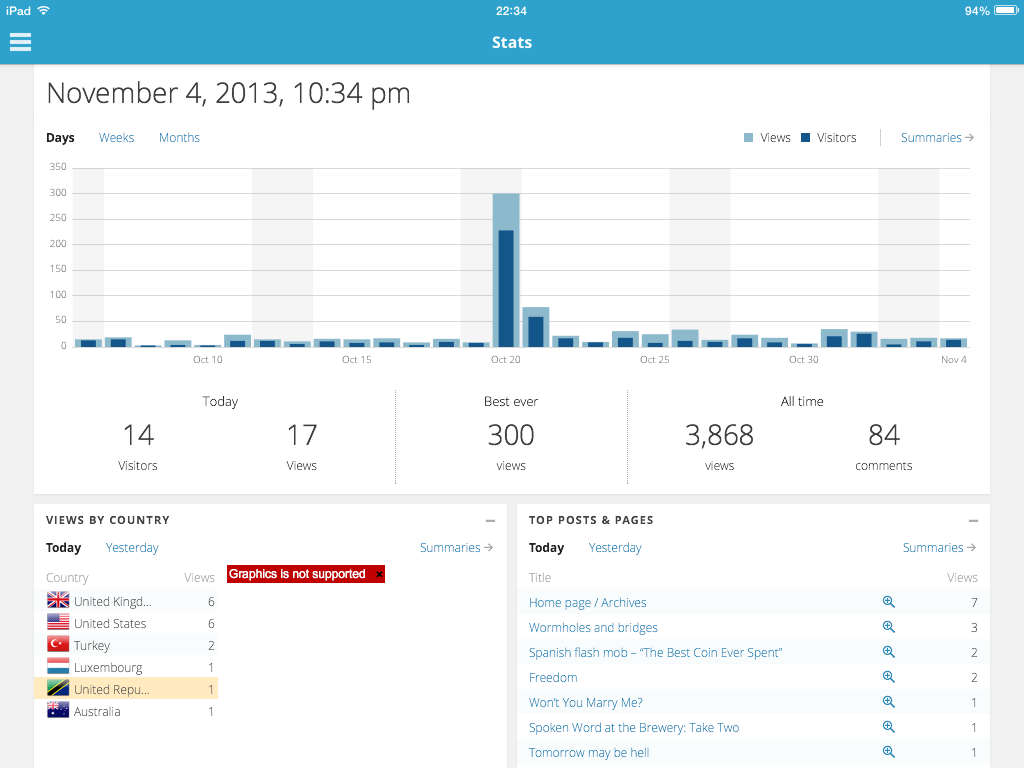
One of the joys of using WordPress is browsing through the stats, which tell me what brings people to the blog, what they look at, and often where they come from. I’ve had visitors from as far afield as Mozambique and Mongolia, searching for everything from devil dogs to gay porn. (Hopefully not everyone will be as disappointed as those two internauts.) I’ve had a week without any views, then hundreds of visitors the day Neil Gaiman retweeted this post about libraries. Have a look at this screen grab and see if you can guess which day that was:

photo

The two things that bring people to the blog most often are on the periphery of my interests; this post about a nursery rhyme and this post about a WW2 fighter pilot preserved in a peatbog. People have searched for Bancree, which is the fictional Scottish island I created for The Visitors, and for novelist friends like Iain Maloney and Ali Shaw. Lots of people come to the blog looking for information about my agent, Sue Armstrong at Conville & Walsh, and my publisher, Jane Wood at Quercus.

More than anything else, though, the blog is for me. It’s how I filter my ideas and monitor what I’m doing. Writing about my life is what I need to live my life.

Flash fiction challenge: Libraries

BigCharlie Poet (the nom de guerre of Simon Hart) and I have been trying out a picture-based flash fiction vs. poetry writing challenge. In case you missed it, here’s round one: Cathedrals.

It was Simon’s turn to choose a picture, this time, and this is what he chose:

libraries

I found this one very difficult. With Cathedrals, I had the story in an instant, and writing was a cruise, but this has taken some working around. I guess that’s the way with writing. I can’t turn it on like a tap. Sometimes the stories shimmer into view as though they’d been there all along, and sometimes they come word by word, kicking and fighting, refusing to stay on the page. This one’s been a toughie, and I’ve tried it three times. My first attempt was an illiterate dystopia where an old man found a book he couldn’t read. It spiralled very quickly, and I abandoned it at 600 words. My second attempt was about a haunted library, and that was a little better – I think I can rescue it for a short story – but it wasn’t good enough for this, and I hadn’t the heart to stick at it.

I have written a previous piece that fits this picture exactly, which doesn’t help. The abandoned library is a perfect representation of one of my Twitter shorts. Struggling to get that story out of my head, I posted it again in the hope of exorcising the blasted thing. It looks like this:

Screen Shot 2013-11-03 at 11.49.06

Having sent that back out into the big wide world, I did feel a little freer, but it wasn’t until I discussed the picture with Mon that I came up with my final idea. She imagined the books dropping away into nothingness, and that was the spark I needed. Time and time again, Mon reminds me of the stories I like to tell the most. She keeps me on track when I’m getting lost. With that image in my head, I sat down and wrote the final piece fairly quickly. It’s the middle of something much bigger, I think. I can see this growing into a novella or even a novel, given time. I’m not done with the characters.

Simon Hart found this one tricky, too, which is a relief. It’s taken both of us longer than the fortnight we’d agreed, but then, hell; we’re busy people. This is what Simon has to say about it:

“Well, it’s finally been written and this has been difficult! I saw the picture and thought it was interesting, suggested it and went ahead with it as the challenge piece… ignoring the fact I have written creatively about libraries before. What it has meant is that those pieces of work have been clamouring at my brain to be let out again. I have refused them, and eventually created this new poem, but not without help. The title and line relating to it come from my Dad pitching me a line far greater than anything my feable mind was coming up with, and I finished only because I cheated and read Simon’s excellent entry on the same photo. Cheers gents.”

Here’s Simon’s response to that troublesome picture:

Engines of Thought

by BigCharlie Poet

There were books strewn everywhere
Left without much apparent care
Though some were in bundles, others in stacks
Most were just left to cover the cracks
In the old dead library’s floor

The words on the pages, scattered like dust
Engines of thought now turned to rust
Childhood stories being lost by the hour
The Tempest losing so much of its power
From the old dead library’s floor

The shelves have been looted for perceived greater worth
And the paper that’s left returns to the earth
The knowledge inside no longer at hand
The words pour away like loose grains of sand
Through the old dead library’s floor

They once taught us magic, and fanciful tales
Told us stories of mad Captains hunting white whales
Taught that being obsessed was a kind of disease
That carried you away on angry dark seas
Not the old dead library’s floor

But now they do nothing, we won’t let them teach us
And where they sit they will struggle to reach us
Abandoned and now out of our sight
They are doomed to their own perpetual night
On the old dead library’s floor

And here’s my response:

Books Like Grains Of Sand

The creature stepped out of the darkness and into the candlelight. It was smaller and far slighter than Morag, and carried itself daintily, as though it was frightened of breaking a limb. Its tiny eyes were black pinheads in the cloth. It had a ragged hole for a mouth. It smelled like coal sheds.

It led her to a door.

“In here, my pet,” it lisped. When it talked, stuffing spilled from the corners of its mouth.

In jerky, spastic movements, it opened the door to the library, and daylight spilled into the gloom. Squinting in the light, Morag peered beyond the creature and saw a vast room. The floor was entirely carpeted in books. Books, books and more books, gathered in loose stacks, strewn by the dozen, piled up in the corners.

“All of them?” she whispered.

The creature’s smile wrapped around its head. Morag heard stitches popping as it grinned.

“All of them,” it said.

It turned the hourglass again, and the sand began to flow.

Morag slung her knapsack, took a deep breath and brushed past the creature into the library. She stumbled to the top of a nearby stack and surveyed the room. The door creaked shut behind her, and the creature’s smile receded to a single line as it melted into darkness.

She was alone in the library. Before her, books lay scattered in their thousands.

“But where to start?” she murmured.

She took a single step, and then she heard the slithering. It was so faint at first, ghostly whispers, but gathered to a rush. Morag scanned the room. The books in the middle were moving. They revolved, and more volumes fell inwards as they shifted, gathering momentum. They spiralled, forming a circle and starting to drop into the floor. It was spreading outwards, increasing speed. It was a whirlpool. With a jolt, the stack beneath her shifted, throwing her to the ground. Morag fell headlong into the torrent.

The daylight closed overhead, grey and fluttering with loose pages. Books battered and struck her as they ground and jumbled in the gyre. The movement was inexorable, dragging her down, dragging her into the centre. Her feet lost contact with the floor and then it all dropped away and Morag was falling, flying, plunging into nothing as the books tumbled all around her. She panicked, flailing and groping for contact, anything to arrest her fall. There was nothing to hold on to. The space beneath her and around her was empty entirely, a sea of nothingness stretching on forever. Books fell around her like rain, covers flapping and pages rippling. As they fell, Morag realised they looked exactly like the sand in the timer.

In a heartbeat, she remembered what Badger told her: about time. About the creature. About this place.

She took a deep breath, shut her eyes, and reached out. Her hand closed around a book. Still falling, she opened her eyes, and turned to the first page. Morag began to read.

Grimm’s Sheesha

peter-full

Last night, storyteller Peter Chand performed his show Grimm’s Sheesha at Dreamfired in Cumbria, and it was bloody brilliant.

A sheesha is a mirror, and you probably all know about the Brothers Grimm; throughout the 19th Century, brothers Wilhelm and Jacob Grimm collected and published folk stories from across Germany and beyond. Their books preserved many – if not most – of our classic fairytales. When they feel so intrinsically European, hard-wired into grey stone and rain and winter, it’s crazy to discover that threads of those same tales have existed in India for centuries. In retrieving and retelling the original stories, Peter’s show gives the Grimms an Indian incarnation – or, more accurately, reflection – and hence the titular sheesha.

Just like people, stories evolve as they travel, building on a core, becoming something new, fitting themselves around each new place. The same elements are plain to see in the fairytales of both cultures – family discord, revenge, blood, luck, magic – but Peter’s stories explode with language and laughter. His characters flit between between Punjabi and English – sometimes with translations, sometimes without – and the seamless interplay of both languages is dizzying, dazzling, mesmerising. The stories balance violence with humour, using voice and movement and body language and expression to conjure holy men and jealous sisters, gods and donkeys, poison and pakora, loom shuttles, bloody shawls and magic mango stones.

It was an electrifying show and an inspiring night. By the end of the performance, my face ached with so much smiling and laughing. I can’t do it justice; hunt down Peter Chand and hurl yourself headfirst into his stories.

I’m fascinated by the evolution of stories, and it was a delight to chat to Peter after the show and hear more about how he’d found and developed the show – and how the show had then evolved again, changing around him with each new performance. His medium is more dynamic than mine, but that idea of evolution is something I can understand; it’s there in my inability to let go of written work, returning to it time and time again, even years after publication, tweaking and cutting and expanding, improving, building towards something ever new. We also spoke about his performance style, which is both relaxed and spontaneous – at one point he said “Bless you” to an audience sneeze without breaking the suspense – and he was kind enough to give me some advice on how to improve. I’ll never be a storyteller of his calibre, and that’s not really where I want to take my work – but I absolutely strive to read and perform my stories with greater confidence, and it was useful to talk to a master! Peter also put me onto Festival At The Edge – the country’s oldest storytelling festival – which I think we’ll try and attend next year.

As a tangent to all this, my friend (and real-life Lovejoy) Ben Piggott claims there are actually only two stories: 

  1. Boy/girl leaves to find fortune
  2. Trouble comes to town

I’ve tried, but I can’t think of a story worth its salt where one or both of these sound hollow. And yes, they’re vast catch-alls, but that’s okay, because they’re also entirely true.

For a number of reasons, I’ve stalled on the novel redraft since discussing Freedom. As of today, I think I’ve found a way back into the light – but I need to brew on it for a couple of days, so that’s for another post. For now, here’s an illustration from The Old Woman In The Wood.

the_old_woman_in_the_wood