
I’m just delighted to share the news that my good friend Iain Maloney has secured a publishing deal for his excellent novel The Wasting Embers. Having been lucky enough to glimpse an early draft, I’m really pleased and excited that this is going to hit the shelves next year.
Grimm’s Sheesha

Last night, storyteller Peter Chand performed his show Grimm’s Sheesha at Dreamfired in Cumbria, and it was bloody brilliant.
A sheesha is a mirror, and you probably all know about the Brothers Grimm; throughout the 19th Century, brothers Wilhelm and Jacob Grimm collected and published folk stories from across Germany and beyond. Their books preserved many – if not most – of our classic fairytales. When they feel so intrinsically European, hard-wired into grey stone and rain and winter, it’s crazy to discover that threads of those same tales have existed in India for centuries. In retrieving and retelling the original stories, Peter’s show gives the Grimms an Indian incarnation – or, more accurately, reflection – and hence the titular sheesha.
Just like people, stories evolve as they travel, building on a core, becoming something new, fitting themselves around each new place. The same elements are plain to see in the fairytales of both cultures – family discord, revenge, blood, luck, magic – but Peter’s stories explode with language and laughter. His characters flit between between Punjabi and English – sometimes with translations, sometimes without – and the seamless interplay of both languages is dizzying, dazzling, mesmerising. The stories balance violence with humour, using voice and movement and body language and expression to conjure holy men and jealous sisters, gods and donkeys, poison and pakora, loom shuttles, bloody shawls and magic mango stones.
It was an electrifying show and an inspiring night. By the end of the performance, my face ached with so much smiling and laughing. I can’t do it justice; hunt down Peter Chand and hurl yourself headfirst into his stories.
I’m fascinated by the evolution of stories, and it was a delight to chat to Peter after the show and hear more about how he’d found and developed the show – and how the show had then evolved again, changing around him with each new performance. His medium is more dynamic than mine, but that idea of evolution is something I can understand; it’s there in my inability to let go of written work, returning to it time and time again, even years after publication, tweaking and cutting and expanding, improving, building towards something ever new. We also spoke about his performance style, which is both relaxed and spontaneous – at one point he said “Bless you” to an audience sneeze without breaking the suspense – and he was kind enough to give me some advice on how to improve. I’ll never be a storyteller of his calibre, and that’s not really where I want to take my work – but I absolutely strive to read and perform my stories with greater confidence, and it was useful to talk to a master! Peter also put me onto Festival At The Edge – the country’s oldest storytelling festival – which I think we’ll try and attend next year.
As a tangent to all this, my friend (and real-life Lovejoy) Ben Piggott claims there are actually only two stories:
- Boy/girl leaves to find fortune
- Trouble comes to town
I’ve tried, but I can’t think of a story worth its salt where one or both of these sound hollow. And yes, they’re vast catch-alls, but that’s okay, because they’re also entirely true.
For a number of reasons, I’ve stalled on the novel redraft since discussing Freedom. As of today, I think I’ve found a way back into the light – but I need to brew on it for a couple of days, so that’s for another post. For now, here’s an illustration from The Old Woman In The Wood.

Seven Seals – Plan of Salvation
As well as teaching film, I make the occasional video, too. This is a music promo for local legends (and one of my favourite bands) Seven Seals. I’m slightly ashamed to say it’s taken me 18 months to finish, but then again, I have a child to take care of. And a redraft. The picture below is a screenshot of my final edit. You don’t know need to know how it works to recognise that it’s been tricky. But for all the work, I’ve enjoyed it. The song is taken from an amazing E.P. called As Above So Below, which you can (and should) buy on iTunes or Amazon. The first Seven Seals album, Owl Cage, is free to download here.
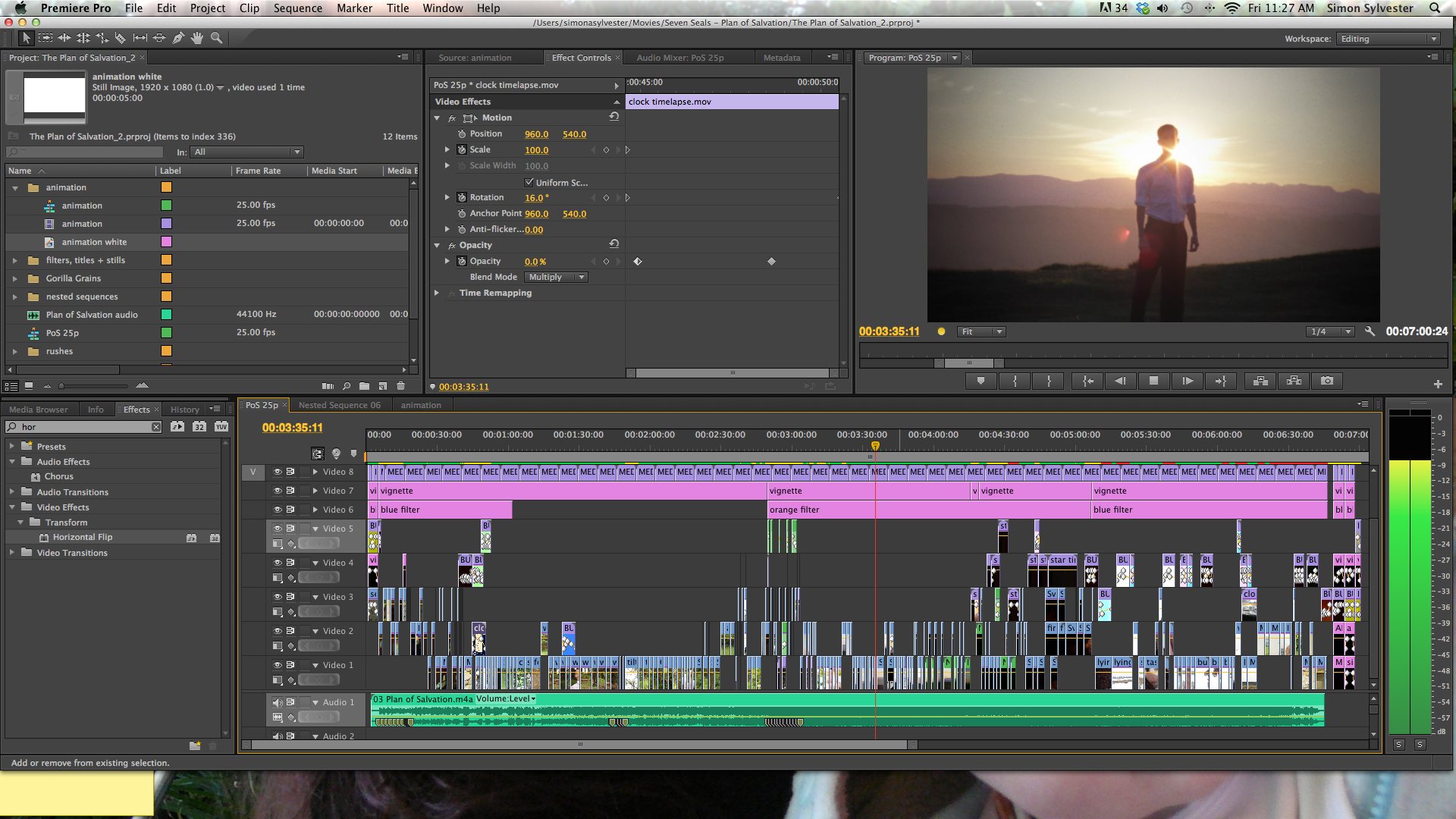
Filmmaking has had a massive impact on my writing. Where I used to strive for an internalised immersion, revealing narrative through stream-of-consciousness, my experiences in making and teaching film have helped me understand the simplicity – and power – of visual storytelling. Thinking of a novel like a movie helps a lot; in structure, in geography, in character, in description, in delivery.
Speaking of which – back to the writing. This novel won’t redraft itself. Unfortunately.
Tomorrow may be hell
Further to my recent post on the terrors of redrafting, I’ve just discovered this excellent line from Neil Gaiman:

Freedom
This is another post about editing. Until today, it hasn’t been going very well. A variety of things have built into a general malaise, and I’ve been struggling to get myself out of it. Yesterday, I read this from Matt Haig: “As a writer, you need to have a thick skin. But you also need to be a hypersensitive wreck to write in the first place.”
Well, for the last few days, I’ve been in hypersensitive wreck mode. I swing in and out of these phases. When a novel is going well, I’m buoyed up and float through life, with at least half my mind firmly in my story, and nothing else really gets in the way. But when it’s going badly, I obsess over and over again on all my many failings and how terrible the novel is, convinced that the universe is going to wake up at any moment and realise that I shouldn’t have made it even this far.
This is my half-term from college. Although I’d done a few line edits on The Visitors, I hadn’t had a chance to really get to work until this week, and it began really badly. I started by making the huge, ugly structural changes I was worried about, cutting and pasting and wreaking a sweeping destruction on the first third of my manuscript. And that left me really despondent. I won’t run through all my paranoias here, but I was really wallowing. There seemed an insurmountable amount of work to do, and part of the plot was now back to front. I convinced myself that I’d shattered whatever was good about it in the first place. I spent some time moaning on Twitter, and went to bed feeling very sorry for myself. At the end of the day, I listened to this about twenty times, trying to summon some strength:
…but to little avail. I started today prepared for more of the same. Scared of going back to the manuscript, I farted around on Twitter, and on Facebook, and read the paper, and spent half an hour trying to read all of the internet. I’d made myself quite genuinely scared of the novel, and was looking for distractions to keep myself away from it. Then I remembered reading about something called Freedom. It’s a program which blocks the internet completely, and can’t be disabled without turning your computer off and on again. It cost $10, and I bought it. I installed it, and I set it to run for eight hours. Then I opened the novel, returned to the redraft, and tried to spend the day at work. Here’s how it went:
There are obvious breaks – between chapters, mostly – when I used to check my email. I couldn’t do that. Instead, I had to keep writing. I used to post updates about my progress, or lack thereof – I couldn’t do that. I couldn’t build a Spotify playlist. I couldn’t read my students’ blogs. I couldn’t add to my Pinterest boards. I couldn’t check my bank balance, or look at lenses I can’t afford on eBay. I couldn’t blog about how shitty I was feeling. I could only work, and so I did. I only stopped for cups of tea and to feed the cats. I checked my email at lunchtime on the iPad, but otherwise went without. And it was brilliant. Immersed in the novel, without distractions, I worked hard, fast, and well. I was coming up with good stuff for the first time in a week, building bridges between ripped sections, smoothing out the prose, and even discovering new connections to expand and consolidate the plot. More importantly, I was feeling good about again. That feeling is so important. Without confidence in your story, it’s impossible to write with conviction.
Strange to reflect that I needed technology to rid me of technology. Freedom truly gave me freedom to work. I know it’s daft to spend money on something willpower should do for free, but Freedom even removed the choice. Even after a single session, I believe it’s the best money I’ve ever spent on my writing. To be clear, I don’t have a motivation problem. When I’m in the flow of my story, I can write continually for hours without stopping. But when I’m as full of dread as I was yesterday, I seek any reason to avoid dealing with the thing that causes me dread.
This redraft is hard. I’m making big changes, and some of them have left me feeling a little divorced from the story. One of my characters has changed her name, and it’s taken me a full fortnight to feel like I know her again. As petty as it sounds, I worked with MS Word’s ‘Track Changes’ function for the first few sessions, and it was driving me distracted, churning out balloons and dotted lines for every tiny change. Thankfully, Jane at Quercus gave her blessing for me to move onto a plain document. I know it’s daft, but that’s helped a lot.
I suppose that demolishing parts of the story was always going to be demoralising, and perhaps it’s no surprise I’ve found it so hard to stay positive about the redraft. But now most of the destruction is done, and I’m starting to rebuild, I’m feeling better all the time. When things go well, it gives me a surge of confidence in what I do, and where I want the story to go. I’m not all the way there yet, and there’s still an awful lot to do, but – for now – I’ve turned a corner.
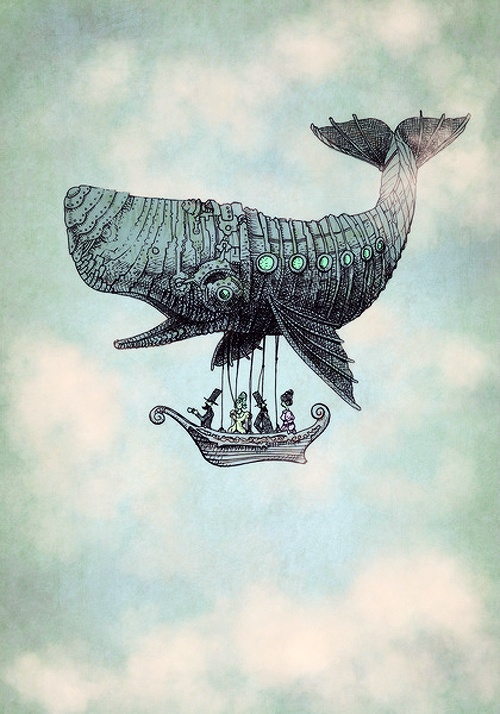
Okay, that’s enough for now. Here’s a picture of a steampunk sperm whale hot air balloon. Writers – get Freedom. It changes everything.
Farewell to the Gold
Eleanor Catton won the 2013 Man Booker with her gigantic novel The Luminaries last week. First of all, congratulations to her. Secondly, a pox on the condescending sexist drivel surrounding her win. I’m looking forward to reading The Luminaries when I get a chance. (My reading is list is currently stacked longer than my arm.)
I know Catton’s novel is partly about gold-panning in New Zealand, and it’s a neat connection to this song by my father-in-law, Paul Metsers. He wrote ‘Farewell to the Gold’ thirty-three years ago, not long before leaving New Zealand for the UK. It’s his best-known song, having been covered by Nic Jones, Bob Dylan and countless dozens of folk singers through the decades. I still think Paul sings it best. I made the video and Paul’s son, Ben Metsers, recorded the sound.
Flash fiction challenge: The Cathedral
Simon Hart (a.k.a. BigCharlie Poet) and I have taken on a challenge. We thought we’d each try writing a piece inspired by the same picture and see what we came up with. We’ve had a week or so to work on something; Simon’s poem is called ‘Empty’, and my story is called ‘If All We Ever See Is Cathedrals’ (which I pinched from a Paddy Garrigan lyric I can’t stop thinking about). Paddy sort of makes an appearance in the story, too. Sorry, Paddy.
This is the picture, which I found on Pinterest:
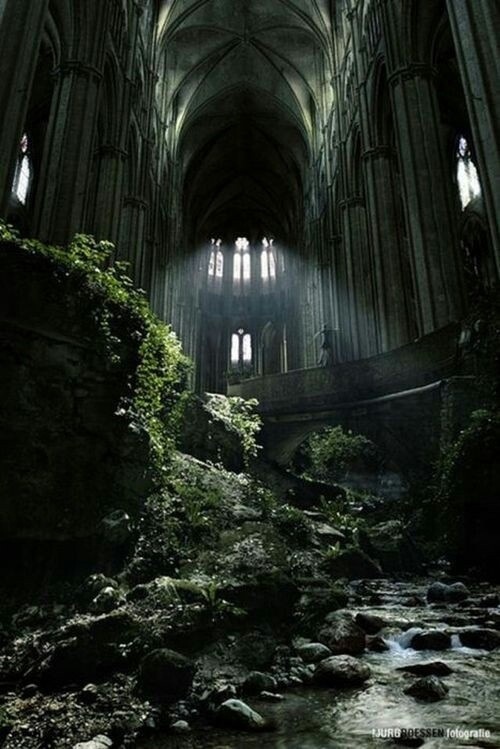
And here’s Simon’s response to it:
Empty
by BigCharlie Poet
He stands alone inside the ruined shell
Watches the water flow in a place that once, he thinks, housed God as well
And he tries to convince himself that he is at peace
That he is free from everything, has achieved a release
From the torments of his daily life
The soul destroying work, the unfeeling distant wife
But there is a feeling he cannot seem to shake
Like someone is encouraging him to return to a state
Of conciousness, where he needs to open his eyes
Where he needs to breathe again, before his body dies
So he dulls the uncomfortable feeling by watching the water flow
Sees the plants as they find a way to grow
Through the abandoned cathedrals fallen floor
“Sam! Wake up…” this time he’s sure
That the prescence is more than just his mind
Is positive that someone is trying to find
A way to break into this place of calm
Where God heard raised to the Heavens many different psalms
“Open your eyes for me Sam!” he hears the voice again
And as he hears it, he notices the light shine through the pane
Of glass flash so brightly that it causes him to stumble
“C’mon Sam! Open those eyes” the voice now a calm but insistent rumble
The next flash of light brings a jolt to his chest
He sees briefly a world he thought he had left
He tries to return to where the calm water is flowing
But with each passing second he knows he is going
Back to a place he can’t seem to escape
He wakes to the question “Sam, what did you take?
What did you take, Sam? I need you to say,
Was it pills that made you this way?
If it was pills, can you give me a nod?”
And as his head moves he thinks, “why not this time, God?”
And here’s my response:
If All We Ever See Is Cathedrals
by Simon Sylvester
It was no more than a hairline, running between two tiles, but as the year progressed, the fracture spread into a delta and ran between the squares of the mosaic. Father Garrigan glared, then called in builders. They lifted the mosaic for restoration, and discovered a network of cracks hidden beneath the rotten grout. Upon closer examination, damage was found all over the cathedral. Uneven lines formed between the huge, half-ton coins that split the annex from the nave. By the end of that autumn, it became plain that the pillars were subsiding.
The Father stood in his cathedral, framed by the huge window arches. Surveyors and scaffolders scurried around him, making ruin of the House of the Lord. The cathedral was closed for a fortnight, and then for six months – and then for a year. Whenever repairs were completed, new faults were discovered. One night, while the foundations were being electronically monitored for vibrations, the floor fell in. Father Garrigan found the cathedral exposed from the sepulchre to the vaulted dome. There was a stream running directly through the building, bubbling up from between the broken flags. The cost of repair became prohibitive. The building was condemned and desanctified. The builders withdrew. The cathedral was abandoned.
With time, slates began to slide from the rafters and shatter on the rocks. Birds and bats roosted on the lip around the dome. A tapestry of moss explored the walls, creeping into alcoves where statues used to stand. The light shone green with algae, and the cathedral dreamed to the music of the stream. Everyone had gone.
Almost everyone had gone.
Louder than ever, now, Father Garrigan hears the voice of God. It echoes from the walls. It sounds like water, and it sounds like the wind. It sounds just a little like laughter.
Wormholes and bridges
Here’s an exhilarating lecture by Neil Gaiman, exploring what it means to read. This essay has all the passion, humanity and humour of his fiction.
When my dad was stationed in Germany, I had to attend a boarding school in Edinburgh for a year. I remember virtually nothing of those few terms – only scattered memories of finding a flat iron in a tree root, and of crawling down a tunnel that older students used for shooting practice. But I do remember the library, and I remember reading. Reading a lot. I can’t recall all the titles, but I know I read King Solomon’s Mines, the Biggles books – which probably explains my unforgivable weakness for adverbs (he thought, wistfully) – and all the Hardy Boys books over and over again. I’m pretty sure I started on Steven King around then, too. I was eight or nine at the time, which might explain a few things.
Anyway – the library is my only memory of that time that’s even halfway to concrete. It was a refuge for me, and I’ve loved libraries ever since. When we lived outside Inverness, the mobile library van was a highlight of my fortnight: visits from Desmond Bagley, Terry Pratchett, Ernest Hemingway. The librarian was a Brummie expat with gigantic muttonchops. It was like swapping books with Noddy Holder. When I was seventeen, I applied for a job driving the mobile library on the Black Isle. I didn’t get it.
I’ve been a member of libraries in Inverness, Bristol, Lancaster, London, Manchester and now Kendal. Libraries have given me a place to read, a place to study, a place to work, a place to think and, when I was at my poorest, a place to be warm. Libraries are portals to parallel universes. They are circuses, space stations and sunken ships. They are deserts and cities and jungles. They are wormholes and bridges. They record the past, and they tell the future, and they record every scrap of human experience.
Libraries are important, and we’re losing them. Government cuts have brutalised already very modest library budgets. As Michael Rosen has pointed out, coalition rhetoric expounds the need for reading, while quietly removing the places to read.
Neil Gaiman’s essay voices all this far more eloquently than me. It’s beautifully written, of course, but a real thrill, too: immediate, passionate and compelling. Please read it – worth every word. And then go and get something from your library.

Spanish flash mob – “The Best Coin Ever Spent”
This had me in floods of tears, soft lump that I am:
Loki
Well, that’s my first Dreamfired done and dusted. It was a really good night – more people need to know about the Storynights.
First up was banjo virtuoso Bill Lloyd. He’s a legend in Cumbria and the north, and he didn’t disappoint, starting with a haunting ‘Wayfaring Stranger’, and segueing into a range of folk songs from America and Ireland. My storyteller uncle Rich Sylvester had the next slot, relating an anecdote about exploring the London Olympic equestrian venue at midnight with a bellyful of Russian beer. It was very funny. Rich is an extremely affable raconteur, and his stories are always engaging – I haven’t seen his work for a few years, and it was great to be part of the audience.
I was on after Rich. I’d decided to get into the traditional spirit by performing without notes. In the minutes before going onstage, my nerves were worse than ever, but I settled fairly quickly. I read two stories I’ve been practising lately – Circle Stone and The Lion Tamer’s Daughter. I stumbled once in Lion Tamer, and for a moment I thought I would go entirely blank – but I recovered, found my place and delivered the rest without a hitch. Circle Stone is an extremely quick flash piece of only 75 words, and it’s surreal enough to counter the darkness of Lion Tamer. The two work well in combination, but I’m going to semi-retire them now. They’re both destined for my flash fiction collection Marrow, and I’ll try and get them published elsewhere first, but I’ve read them a lot recently, and it’s time for some new material. On reflection, though, the reading went well. I don’t think I’ll make a habit of performing without notes, but Dreamfired was a perfect place to give it a whirl.
After me came a poet, whose name I didn’t catch, who read some playfully nostalgic pieces; and then a story about a 21st century Grim Reaper. Bill Lloyd returned to round off the first part of the night with another couple of songs – his cover of Frankie’s Gun, which I absolutely love – it was Bill who introduced me to the music of The Felice Brothers – and one of his own compositions, a haunting Armenian lament.
This is what Frankie’s Gun looks like:
After the interval came Emily Parrish, aka Scandalmongers. She walked onto the stage singing and beating a drum, and launched without preamble into the Norse creation myth. Her show explores the role of Loki, the trickster god, and all his jealousies and cruelty and fun. What made the show all the more remarkable was the way she entwined Norse mythology with her own childhood. The transitions between the Cotswolds and Asgard were frankly astonishing – from the top of a perfect climbing tree to the horrors whispered into Baldr’s troubled brain. It was lyrical, visceral and intense, and it left the audience stunned.

Loki comes highly recommended from me – catch it if you can.
Thanks, too, to Kat Quatermass, who organises and hosts Dreamfired. Lovely to meet her after months of email contact. I’m definitely going back in November to catch Peter Chand performing Grimm’s Sheesha.
What’s next for me, then? I’ve been thinking about my novel edits for a week or so – a process I refer to as ‘brewing’ – and I’m almost ready to start work. I mentioned in a previous post the structural changes I need to make, and my uncertainty about how to make some of those changes. That has passed. I now know where that character is going to enter the story. Although it means a lot of work, I feel secure in the knowledge of how to do it, so a lot of that worry has eased.
My next booked reading is at the Brewery’s Spoken Word night in February, though I’ll try and land a few more open mic spots before then. Stay tuned. And go to Dreamfired.
 Simon Sylvester