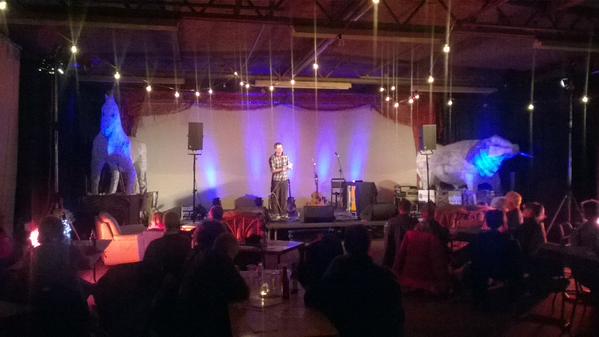
Last night, I had the second of three gigs this week, supporting Joan Shelley at Penrith’s Old Fire Station for Eden Arts and New Writing Cumbria. I rattled through new stories, Marrow stories and selkie stories from The Visitors. I think it went OK. I always misplace my critical faculties while reading. I simply have no sense of how it’s gone across, whether people have liked it, hated it, how long I was reading for – nothing. But I think, I hope, it went well. Here’s the space and me wittering on about something:
The headline act was just fantastic. Joan Shelley’s low-key, heart-rending folk and country songs were absolutely wonderful, at once crystalline and compelling, delicate and beautifully raw. She was joined by multi-instrumentalist Colm O’Herlihy for a few pieces, bringing new depths into the sound. Banjos and guitars, foot taps, a box of harmonic tones. It was mesmerising.
Have a listen here:
*
It was an honour and a privilege to share a stage with Joan and Colm, as well as a reminder to keep striving, to keep aiming high.
We drove to Penrith in dusk. On the way past Shap, we passed right beneath a gigantic murmuration of starlings – perhaps the biggest I’ve seen firsthand – curving and ballooning in twilight, speckles of black against the blue. We drove back beneath a full moon, trees silhouetted against the night, clouds above in grey and silver, an ocean lapping at the shores of the horizon. The mornings are beginning to bloom.
Dora has a lot of favourite books. We try to keep them on her own wee bookshelf in her room, but as the days and weeks roll on after a big tidy-up, they inevitably gather in a strata by her bed. That teetering stack becomes an archaeology of her favourites. There are all sorts in there, but some books are never far from the top. Where The Wild Things Are. The Gruffalo, Zog, Room On The Broom. We’re Going On a Bear Hunt. The absolutely terrifying Tailypo. Mrs Gaddy & The Ghost. I Want My Hat Back.
Dora’s current favourite is called The Sea Tiger. We spotted it in Waterstones while we were in Scotland last month, and we couldn’t resist. It’s a extraordinarily beautiful book:
The Sea Tiger is Oscar’s best friend – his only friend. They do everything together. Where the Sea Tiger leads, Oscar follows. They explore, they have adventures, until a point comes where Oscar needs the strength to go alone. It’s a book about being brave.
To celebrate World Book Week, all the children at nursery were asked to bring in their favourite story. Dora chose The Sea Tiger without hesitation. We packed her off for the day, lunchbox and wellies, slippers and book. I didn’t think another thing of it until I came home that night.
‘Did everyone at nursery like The Sea Tiger?’
Dora thought about it, then remembered. Her face clouded over. ‘No. It’s a silly book.’
I was astonished. ‘What? Did someone not like it?’
‘They thought it was silly,’ she said, face scrunched into a frown.
I was dumbstruck. She was repulsed by her favourite book. Why would other kids have disliked it? Too weird? Too odd? Too magical? Compared to what? All the books she loves are weird and odd and magical. Children are weird and odd and magical. All that anarchy, that chaos, exploring and categorising this insane planet for the first time.
I’m not sure what I’m trying to say. I’ve been absolutely shaken by my daughter’s first true experience of shame. She was ashamed, ashamed of something that she loved. That’s heartbreaking. Three years old, and another step on the long path to adulthood checked off the list.
I read The Sea Tiger again, to myself. It is everything a children’s book should be. Surreal, wild, enchanting, transporting. It’s a book about imagination and courage. It’s a book about finding your own way. I thought of Robin Williams and that little spark of madness we mustn’t lose. I thought about what I write, why I write, seeking out those kernels of magic and madness and paying them whatever meagre tribute I can muster.
Dora wouldn’t even look at the book last night, but this morning I read it to myself until she came to join me. She was as entranced as ever, thrilled and enchanted by Oscar and the tiger and their undersea adventures. That helped, but I feel very much like it was a finger in the dyke, plugging up an overwhelming inundation of the ordinary, the acceptable, the normal. I hope Dora clings to her spark of madness. I hope she never lets it go. For her next years of play, of princesses and pirates, of dinosaurs and monsters and treasure and kittens, it’s up to Mon and I to nourish it, to feed it, to fuel the fires of her imagination. That is our role as parents: curators, not makers. But then will come the homework, the tests, the clothes, the friends and the not-friends anymore, Dad, the cycles of approval and rejection. When she leaves us, she’ll have to feed her own fires.
I know all this is melodramatic. I have always tended towards extremes, especially in my words, but that’s who I am. I hope we can give Dora both the space and the guidance to be whoever she is. And I hope, with every fibre of my soul, that she stays more a tiger than a princess.
I should have written about this sooner, but the month since we returned from Thailand has been a blur of college, film and writing. In short, I’m honoured beyond measure that The Visitors has been February’s Book of the Month for Waterstones Scotland. It’s been incredible – my excellent friends in Scotland have been sending me pictures of the book for sale in Dundee, Edinburgh, Glasgow and beyond, and some of the window displays have been absolutely breathtaking. I’m a very lucky writer.
The good people at Quercus asked if I could pop up to Scotland to sign some books and do a reading – which fortunately fell over half term. Cue a manic two days on the road with my wife – first dropping off Dora with her grandparents, then staying with my aunt and uncle in Edinburgh, stopping off at Waterstones stores in Edinburgh Princes Street and George Street, then Falkirk, on to Glasgow Argyle Street and Sauchiehall Street, and finishing up at the Braehead shopping centre. It was a real whistle-stop thing, calling in long enough to sign a stack of books, chat to the staff, and push on again.
I’m delighted to report that it seems to have been doing well – aided in no small part, I’m sure, by Leo Nickolls‘ stunning cover. Some stores only had a couple of copies left, and it had made the charts in others. It’s also been cropping up in Blackwells, W.H.Smiths, and Waterstones south of the border.
While we were in Glasgow Sauchiehall Street, I read a few chapters from The Visitors. I’ve read from it before at spoken word nights, but this was the first time I’d done anything like a proper talk on the book. I read three chapters. Having been so immersed in The Hollows, it was even a little strange to be back on Bancree and inside Flora’s head, but I enjoyed it. The reading was followed by some excellent questions from the audience, then catching up with old friends. Within 48 hours, we were back on the road to Cumbria.
I’ve been lucky. I know I’ve been lucky. I’m incredibly grateful to Quercus, and to Sue at Conville & Walsh, and to Waterstones, for showing this much faith in my work. I hope I won’t ever take that for granted, because I want to write until the day I drop. I’m still rising early to chip away at The Hollows. I’m finding that it doesn’t really matter how much I write in these dawn sessions, as blackbirds squabble in the garden and the radiators creak into life; whether I write 100 words or 500 words, it’s much more about keeping in touch the story, tagging in every day. Last year, I had to spend months at a time without writing at all, and I fell away from the manuscript. There were times I returned to it and couldn’t remember a word of what I’d written previously. Even if, or when, I get that busy again, I’m going to try to keep going with these little sessions every day – they mean that when I have a full writing day, I can hit the ground running. I’ve written more good material this February alone than all of last year put together. That gives me courage.
Earlier today, my heart broke. I’ve been working on my second novel, The Hollows, for almost exactly a year – I started it on Christmas Eve 2013, though I couldn’t write for half the year. I’m now 30,000 words into my first draft. It’s excruciatingly hard to write this, but I’m about to change it all. The reason is the best-selling author Kate Mosse, who appears to have written my book already. I haven’t read it, but her latest novel, The Taxidermist’s Daughter, explores the same themes of memory – suppressed, regressed and rediscovered – as The Hollows. Her novel revolves around a father-daughter dynamic, like The Hollows. Her novel is set in a huge marsh, like The Hollows. I could handle all of that. I’d guess that was true of lots of novels. But today, I also discovered that the lead character of The Taxidermist’s Daughter has no early memories after a traumatic childhood experience; that a modern crime begins to unlock those hidden memories; and that the unlocking of those memories reopens the wounds of an old injustice. That was basically the plot of The Hollows. I’m heartbroken, because I was finally beginning to gain some traction. It was finally starting to move, but I can’t stomach those similarities. It’s too close. It’s no good.
I’m not going to start again, because I’ve written some good stuff. But I am going to change it radically. That means significant cuts – again – and it means the whole enterprise will take longer than I’d hoped, and that’s devastating. I was almost halfway through, and now I’m back to the beginning. I can’t just get hold of The Taxidermist’s Daughter, read it, and rewrite around it; no story is built from omission, and the thought of it makes me sick. But it does mean revisiting the crossroads I discussed last week, and taking another path. It hurts, and I’ll set out with heavy heart, but I know, with every fibre of my being, that I’m nourishing the kernel of a good story, and I’m not going to let it go.
Whales, mandolins and singing bottles… and once again, I find myself staggered at how my stories hurt me.
My wife showed this to me, not long after we met. It’s one of the ways I knew she was the girl for me. An authentically gruesome spin on the old folk tale of The Hobyahs, here’s the tale of Little Dog Turpie.
I’m absolutely delighted to say that The Visitors has taken first place in the Not The Booker prize 2014. Run by The Guardian, the competition is presented as a slightly tongue-in-cheek parallel with the Man Booker Prize. The actual prize, for example, is a mug:
It’s taken an astoundingly long time to get this far – the first nominations were something like three months ago – and the way it accelerated into the final week was unnerving. The prize is awarded through a combination of public votes and a judging panel. After an agonising week of voting, The Visitors was neck and neck with Tony Black and his novel The Last Tiger (which sounds amazing). With the vote tied, we were awarded a point apiece, which left the three judges to reach a decision during a live video discussion about the shortlist.
I left work early and cycled home to watch the online stream of the discussion. By the time chairman Sam Jordison asked the judges for their final votes, I found myself pacing the room, wanting to know, not wanting to know. The anticipation was driving my heart out through my chest.
So there we have it. It’s still sinking in, even four days later. After the decision was announced, Mon came home and took me out for lunch. That was the right thing to do. There’s no way I would have managed any work that afternoon.
It’s a truly humbling thing to happen, and I feel both proud and grateful that my book has had so much support. Please consider this a massive thank you to anyone and everyone who has bought, read, enjoyed, voted or commented on The Visitors. You’re amazing!
Releasing a book into the wild is a terrifying thing to do. I spent so long wrapped up in Bancree by myself that it still feels raw to share the island with other people. Knowing that folk might like my story conjures a huge, tangled ball of things: relief and disbelief, elation, a lurch of adrenaline.
I’m absolutely thrilled, but I’m also looking ahead. I have more books to write. Not The Booker coming to an end coincides with my backlog of film jobs beginning to ease. In a week or so, I think I can get back to writing regularly. It’s been months since I had concerted time to work, and I can barely remember big chunks of The Hollows. My first few sessions will be stripping things away, I’m sure, and clearing the ground to start again. I can’t wait, and I’m glad to be returning on the right side of Not The Booker.
I’m cautiously delighted to say that The Visitors has been shortlisted for the Guardian’s Not The Booker prize. It’s been a rather bruising process to get this far. The longlist was very long, featuring a hundred novels. Not The Booker is infamously decided by public vote, which leads to all kinds of hijinks from authors, publishers and agents drumming up support. That’s a hundred clusters of psychic tension detonating online simultaneously. No wonder things get heated.
I was in Greece for the first two days of the week-long voting window, by which point there were already clear leaders. With five days to go, I started doing what most of the others had done, and announced my part in the longlist as loud and far as I could. I was fortunate that a lot of people who’d read and liked The Visitors voted for me, and I managed to reach the shortlist. I’m extremely thankful and humbled by the support for my book.
The shortlist holds some intimidating competition – genuine literary titan Donna Tartt, no less, as well as Louis Armand, Mahesh Rao, Tony Black and Iain Maloney. I’m a little concerned that The Visitors seems to be the only work of genre fiction on the list; I’m worried it won’t be deemed worthy enough. And now I’m actually up for review, there’s the prospect of this sort of evisceration at the hands of Sam Jordison, too. Ouch. All in all, I’m expecting dark things from the Guardian readers – which begs the question: why bother entering?
I’ve been thinking a lot about this lately. The first time my agent and I went to meet my editor at Quercus, we discussed the importance of promotion and self-promotion. It’s simply a mandatory part of an author’s life, now – especially a debut author. Publishers are spread thin. They can’t afford to spend time plugging new writers, and that means new writers have to plug themselves.
It’s unfortunate, then, that I’m not great at selling myself or my work. I feel embarrassed at intruding on other people’s time, and I despise arrogance so much in other people that I cringe at anything that could make me seem arrogant. It took months of goading by my wife before I summoned courage to introduce myself to my local library and local Waterstones. On both occasions, I fumbled through a minute of apologies before finding a way to explain who I was, that I had a book out, and that I wanted to say hello. They were perfectly nice, and keen to discuss running some future events, but the process leaves me feeling weird, and even a little cheap.
If I’m ever going to find a way to write full-time – or, being more realistic, to better balance my life and jobs around writing – then this is the sort of thing I need to do. As my Dad says – you’ve created a product, and now you need to sell it.
Books are products, for sure. I think stories are far more than that. Books are the vessels that carry stories, though, so maybe I’m splitting hairs. I know that I want to write stories, but also that I don’t really want to sell my own books, because it makes me feel so uncomfortable; I know that I want as many people as possible to read my work, and that selling my own books, and selling myself, is one of the only ways I can find to keep writing my stories. For most writers, that’s the binary pair of modern publishing.
When I try to reconcile these two distinct strands of my industry, I have to accept that all I want to do – what I wish for every day – is to write full-time and get these stories onto paper, into people’s heads, into people’s hearts. Whether I like it or not, that means playing the game.
I don’t know how it’s going to go, but my money’s on Tartt or Black.
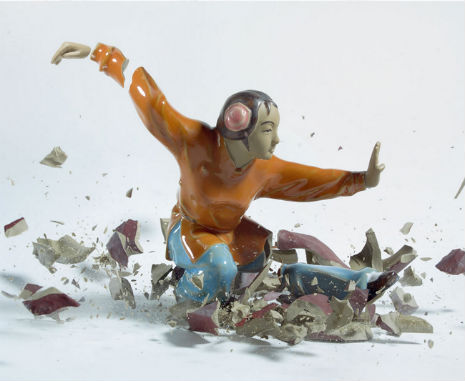
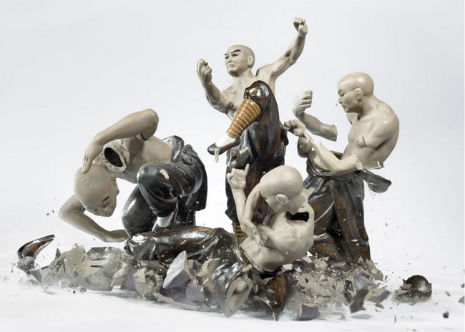
These are extraordinary – German photographer Martin Klimas drops these statuettes, and rigs his camera to trigger at the sound of their impact. In doing so, he creates a threshold: giving these porcelain figurines an explosive moment of life at the exact point of their death. His website has more of these amazing images, as well as other high-speed photographs. Mesmerising work.
The Visitors is a little bit about selkies. Selkies are seals, and they are also people. They have a fur coat that allows them to take the form of a seal. When they step out of the coat, they become human. Selkies can be men or women, but they are always extraordinarily beautiful.
There are a multitude of selkie stories, but the most common starts with a selkie woman removing her coat and dancing on the shore. A young man – usually a fisherman or crofter – spies her dancing, and steals the coat. With her fur held hostage, the selkie has no choice but to marry the man. They live together for a while, but then the selkie finds her skin and escapes back into the sea. The man is left to nurse a broken heart. Often, the couple have children. In some stories, it is a child that finds the coat, and returns it to the mother. Sometimes the selkie takes her children back into the ocean, and sometimes they are left behind. In that version of the story, the mother and children meet in the surf to play.
In the other typical selkie story, an island woman cries seven tears into the sea to attract a selkie mate. Selkie men give children to barren women.
I love the idea of selkies, but I struggle with some aspects of these traditional stories. They crush female independence. In the first, the selkie is kidnapped and loses years of her life to captivity. The man takes what he wants, and is punished only by the accident of her escape. In the second story, the male selkie is a god, and the woman summons him on bended knee. Either human men dominate supernatural women, or supernatural men dominate human women. Both men and women mean more to me than that. When I started writing The Visitors, I wanted something different from selkie stories. I wanted equality. That’s been my guiding light for the novel, from start to finish. John and Izzy share traditional tales, but Ailsa and Flora question the validity of that tradition, and take a closer look at what it means to be a selkie.
Selkies are special. I watched the seals hunting in the bay at Grogport, and saw them bask and splash in Portnahaven harbour. There is life and knowledge in their eyes. When you look at them, they look back. On Kintyre, we walked the coast around Skipness on a grey, steely day, and we were followed by a seal. For half a mile or more, as we skirted the coast, the seal stayed twenty or thirty yards away from us. It seemed to move without locomotion, so that dark snub head simply kept pace with us, looking towards the shore. We sat on old stones to eat our lunch, and the seal bobbed and ducked at one end of the headland. It didn’t move away until we struck back inland, and then it vanished in a wink. I looked back to seek it out, but the seal had gone.
I asked my friends about seals and selkies, and they swamped me with stories. Chris gave his first pocket money to Save The Seals. Tom talked to the seals in a sealife centre, and the seals talked back. Dan’s friend confused swallows for seals in a dream, so he drew her a picture of a swallow with a seal’s head. Kirstin’s father whistled to the seals in Shetland, and they popped to the surface to see what all the fuss was about. Jon was kissed by a sealion. Sakina can’t shake the tale of the seal maiden. Ross works in Copenhagen, and daydreams that commuters with sealskin coats are modern-day selkies. Amy holidayed on Mull when she was seven, and spent the summer playing with a selkie called Della.
Why do we give seals such humanity? They are manifestly foreign to us, but the connection is overwhelming.
When I was 25 or 26, I spent a year working and backpacking in Australia. I remember snorkelling on Ningaloo Reef, diving as far down as I could go. I looked up exactly as the sun dropped behind a cloud. The water turned suddenly cold and pressed against me, and I felt very afraid, scared of the deep and the dark and the cold and the blue. When I think of selkies, they are underwater, floating with perfect neutral buoyancy, and shafts of sunlight sway woozy on the surface above. The darkness drops away behind them, and the selkie exists in two places: as a seal, utterly unafraid, and as a human, drawn against the current, compelled to the surface. Selkies live in thresholds. The selkie woman, when she escapes, returns to embrace her children in the surf. The shoreline, changing always with the tide, is where seals and people meet as selkies. It is a nowhere place, and yet it is all they have.
A hunter doesn’t know his wife is a selkie. While hunting, he sees her as a seal, and harpoons her. She becomes human, and dies in his arms.
The crofter is left heartbroken on the shore, and his selkie wife returns by stealth to see her children.
This selkie is allowed only one night of the year to be human.
Two lovers share a single skin, so that they can never be together in the same form; always one as a seal, and one as a human.
Selkies are born from the souls of drowned sailors.
Selkies are cousins to the muc-sheilche, the kelpie, the nokken, the finfolk. Those creatures are killers and enemies to men. So what makes the seal a victim? A romance? A tragedy?
When we visited Islay, we drove out to Portnhaven. We clambered across the rocks to the weedy edge of the harbour, and we watched the seals. Half a stone’s throw across the water, they gathered to sunbathe by the dozen. They winked as though the Atlantic was a hot tub. They flickered in the water, phantoms bound in straps of kelp. They came so close that I found myself laughing aloud – laughing in wonder, joy and disbelief.
When I started writing The Visitors, I wanted to explore that connection with the seals, that projection of knowledge, and emotion, and empathy. I don’t know if I succeeded, but I’ve fallen more in love with seals and selkies.
My wife found this picture of a seal. It was taken in California, rather than Coll, but it’s the way I see a selkie. Curious and cautious, incredibly close, and impossibly distant.







 Simon Sylvester