RedraftredraftBRAINMELT

For the last eight weeks, this has what my life has looked like:

RedraftredraftredraftredraftredraftredraftredraftredraftredraftredraftredraftredraftredraftredraftredraftredraftredraftredraftredraftredraftredraftredraftredraftredraftredraftredraftredraftredraftredraftredraftredraftredraftredraftredraftredraftredraftredraftredraftredraftredraftredraftredraftredraftredraftredraftredraftredraftredraftredraftredraftredraftredraftredraftredraftredraftredraftredraftredraftredraftredraftredraftredraftredraftredraftredraftredraftredraftredraftredraftredraftredraftredraftredraftredraftredraftredraftredraftredraftredraftredraftredraftBRAINMELT.

In case you hadn’t noticed from my incessant moaning, I’ve been redrafting my novel. Again. It’s been a vast job, because – following discussions with Jane Wood, my amazing editor at Quercus – we decided to change the ending quite substantially. This isn’t as simple as knocking off the last few chapters and rewriting, alas; to make the climax and conclusion fit, organically and emotionally, the threads of the plot need to extend a long way back into the story. Because The Visitors is already woven rather tight, unravelling the narrative to make the new ending fit has been tough. Around college and film jobs, I’ve been working on it in evenings and spare days since mid-October. After the first fortnight, I took to saving the manuscript as a new document at the end of each session. This is what the folder looks like:

redraft of death

That’s right. It’s called the REDRAFT OF DEATH.

But check it out, humans; I have actually finished. I sent the new draft off to editor Jane and agent Sue late last night, along with a summary of everything I’ve changed. On reflection, it’s been a massive rewrite. As well as the new ending, I’ve changed names, moved locations, cut chapters, written new chapters, tightened dialogue, tightened prose, and – perhaps biggest of all – introduced an important character at the start of the story, rather than halfway through. Maintaining his presence from this early beginning meant a light rewrite of the entire first third. I’ve also made a big change in the death of another character, which brought a new angle to the idea of ‘killing your darlings’.

Dealing with the sheer volume of information is what causes brainmelt. Trying to keep everything in perspective – emotion, story, plot, character, description, geography, chronology – is exhausting. To help manage the changes, I riddled the manuscript with notes to myself, so I wouldn’t lose track of the things that needed work. It was quite telling to come across these messages, later on, and reflect on my thought processes. Here’s an example:

“Move the distillery to the island where it should have been from the beginning, you dick.”

So yeah, it’s been tough. I’m expecting another round of line edits, at the least, but hopefully the bigger structural stuff is now finished. I would have worked quicker but for the day jobs. Trying to switch into a more creative mode and recover a spark is tough. There have been times I’ve sought out any distraction to keep me from inflicting more destruction on my work. That’s where Freedom has really helped. I can’t recommend it to writers (and other procrastinators – YOU KNOW WHO YOU ARE) highly enough.

For all the effort, I still wouldn’t be doing anything else. I saw a great quote the other day. Though I can’t remember who said it, it was something like, “For all that writing is incredibly tough, it’s worth remembering that it’s still making up stuff for fun.”

True dat. More than anything else, I’m increasingly looking forward towards my next novel. It’s called The Hollows. It’s mostly planned, and I’m champing at the bit to start work. Now term is almost finished, I’m going to give myself a few days off to clear my backlog of video jobs, then try and take a day or two over Christmas to get writing.

After dealing so exhaustively with a manuscript of 94,500 words, it’s very strange to be faced again with all the promise and terror of a blank, white page.
A century of…

I realised, after posting this video about a ballerina dancing on butcher knives, that I’d hit a hundred posts on the blog. A century is still pretty arbitrary, really, but it’s as good a place as any to stop and think about why I keep a blog.

I started writing the blog six months ago to track the progress of my novel. The book was called Riptide Heart, back then. It’s now called The Visitors, and it will be published by Quercus Books in 2014. All that has happened in the lifetime of this blog. I’ve tracked my highs and lows and uncertainties throughout the publication process, from finding an agent (a year ago) to signing the contract (last week).

As well as the novel, I’ve written a lot about reading my work live, and the struggles I’ve had with my nerves. Each of my various readings has been painfully revisited, but that return has helped me filter and understand the experience. I’ve also explored my decision to gather my flash fiction into a collection, which is called Marrow, and will almost certainly be self-published, and teaching myself InDesign to lay it out professionally. (More on this soon! As I approach the end of my redraft and clear my backlog of film jobs, I should have the time and space to push ahead and get this wrapped up and printed.) I’ve posted published and unpublished flash fictions, and talked about my writing processes. I’ve written about my film work, and catalogued some of the things that I find inspiring or magical. I’ve posted galleries of the threshold spaces I’m so obsessed with.

All in all, then, my blog has ranged far wider than I ever thought it would. More than anything else, I’ve been surprised at how personally I’ve addressed some of these subjects. When I started, I expected the blog to be fairly analytical, for want of a better word; dry, professional. But in struggling with my live performance readings, and in wrangling my novel redraft, I’ve found myself at times alarmingly open about how I feel about my work. I like that the process of writing has taken me in that direction quite organically.

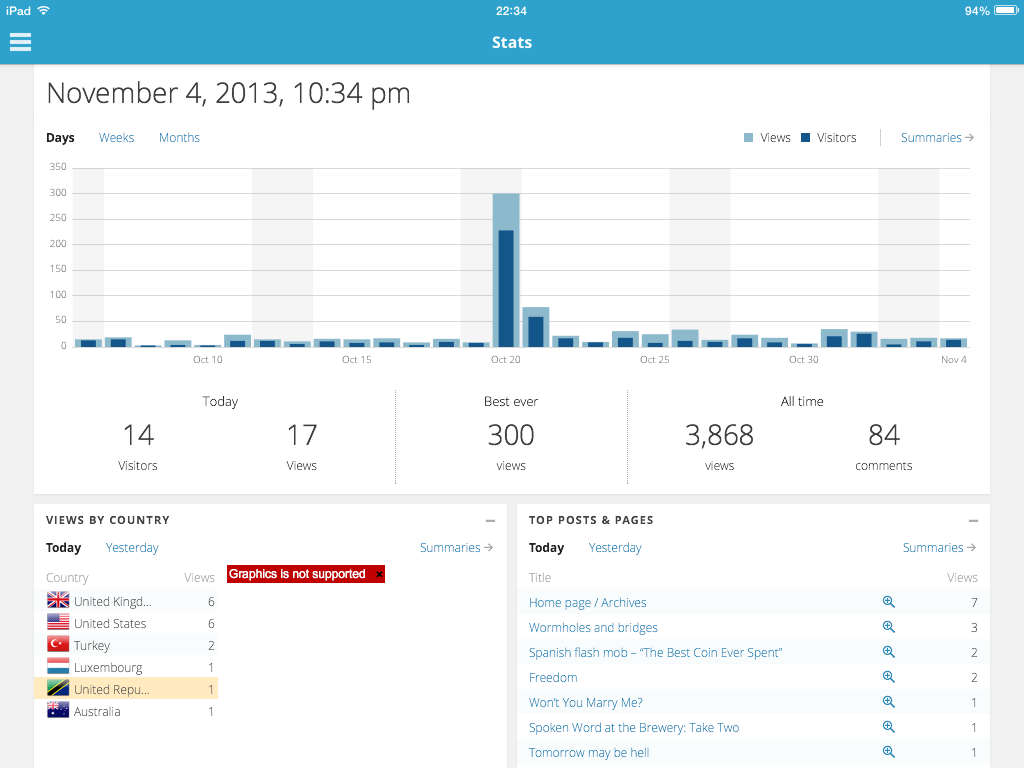
One of the joys of using WordPress is browsing through the stats, which tell me what brings people to the blog, what they look at, and often where they come from. I’ve had visitors from as far afield as Mozambique and Mongolia, searching for everything from devil dogs to gay porn. (Hopefully not everyone will be as disappointed as those two internauts.) I’ve had a week without any views, then hundreds of visitors the day Neil Gaiman retweeted this post about libraries. Have a look at this screen grab and see if you can guess which day that was:

photo

The two things that bring people to the blog most often are on the periphery of my interests; this post about a nursery rhyme and this post about a WW2 fighter pilot preserved in a peatbog. People have searched for Bancree, which is the fictional Scottish island I created for The Visitors, and for novelist friends like Iain Maloney and Ali Shaw. Lots of people come to the blog looking for information about my agent, Sue Armstrong at Conville & Walsh, and my publisher, Jane Wood at Quercus.

More than anything else, though, the blog is for me. It’s how I filter my ideas and monitor what I’m doing. Writing about my life is what I need to live my life.

Flash fiction challenge: Libraries

BigCharlie Poet (the nom de guerre of Simon Hart) and I have been trying out a picture-based flash fiction vs. poetry writing challenge. In case you missed it, here’s round one: Cathedrals.

It was Simon’s turn to choose a picture, this time, and this is what he chose:

libraries

I found this one very difficult. With Cathedrals, I had the story in an instant, and writing was a cruise, but this has taken some working around. I guess that’s the way with writing. I can’t turn it on like a tap. Sometimes the stories shimmer into view as though they’d been there all along, and sometimes they come word by word, kicking and fighting, refusing to stay on the page. This one’s been a toughie, and I’ve tried it three times. My first attempt was an illiterate dystopia where an old man found a book he couldn’t read. It spiralled very quickly, and I abandoned it at 600 words. My second attempt was about a haunted library, and that was a little better – I think I can rescue it for a short story – but it wasn’t good enough for this, and I hadn’t the heart to stick at it.

I have written a previous piece that fits this picture exactly, which doesn’t help. The abandoned library is a perfect representation of one of my Twitter shorts. Struggling to get that story out of my head, I posted it again in the hope of exorcising the blasted thing. It looks like this:

Screen Shot 2013-11-03 at 11.49.06

Having sent that back out into the big wide world, I did feel a little freer, but it wasn’t until I discussed the picture with Mon that I came up with my final idea. She imagined the books dropping away into nothingness, and that was the spark I needed. Time and time again, Mon reminds me of the stories I like to tell the most. She keeps me on track when I’m getting lost. With that image in my head, I sat down and wrote the final piece fairly quickly. It’s the middle of something much bigger, I think. I can see this growing into a novella or even a novel, given time. I’m not done with the characters.

Simon Hart found this one tricky, too, which is a relief. It’s taken both of us longer than the fortnight we’d agreed, but then, hell; we’re busy people. This is what Simon has to say about it:

“Well, it’s finally been written and this has been difficult! I saw the picture and thought it was interesting, suggested it and went ahead with it as the challenge piece… ignoring the fact I have written creatively about libraries before. What it has meant is that those pieces of work have been clamouring at my brain to be let out again. I have refused them, and eventually created this new poem, but not without help. The title and line relating to it come from my Dad pitching me a line far greater than anything my feable mind was coming up with, and I finished only because I cheated and read Simon’s excellent entry on the same photo. Cheers gents.”

Here’s Simon’s response to that troublesome picture:

Engines of Thought

by BigCharlie Poet

There were books strewn everywhere
Left without much apparent care
Though some were in bundles, others in stacks
Most were just left to cover the cracks
In the old dead library’s floor

The words on the pages, scattered like dust
Engines of thought now turned to rust
Childhood stories being lost by the hour
The Tempest losing so much of its power
From the old dead library’s floor

The shelves have been looted for perceived greater worth
And the paper that’s left returns to the earth
The knowledge inside no longer at hand
The words pour away like loose grains of sand
Through the old dead library’s floor

They once taught us magic, and fanciful tales
Told us stories of mad Captains hunting white whales
Taught that being obsessed was a kind of disease
That carried you away on angry dark seas
Not the old dead library’s floor

But now they do nothing, we won’t let them teach us
And where they sit they will struggle to reach us
Abandoned and now out of our sight
They are doomed to their own perpetual night
On the old dead library’s floor

And here’s my response:

Books Like Grains Of Sand

The creature stepped out of the darkness and into the candlelight. It was smaller and far slighter than Morag, and carried itself daintily, as though it was frightened of breaking a limb. Its tiny eyes were black pinheads in the cloth. It had a ragged hole for a mouth. It smelled like coal sheds.

It led her to a door.

“In here, my pet,” it lisped. When it talked, stuffing spilled from the corners of its mouth.

In jerky, spastic movements, it opened the door to the library, and daylight spilled into the gloom. Squinting in the light, Morag peered beyond the creature and saw a vast room. The floor was entirely carpeted in books. Books, books and more books, gathered in loose stacks, strewn by the dozen, piled up in the corners.

“All of them?” she whispered.

The creature’s smile wrapped around its head. Morag heard stitches popping as it grinned.

“All of them,” it said.

It turned the hourglass again, and the sand began to flow.

Morag slung her knapsack, took a deep breath and brushed past the creature into the library. She stumbled to the top of a nearby stack and surveyed the room. The door creaked shut behind her, and the creature’s smile receded to a single line as it melted into darkness.

She was alone in the library. Before her, books lay scattered in their thousands.

“But where to start?” she murmured.

She took a single step, and then she heard the slithering. It was so faint at first, ghostly whispers, but gathered to a rush. Morag scanned the room. The books in the middle were moving. They revolved, and more volumes fell inwards as they shifted, gathering momentum. They spiralled, forming a circle and starting to drop into the floor. It was spreading outwards, increasing speed. It was a whirlpool. With a jolt, the stack beneath her shifted, throwing her to the ground. Morag fell headlong into the torrent.

The daylight closed overhead, grey and fluttering with loose pages. Books battered and struck her as they ground and jumbled in the gyre. The movement was inexorable, dragging her down, dragging her into the centre. Her feet lost contact with the floor and then it all dropped away and Morag was falling, flying, plunging into nothing as the books tumbled all around her. She panicked, flailing and groping for contact, anything to arrest her fall. There was nothing to hold on to. The space beneath her and around her was empty entirely, a sea of nothingness stretching on forever. Books fell around her like rain, covers flapping and pages rippling. As they fell, Morag realised they looked exactly like the sand in the timer.

In a heartbeat, she remembered what Badger told her: about time. About the creature. About this place.

She took a deep breath, shut her eyes, and reached out. Her hand closed around a book. Still falling, she opened her eyes, and turned to the first page. Morag began to read.

Seven Seals – Plan of Salvation

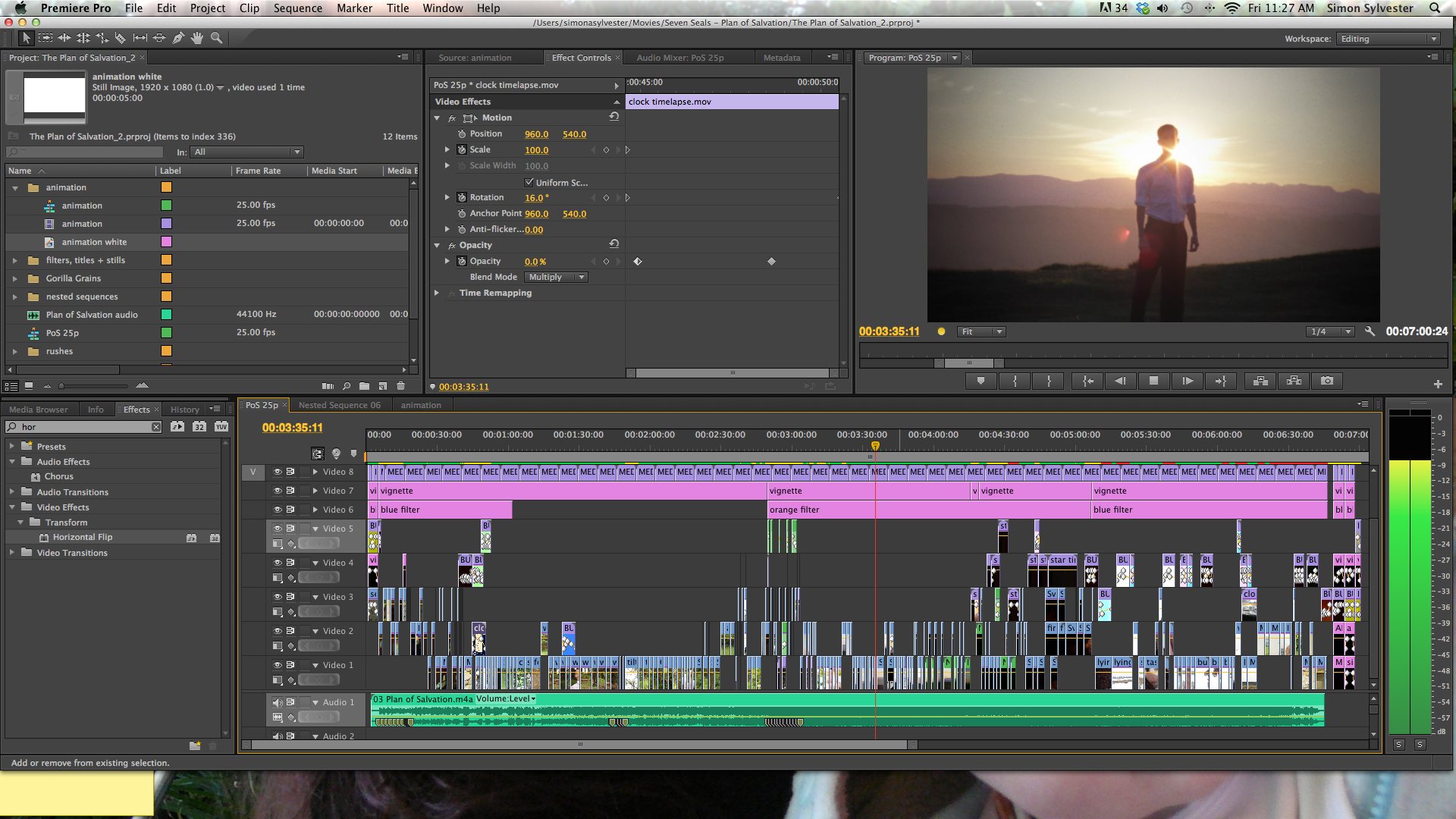
As well as teaching film, I make the occasional video, too. This is a music promo for local legends (and one of my favourite bands) Seven Seals. I’m slightly ashamed to say it’s taken me 18 months to finish, but then again, I have a child to take care of. And a redraft. The picture below is a screenshot of my final edit. You don’t know need to know how it works to recognise that it’s been tricky. But for all the work, I’ve enjoyed it. The song is taken from an amazing E.P. called As Above So Below, which you can (and should) buy on iTunes or Amazon. The first Seven Seals album, Owl Cage, is free to download here.

PoS

Filmmaking has had a massive impact on my writing. Where I used to strive for an internalised immersion, revealing narrative through stream-of-consciousness, my experiences in making and teaching film have helped me understand the simplicity – and power – of visual storytelling. Thinking of a novel like a movie helps a lot; in structure, in geography, in character, in description, in delivery.

Speaking of which – back to the writing. This novel won’t redraft itself. Unfortunately.

Freedom

This is another post about editing. Until today, it hasn’t been going very well. A variety of things have built into a general malaise, and I’ve been struggling to get myself out of it. Yesterday, I read this from Matt Haig: “As a writer, you need to have a thick skin. But you also need to be a hypersensitive wreck to write in the first place.”

Well, for the last few days, I’ve been in hypersensitive wreck mode. I swing in and out of these phases. When a novel is going well, I’m buoyed up and float through life, with at least half my mind firmly in my story, and nothing else really gets in the way. But when it’s going badly, I obsess over and over again on all my many failings and how terrible the novel is, convinced that the universe is going to wake up at any moment and realise that I shouldn’t have made it even this far.

This is my half-term from college. Although I’d done a few line edits on The Visitors, I hadn’t had a chance to really get to work until this week, and it began really badly. I started by making the huge, ugly structural changes I was worried about, cutting and pasting and wreaking a sweeping destruction on the first third of my manuscript. And that left me really despondent. I won’t run through all my paranoias here, but I was really wallowing. There seemed an insurmountable amount of work to do, and part of the plot was now back to front. I convinced myself that I’d shattered whatever was good about it in the first place. I spent some time moaning on Twitter, and went to bed feeling very sorry for myself. At the end of the day, I listened to this about twenty times, trying to summon some strength:


…but to little avail. I started today prepared for more of the same. Scared of going back to the manuscript, I farted around on Twitter, and on Facebook, and read the paper, and spent half an hour trying to read all of the internet. I’d made myself quite genuinely scared of the novel, and was looking for distractions to keep myself away from it. Then I remembered reading about something called Freedom. It’s a program which blocks the internet completely, and can’t be disabled without turning your computer off and on again. It cost $10, and I bought it. I installed it, and I set it to run for eight hours. Then I opened the novel, returned to the redraft, and tried to spend the day at work. Here’s how it went:

There are obvious breaks – between chapters, mostly – when I used to check my email. I couldn’t do that. Instead, I had to keep writing. I used to post updates about my progress, or lack thereof – I couldn’t do that. I couldn’t build a Spotify playlist. I couldn’t read my students’ blogs. I couldn’t add to my Pinterest boards. I couldn’t check my bank balance, or look at lenses I can’t afford on eBay. I couldn’t blog about how shitty I was feeling. I could only work, and so I did. I only stopped for cups of tea and to feed the cats. I checked my email at lunchtime on the iPad, but otherwise went without. And it was brilliant. Immersed in the novel, without distractions, I worked hard, fast, and well. I was coming up with good stuff for the first time in a week, building bridges between ripped sections, smoothing out the prose, and even discovering new connections to expand and consolidate the plot. More importantly, I was feeling good about again. That feeling is so important. Without confidence in your story, it’s impossible to write with conviction.

Strange to reflect that I needed technology to rid me of technology. Freedom truly gave me freedom to work. I know it’s daft to spend money on something willpower should do for free, but Freedom even removed the choice. Even after a single session, I believe it’s the best money I’ve ever spent on my writing. To be clear, I don’t have a motivation problem. When I’m in the flow of my story, I can write continually for hours without stopping. But when I’m as full of dread as I was yesterday, I seek any reason to avoid dealing with the thing that causes me dread.

This redraft is hard. I’m making big changes, and some of them have left me feeling a little divorced from the story. One of my characters has changed her name, and it’s taken me a full fortnight to feel like I know her again. As petty as it sounds, I worked with MS Word’s ‘Track Changes’ function for the first few sessions, and it was driving me distracted, churning out balloons and dotted lines for every tiny change. Thankfully, Jane at Quercus gave her blessing for me to move onto a plain document. I know it’s daft, but that’s helped a lot.

I suppose that demolishing parts of the story was always going to be demoralising, and perhaps it’s no surprise I’ve found it so hard to stay positive about the redraft. But now most of the destruction is done, and I’m starting to rebuild, I’m feeling better all the time. When things go well, it gives me a surge of confidence in what I do, and where I want the story to go. I’m not all the way there yet, and there’s still an awful lot to do, but – for now – I’ve turned a corner.

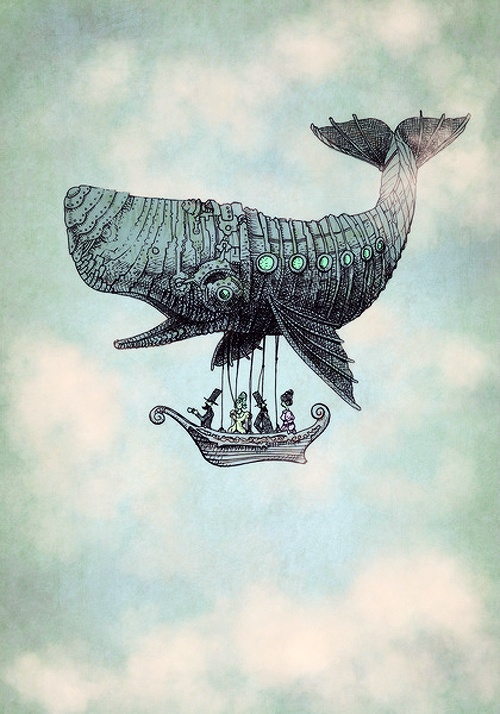
Okay, that’s enough for now. Here’s a picture of a steampunk sperm whale hot air balloon. Writers – get Freedom. It changes everything.

whale balloon

Loki

Well, that’s my first Dreamfired done and dusted. It was a really good night – more people need to know about the Storynights.

First up was banjo virtuoso Bill Lloyd. He’s a legend in Cumbria and the north, and he didn’t disappoint, starting with a haunting ‘Wayfaring Stranger’, and segueing into a range of folk songs from America and Ireland. My storyteller uncle Rich Sylvester had the next slot, relating an anecdote about exploring the London Olympic equestrian venue at midnight with a bellyful of Russian beer. It was very funny. Rich is an extremely affable raconteur, and his stories are always engaging – I haven’t seen his work for a few years, and it was great to be part of the audience.

I was on after Rich. I’d decided to get into the traditional spirit by performing without notes. In the minutes before going onstage, my nerves were worse than ever, but I settled fairly quickly.  I read two stories I’ve been practising lately – Circle Stone and The Lion Tamer’s Daughter.  I stumbled once in Lion Tamer, and for a moment I thought I would go entirely blank – but I recovered, found my place and delivered the rest without a hitch. Circle Stone is an extremely quick flash piece of only 75 words, and it’s surreal enough to counter the darkness of Lion Tamer. The two work well in combination, but I’m going to semi-retire them now. They’re both destined for my flash fiction collection Marrow, and I’ll try and get them published elsewhere first, but I’ve read them a lot recently, and it’s time for some new material. On reflection, though, the reading went well. I don’t think I’ll make a habit of performing without notes, but Dreamfired was a perfect place to give it a whirl.

After me came a poet, whose name I didn’t catch, who read some playfully nostalgic pieces; and then a story about a 21st century Grim Reaper. Bill Lloyd returned to round off the first part of the night with another couple of songs – his cover of Frankie’s Gun, which I absolutely love – it was Bill who introduced me to the music of The Felice Brothers – and one of his own compositions, a haunting Armenian lament.

This is what Frankie’s Gun looks like:

After the interval came Emily Parrish, aka Scandalmongers. She walked onto the stage singing and beating a drum, and launched without preamble into the Norse creation myth. Her show explores the role of Loki, the trickster god, and all his jealousies and cruelty and fun. What made the show all the more remarkable was the way she entwined Norse mythology with her own childhood. The transitions between the Cotswolds and Asgard were frankly astonishing – from the top of a perfect climbing tree to the horrors whispered into Baldr’s troubled brain. It was lyrical, visceral and intense, and it left the audience stunned.

emily-loki

Loki comes highly recommended from me – catch it if you can.

Thanks, too, to Kat Quatermass, who organises and hosts Dreamfired. Lovely to meet her after months of email contact. I’m definitely going back in November to catch Peter Chand performing Grimm’s Sheesha.

What’s next for me, then? I’ve been thinking about my novel edits for a week or so – a process I refer to as ‘brewing’ – and I’m almost ready to start work. I mentioned in a previous post the structural changes I need to make, and my uncertainty about how to make some of those changes. That has passed. I now know where that character is going to enter the story. Although it means a lot of work, I feel secure in the knowledge of how to do it, so a lot of that worry has eased.

My next booked reading is at the Brewery’s Spoken Word night in February, though I’ll try and land a few more open mic spots before then. Stay tuned. And go to Dreamfired.

Dreamfired

Loki-norse-mythology-loki-30846883-570-732

On Friday 11th October, Dreamfired takes over Brigsteer village hall for a night of traditional music and storytelling. I’ve managed to land one of the support slots for headliner Emily Parrish, aka Scandalmongers. She’s retelling the classic Norse myth of Loki, the trickster and troublemaker at Odin’s court. Her show has received amazing reviews, and I’m really excited about seeing her perform live.

I’ll be reading two short pieces I’ve been practising live – Circle Stone and The Lion Tamer’s Daughter. I wanted to get into the spirit of the night by performing from memory: no notes, no paper. Reading them at Spotlight and Spoken Word has been good for practising their delivery. I already know Circle Stone by heart, and I’m four-fifths of the way there with Lion Tamer. The prospect of reading live is not yet as scary as it will be on Friday afternoon.

By dumb chance, my storytelling uncle Rich Sylvester is up in the Lakes for a workshop that weekend, so he’s coming along too – and I’ve just discovered that legendary Cumbrian singer, songwriter and banjo maestro Bill Lloyd is playing as well. It’s a blinding line-up, and I feel a little overawed to be reading at such a great event. I’m looking forward to sharing my stories, then sitting back with a beer to enjoy a great night of tall tales and folk music…


Spoken Word at the Brewery: Take Two

For one reason or another, something has arisen on the last Saturday of the month – every month – for well over a year. And that’s a real shame, because Spoken Word is on at the Brewery Arts Centre in Kendal on those last Saturdays, and I’ve therefore missed well over a dozen of my local literature night. Yesterday, however – at last – I was able to make it across town to the Brew, and I read at the open mic.

This won’t mean anything to anyone but me, but Spoken Word was also the place of my first ever live reading, more than three years ago. That’s why this post is called Take Two. It was curiously satisfying to take to the stage again and remember how I was shredded with nerves back then. And another first for me, this time round – I’ve never read without Monica in the audience. I missed her. It’s much easier to perform knowing at least one person out there is absolutely rooting for you.

I was first to sign up to the open mic, so I was first onstage after excellent compere Ann the Poet had introduced the night and read a couple of her poems. I always enjoy Ann’s work – it’s witty, it’s wise, it has energy, and her poems tell stories about people. For me, that’s what all this is about. She’s also a very funny host. She looks like this:

annuke

It was weird being the first reader onstage. There hadn’t been a chance to gauge the audience, and so I didn’t know entirely how to pitch my work. With a five-minute slot to play with, I read The Lion Tamer’s Daughter and Circle Stone. I didn’t exactly pick up where I left my last reading in terms of confidence, but I tried to invest a little more faith in my stories. They seemed to go down quite well, and Circle Stone found a bigger laugh than at Spotlight.

The other open mic readers were brilliant – I especially enjoyed poet Kate Davies. She had polio as a child, and her second piece was a stunning juxtaposition of that experience with a car maintenance manual; the more of an automaton she made the child, the more human she became. It was mesmerising.

After the break, Luke Brown read two of his short stories. He’s a young writer of great reputation round Cumbria, so I was really excited to see him live – and he didn’t disappoint. His work was engrossing, and both his stories had killer, killer pay-offs. I really hope I can see him again. I haven’t found a website for him yet, but if I do, I’ll update the blog.

Second headliner Louise Mary Martin topped out the bill. I’ve come across her work before – she’s the singer in South Lakes reggae group Righteous Bees, and my brother-in-law Ben Metsers has used her vocals in some of his work. Last night she played four songs – two bluesy Americana/alt.country covers, played with guitar, and two extraordinary songs in which she used live loops of her vocals in dense layers, beautifully timed to create a stunning collage of sound. I’ve seen it before from Adam Stafford:

…but it was quite something else to watch live. The focus and the timing required is amazing. Just astonishing stuff.

It was a great night, with one slight downer. During the interlude, while I was chatting with Kate Davies, a man I didn’t know joined us. He was perfectly friendly, but our conversation left me feeling strange. He told me that the trouble with my story was the moment he knew it was about lion tamers (i.e., from the title), he thought of a news article from the 1960s about a lion tamer who was attacked by his own lion – and he thought of that instead of my piece. Which I guess is fine, but I don’t know how any writer can future-proof their work against audience association. Indeed, writers need audiences to bring their own associations with them; it’s a reader’s empathy that brings a story to life. Anything less would be exposition. The man also thought I was self-conscious during my reading. Maybe I was, a little, but I was a goddamn powerhouse compared to a year ago. That was a bit of a funny one to leave me with.

I wanted to talk to Luke Brown afterwards and congratulate him on such a great show, but he was swamped with other people wishing him well, and I had to go. I walked home through Kendal listening to a playlist I’m making for Monica. As I headed out of town, taking the back road to Burneside, the last streetlight made a giant of my shadow, casting it far up the road into the night. The further I went, the dimmer the streetlamp, until my shadow and I were absorbed entirely by the darkness. It was a clear night, but there was no moon. My eyes adjusted to the gloom and I walked a mile or so lit only by stars, pinpricks of light lifting the path half a shade above the vegetation.

I thought a lot about my reading, and about what the man said. By the time I reached my house, my mind was clear. Different opinions are how we know ourselves as individuals, and I’m sure I’ll hear much worse when The Visitors hits the shelves. I can’t do anything about an audience’s associations, and nor would I want to. And if I seemed self-conscious, then that’s partly because I am, and it’s something I need to keep working on. I do want to improve my performance even further, to be bolder, to be more technically confident in how I speak into a microphone, to relax into my stories, to try different voices. And I’ve another date in the diary to aim towards, now: Ann has asked me back to read as one of the guest slots for February’s Spoken Word. I feel deeply honoured to have that as something to work towards. I’ll go back to the open mic whenever I can, too, and I’ll keep trying new stories. Because I have to.