Slamming

After a wild and wonderful night in Manchester, I’m bowled over to report that I somehow managed to win the Flashtag Short Short Story Slam. It’s still sinking in, but I’m delighted.

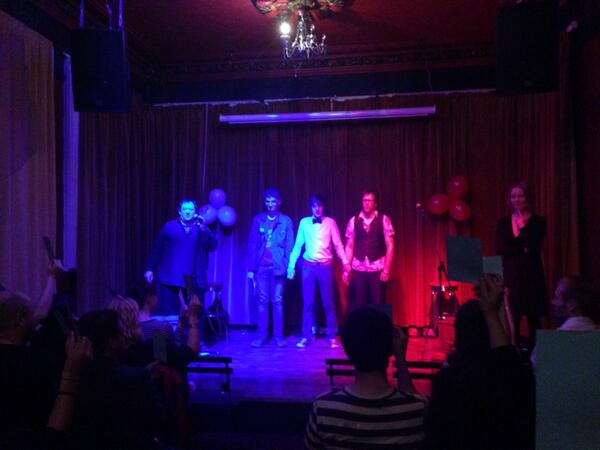
It was something of a journey – we left Dora with her grandparents, and drove down from Cumbria in the afternoon. Mon and I met friends Steve and Clare in the Northern Quarter, ate in the revelation that is V Revolution, then headed across the road to Gullivers to scope the venue: a brilliant space of worn floorboards and ornate plaster ceilings. The stage was bathed in blue and red light, creating corners from which the writers would prowl to read their stories. For the first round, competitors were paired off at random, with names plucked from a bowl and a coin toss to decide who read first. Once each writer had performed their story, the audience voted blue or red to decide a victor, and that writer continued to the next round.

Bl2YKBRIEAA4qch

It started ferociously, with the amazing Joy France reading an intimidatingly strong story about cleanliness (and willies). Her opponent was good, but that story would have annihilated all comers. I was very, very glad I hadn’t been drawn against her. She was duly voted through, and set the bar for the rest of the night. The stories were consistently excellent. Hand on heart, there wasn’t a bum note. Mark Mace Smith and Mark Powell, Joe Daly, Abi Hynes, Sarah Stuart, Geraint Thomas, Trisha Starbrook, Thomas Jennings and Ailish Breen all read absolute belters.

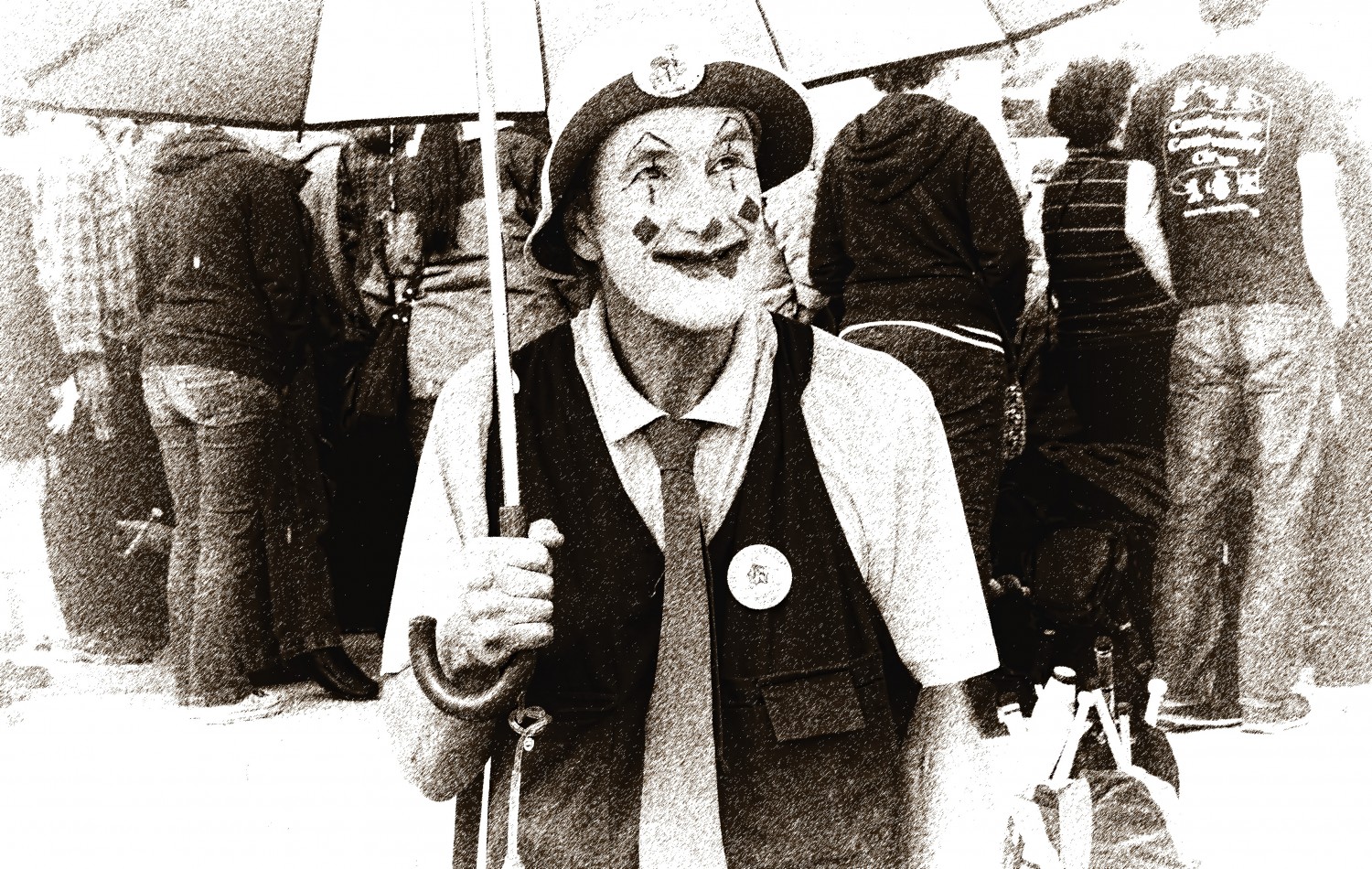
My name was drawn in the fourth bout. I read a piece called What I’ll Do To Be In Love With You, about a boy who turns into a harmonica. I was anxious, as always, but I’d been practicing, and I made myself take the time to enjoy it. My opponent was Thomas Jennings, who read a brilliant piece about the end of the world as experienced through last orders in a MacDonalds. It was a funny and affecting story, and I would have been happy to lose to it; but I scraped through into round two, where I was paired off with Mark Mace Smith. Mark is a vivacious slam poet who often performs under the name Citizen Mace – check out his stuff here – and he made for another tough competitor. I was up first, with a story called Charlie Loved The Circus. This is a 200-word nasty about why you shouldn’t be mean to clowns. Mark’s piece was a sweet wee story about a man falling – literally – for a girl. Another close vote, but I made it to the third round.

In the final, I read against Mark Powell and Joe Daly. Both are stalwarts of the Manchester literary scene – Mark runs Tales Of Whatever, and Joe is one half of Bad Language – and their stories were excellent. I was last to read, and went with a story called The Jubilee Best Bake Competition. I always planned to read this with an accent, but bottled it at Verbalise. So I bought a frumpy hat onstage. It’s made of green wicker, has a broad brim and is covered with flowers. Once I’d donned the hat, I couldn’t back down from the accent; and so I launched into my idea of what happens when the village baking competition takes a turn for the worse. The audience (joined, at this late point, by three exceedingly stocious men who thought they’d come to a boxing match) kindly gave me some laughs, and that helped me relax into the story. The hat helped, too.

The vote was tight again, but I sneaked it. I’m still thrilled, delighted and surprised – as well as humbled and happy to have shared my stories with such an amazing crowd. We stayed for a couple of hours after the slam, happily chatting away with the Flashtaggers, audience and contestants. It made me wish, once again, that I’d made more of the astoundingly vibrant Manchester literary scene when I actually lived there; then again, I’d barely started writing when we lived in Withington.

It was after 11 when we left Manchester, and we drove a deserted motorway in the dark. The journey gave me time to think. I’m over the moon to have won, but there are two things that burn brighter. Firstly, I won’t forget the sense of community I experienced at the slam; it’s a real thrill to share my love of stories with friends and strangers, and events like the slam are a howl of affirmation that stories are alive and people are hungry to share them.

Secondly, and quite honestly, I would have been proud to have been knocked out at any point, from round one onwards. This is because, for the first time, I read my stories the way I want them read. I used to gabble or murmur my way through a reading. A year or so ago, I set out to be better. I haven’t shaken the nerves, but I’m learning to manage them, and I’m coming to trust my stories. I’m not a confident person, but running a gauntlet of open mics has given me some confidence in my work.

Back at home in Cumbria, I tiptoed in to see my daughter. She snuffled in her sleep, and buried herself in the blanket. All journeys, no matter how big, are measured in stages and steps. For all the things I would change about myself – to write more often, to be more focused, to perform better – I wouldn’t change a step of the path I’ve taken to where I stand now.

Here’s a picture of me with a cheesy grin and my cheque for £1,000,000,000,000,000,000,000,000,000,000,000,000,000,000,000,000,000,000. I’ll be cashing this tomorrow, Flashtag – if there’s any trouble at the Post Office, I’ll be back with my bat.

Bl2qVwgIQAAIIiN.jpg-large


A sealskin coat

13743730642752
Painting by Jessica Shirley http://jessicashirley.blogspot.co.uk/2011/03/selkie-girl.html

The Visitors is a little bit about selkies. Selkies are seals, and they are also people. They have a fur coat that allows them to take the form of a seal. When they step out of the coat, they become human. Selkies can be men or women, but they are always extraordinarily beautiful.

There are a multitude of selkie stories, but the most common starts with a selkie woman removing her coat and dancing on the shore. A young man – usually a fisherman or crofter – spies her dancing, and steals the coat. With her fur held hostage, the selkie has no choice but to marry the man. They live together for a while, but then the selkie finds her skin and escapes back into the sea. The man is left to nurse a broken heart. Often, the couple have children. In some stories, it is a child that finds the coat, and returns it to the mother. Sometimes the selkie takes her children back into the ocean, and sometimes they are left behind. In that version of the story, the mother and children meet in the surf to play.

In the other typical selkie story, an island woman cries seven tears into the sea to attract a selkie mate. Selkie men give children to barren women.

db44_SelkieI love the idea of selkies, but I struggle with some aspects of these traditional stories. They crush female independence. In the first, the selkie is kidnapped and loses years of her life to captivity. The man takes what he wants, and is punished only by the accident of her escape. In the second story, the male selkie is a god, and the woman summons him on bended knee. Either human men dominate supernatural women, or supernatural men dominate human women. Both men and women mean more to me than that. When I started writing The Visitors, I wanted something different from selkie stories. I wanted equality. That’s been my guiding light for the novel, from start to finish. John and Izzy share traditional tales, but Ailsa and Flora question the validity of that tradition, and take a closer look at what it means to be a selkie.

Selkies are special. I watched the seals hunting in the bay at Grogport, and saw them bask and splash in Portnahaven harbour. There is life and knowledge in their eyes. When you look at them, they look back. On Kintyre, we walked the coast around Skipness on a grey, steely day, and we were followed by a seal. For half a mile or more, as we skirted the coast, the seal stayed twenty or thirty yards away from us. It seemed to move without locomotion, so that dark snub head simply kept pace with us, looking towards the shore. We sat on old stones to eat our lunch, and the seal bobbed and ducked at one end of the headland. It didn’t move away until we struck back inland, and then it vanished in a wink. I looked back to seek it out, but the seal had gone.

I asked my friends about seals and selkies, and they swamped me with stories. Chris gave his first pocket money to Save The Seals. Tom talked to the seals in a sealife centre, and the seals talked back. Dan’s friend confused swallows for seals in a dream, so he drew her a picture of a swallow with a seal’s head. Kirstin’s father whistled to the seals in Shetland, and they popped to the surface to see what all the fuss was about. Jon was kissed by a sealion. Sakina can’t shake the tale of the seal maiden. Ross works in Copenhagen, and daydreams that commuters with sealskin coats are modern-day selkies. Amy holidayed on Mull when she was seven, and spent the summer playing with a selkie called Della.

Why do we give seals such humanity? They are manifestly foreign to us, but the connection is overwhelming.

When I was 25 or 26, I spent a year working and backpacking in Australia. I remember snorkelling on Ningaloo Reef, diving as far down as I could go. I looked up exactly as the sun dropped behind a cloud. The water turned suddenly cold and pressed against me, and I felt very afraid, scared of the deep and the dark and the cold and the blue. When I think of selkies, they are underwater, floating with perfect neutral buoyancy, and shafts of sunlight sway woozy on the surface above. The darkness drops away behind them, and the selkie exists in two places: as a seal, utterly unafraid, and as a human, drawn against the current, compelled to the surface. Selkies live in thresholds. The selkie woman, when she escapes, returns to embrace her children in the surf. The shoreline, changing always with the tide, is where seals and people meet as selkies. It is a nowhere place, and yet it is all they have.

Faroese_stamp_580_the_seal_womanA hunter doesn’t know his wife is a selkie. While hunting, he sees her as a seal, and harpoons her. She becomes human, and dies in his arms.

The crofter is left heartbroken on the shore, and his selkie wife returns by stealth to see her children.

This selkie is allowed only one night of the year to be human.

Two lovers share a single skin, so that they can never be together in the same form; always one as a seal, and one as a human.

Selkies are born from the souls of drowned sailors.

Selkies are cousins to the muc-sheilche, the kelpie, the nokken, the finfolk. Those creatures are killers and enemies to men. So what makes the seal a victim? A romance? A tragedy?

When we visited Islay, we drove out to Portnhaven. We clambered across the rocks to the weedy edge of the harbour, and we watched the seals. Half a stone’s throw across the water, they gathered to sunbathe by the dozen. They winked as though the Atlantic was a hot tub. They flickered in the water, phantoms bound in straps of kelp. They came so close that I found myself laughing aloud – laughing in wonder, joy and disbelief.

When I started writing The Visitors, I wanted to explore that connection with the seals, that projection of knowledge, and emotion, and empathy. I don’t know if I succeeded, but I’ve fallen more in love with seals and selkies.

My wife found this picture of a seal. It was taken in California, rather than Coll, but it’s the way I see a selkie. Curious and cautious, incredibly close, and impossibly distant.

seal

Not right not writing

I’m a bit behind on my blogging, so here’s a quick round-up while I have the time to do some rounding.

I’ve barely written a word for two months. A combination of college, gardening and film jobs has demanded every scrap of time, and my writing has taken a unfortunate but unavoidable back seat. That makes me ache. I’m not right when I’m not writing. I’ve only recently become aware of how writing relaxes me; and that not writing is one of the things that stresses me out. I’ve also noticed that ideas are more of a struggle when I’m not writing with any regularity. When I’m working often, I’m flooded with plots and characters and lines of dialogue. Not having that internal chatter makes me anxious, and I haven’t been feeling quite myself; this has been exacerbated by pushing myself to come up with new work for the Flashtag Short Short Story Slam, which is only a fortnight away. I think I have the three pieces now, but they’ve been hard work, and I’m not yet convinced they are the right stories.

I travelled to London last week to meet my agent Sue, editor Jane and publicist Margot. The amazing Quercus building feels like something from a James Bond film; everything is glass and aluminium, with automated barriers and security cards. It’s a far cry from my little house, where starlings and sparrows have started nesting in the slate walls. We popped down from the Quercus office to a quiet bar called Hardy’s, and we drank wine and talked about publicity for The Visitors. There’s an idea to offer short stories or flashes as bonus material with the book – and I might make a couple of short films about how it came to life, too. We also talked about some of my future ideas, including current work-in-progress The Hollows. It was a great meeting, and I left it feeling really enthused. With all the chaos of my day jobs, it’s easy to lose sight of the novel. It’s everything I’ve dreamed of for five years, and it’s actually happening. Sometimes I forget.

What else? I’ve written a post for Thievery, Kirsty Logan’s fascinating series of story inspirations. I decided to confess about a novel I started in 2009, but abandoned at 50,000 words (though I recovered the central strand for my novella Year Of The Whale – I really, really need to finish that). My Thievery post will be up in May – I’ll post links when it’s live.

Although I’ve not been writing as much as I’d like, I have been thinking a lot. The Hollows is never far from me, and though I haven’t even opened the document for three weeks, in my head, I’m streamlining it all the time. I’ve learned so much from writing and especially redrafting The Visitors, and I’m determined to make The Hollows a better first draft. In the background to my day jobs, characters have been changing everything from hair colour to their reasons to be alive. The plot is essentially unchanged, but how the characters arrive there is evolving all the time. I found this with The Visitors, too; even as I developed the threads of the manuscript, I returned constantly to the early chapters, forming and reforming them. This is like the twist of a rope; the threads need to be right at the start, or the rope tangles and disintegrates. I’m filming throughout this coming weekend, but next week I should be able to sit down and start making the changes.

Two nights ago, after a long and stressful day at work, I turned out the lights and tried to sleep. From nowhere, my head was thronged with ideas. I had to get up and write them down; first of all, three flash fiction ideas at once, about taxidermy, trains and cheating, and then, a few minutes later, the setting, start and main character of another novel – which looks like being number five in my current queue of books to write, after The Hollows, We Are Always Reaching Out For Heaven, Vanishings and Black Horse. I’m already really excited about it. Which is just as well, really; if I wasn’t excited about the story, I couldn’t expect anyone else to be. You need to be excited about a story to spend so long with it – both the hundreds of hours staring at a computer screen, writing and writing and thinking that I should get up and make a tea, just another minute, one more minute until I make a cup of tea, as soon as I finish the sentence, the paragraph, the chapter – and the time in the world of the book, observing and conversing with the characters, exploring the map of their world, listening to the crunch of dry grass beneath their feet – and back to the computer to sculpt it all together, working until you realise it’s cold and you forgot to find that other jumper two hours ago, and is there any wine left?

The other piece of big news is that in May, Iain Maloney and I will be co-headliners for legendary Manchester spoken word night Bad Language. I’ve known Iain since 1998. We’ve been bouncing work off each other for the last five or six years, and his excellent debut novel First Time Solo is out through Freight at the same time as The Visitors. Iain lives in Japan, but he’s in the UK for a whistle-stop book tour. I’m delighted to be sharing a stage with him for the first time.

Finally, another writer friend, the outrageously imaginative Ali Shaw, has sent me a draft of his next novel. I devoured the first chapter. It’s going to be really, really, really good. I’m currently taking a sabbatical from A Song Of Ice And Fire, and almost at the end of Third Reich by Roberto Bolano (which is also extremely good), and I can’t wait to read the rest of Ali’s book.

Here’s a picture of a scarecrow stick man:

scare crow

A year in the life

I’ve just realised that my blog is one year old. I had no idea when I wrote my first post, about Quitting Writing, that I’d be blogging so often. It’s become the space in which I organise my thoughts, and rationalise this topsy-turvy journey to publication. A year ago, I had an agent and the first draft of a manuscript called Riptide Heart. A year later, the novel is called The Visitors. I’ve completed multiple marathon redrafts, worked myself into exhaustion on insane strings of 11pm finishes, and spent hundreds of hours thinking about the book. Looking back, finishing the first draft feels like one of the smallest steps on a road that doesn’t truly finish – once the book is out there, it will continue the journey without me.

The proof copies should be going out any day, which is terrifying and exhilarating all at once. Because my day job remains so frantic, my experience of publishing tends to occur to milestones. I’ve been incredibly lucky, but I sometimes wish I had more space to enjoy it. It feels like I lurch from one deadline to the next, and seldom savour the completion of a job. The blog has therefore become essential to me personally: in sharing and formalising the milestones, I’ve created my own map of the voyage. Thanks to everyone who’s visited.

I’ve really enjoyed sharing some of the sights along the way. Of all the things I’ve posted to the blog, I think this is the one that’s stuck with me the most. Enjoy:

Borderlines & The Writers Quarter

I’m delighted to share the news that Brindley Hallam Dennis has decided to organise a festival of writing in locations throughout Carlisle this September. Rather than traditional book festivals, which sustain the celebrity of authorship, Borderlines will celebrate writing itself, using workshops, readings and guerrilla flash fiction to connect reading and writing.

Given the location, this is especially exciting for Cumbrian, Scottish, Northumberland and Lancashire writers. I’d love to take part – I like the idea of celebrating writing for writing’s sake.

OLYMPUS DIGITAL CAMERA

Verbalised

On Saturday, I had the guest headline spot at Verbalise at the Brewery. It was an amazing night, for all the squirming terror I went through in the days before the show. It’s strange to get so nervous before a reading. As a teacher, I address large groups all the time, but everything changes when it’s my writing under the microscope. Usually, it goes like this: in the hours before a reading, I feel a pain low in my stomach, and then my throat grows tighter as those hours dissolve into minutes. When I walk onstage and begin to read, my heart pounds in my larynx. At last, around halfway through the reading, or halfway through my second piece – whichever comes first – something changes. In a matter of heartbeats, the nerves are gone, I calm down and enjoy the stories, enjoy the sound of my own words. My grail is to achieve that sense of enjoyment at the start of the reading, rather than the mid-point, and Verbalise was a big step in the right direction.

Before I talk about my reading, I want to sing the praises of the open mic. It was an absolute cracker, kicked off by flash fiction guru Brindley Hallam Dennis. I’m a huge fan of Brindley’s stories, and it was a thrill to see him performing again. He started with another of Kowalski’s Assertions, then read a gem of flash fiction called The Right Words, which looks like this:

After Brindley, I was doubly delighted that my photo challenge sparring partner BigCharlie Poet came north for his first Verbalise open mic. He read two of the poems from our challenge series – Cathedrals and Graffiti – which were even better in person than on the page. He was so good that compere Ann asked him back to headline later in the year. Another future headliner was at the open mic, too, in the glorious form of Joy France, and it was a wonder to witness her at work – she performed a wicked little flash piece and this scintillating poem:


The open mic also featured ace local poet, journalist and painter Helen Perkins, who read her poem for the Drowned Villages competition. South Lakes poet laureate Kate Davies performed a sinister piece about a caul-shrouded something that nipped at children and crunched their bones, and Luke Brown read a twisted tale of flooding and infanticide. Friend Harriet Fraser read three poems, including the exceptional ‘Michael’ from her project Landkeepers. This brooding piece sees the departure of an experienced farmhand from a remote Cumbrian valley, much to the regret of the farmer who worked with him – set against the Sisyphean job of plugging holes in drystone walls. It’s a beautifully bittersweet metaphor.

Finally and brilliantly, one of my best and oldest friends, Steven Malcolm, had come up for the weekend as well. Steve is a wonderful writer, but had never performed his work before. Verbalise marked his first ever open mic. He read two short stories – the first about a bystander struggling to process the accident they’d witnessed, and the second about a man who married a Volvo. They were dreamy, dark and very good.

After the interval – oh, lawks – it was my turn. I gabbled my way through a hapless introduction, and then I started reading stories from Marrow. For all the fear I’d endured throughout the day, I found my groove fairly quickly. I started with The Black And The White Of It, then read Hutch, then new piece The Jubilee Best Cake Competition. I’d originally planned on performing this last piece with an accent, in the style of a well-to-do Yorkshire dear (more like Alan Bennett, probably) but I bottled it at the last moment. I’ll try and summon courage at my next open mic. Maybe. After those three stories, I made a rare switch to poetry. I read Was I Scottish, which is about the dissonance I feel at being Scottish/English/British/whitever, and then my own entry for the Drowned Villages competition, which is called Coffin Routes. Both seemed to go over quite well. (Curiously, I found the poems much easier to perform than the stories. I’m still not sure why, given how fundamentally unsure I feel about my poetry. I’ll brew on this a wee while longer.)

After the poems, I went back to Marrow. I performed the title story, which I’m pleased to say elicited palpable disgust in the audience, followed it with Circle Stone, then finished with the elegiac After The Rain. I garbled something about my book and my blog, and then I fled the stage. I sat in my chair and stared at the floor for many minutes. I struggled to swallow. 

Here’s the thing. I think it was a good set. But I have no idea of the passage of time for the duration of the performance. I have no idea if I was up there for three minutes or thirty. Quite sincerely, I cannot comprehend how much time went by. My brain eliminated the tick of the clock, sacrificed to a balance of performance, finding the microphone, reading the book, reading the audience, judging myself, monitoring my breath and not falling over. I needed to recover.

Afterwards, still calming down, I nattered with friends old and new. I discovered that the event had sold out, which is most excellent – the Warehouse was over capacity even before a few more folk snuck in to stand. I also sold eight more books. A quarter of my hundred copies have gone in the first week. (If you’d like one, wander this way.) Even better, compere Ann The Poet has asked me back to headline again in 2015.

Despite the terrors of anticipation, I had a good time. The expansive open mic and the positive response to my own work left me feeling great about stories and writing. I still wish there were more events and open mics in South Lakes – I look to the scenes in Glasgow and Manchester with envious eyes – but what we have in Dreamfired and Verbalise is pretty special.

Here’s a picture of me juggling a pint, a poem and my copy of Marrow.

1621930_10152278926827433_788882446_n

The marrow

Here it is, folks. After all those late nights of InDesign tutorials, Photoshop forums, calculations, colour swatches, dimensions, budgets, cursing, blurry vision, uploads, downloads and even a little bit of writing, Marrow has arrived. I’m delighted with the print quality – thanks to Inky Little Fingers for a really good little book. Recycled paper, yo.

Marrow is a collection of 28 flash stories ranging from 13 to 1,000 words. Around half have been appeared elsewhere – in Gutter, Fractured West, Valve, Flashtag, Paragraph Planet, Causeway, Smoke, Dark Mountain and others. The stories feature fighter pilots and guinea pigs, wishing trees and wet weekends, untuned pianos, tattoos, voodoo, daydreams, ink and avocados. There are private eyes and talking poppets – lions and lemons – selkies and tsunamis.

I’ve done this so I have something to share at readings – something to hold in the hand. It feels slightly surreal, but good. If you’d like a copy, get in touch. It costs £5, plus another £1 for UK posting. If you’d like to buy one, mosey over here.

Thanks to everyone who helped me out with advice, proofing and redrafting. Couldn’t have done without you.

marrow stack

Verbalising

This is just a quick post to invite you – yes, you – along to Verbalise at the Brewery on the 22nd February.

It’s going to be ace. The open mic is already packed with talent – I know that short story guru Brindley Hallam Dennis is coming, and so is my photo challenge sparring partner BigCharlie Poet, both of whom are exceptional performers. I feel absolutely honoured to have a guest slot, and I’m really looking forward to getting my teeth stuck into such a long session – I’ve never had 20 minutes to play with before. I’m already planning my stories. I’m definitely going to read Marrow, which is about dubious experiments in home cooking, and Hutch, which is about guinea pigs vanishing from a suburban garden. I’m probably going to read The Black And The White Of It, too. All three are in my flash fiction collection, Marrow, which should – assuming I’ve managed to print it right way up and right side out – be a real buzz to read from. I’m also going to read some new work. I’ve been working on a piece about the dark side of a village bakery competition, and I also want to try running a dozen of my Twitter stories together as a quickfire rattle through relationship disasters. I think I’m going to call that 10 Second Speed Dates, and might even try and read against the clock. If there’s time, I might read a very short flash piece called Real Life, too, which was published by Paragraph Planet last week. I’m going to relish the words – to invest my confidence in these stories I’ve written and endlessly rewritten. After all that time glued to a computer, reading live is where the stories draw breath.

If you can come, it would be great to see you. Compere Ann the Poet tells me that anyone who wants an open mic slot will get one, so roll on up and bring a story…

A quick aside with some good news, too – after a couple of story rejections in January, I’m delighted to have had two acceptances in as many days. I’ve landed flash fiction Circle Stone with the tenth issue of estimable magazine Gutter, and sci-fi short story Patience in an anthology called After The Fall. Go team!

Kicking monsters down the hall

Improving my spoken word performance is an ongoing mission. There’s no substitute for actually reading live, and I have my first two events of the year booked in for February. First up is a support slot at Dreamfired on Valentine’s Day, and then I’m top of the bill (eek!) for Verbalise at the end of the month.

As well as actual readings, I’ve started looking for workshops. I attended a great Spotlight session in Lancaster with Brindley Hallam Dennis last year. He set the class the truly startling task of having other people read our work. My workshop partner went through my flash piece Marrow at a third of the pace I usually do, really savouring the words, and she made it three times better. That was an important lesson. I’ve also taken a huge amount from veteran performer David Hartley’s tips for spoken word.

I watch a lot of readings, both live and online, to see how other writers project and present their words. I’ve seen some great stuff, and some terrible stuff. This performance by Shane Koyczan is absolutely, completely, one of the very best. I’ve listened to it a dozen times, and it grows ever more wonderful.

The Blog Tour – answers

I was delighted when Elizabeth Stott invited me to follow her on the blog tour. I’m a fan of Elizabeth’s writing – I bought her short story Touch Me With Your Cold, Hard Fingers from Nightjar Press last year, and was engrossed in the tense, almost existential body horror she conjured in a few short pages. A lot of Elizabeth’s work generates that sense of claustrophobia – another of her stories, Mrs Wetherby, delivers simmering sexual tension amongst uptight ex-pats in the setting of a baking Gulf. Have a read – highly recommended.

Many thanks to Elizabeth for the invitation – here are her answers to the blog tour questions – and here are mine:

What am I working on?

More than I can handle! Foremost is new novel Grisleymires. Whenever possible, I’m trying to guide my rare writing days towards this; it’s the story of a man who loses his memories, and the woman who goes to find them. It’s set in a huge swamp, which is great fun to write, and I’m really excited by the characters and how they’re evolving. The issue is finding time to write around my other projects. I’ve been working on a novella called The Year Of The Whale for about five years (though I haven’t touched it for the last two). That’s about a whale beached in Morecambe Bay. It’s about 20,000 words finished, with only another 5 or 10k to go, but novels are taking precedence. I’d love to finish it soon, though – my partner Monica wants to make a series of linocut prints to illustrate it, and I think that could look fantastic – something like Alex Garland’s novella The Coma.

I’m also putting the finishing touches to my first flash fiction collection, Marrow, and starting to draft the second, which might be called Real Life. Around all this, I’m periodically developing my future novels – I already have plans for another four or five after Grisleymires. I’d love to write more often, but I struggle for time around my teaching and film jobs.

The final thing I’m working on is the copy edit of my first novel, The Visitors. The editor’s notes are due back next week, and I’ll need to go through those slowly and carefully (and with flagons of cider, according to Ali Shaw).

How does my work differ from others in its genre?

This is a difficult question to answer, as I believe all writers differ from others – that’s part of the wonderful polyphony of writing. As soon as a writer begins to speak in the first words of their own voice, they’re different. Genres are useful for sifting and gathering – I use genre far more as a reader than a writer.

That said, I guess I’m moving increasingly towards low fantasy. That’s where I can best tell the stories I want to tell. If my stories are in any way unique, it’s because of the themes I work in and the juxtapositions I explore. When I walk through woodlands, I worry about velociraptors. When I visit London, I imagine minotaurs haunt the Underground, dodging Tube trains as they roam beneath the city. There are doppelgängers watching from rooftops, waiting to make the switch. There are secret societies of pigeon fanciers that keep the internet alive, and kelpies working for the local council. I try to infuse my work with the same sense of magic I find in the world. I think every writer tries to do that. I’m interested in memories, and walking, and the idea of threshold spaces. I’m interested in myths and especially in folk tales. I’m interested in the breakdown in gender and what it is to be alive. Ultimately, though, lots of writers are interested in those things. What makes my work different is that it’s mine.

Why do I write what I do?

Writing brings me comfort through escapism, I suppose. I’m an army brat – we didn’t settle in one place until I started secondary school in Inverness, and I’ve often struggled to feel at home. Books and stories have been havens for as long as I can remember, and it was probably only a matter of time before I tried to create my own. As for the actual topics I write about – that’s evolved wildly over the six or seven years that I’ve been writing fiction. I started with experimental, deliberately obscure literary pieces, aping the styles of challenging writers like Hubert Selby Jnr and William S. Burroughs. After finishing my first attempt at a novel, which took me to some personally unpleasant places, I started to rediscover my love of stories that took me on adventures, rather than stories that were flayed to the bone. I reread David Mitchell and Sarah Waters and Jasper Fforde and Neil Gaiman – and I realised that those were the worlds that sang loudest to me. And so I started again, near enough, finding new ways to tell my stories. The more I’ve worked in this vein, the more I’ve enjoyed my writing.

How does my writing process work?

My ideas tend to arrive as acorns – I stumble upon them everywhere, buried in mud or blown into gutters. Some of those ideas never escape my notebook – and others explode, branching and sprouting into completely new directions. I can’t explain how an idea arrives already fully formed, but my best stories are already bristling with life. They evolve as I write. I know I’m working with strong characters when they start doing things I don’t expect; when it becomes inevitable, no matter what I’ve planned, that they’re going to do something else.

Landscape and place are important to the way I work – I like those strong characters to be in landscapes that I care about, so the air fills my lungs and I can feel the ground beneath my feet. In good locations, the story is a drop of water, taking the most organic route to ground. Place is as important to me as character, plot and emotion – when I write, I try to keep all those strands of story entwined together. Writing is a holistic process, following disparate elements all at once. That’s one of the things that makes extensive redrafting so hard. It’s easy for the fabric of the story to become tangled. When my stories are in a muddle, so am I.

Because I have so little time to work, I tend to write in fierce bursts. If I’m on a roll, I can manage more than 10,000 words a day, but that’s rare. A good writing day is 2,000-3,000 words I’m really pleased with. When I’m not writing, I think about my work constantly. I’m often awake at night, staring into darkness, tracing my way through story strands, trying to work out where they run to, where they meet. More often than not, I fall asleep without working it out – but sometimes I have to turn the light back on and write them down.

I’m also an helpless tinkerer. I can’t let go of my stories, and I return to them obsessively – even years after they’ve been published – to develop the story and tweak the prose. My flash fiction collection Marrow is typical of this – of the 28 pieces, around half have been published elsewhere – but in preparing the collected manuscript, I’ve spent months compulsively redrafting them. Some no longer bear any relation to the original. I can’t help myself. That tweaking and revising comes into first drafts, too. My stories are probably one third writing, two-thirds editing.

Another of the keys to my workflow is reading aloud – as I write, I constantly read, lips moving, shaping the phrases to find the most organic flow, and then reworking it on the page. On the rare occasions I’ve been asked for writing advice, that’s my first suggestion. Nothing has done as much for developing my work as reading aloud. My second suggestion is to carry a notebook. You never know when those acorns will tumble from the sky.

***

So there we have it. If anyone’s still reading, these are some of the things that go into my work. I’m now passing the baton on to David Hartley and Iain Maloney, who’ll publish their blog tour answers on Monday 3rd February. In their own words, they’re a bit like this:

David Hartley is a story botherer and blog tickler based in Manchester whose debut collection of flash fiction ‘Threshold’ was published by Gumbo Press precisely a year ago. He is one fifth of the writing collective Flashtag and can be regularly seen haunting the open mic stages of the North West. He blogs at http://davidhartleywriter.blogspot.co.uk/ and tweets at @DHartleyWriter

Iain Maloney was born in Aberdeen, Scotland and now lives in Komaki, Japan. A widely published writer of fiction, non-fiction and poetry, his debut novel, First Time Solo, a story of World War 2 RAF pilots and jazz, will be published be Freight Books in June 2014. He blogs at http://iainmaloney.wordpress.com
Thanks for reading.