Jesus’ Blood Never Failed Me

Day 84 of my 100 Days of Writing! I’ve been steady away on the novel, and it’s been feeling pretty good. Managed to blast through 4,074 words, and I liked most of them, too. It’s been my most productive writing day in well over a year — a year of missteps and wrong turns, 100 words here and 200 words there, fuelled on the blind optimism that it would somehow work out in the end. It’s strange how these things go. After three versions of The Hollows, plus my very first, mercifully unpublished novel, I’ve now written five of the blasted things, of which only The Visitors was published — and that came after a torturous year of redrafts and rewrites. As much as I’d like to, I don’t know if I’ll ever work out how to write a long story in a single go. My stories seem to meander and discover things along the way. Characters change, plots change, I change — in particular, I change. Once I’ve lost faith in my writing, I find it hard to reclaim.

I needed a total break from The Hollows, and I have one in the new novel. Writing into the new and empty pages is my favourite part of the process — it’s like reading a book for the first time, and knowing I’m the first person in the world to read it. Possibly the only person, given how the stories stutter. So far on this book, I’ve already battled up to 35,000 words and then promptly cut 20,000 of them. No matter how it hurts, the last years have taught me to understand when it isn’t working — and why. If it takes all that pruning to discover the true shape of the thing, then not a word of it is wasted.

My soundtrack today has been a combination of Mogwai, Rachels, and Gavin Bryars. I first heard Bryars’ astonishing work Jesus’ Blood Never Failed Me on BBC 6Music, and immediately set out to track it down. It’s twinned with the equally extraordinary Sinking Of The Titanic — two tracks soaring through 50 minutes of woozy wonder. Check it out, popsters:

Always, always, always the sea

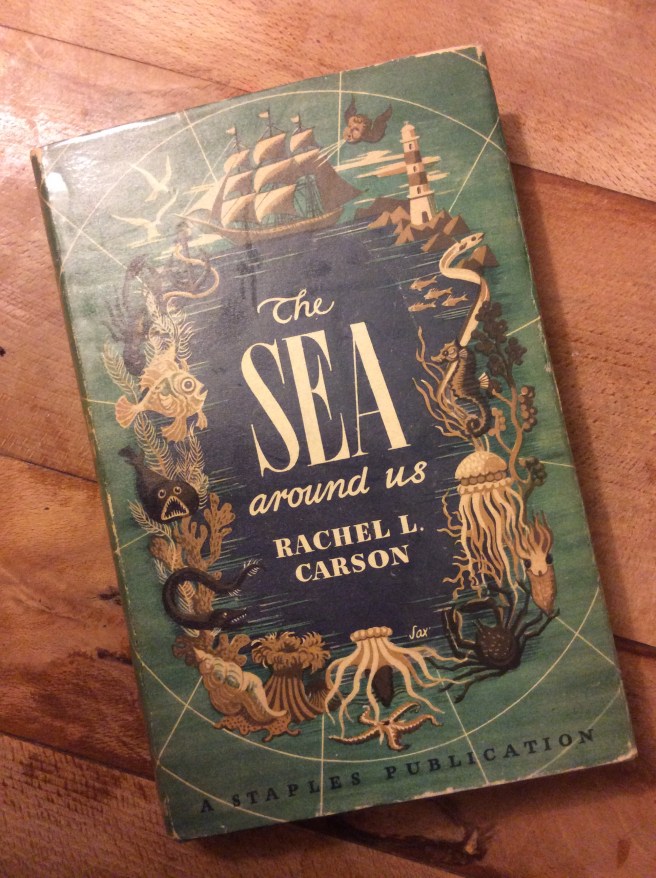
I’ve been thinking a lot about the sea, lately — I was lucky to be given several books about the sea for Christmas presents, and then my excellent wife tracked this stunner down for me too —

img_3843

The next story I write will be about the sea — the idea fell into my head, perfect as a cowrie, while I was working on the closing chapters of my last book. And although I was planning another novel altogether for my next one, the sea book has overtaken it. I’m excited.

I’m desperately trying to finish off a film edit right now, so bear with me — I’ll write more about the sea another time. For now, I’ll leave you with this — a quick mix I threw together of ocean songs, featuring British Sea Power, Bat For Lashes, Modest Mouse, Frightened Rabbit, James Yorkston, The Waterboys and many more. Enjoy.

Counting beans

Ever since losing a large document many moons ago, I have become a compulsive hoarder of files. I email myself a copy of the manuscript every time I make any significant changes, keep the files neatly labelled by date and word count, and sleep safe in the knowledge of a bombproof back-up (until the day that California slides into the sea).

The second draft of my story is now finished. This also means, as a curiosity, that I can look back and map my progress with a chart like this:

endless-mirrors-word-count

So there we go. I didn’t really start backing up the manuscript until I had something worth saving, which was in late summer — and thereafter, almost every Thursday and Friday (my writing days) had a file of its very own.

Now, what does this tell us?

Yes, that’s right — bugger all. What we therefore need is some context. Here is my context.

endless-mirrors-word-count-annotated

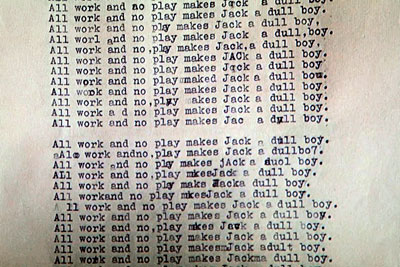
Here’s the thing — I know that word counts don’t actually count anything at all, whether it’s 500 a day or 5,000. They measure only a quantity of words, not a quality. Grinding the fuckers out in the right order is what matters. Counting words alone is the same as counting beans, as Jack Torrance knows all too well—

luna59_13

— and still, with all that said, I like looking at that chart and how it simplifies the last 11 months into the zigs and jigs of gradual progress. There have been so many times when I thought I wouldn’t finish the book, and so many times when it bamboozled me completely, and there’s an odd sense of finality to seeing it mapped out. Those 4am and 5am mornings, those eye-dragging days of staring at Scrivener, and those crushing, inevitable moments of deleting a chapter here, a character there — all that graft set out into a neat blue line.

Will it need edits? Very much so. I’ve now sent the manuscript to some writery friends because I need walls to bounce off, and I’m both dreading and excited at what they’ll have to say. Their perspectives will help me triangulate my own sense of what needs doing. For now, I’m going to put the book away and not think about it until 2017. I might drink a beer or something.


The Old Man Of The Sea

Help me, internet.

When I was a kid, I remember reading a short story, possibly from a book of short stories, that finished with the Old Man Of The Sea swimming away in a furious huff. He was seething because his plans had been somehow thwarted. I remember the illustration in particular — the old man, long hair swamped by the sea, low down and mean in the waves.

I’m now trying to find this book, but haven’t a clue what it’s called or who wrote it. I’m fairly sure it’s not the Grimms or Andersen, and we’ve also now discounted The Water Babies, Rupert the Bear, Sinbad, and The Old Man Of Lochnagar.

Dora loaned me her good pencils so I could draw an approximation of the old man in his grump. Here he is — any ideas?

old-man-of-the-sea

Bricks

I used to have a smartphone. My brother gave it to me — in fact he gives me lots of things. At least half of my clothes are Tim’s cast-offs, and I think he despairs of me a little sometimes. When I was getting ready for my wedding, he was extremely irritated to learn that I didn’t own a tie. He then loaned me a tie to get married in, and actually he had to tie the knot as well. Sorry Tim.

But this post is about phones, or rather — technology. See, this smartphone that Tim gave me, all those years ago — it was great. I could check email on the go. I wrote my Twitter stories on it sometimes, and took lots of photos. When I was bored, on trains or at bus stops, I played Catan or chess.

Now, bear with me. This post will go sideways a couple of times, because it is also about notebooks. For almost as long as I’ve been writing fiction — about eight or nine years, now — I’ve kept a notebook in my back pocket. Into those notebooks have gone countless ideas, most of them nonsense, and lots of lines of dialogue, or overheard snatches of conversations, even single words I wanted to think about later. The act of writing them down was perhaps more important than reading them later — I liked the moment of formalising and clarifying the thought, no matter how fleeting it would prove.

It used to take me somewhere between two weeks and two months to get through a notebook. I gradually found myself taking longer to fill them — and then so long that they disintegrated in my pockets. It probably took me a year or so before I connected the smartphone to the notebooks, but once I’d joined the dots, I couldn’t unjoin them — the simple truth was that I was writing less since I’d got the smartphone. And the more I thought about it, the more I realised that I wasn’t simply writing less — I was thinking less. I was feeling less. Before I owned a smartphone, I’d spent my train trips and bus stops eavesdropping on people, real people in real places with real lives, imagining who they were and where they’d come from. I used to write down the cadences and accents of their speech, and bring those patterns in my writing. I wrote about their clothes, their shoes, the way they walked. With a smartphone, all that stopped — because I was playing Catan instead, and that was easier.

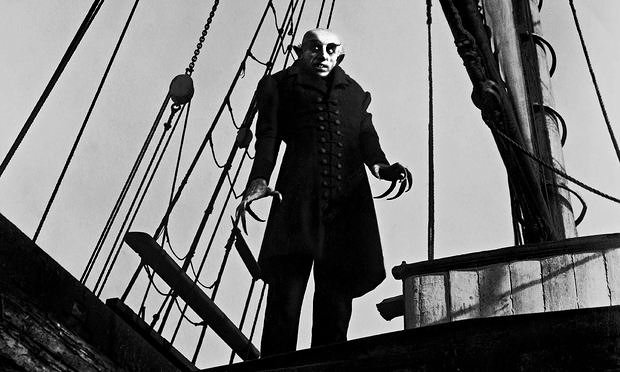
When Tim’s old phone died, I didn’t replace it — instead, I spent £9 at the supermarket and bought a dumbphone — a brick. We call smartphones smart, but in truth they dull our senses. They lock us into ourselves, shut us down. On the rare occasions I’ve been asked for writing advice, I’ve suggested getting rid of your smartphone, should you have one. They are vampires for your time and your wits.
nosferatu-012

This isn’t only me being a Luddite (although there is also some of that involved). I’ve been worried for a while about social media, about online interaction, about the casual saturation of technology into every bit of our lives. In my younger days, when I had a little more piss and vinegar, I got into some humdinging arguments online. I once lost out on a dream job because I couldn’t bite my tongue in an email exchange — I simply couldn’t abide for someone else to have the last word — and this is interesting, because in real life I consider myself to be exceedingly diplomatic — I’ve worked for monstrously unreasonable people and more than once sustained a wage by biting my tongue. So what is it that happens to us, below the line? Why does a red mist descend, once we’ve plunged into the comments?

Part of me thinks it’s the lack of body language, the lack of nuance in our communication — but then surely that would be true of letters, too, and it’s not. Perhaps the difference is in the immediacy and the spontaneity of our response. There’s no delay anymore, no moment of measure. Communication has become a mirror. We look into the screens, and they look back, and if we miss the moment, it’s gone — and the compulsion to curate our own image leads to meltdowns, polarisation, echo chambers, horseshit and dead ends. The need to share, share, share — it’s left us so lonely.

I’m talking about this because Jonathan Safran Foer has just written a compelling piece about how technology diminishes us. His article is far more coherent than this one, and he’s right. How often do we see cafes or carriages full of people staring at their screens? I take a train to work at the same time as scores of secondary school kids. Almost all of them are almost always on phones. And again, I teach in a college — last term, the network server died (there was an incident involving paint) and we went two days without internet access. Most of my students were climbing up the walls. So that’s the Western world, that’s modern life — right? Evolve or die. And that’s okay. I think I’m happier as a dinosaur.

A few years ago, the college gave me an iPad to improve the use of technology in my teaching. It was a nice idea, but it didn’t actually happen. The single biggest impact on my life was the sudden impossibility of escaping work. My colleagues and I regularly sent work messages at 10 or 11 or midnight. My cat Remus is a gigantic soaring arsehole, but I was delighted when he knocked my iPad off the sofa a month or so ago, because now the screen is broken. I genuinely miss 80 Days, but in return I’ve recovered hours of my life. I’ve come to relish the moments without wifi, without a phone signal, those moments when we are offline, like it or not — it’s one of the reasons I love the Hebrides. I use Freedom when I’m writing, and I get most of my real work done while it’s in action.

There was a study, a few years ago, that showed how people modified their real-life behaviour in order to gain better online approval (can’t find the link, sorry). Another study suggested that taking a photo actually reduced the photographer’s memory and perception of the moment. It’s nothing new to say that these technologies are becoming filters that we can’t escape.

Another sidestep — on Wednesday, Mon and I went to watch Frightened Rabbit in Manchester Cathedral. It was our first night out since Indy was born. The band were magnificent, but the audience were not so good, and I lost count of the glow of smartphone screens. They made a constellation of the crowd. I don’t go to many gigs these days, so maybe this is how things are, but it seemed to me that a lot of people were at the gig to tell people they were at the gig, rather than to see the actual band.

I know I sound like a scared old man. And I’m not blind to the irony of posting this online.  The internet and these technologies have brought us wonders. Email gives me an online book group with friends I’d otherwise meet once or twice a year at best, and that book group got me reading again. Thanks to Facebook, my brother gets to see more of Dora and Indy than he would in real life. I can follow the antics of my cousin Ali in Antarctica. I’ve applied for jobs online, and solved technical crises while editing my films — won competitions, promoted my books, discovered scores of extraordinary things. I first met Mon in 2000, when the internet was new and odd and easy to turn off — but without the internet, we wouldn’t have discovered each other again in 2008, and we wouldn’t have started going out.

So yes, of course, the internet saturates my life too, and I’m not trying to take a moral high ground. There are still times, lost in strange cities — and all cities are strange — that I want the safety of Maps. There are many occasions when I’m aching for a camera, walking to work, when the sun casts fire through the fog, and all the world is aflame — or when I need a number, or directions. But look — even now, as I write, I’m curating my own image in how I shape this article, how I pick my words. I very seldom go to cities. Most of the photos I’d take would not be of foxfire. I prefer real maps to the pulse of a tracker, talking to itself.

I know this is confused and contradictory. I’ve spent 1,500 words discussing my quiet worries about technology. I’ve used technology to write it and technology to share it. I am painfully aware of this, and I have no solution, other than an instinct that we needn’t even stop and think — so much as stop, for a while, for a while.

A business of wrens

720-wren-img_3405

I’ve been making good progress on the book in the last two weeks, so I’m allowing myself a wee break to write about collective nouns. I love collective nouns. There’s something about them, at once melancholy and sweet — an innocence — that I find utterly beguiling. We all know prides of lions and herds of cows, but the rare ones are better, because they’re strange and odd and upside-down. In his heartbreaking new album Skeleton Tree, Nick Cave sings about a charm of hummingbirds. A week or so ago, researching a story about birds, I wrote of murders and murmurations, wakes and gulps, springs and flings, scolds and pantheons.

A good collective noun needs to personify some characteristic of the collection, rather than simply iterate what the noun is or does. My favourite collective noun is a drift of swifts — the sheer simplicity of the rhyme, the soaring swing of the swifts as they zip around the house in the sheerest of circles.

In the new book, I wrote of a pocketful of jackdaws. I didn’t think a thing of it until reading the chapter back, later on, and wondering where it had come from. Then I decided to ask people to make up some collective nouns of their own. This was only a few days after Trump had been elected, and around a third of the responses were basically ‘a bastard of Trumps’ or similar. Here are some of mine, on the left, and my favourites from the folk who joined in on the right:

A business of wrens
A pocketful of jackdaws
A compass of clouds
A misery of clowns
A duplicity of toads
An orchestra of bees
A clarity of cats
A spindle of witches
A philosophy of starlings
An orbit of angels
A kerfuffle of mice
A haunting of pike
A cathedral of jellyfish
A parley of pirates
A calamity of bats
An ocarina of ocelots
A knot of weasels
A panic of pigeons
A snippet of crones
A juice of pumas
A punnet of fucks
A scuttle of rats
A tangle of sparrows
A sundial of shadows
A shower of seedlings
A murmur of dreams
A wheeze of bagpipers
A choir of carnations
An apprehension of streetlights
A bribe of winkles


There were many more — I couldn’t include them all. There’s something in a good collective noun that elevates the noun itself, or reveals another side of its nature. Some of these are so obvious they should fit into daily use — ‘Pigeons exploded in their panics, clattering about the station roof’ — and others are more abstract. There’s no particular reason, for instance, why ‘a juice of pumas’ should work, but somehow, it does — ‘One by one, a juice of pumas slipped from the gloom and gathered near the tracks.’

What are your favourite collective nouns? And what would you invent for a new one?


The Time & The Tools

There’s a great line from Stephen King — one of many — that says something like,

If you haven’t got the time to read, then you haven’t got the time — or the tools — to write.

For pretty much all of last year, I didn’t read. This was for a combination of reasons. Firstly, I was playing some truly imaginative and transporting video games on my iPad, like Year Walk, Limbo, Botanicula, Thomas Was Alone, The Room 1 & 2 & 3, Around The World In 80 Days. I convinced myself that they were an adequate substitute for books, and they also filled my need to solve puzzles and problems. Besides, I had so little time, and it was easy to get a quick fix of something in a game, where books needed concentration and space. In truth, of course, they were making me lazy. They needed more effort, but less imagination.

Secondly, as I became increasingly bamboozled by my own book, I deliberately and increasingly shunned other books. This time, I told myself that I didn’t need any more ideas floating around my head when I was drowning in too many ideas of my own. I wanted blank space in my brain, not clutter.

Thirdly, I was so damned tired that I was only managing two or three pages a night before my eyes began to drag. A book a month, a book in two months. I was writing faster than I was reading. So what was the point? In short, reading had become a chore, and my pile of books to be read was going up much faster than it was coming down. I was tired and lost and my wits were dull.

Eventually, something changes, because something always must.

Earlier this year, I taught a creative writing night class. There were some cool writers on the course, and we had a lot of fun. Each week I gave homework of short stories or novel extracts — Neil Gaiman, Junot Diaz, Amy Hempel — and we’d begin the following session with close reading, trying to dig a little deeper into how the author made the story sing — and how we could test the same techniques in our own work.

Around the same time, my friend Steve started an online book club between a few old friends. Living in York, Kendal, Oxford, London and Nottingham, we don’t really get to see each other anymore, and he thought it would be a good way to stay in touch. (He was right.)

Between these two happenings, I started reading again, and more importantly, enjoying it. Somehow, I’d forgotten how much I loved to read. Before Dora exploded in our lives, I used to read two or three books a week. And I’m nowhere near that, but in recent months I’ve read The Final Solution by Michael Chabon, Taduno’s Song by Odafe Atogun, Thief Of Time by Terry Pratchett, Dept. Of Speculation by Jenny Offill, Slade House and The Bone Clocks by David Mitchell, The Book Of Strange New Things and Under The Skin by Michel Faber, The Beauty by Aliya Whiteley, After The Quake by Haruki Murakami, Sexing The Cherry by Jeanette Winterson, Stirring The Mud by Barbara Hurd, The Gracekeepers by Kirsty Logan, 1356 by Bernard Cornwell, The Tiny Wife by Andrew Kaufman, The Wake by Paul Kingsnorth, an extraordinarily good short story collection by my pal Luke Brown and a bunch of others that I can’t recall. I also reread His Dark Materials by Philip Pullman — nothing makes me feel quite so aware of my own failings as a writer than that extraordinary trilogy of Northern Lights, Subtle Knife and Amber Spyglass.

Now, I know that doesn’t come out at two or three a week, but it’s an awful lot more than none a week. And I’ve come to realise how right Stephen King is. You can’t take a drink without visiting the well. You can’t write stories without reading stories. I’d convinced myself that all those other worlds, other characters, other ideas would jumble and twist with my own, and make things worse — but it hasn’t been like that at all. I’ve come to discover that every time I read a book, it adjusts my compass for what I think writing is supposed to be — and that I can’t write without that compass. I’ve remembered what it is to drown in a story, to be so totally committed to another character that I forget myself, and to come out the other side it, changed.

Listen to the King — reading is the tools for writing. I don’t know how I’d forgotten it, but I’ve remembered now. My compass is beginning to right itself, and the needle ticks, ticks towards the track. The direction is still murky, but it’s surer underfoot, and I’ve Lyra Belacqua ahead of me, tutting.

What have you been reading, people? What have I missed? What are your tools?

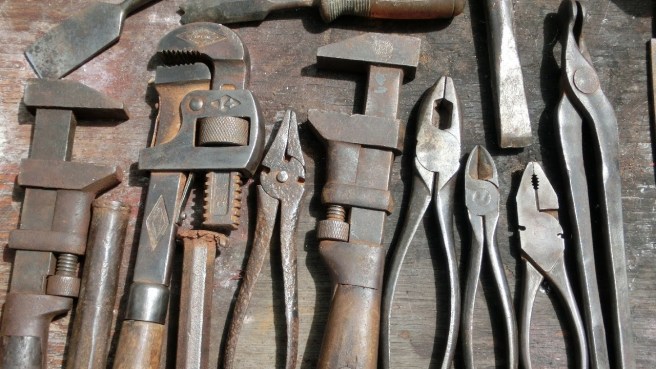
tools

I’ve Got Heaven At My Door

I’ve now seen Penny Woolcock and British Sea Power‘s astonishing documentary, From The Sea To The Land Beyond, about ten times, including a live screening at Glasgow Film Festival last year. It’s an astonishing work—a feature length film comprising entirely of archive footage and BSP’s score, by turns haunting and playful. The footage was lifted entirely from the BFI archives, and tells nothing less than the social history of Britain through our relationship with the sea. It’s extraordinary: through the flickering windows of hundred-year old reels, the film explores Britain’s food, wars, suffrage, leisure, the rise of the middle class, industrial action, economic boom and bust, immigration, capitalism and more.

Ever since watching From The Sea To The Land Beyond, I’ve wanted to work with some archive footage. I used a little of it in my hay meadows documentary To The End We Will Go, but when I recently happened upon some fascinating public domain material, I decided to cut something entirely from archive. And here, then, is something of a music video; taken from my friend Dan Haywood‘s wonderful album Dapple, I’ve cut together footage of USAAF atomic bomb tests and the seminal agricultural documentary The Plow That Broke The Plains, all soundtracked by Dan’s glorious song I’ve Got Heaven At My Door.

It’s not the most complex thing in the world, but then again, I have very little time right now—I’ll write more about that in my next post—I threw this together over a couple of lunchtimes at college. For now, here’s the video, and I’ll get back to my novel.

Unfinished business

This is my first post since 1st October 2015; a window of more than three months, and the longest I’ve gone without an update since I started the blog. I signed off because my head was on fire and I needed some space. As a result, I haven’t shared some amazing things that happened to me last year—ten awesome days of rain and shine on the beaches of Coll and Tiree, an appearance at Bloody Scotland crime-writing festival, the US publication of The Visitors, and most especially my first time at Edinburgh International Book Festival, where I was reading with the ManBooker shortlisted genius Chigozie Obioma. Maybe he was as nervous as me about the festival, but something just clicked. I don’t know if I’ve ever warmed to someone quite as spontaneously as I did Chigozie. In the middle of our discussion a battered bookmark slipped from the pages of his book. It said, Literature tastes better with beer, and I thought, yeah, this is one of the good guys. (And his novel, The Fishermen, is a wonder.) Edinburgh is a city like no other, and the festival was an extraordinary experience. To cap it all, walking back to the hotel through the summer gloaming, I came up with a new novel idea. That was a good day.

My head was on fire because of The Hollows. I finished the second draft in June and took the print-out on holiday to Coll and Tiree, where I spent my downtime going through it with a red pen. I finished the last pages as the ferry trundled back into Oban, redrafted in a week, and asked some friends to read it. To be completely honest, I was feeling pretty pleased with myself. I’d written the whole thing in about thirty days, edited it in another five, and I thought it was good. I blogged about experiencing something of a slump, but that’s normal for me, and I expected to get out of it. Unfortunately, I didn’t get out of it at all. It became worse.

The problem probably goes back to the Kate Mosse incident. I think that skewed my compass more than I realised at the time; in writing the second draft, trying to make some space between me and her, I moved too far into the fantastical, and away from the magic realism I’m pitching at; and my sheer joy of progress in writing the new draft so quickly—the drowning that I long for in my writing—that same joy blinded me to things I should have been more conscious of, things I should have been stronger about. My amazing beta readers enjoyed the book, but a couple of issues cropped up time and time again, and this consensus helped me gain some perspective on the book. Put more bluntly, it became clear that a particular strand of the story wasn’t working as well as it needed to. So go and change that one strand, right?

basic-techniques-of-tapestry-weaving-6-decorating_2

I sometimes think of writing a book like weaving a tapestry: the multiple threads of the characters, settings, atmospheres, emotions and plot woven against the weft of pace and rhythm, all of them bound together into a single piece. As a metaphor, it works. The problem comes in trying to unravel one or two of the threads: it can’t be done without wrecking the rest. Pull at one, and the whole thing falls apart. When I tried to redraft, I found I couldn’t do it; between the first failed version of the story, and then the flawed second, I was utterly discombobulated. It made me miserable for a very long time. One day, I’d start writing it again, completely from scratch, with the ghosts of my characters screaming outrage over my shoulder—the next day, I’d junk everything I’d done the day before, and go back to my second draft, pussyfooting around with single words and phrases—and the day after, I’d return to the very first version, and work out what I could salvage, looking for something, anything to show me the way.

At this point, I was overthinking it. I was tortured by possibilities, and wound up going backwards. The whole miserable process was compounded by the aching, awful thought of all the time I’d lost—by my reckoning, nearly a quarter of a million words of finished work over two years, and none of it anywhere near an actual book. At times I’ve been utterly inconsolable, and at other times I’ve probably been horrendous to live with. I’m extremely lucky to have in Monica a partner who understands these processes.

At the start of November, half-a-dozen small video jobs dropped into my lap in the space of a fortnight. That meant no writing for the rest of 2015, and I spent the rest of the year working flat-out to finish the films—they are now mostly wrapped, and so my writing days are back. In the end, some enforced time away has been helpful. My feet are back on the ground, and I’m not wallowing anymore. I can’t pretend I have a completely clear vision of the way ahead, but I’ve finally started getting some sense of the way. After days and days of effort and countless hours with my notebook and the myriad manuscripts, I’ve cut 70,000 words from the draft, tweaked those strands I needed to tweak, and I’m now writing into empty white pages for the first time in a year. I no longer know what will happen in some parts of the story, but actually that’s fine—that’s one of the fun parts. As daft as it sounds, I’m going to bed earlier, too, and waking with a little time to write. That helps.

I shared too much about the last draft. I’m never confident about my work, but I think I became a little complacent after discussing it in such detail. Having experienced heartbreak once, with the Kate Mosse incident, I simply didn’t believe it could happen again. I think I felt I’d paid my dues with The Hollows—that I was owed a bit of a pass. I was therefore unprepared, and it hurt much, much worse. It has taken months for me to want to write again—rather than feel I have to. And I do want to write, now. The drive is creeping back. I feel far more cautious, and I’m approaching every writing day with care—care for my story, and care for my heart—but I want to be writing, which is the big thing. I’m miserable when I don’t write.

The Hollows has sung to me for three years, and I’m going to get it right. The characters evolve and change, much like the fens they live in, the fens I’m writing about, landscapes in flux, stories in flux. I would say watch this space—but don’t watch too hard. I’ll be a wee while. Third time lucky.

fen_tcm9-250539


The Slump

In the nine years since I started writing fiction, I have completed three novels and a novella. All of them have been written in the first person, and needed me to immerse myself entirely in another character, another world; and so I’ve been a veteran of WW2, flitting between London and Burma; a 17-year-old girl, desperate to escape her Scottish island; an arthritic fisherman walking across Morecambe Bay; and a fortune-teller seeking herself in a world of swamps. My stories are becoming steadily more fantastical. They’re taking me further from myself. That’s fine in terms of what I want to write about, but it also makes it harder to come back. My friend Ali Shaw once compared writing to being underwater, and I think that’s right; the deeper you go, the further you get from the surface.

After finishing each of these four stories, I’ve experienced a few weeks of manic creativity, cartwheeling through handfuls of shorter pieces. Most recently, on wrapping up a first draft of The Hollows, I redrafted and typeset Dare in a week. But then, after these bursts, I’ve always fallen into something of a slump, and that’s where I am now, casting about for what to do, suddenly convinced that all those months of work are worthless.

I’ve talked before about how I write to drown. Over time, that immersion—especially in something as big as a novel—becomes total, until it’s the real world that becomes disorientating. I’m so fortunate to have in Mon someone who understands that stories leave me stoned; she helps me find my way. But returning to the real world feels odd. I’m struggling to get excited about things I should be excited about. I’m distracted and quick to gloom. I suspect that almost all creative work is built on a measure of doubt, and right now that’s all I have, needling and nagging all the time: what if it’s garbage? All of it? Everything I’ve done? The last year was wasted work. What if this year is too? How would I start again?

I would start again, because I have to. But the further I get from The Hollows—and it’s vital, I know, to get some perspective, to put distance between me and it before I go back to redraft—the more that doubt creeps in. Almost everyone I know, and certainly all the writers and artists, struggle with doubt. Carving out and sharing these inside parts of your head is an excruciation. I couldn’t write without that doubt; it keeps me lean, questioning, pushing myself to do better, to be better. Doubt is the compass of when I’m not good enough; and so to cut, rewrite, cut, rewrite, cut. But here’s the crux: when I’m not writing, not working on a story, that doubt—the same doubt I need to write in the first place—has nothing to gnaw on but me. It bites harder than ever after spending so long in another world, and then leaving it behind. That’s the Slump.

So quit wallowing and start something new, right? It’s not so simple. I have several ideas lined up for what I’ll do next, and I’m 2,000 words into my first proper short story in over a year. But from a pragmatic point of view, it’s senseless to start another big project before I’ve polished off the last, and every redraft is distinct and demanding. The Slump goes beyond that anyway. It’s a spiritual anticlimax. It’s hitting a wall after running a marathon. It’s a burn out, an exhaustion of ideas. I don’t really know how to get myself out of the Slump, other than to take heart from the knowledge that I always have before. This morning I played hide and seek with Dora. That helped. This afternoon I’m going back to my short story. That may help too.

Half-a-dozen people have now read The Hollows. They’ve all enjoyed it, I think, and they have all suggested a few things that don’t quite work; thankfully, these things have pretty much been the same for all of them, and they also tie into my own sense of the story, now I’m getting some distance from it. Redrafting would be impossible without that sense of triangulation, which is, in turn, why writing needs community. I’m gearing myself up for potential edits, but I’m not there yet. I think I’ll be ready by the time this slump comes to an end; or perhaps the slump comes to an end because I’m ready. It’s coming closer, but it’s not here yet.

Writing is doubt. Writing is perspective. Passion. Immersion. Empathy—books are empathy machines. Writing is the witch in your kitchen in the corner of your eye. If you spin to look at her directly, she’s gone. Writing is a sideways mirror. Writing is accidents of words, like wind chimes are accidents of music. I don’t know what else to do but play on through it.

john kenn